
 Recruit
Average Salary in Bulgaria
-
 Drew Donnelly
- Published
- September 21, 2026
- 5 ★ on G2








Let RemotePeople handle payroll, compliance, and HR admin worldwide so you can focus on building your team.
Bulgaria is an excellent outsourcing destination due to its cost-effective labor and skilled workforce. Employers thinking of hiring in the region may wonder, what is the average salary in Bulgaria? This article will provide all the information you need to make a fair offer.
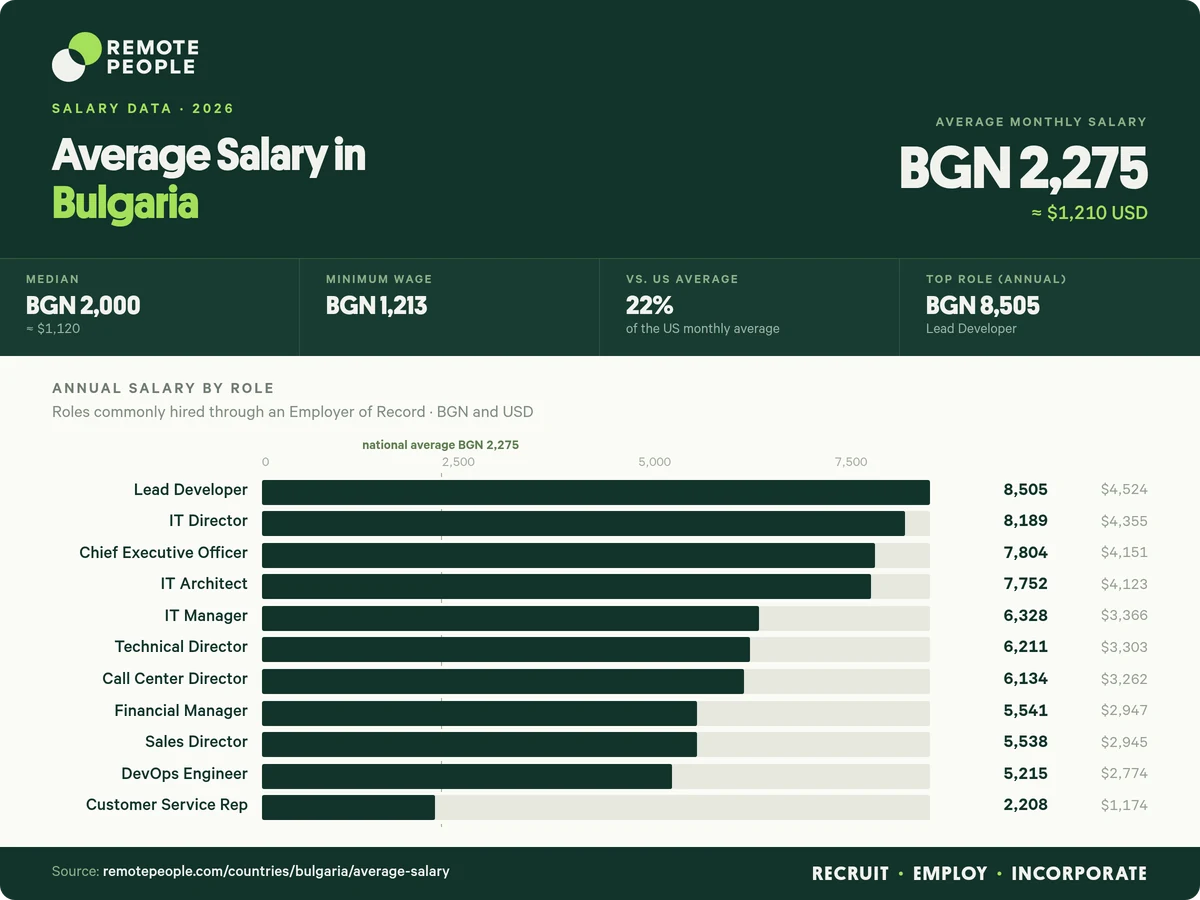
The average salary in Bulgaria is 2275 BGN (Bulgarian Lev), which translates to approximately USD 1210. However, this number provides limited insight. You must also consider how education, experience, location, and profession impact salaries in the region.
This article will explore all aspects of salaries in Bulgaria and provide the information you need to know.
What is the Average Salary in Bulgaria?
The average salary is calculated by adding salaries from across the country and dividing the total by the number of workers. Average Bulgaria salary is 2,275 BGN, approximately $1,270. Bulgaria median salary and salary range provide more insight.
Median Income
The median salary is also known as the ‘middle salary.’ Bulgaria’s median monthly income is about 2,000 BGN (approximately $1,120). That means 50% of Bulgarian workers make more than this amount, and 50% earn less.
Salary Range
The salary range spans from the lowest to the highest in the country. Low-paid Bulgarian workers can earn as little as 840 BGN monthly (approximately $470), while high-paid workers can earn close to 14,700 BGN (roughly $8,200).
Salary Comparison by Profession
Salaries vary among industries, with skilled workers making more than manual laborers. This salary comparison chart lists salaries in Bulgaria across various sectors.
Profession | Annual Salary (BGN) |
|---|---|
Lead Developer | 8,505 |
IT Director | 8,189 |
Chief Executive Officer | 7,804 |
IT Architect | 7,752 |
IT Manager | 6,328 |
Technical Director | 6,211 |
Call Center Director | 6,134 |
Financial Manager | 5,541 |
Sales Director | 5,538 |
DevOps Engineer | 5,215 |
Customer Service Rep | 2,208 |
Data Entry Specialist | 1,500 |
Clothing Technologist | 1,429 |
General Laborer | 1,378 |
Medical Orderly | 1,343 |
Machine Operator | 1,184 |
Tailor | 1,137 |
Porter | 1,113 |
Fabric Cutter | 1,094 |
Average Wage in Bulgaria by Education
Education has a direct impact on the salary of Bulgarian workers. It also affects employment levels.
Just 47% of 25- to 34-year-olds without an upper secondary qualification are employed, compared to 79% in the same age group with an upper secondary, post-secondary, or non-tertiary qualification.
Workers without a secondary qualification are also at risk of earning low salaries. 42% of 25—to 64-year-olds with just a primary education receive earnings at or below the median income, compared to 17% of workers with an upper secondary and post-secondary qualification and 8% with a non-tertiary qualification.
Salary Comparison by Experience
Bulgaria’s work economy honors a ‘length of service pay’ or an incremental increase of .6% every year employees have worked at a company or a similar profession. Salary offers typically consider the ‘length of service’ pay amount.
Salary Comparison by Location
Location also affects salary. Workers in major cities like Sofia, Plovdiv, and Varna may make more than workers in rural areas due to the higher cost of living and more job opportunities. Average salaries for urban workers may be around 3,100 BGN, while workers in rural areas earn closer to 1,900 BGN.
How Much is Minimum Wage in Bulgaria?
The minimum wage in Bulgaria increased to 1,213 BGN per month (equivalent to €620.20) effective January 1, 2026, up from 1,077 BGN in 2026 — a 12.6 % increase set by the Council of Ministers. The minimum hourly wage was raised to 7.31 BGN (about €3.74) as part of the same decision.
This increase reflects government efforts to boost earnings for nearly 600,000 workers but has faced mixed reactions from employers and industry groups, some of whom argue the hike may not fully consider broader economic conditions and could impact competitiveness.
Average Salary in Bulgaria vs. the Rest of the World
The following sections compare Bulgarian wages to those of developed, developing, and underdeveloped countries worldwide, helping you better understand the country’s salary.
Bulgaria vs. Developed Countries
Country | Average Salary | Comparison to Average Bulgaria Salary |
|---|---|---|
United Kingdom | £3,000 (approx. $4,100) | − 69% |
United States | $5,220 | − 76% |
Norway | 50,000 NOK (approx. $4,700) | − 73% |
Germany | €4,300 (approx. $4,470) | − 72% |
Austria | €3,700 (approx. $4,050) | − 69% |
Bulgaria vs. Developing Countries
Country | Average Salary | Comparison to Average Bulgaria Salary |
|---|---|---|
Romania | 4,000 RON (approx. $835) | 52% |
Russia | 73,700 RUB (approx. $700) | 81% |
Albania | 83,330 ALL (approx. $860) | 29% |
Kazakhstan | 342,000 KZT (approx. $645) | 97% |
Ukraine | 18,000 UAH (approx. $500) | 154% |
Bulgaria vs. Undeveloped Countries
Country | Average Salary | Comparison to Average Bulgaria Salary |
|---|---|---|
Thailand | 15,000 Baht (approx. $420) | 202% |
Philippines | 15,000 PHP (approx. $265) | 379% |
Vietnam | 7.5 million Dong (approx. $300) | 323% |
Egypt | 3,900 EGP (approx. $125) | 916% |
Pakistan | 60,000 PKR (approx. $210) | 505% |
Bulgaria is a developing country with a market-based economy. It offers cost-effective labor, a skilled workforce, and a business-friendly environment. The time zone aligns well with Central and Western European countries.
Bulgaria’s work economy is driven by construction, mining, agriculture, and service-based industries. It is the largest electricity exporter in southeastern Europe, and its economy has grown significantly since the fall of the Soviet Union.
What are the Most Common Outsourced Industries in Bulgaria?
Employers considering outsourcing to Bavaria may seek workers in the following sectors.
IT Services
Bulgaria boasts a large pool of skilled IT professionals with significant growth in software development. It is home to various startups and innovation hubs, particularly near the capital city of Sofia. The government actively supports the IT sector through initiatives that foster innovation.
IT workers in the region typically earn between 2,146 BGN (approximately $1,200) and 6,288 BGN (roughly $3,520). This rate compares to American workers earning about $5,058 a month, resulting in significant employer savings.
Customer Support
Bulgari offers a thriving customer support industry, particularly in the call center sector, due to its strong multilingual capabilities and well-educated workforce. Many businesses praise Bulgarian call center services, noting reps’ abilities to handle complex technical support issues. Its zone alignment with other European countries also ensures accessibility.
A skilled customer service rep can make around 2,218 BGN monthly (approx. $1,240). American reps make closer to $3,300 monthly.
Finance and Accounting
Bulgaria’s finance and accounting outsourcing industry is experiencing significant growth thanks to its competitive costs, multilingual workers, and business-friendly regulations. Tax incentives streamline registration, and EU regulations like GDPR ensure compliance and data security.
Accountants in Bulgaria make an average of 2,717 BGN per month (approx. $1,520) as compared to American accountants who make closer to $5,700. The cost savings make Bulgaria an ideal destination for financial services.
Conclusion
Bulgaria offers a highly skilled workforce, a convenient European location, and a low cost of living that contributes to affordable average salaries. Companies that hire regional employees can access a wealth of talent while reducing human resource expenses, which benefits both the hirer and the hiree.