Recruit
Average Salary in Chad
-
 Drew Donnelly
- Published
- September 21, 2026
Curious about salaries in Chad? This guide breaks down the average wages, compares professions, highlights minimum wage figures, and explores how Chad’s earnings measure up internationally.
- 5 ★ on G2








Let RemotePeople handle payroll, compliance, and HR admin worldwide so you can focus on building your team.
Chad’s skilled workforce and cost-effective labor make it an ideal destination for outsourcing. Employers seeking remote partnerships in the area may wonder, What is the average salary in Chad? This information will help them prepare a competitive job offer.
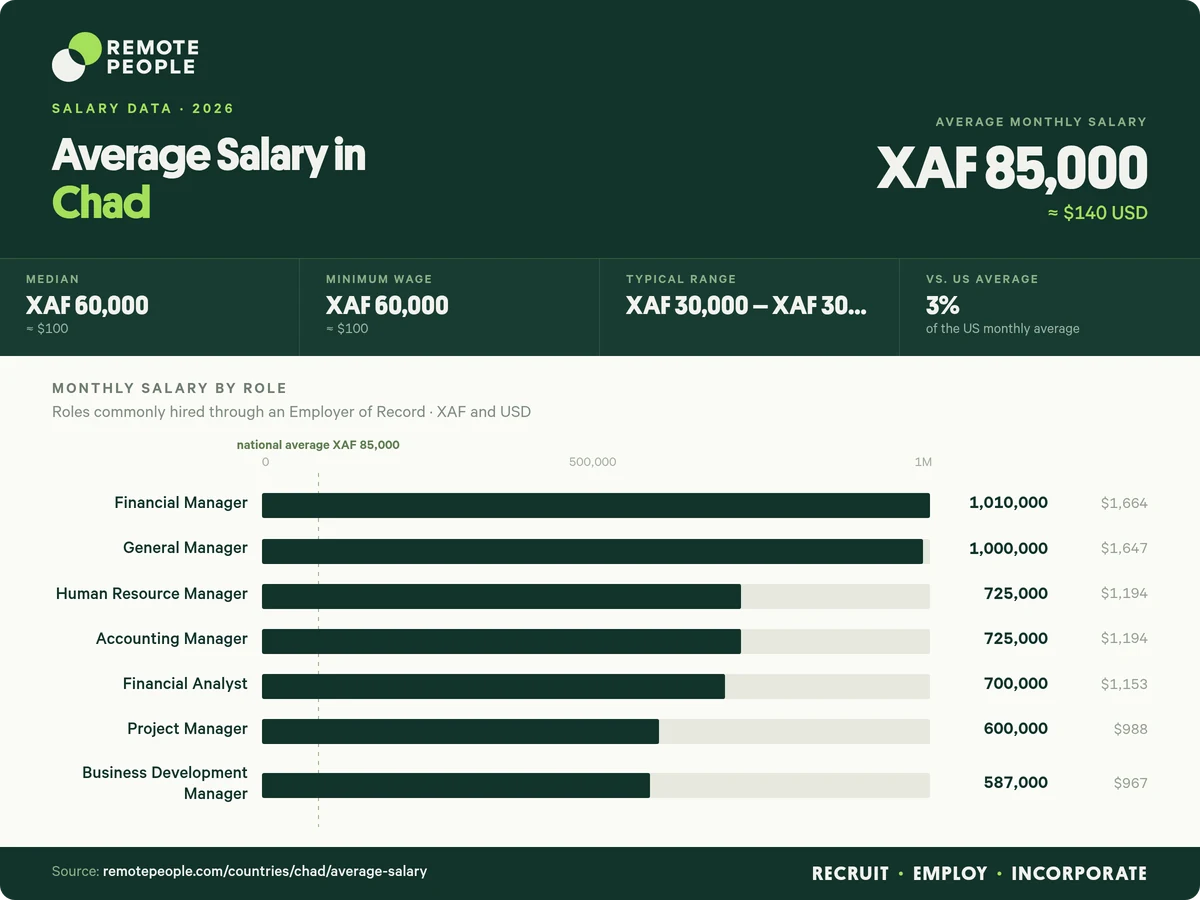
The average salary in Chad is approximately 85,000 Central African Francs (XAF), approximately USD 140. However, you must consider how wages vary by education, experience, location, position, and industry. Comparing wages in the country to earnings worldwide provides additional insight.
This guide will explore all aspects of salaries in Chad, preparing you for your hiring journey.
What is the Average Salary in Chad?
The average salary in Chad is approximately 85,000 XAF, approximately $140. Agriculture, a low-paying sector, dominates the country’s work economy. There are also limited development and growth opportunities.
Median Income
Chad’s median monthly income is approximately 60,000 XAF, about $100. Half the country earns higher wages, the other half earns less.
Salary Range
The salary range spans from the lowest to the highest wages in the country. In Chad, low earners make about 30,000 XAF, equivalent to approximately $50, while high earners make closer to 300,000 XAF, equivalent to roughly $500. However, these salaries are typically reserved for international workers.
Salary Comparisons in Chad
The average salary provides some insight, but you must also consider how wages vary by experience, education, location, position, and industry. The following sections will explore these factors to provide a more comprehensive understanding.
Salary by Position
This salary comparison chart illustrates the variation in wages by position.
Position | Average Monthly Salary (XAF) |
|---|---|
Financial Manager | 1,010,000 |
General Manager | 1,000,000 |
Business Development Manager | 587,000 |
Human Resource Manager | 725,000 |
Accounting Manager | 725,000 |
Financial Analyst | 700,000 |
Project Manager | 600,000 |
Average Wage in Chad Based on Education
Education plays a significant role in salaries. Statistics show that it directly contributes to human capital, wealth, and potential earnings in the workforce.
Unfortunately, many families in Chad don’t have access to education due to poverty. Children are forced out of school to join the workforce. In other instances, families may be unable to afford school fees, or their regions may lack the necessary infrastructure to support schools.
The government is addressing the issue through various programs and initiatives.
Salary Comparison by Experience
Experience impacts salaries in Chad as experienced workers earn more than entry-level workers, and employees become eligible for raises with tenure in their field. In Chad, larger companies may adhere to employment contracts that set standards for wages and wage structures. Smaller companies may negotiate salaries based on experience and other factors.
Bonuses are often incorporated into pay structures and are helpful in motivating employees. Experienced workers may receive bigger bonuses than entry-level workers.
Salary Comparison by Location
Location is another factor to consider when determining wages. In Chad, urban workers, particularly those in the capital city of N’Djamena, typically earn more than their counterparts in rural areas due to the higher cost of living and proximity to large companies offering more job opportunities. Some companies may implement geographic pay differentials to account for living and labor costs.
How Much is Minimum Wage in Chad?
The minimum wage in Chad is 60,000 XAF, approximately $100, for workers in the non-agricultural, formal sector, and 52,500 XAF, roughly $90, for workers in the agricultural industry. The wage has been in effect as of 2026, and there is no word on when an increase will occur.
Average Salary in Chad vs. the Rest of the World
The following chart will compare salaries in Chad to those in developed, developing, and least developed countries to provide more insight.
Chad vs. Developed Countries
Country | Average Salary | Comparison to Average Chad Salary |
|---|---|---|
Japan | 340,000 JPY (approx. $2,300) | – 94% |
United Kingdom | £3,000 (approx. $4,100) | – 97% |
Norway | 50,000 NOK (approx. $4,700) | – 97% |
Germany | €4,300 (approx. $4,470) | – 97% |
Austria | €3,700 (approx. $4,050) | – 97% |
Chad vs. Developing Countries
Country | Average Salary | Comparison to Average Chad Salary |
|---|---|---|
Romania | 4,000 RON (approx. $835) | – 83% |
Russia | 73,700 RUB (approx. $700) | – 80% |
Albania | 83,330 ALL (approx. $860) | – 514% |
Kazakhstan | 342,000 KZT (approx. $645) | – 78% |
Ukraine | 18,000 UAH (approx. $500) | – 72% |
Chad vs. Undeveloped Countries
Country | Average Salary | Comparison to Average Chad Salary |
|---|---|---|
Afghanistan | 13,200 AFN (approx. $150) | −7% |
Philippines | 15,000 PHP (approx. $265) | −47% |
Cambodia | 1,150,000 KHR (approx. $280) | −50% |
Egypt | 3,900 EGP (approx. $125) | 12% |
Pakistan | 60,000 PKR (approx. $210) | −33% |
What are the Most Common Outsourced Industries in Chad?
Employers seeking remote partnerships in the country will see the most benefits when focusing on the following industries:
Oil Production
Although oil production in Chad is modest compared to that of other countries, it accounts for a substantial portion of the country’s GDP. Exports are primarily transported via a pipeline based in Douala. The industry has been in decline over the years, but there is potential for foreign investors to help drive recovery and explore new resources.
Cotton Production
Cotton contributes significantly to Chad’s agricultural industry. Most cotton production occurs in the country’s five Sudanian prefectures. The government faces challenges, including climate change and conflicts between farmers and herders. However, there are efforts to improve the industry through technology.
Livestock
Livestock is an economic pillar of Chad’s economy. It has one of the largest livestock populations in Africa, accounting for approximately 18% of the country’s GDP and providing employment for around 19% of the workforce. It is a significant source of cattle exports for neighboring countries, such as Nigeria and Cameroon.
In addition to being a source of cotton, oil, and livestock products, companies worldwide can form remote partnerships in Chad to access expert services in these industries.
Conclusion
Chad’s low average salaries make it an affordable destination for outsourcing. Although the country is facing internal challenges, it offers low-cost, high-quality products and services that can make some organizations leaders in their fields, while helping workers overcome poverty issues, resulting in beneficial outcomes for all parties involved.