Recruit
Average Salary in the Democratic Republic of the Congo
-
 Drew Donnelly
- Published
- September 9, 2026
Curious about salaries in the Democratic Republic of the Congo? This guide breaks down the average wages, compares professions, highlights minimum wage figures, and explores how the Democratic Republic of the Congo. Partnering with an Employer of Record (EOR) in Democratic Republic of the Congo lets you employ staff there without establishing a legal entity of your own.
- 5 ★ on G2








- Democratic Republic of the Congo Services
- What is the Average Salary in the Democratic Republic of the Congo?
- Salary Comparisons in the Democratic Republic of the Congo
- How Much is Minimum Wage in the the Democratic Republic of the Congo?
- Average Salary in the Democratic Republic of the Congo vs. the Rest of the World
- What are the Most Common Outsourced Industries in the Democratic Republic of the Congo?
- Conclusion

Let RemotePeople handle payroll, compliance, and HR admin worldwide so you can focus on building your team.
The Democratic Republic of Congo’s young workforce, abundant natural resources, and cost-effective labor make it an excellent outsourcing destination. Employers seeking remote partnerships in the country may wonder, What is the average salary in the Democratic Republic of Congo? This information will help them prepare a fair hiring offer. Employers may also run background checks in the Democratic Republic of the Congo for certain roles, so it is worth knowing what is permitted before you hire.
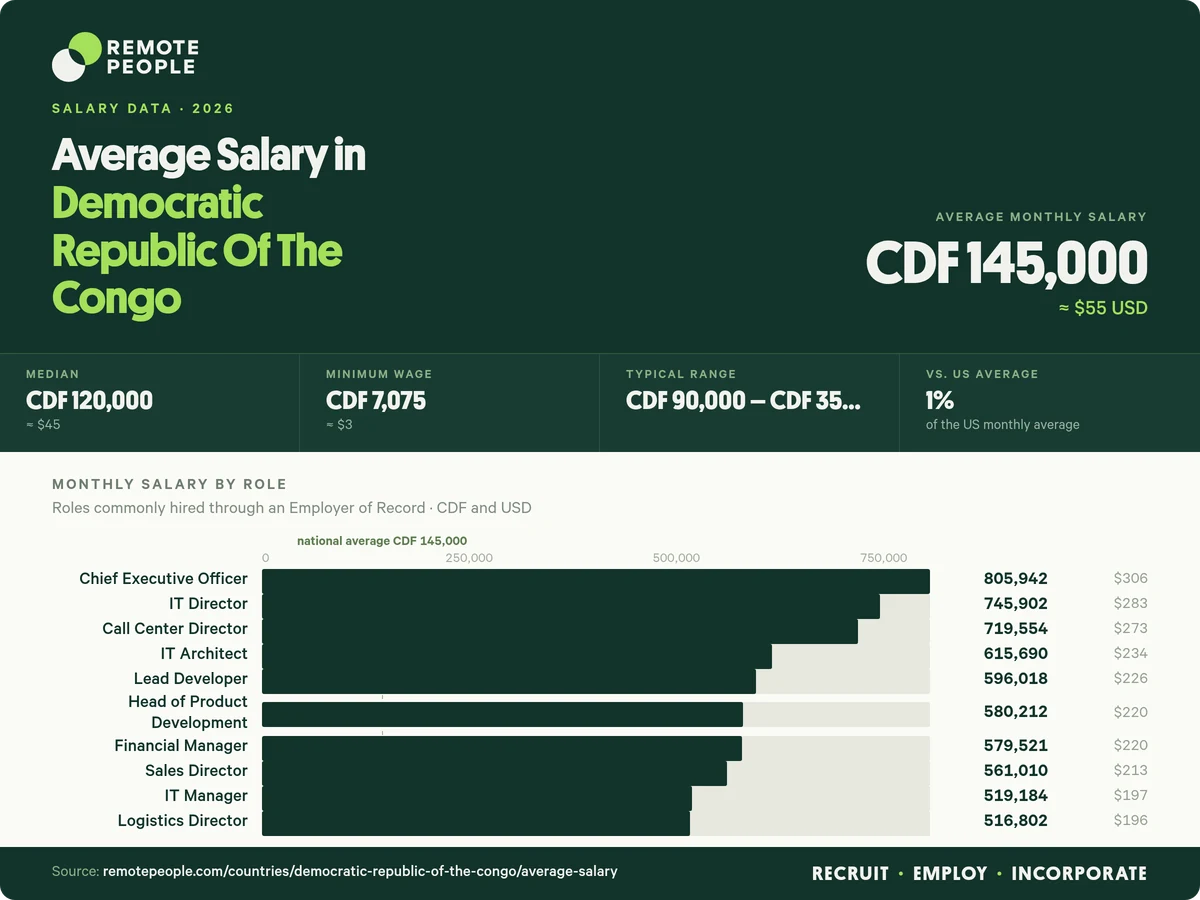
The average salary in the DRC is 145,000 CDF (Congolese Francs) per month, equivalent to approximately USD 55. However, you must also consider how wages are impacted by education, experience, location, position, and industry. Comparing salaries in the country to earnings worldwide provides additional insight.
This guide explores all aspects of salaries in the DRC to prepare you for your hiring journey.
What is the Average Salary in the Democratic Republic of the Congo?
The average salary in the DRC is 145,000 CDF, equivalent to approximately $50. The country is one of the poorest in the world, with many people living in poverty. Economic instability, high inflation, and a lack of opportunities in the formal sector contribute to low wages in the country.
Median Income
DRC’s median monthly income is 120,000 CDF, about $45. Half of the population earns higher salaries, while the other half earns less.
Salary Range
The salary range in DRC spans from the lowest to the highest wages in the country. Low earners make around 90,000 CDF per month, about $35, while high earners make closer to 350,000 CDF, about $135.
Salary Comparisons in the Democratic Republic of the Congo
The average salary provides some insight, but you must also consider how wages vary by experience, education, location, position, and industry. The following sections will explore those factors for further comprehension.
Salary by Position
This salary comparison chart reveals how wages vary by position.
Position | Average Monthly Salary (CDF) |
|---|---|
Chief Executive Officer | 805,942 |
IT Director | 745,902 |
Call Center Director | 719,554 |
IT Architect | 615,690 |
Lead Developer | 596,018 |
Head of Product Development | 580,212 |
Financial Manager | 579,521 |
Sales Director | 561,010 |
IT Manager | 519,184 |
Logistics Director | 516,802 |
Banking Cashier | 147,426 |
Fabric Cutter | 147,158 |
Clothing Technologist | 146,512 |
General Laborer | 145,629 |
Packer | 143,505 |
Seamstress | 137,010 |
Porter | 132,367 |
Medical Records Clerk | 131,983 |
Tailor | 130,959 |
Average Wage in the Democratic Republic of the Congo Based on Education
Education plays a significant role in wage determination in the DRC. Statistics reveal that workers with education are more likely to attain jobs in the public sector as compared to the informal sector. However, there is no correlation between education and job opportunities in the private sector, likely due to a lack of skilled jobs available for university graduates.
Furthermore, the more education you have, the higher your earnings are likely to be.
Salary Comparison by Experience
Experience also impacts salaries, as experienced workers typically earn more than entry-level workers, and employees become eligible for raises with increasing tenure in their field. Additionally, skilled and professional workers are more likely to find employment in the formal sector, which offers significantly higher pay than the informal sector.
Salary Comparison by Location
Location is another factor to consider in wage determination, as workers in urban areas tend to earn more than those in rural areas due to higher living costs and proximity to large companies offering higher-paying job opportunities. In the DRC, workers in the capital city of Kinshasa earn higher salaries due to a more advanced infrastructure. Statistics show employees in the region can earn salaries four times higher than those in the rural province of Kasai Oriental.
How Much is Minimum Wage in the the Democratic Republic of the Congo?
The minimum wage in the Democratic Republic of the Congo (DRC) is now CDF 21,500 per day (approx. 8 USD/day), fully effective January 2026. This represents a significant increase from previous rates, reflecting the government’s efforts to improve living standards. While this wage sets a legal baseline, enforcement can still vary across regions and industries, and some employers may struggle to fully comply, exposing workers to inconsistent pay.
Average Salary in the Democratic Republic of the Congo vs. the Rest of the World
The minimum wage in the DRC is 7,075 CDF, equivalent to approximately $2.70 per day. The last increase took place in 2018. Although the rate is above the poverty line, many employers pay their workers less, facing legal penalties and exposing them to exploitative conditions.
Democratic Republic of the Congo vs. Developed Countries
Country | Average Salary | Comparison to Average DRC Salary |
|---|---|---|
Japan | 340,000 JPY (approx. $2,300) | − 98% |
United Kingdom | £3,000 (approx. $4,100) | − 99% |
Norway | 50,000 NOK (approx. $4,700) | − 99% |
Germany | €4,300 (approx. $4,470) | − 99% |
Austria | €3,700 (approx. $4,050) | − 99% |
Democratic Republic of the Congo vs. Developing Countries
Country | Average Salary | Comparison to Average DRC Salary |
|---|---|---|
Romania | 4,000 RON (approx. $835) | − 93% |
Russia | 73,700 RUB (approx. $700) | − 92% |
Albania | 83,330 ALL (approx. $860) | − 1,464% |
Kazakhstan | 342,000 KZT (approx. $645) | − 91% |
Ukraine | 18,000 UAH (approx. $500) | − 89% |
Democratic Republic of the Congo vs. Undeveloped Countries
Country | Average Salary | Comparison to Average DRC Salary |
|---|---|---|
Afghanistan | 13,200 AFN (approx. $150) | − 63% |
Philippines | 15,000 PHP (approx. $265) | − 79% |
Cambodia | 1,150,000 KHR (approx. $280) | − 80% |
Egypt | 3,900 EGP (approx. $125) | − 56% |
Pakistan | 60,000 PKR (approx. $210) | − 74% |
The DRC is a least developed country with a low-income economy. Challenges include a weak infrastructure, political instability, and corruption. It is heavily reliant on low-paying industries, such as mining and agriculture.
Despite internal challenges, DRC has growth potential through outsourcing opportunities. Its natural resources are in demand across international markets. Low-cost labor can result in reduced expenses for employers who outsource.
What are the Most Common Outsourced Industries in the Democratic Republic of the Congo?
Employers who outsource to the DRC will see the most significant benefits when focusing on the following industries.
Mining
The DRC’s vast natural resources make it a prime destination for copper, diamonds, gold, tantalum, tin, and cobalt. It holds the largest reserves of cobalt worldwide, accounting for approximately 70% of global production. The industry encompasses large-scale industrial projects, semi-industrial ventures, and extensive artisanal and small-scale mining operations.
Agriculture
Agriculture plays a vital role in the DRC’s economy, with most farmers living off subsistence farming crops like cassava, maize, plantains, and rice. Cash crops, including coffee, palm oil, rubber, and sugar, are primary exports, but they are often threatened by political instability and infrastructure deficiencies. Despite challenges, the country has significant potential for growth due to its abundant arable land, extensive water resources, and diverse climate conditions.
Energy
The Democratic Republic of the Congo (DRC) has a significant hydropower energy potential due to its location in the Congo River Basin. It often drives the mining industry. Although many residents don’t have access to energy, the government is working to improve conditions by promoting renewable energy and supporting hydropower projects.
Companies that outsource to the DRC can benefit from the country’s natural resources in mining, agriculture, and energy, as well as related services.
Conclusion
The Democratic Republic of the Congo’s low average salary makes it a promising destination for outsourcing. Companies that form remote partnerships in the area can benefit from cost savings and access to natural resources, which enable them to stand out in their industries while helping the country overcome poverty, achieving positive outcomes for all parties involved.