Recruit
Average Salary in Estonia
-
 Drew Donnelly
- Published
- September 5, 2026
Curious about salaries in Estonia? This guide breaks down the average wages, compares professions, highlights minimum wage figures, and explores how Estonia’s earnings measure up internationally.
- 5 ★ on G2








Let RemotePeople handle payroll, compliance, and HR admin worldwide so you can focus on building your team.
Estonia is an excellent outsourcing destination due to its highly skilled tech talent, robust digital infrastructure, and cost-effective labor. Employers seeking remote workers in the area may wonder, “What is the average salary in Estonia?” This information will help them prepare a fair offer.
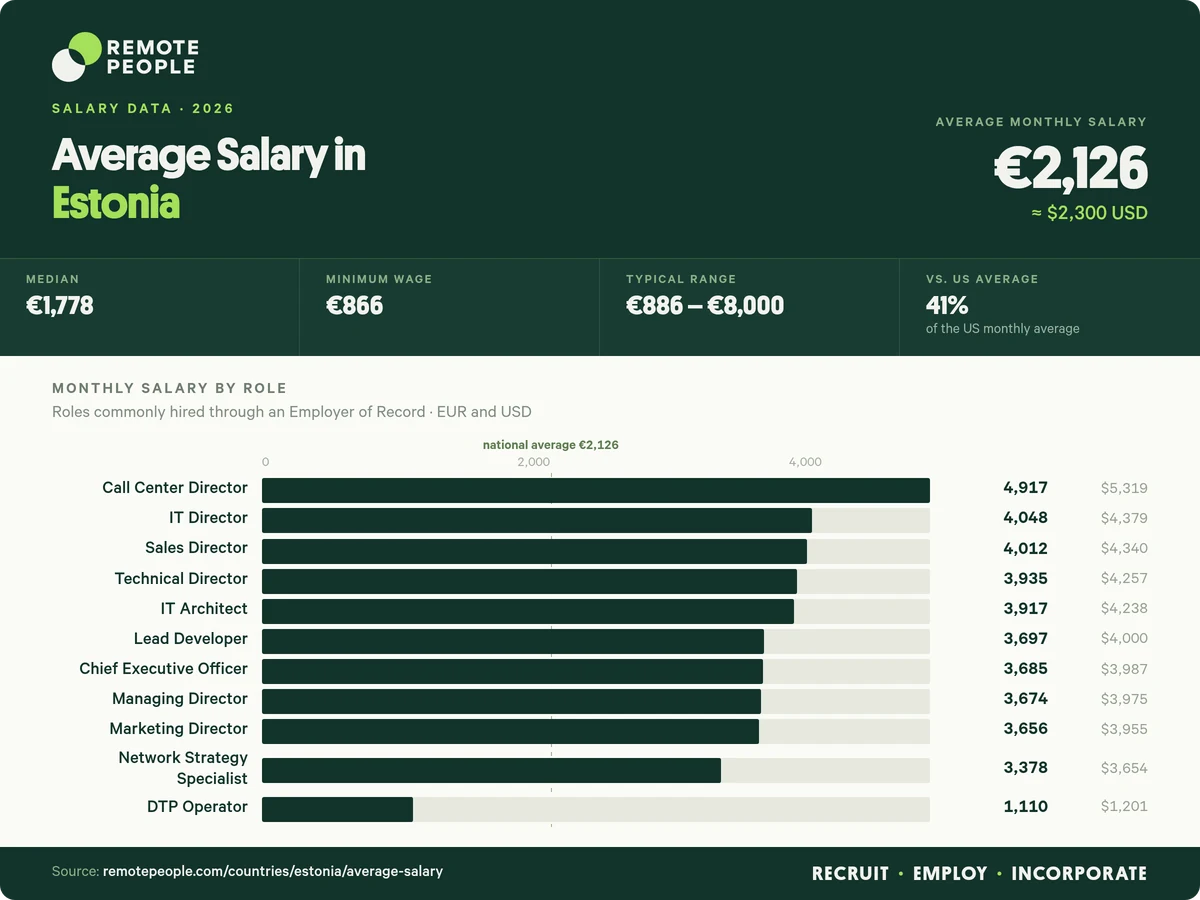
The average salary in Estonia is €2,126 per month, or about USD 2,300. However, experience, education, industry, location, and position must also be considered when determining salary.
This guide reviews those factors and provides the information you need to know.
What is the Average Salary in Estonia?
Median Income
Comparing average vs median salary provides more insight. To calculate the average wage, you must add salaries from across the country and divide the sum by the total number of workers. The median salary, on the other hand, is a middle salary.
Estonia’s median monthly income is €1,778 (approximately USD 1,900). Half the country’s workers earn more than this amount, and the other half earn less.
Salary Range
The salary range spans from the lowest to the highest in the country. Low earners make the minimum wage of €886 per month (approximately $965), while high earners make close to €8,000 per month (roughly $8,720).
Salary Comparisons in Estonia
Salary by Position
Industry and position impact earnings. Workers in skilled positions tend to earn more than employees in unskilled positions. This salary comparison chart lists salaries by position to provide more insight.
Position | Monthly Salary (€) |
|---|---|
Call Center Director | 4,917 |
IT Director | 4,048 |
Sales Director | 4,012 |
Technical Director | 3,935 |
IT Architect | 3,917 |
Lead Developer | 3,697 |
Chief Executive Officer | 3,685 |
Managing Director | 3,674 |
Marketing Director | 3,656 |
Network Strategy Specialist | 3,378 |
DTP Operator | 1,110 |
Survey Interviewer | 1,101 |
Telecommunications Technical Staff | 1,088 |
Merchandiser | 1,083 |
Cobbler | 1,062 |
Seamstress | 1,046 |
Fabric Cutter | 1,046 |
Tailor | 993 |
Porter | 946 |
Average Wage in Estonia by Education
Estonian workers with advanced degrees earn more than those with high school diplomas. 2021 statistics reveal that workers 25 to 34 years old with tertiary education have 14% higher employment rates than those with below-secondary attainment and 3% higher than those with upper-secondary or post-secondary attainment.
In the 25-65 age range, upper-secondary or post-secondary non-tertiary attainment workers earn 29% more than workers with secondary attainment. Those with a tertiary attainment earn about twice as much.
Salary Comparison by Experience
Experience is typically a factor in salary assessment. Workers with more industry experience generally earn higher salaries. They may also be eligible for raises as they gain experience within their companies.
However, in Estonia, education is a bigger factor. The country is seeing rising wages for young, educated workers and declining returns for older, experienced workers with less education. Younger, experienced workers may thrive in the job market, but educated workers will do better than uneducated workers.
These trends have increased since Estonia broke free from Soviet rule and transitioned to a free labor market.
Salary Comparison by Location
Location also impacts salary. Workers in urban areas tend to earn more than workers in rural areas due to a higher cost of living, proximity to prominent companies, and more job opportunities.
In Estonia, workers in major cities like Tallinn and Tartu earn higher wages. The average monthly salary in Tallinn is €2,415 and in Tartu, it is around €2,200. Meanwhile, workers in rural areas often earn less than €1,900 per month.
How Much is Minimum Wage in Estonia?
The minimum wage in Estonia per month is €866. It increased by €66 (8.05%) on January 1, 2026. The increase exceeds 2024’s CPI of 3.9%, giving workers more buying power. However, when looking at the ranking of national minimum wages among countries, Estonia is in 37th place, making it among the lowest minimum wages worldwide.
Average Salary in Estonia vs. the Rest of the World
Comparing Estonia’s salaries to other countries can give you more perspective. These charts will provide comparisons for developed, developing, and undeveloped countries.
Estonia vs. Developed Countries
Country | Average Salary | Comparison to Average Estonia Salary |
|---|---|---|
United Kingdom | £3,000 (approx. $4,100) | − 78% |
United States | $5,220 | − 127% |
Norway | 50,000 NOK (approx. $4,700) | − 104% |
Germany | €4,300 (approx. $4,470) | − 94% |
Austria | €3,700 (approx. $4,050) | − 76% |
Estonia vs. Developing Countries
Country | Average Salary | Comparison to Average Estonia Salary |
|---|---|---|
Romania | 4,000 RON (approx. $835) | 64% |
Russia | 73,700 RUB (approx. $700) | 70% |
Albania | 83,330 ALL (approx. $860) | 63% |
Kazakhstan | 342,000 KZT (approx. $645) | 72% |
Ukraine | 18,000 UAH (approx. $500) | 78% |
Estonia vs. Undeveloped Countries
Country | Average Salary | Comparison to Average Estonia Salary |
|---|---|---|
Thailand | 15,000 Baht (approx. $420) | 82% |
Philippines | 15,000 PHP (approx. $265) | 88% |
Vietnam | 7.5 million Dong (approx. $300) | 87% |
Egypt | 3,900 EGP (approx. $125) | 95% |
Pakistan | 60,000 PKR (approx. $210) | 91% |
Estonia, a developed country with a high-income economy and a high standard of living, is a leader in technology with a digitized infrastructure. The country’s work economy focuses on commerce and services, although agriculture and manufacturing have become important sectors.
The country is an excellent outsourcing destination, particularly for IT services. It offers a highly educated workforce and cost-effective labor. Its strategic location near other major European markets provides a nearshoring advantage for some companies.
What are the Most Common Outsourced Industries in Estonia?
IT Services
Estonia ranks second in Europe for IT infrastructure, scoring 14.28. It boasts a skilled workforce due to universities offering high-quality tech-related education. The country is also supported by a government focusing on entrepreneurship and education.
A software engineer in Estonia earns roughly $61,800 per year, while American workers earn closer to $124,200 per year. Employers that hire Estonian tech workers will benefit from considerable savings.
Financial Technology
Estonia’s efficient technological services extend into the Fintech market. Due to its simplified tax system, ranked among the OECD’s best, Estonia is an ideal destination for fintech outsourcing. The infrastructure supports a cashless society where over 99% of financial transactions are digital.
A fintech analyst in Estonia typically earns around €43,269 (approx. $47,000) per year. An American analyst earns nearly $80,000 annually, giving employers plenty of bargaining power.
Customer Service
Estonia has a thriving customer service industry, making it ideal for e-commerce support. Its digital-first approach provides consumers with self-service options and online portals to maximize efficiency. Their systems are secure and focused on direct communication.
Customer service reps in the country earn around €1,325 monthly (approx. $1,450), while American workers make an average of $3,306. Remote hiring can lead to significant cost savings.
Conclusion
Estonia is an ideal outsourcing destination due to its highly skilled workforce, low-cost labor, and robust digital infrastructure. Employers who hire remotely can benefit from cost savings and efficient processes. Outsourcing opportunities can benefit all parties.