Recruit
Average Salary in Guinea-Bissau
-
 Drew Donnelly
- Published
- September 6, 2026
- 5 ★ on G2








Let RemotePeople handle payroll, compliance, and HR admin worldwide so you can focus on building your team.
Guinea-Bissau’s low labor costs and strategic location make it an ideal destination for outsourcing. Employers looking to develop remote partnerships in the area may wonder, What is the average salary in Guinea-Bissau? This information will help them prepare a fair hiring offer.
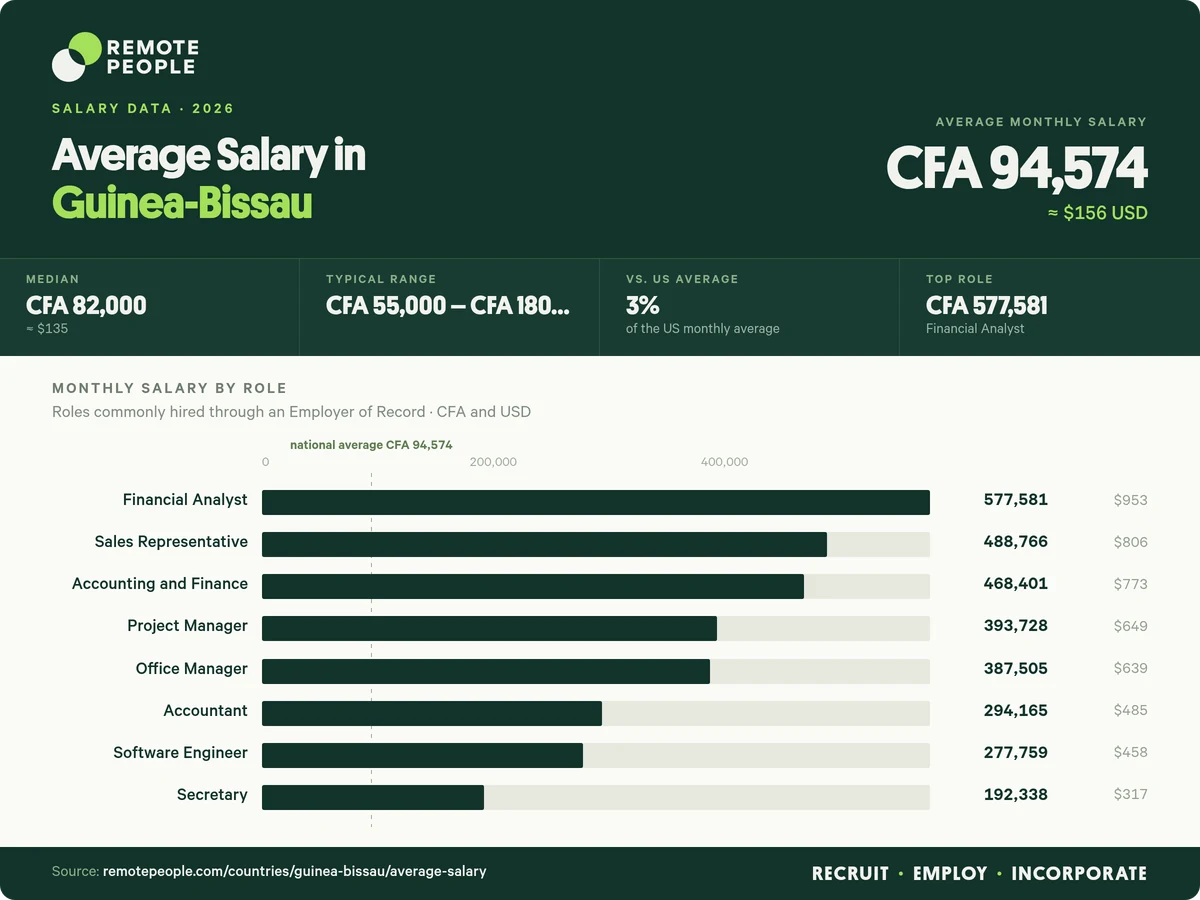
The average salary in Guinea-Bissau is 94,574 West African Francs (CFA), about USD 156. However, wages vary by experience, education, location, position, and industry. Comparing wages in the country to earnings in other nations provides additional insight.
This article will explore all aspects of wages in Guinea-Bissau, preparing you for your hiring journey.
What is the Average Salary in Guinea-Bissau?
The average salary in Guinea-Bissau is 94,574 CFA, equivalent to approximately $156. Wages in the country are low due to slow economic development. The government heavily relies on the low-paying agriculture industry.
Median Income
The median salary in Guinea-Bissau is 82,000 CFA, equivalent to approximately $135. Half the population earns higher wages; the other half earns less.
Salary Range
The salary range spans from the lowest to the highest wages in the country. In Guinea-Bissau, low earners make about 55,000 CFA, about $91, while high earners make closer to 180,000 CFA, about $297.
Salary Comparisons in Guinea-Bissau
Average salary provides some insight, but you must consider how wages vary by education, experience, location, profession, and industry. The following sections will explore how these factors impact earnings.
Salary by Position
This salary comparison chart reveals how wages vary by position:
Position | Average Monthly Wage (CFA) |
|---|---|
Financial Analyst | 577,581 |
Sales Representative | 488,766 |
Accounting and Finance | 468,401 |
Project Manager | 393,728 |
Office Manager | 387,505 |
Accountant | 294,165 |
Software Engineer | 277,759 |
Secretary | 192,338 |
Average Wage in Guinea-Bissau Based on Education
Education is a significant factor in determining wages. Guinea-Bissau is a country struggling with learning poverty. Statistics indicate that a lack of education can have a negative impact on earnings in adulthood, particularly among women.
The country is taking measures to rectify the issue; however, reduced access to education currently contributes to low earnings in the country.
Salary Comparison by Experience
Experience contributes to higher salaries, as experienced workers typically earn more than entry-level workers, and employees become eligible for raises with increasing tenure in their field. This situation is relevant in Guinea-Bissau, especially in skilled industries.
Salary Comparison by Location
Location impacts wages, as urban workers typically earn more than those in rural areas due to higher living costs and proximity to large companies offering higher-paying job opportunities. This situation applies to Guinea-Bissau; however, many areas are at least partially rural, making it challenging to draw a clear distinction.
The poorest areas in the nation include the primarily rural Oio, Gabu, and Quinara regions. Areas that have seen a reduction in poverty include urban Bissau and predominantly rural areas of Cacheu, Bolama, the Bijagos, and Bafata.
How Much is Minimum Wage in Guinea-Bissau?
There is conflicting information on the minimum wage in Guinea-Bissau across the internet. However, reliable sources reveal it is 59,000 CFA, about USD 97.
Average Salary in Guinea-Bissau vs. the Rest of the World
The following charts will compare salaries in Guinea-Bissau to earnings in developed, developing, and least developed countries, providing deeper insights.
Guinea-Bissau vs. Developed Countries
Country | Average Salary | Comparison to Average Guinea-Bissau Salary |
|---|---|---|
Japan | 340,000 JPY (approx. $2,300) | − 1,374% |
United Kingdom | £3,000 (approx. $4,100) | − 2,529% |
Norway | 50,000 NOK (approx. $4,700) | − 2,913% |
Germany | €4,300 (approx. $4,470) | − 2,765% |
Austria | €3,700 (approx. $4,050) | − 2,496% |
Guinea-Bissau vs. Developing Countries
Country | Average Salary | Comparison to Average Guinea-Bissau Salary |
|---|---|---|
Romania | 4,000 RON (approx. $835) | − 435% |
Russia | 73,700 RUB (approx. $700) | − 349% |
Albania | 83,330 ALL (approx. $860) | – 451% |
Kazakhstan | 342,000 KZT (approx. $645) | − 313% |
Ukraine | 18,000 UAH (approx. $500) | − 221% |
Guinea-Bissau vs. Undeveloped Countries
Country | Average Salary | Comparison to Average Guinea-Bissau Salary |
|---|---|---|
Afghanistan | 13,200 AFN (approx. $150) | 4% |
Philippines | 15,000 PHP (approx. $265) | – 70% |
Cambodia | 1,150,000 KHR (approx. $280) | − 79% |
Egypt | 14,317 EGP (approx. $284) | − 82% |
Pakistan | 60,000 PKR (approx. $210) | − 35% |
Guinea-Bissau is a least developed country with a low-income economy. It is vulnerable to political instability and external factors. The nation relies heavily on subsistence activities, such as fishing and agriculture.
The country’s low labor costs, growing economy, and strategic location make it a promising outsourcing destination. However, it is plagued by political instability and an underdeveloped infrastructure. Still, with some effort, it could emerge as a convenient remote partner.
What are the Most Common Outsourced Industries in Guinea-Bissau?
Employers seeking remote partnerships in Guinea-Bissau will benefit most when focusing on the following industries.
Agriculture
Guinea-Bissau’s agricultural industry is primarily dominated by subsistence farming, which produces food crops such as cassava, beans, and vegetables. However, cashew is a cash crop and a significant export. The country also shows promise in diversifying its economy through horticulture, livestock, and irrigation.
Fishing
Small-scale fishing plays a crucial role in Guinea-Bissau’s economy, providing over 35% of the nation’s animal protein intake and employing over 255,000 people. Industrial fleets from China and Europe operate in Guinea-Bissau’s waters, but their catches are often unreported, contributing to concerns regarding the industry’s sustainability. The country also faces challenges related to illegal fishing and overfishing.
BPO
Although Guinea-Bissau’s BPO industry is in its early stages, it shows promise, specifically due to its affordable labor. The country also boasts a young and diverse workforce, as well as a steadily growing economy.
Companies considering outsourcing opportunities can also utilize Employer of Record (EOR) services to manage payroll, taxes, and compliance, eliminating the need to establish a separate legal entity.
Conclusion
Guinea-Bissau’s low average salary and strategic location make it a convenient destination for outsourcing. Employers that partner with the country to offer remote opportunities can benefit from cost savings and access to exceptional products and services, while helping workers overcome poverty, achieving positive outcomes for all parties involved.