
 Recruit
Hong Kong Company Registration Services
-
 Drew Donnelly
- Published
- August 4, 2026
Hong Kong offers a fast and straightforward business registration process, allowing companies to be set up in just 1-2 days. Its low and transparent tax regime, with no VAT, no capital gains tax, and a corporate tax rate of only 16.5%, makes it an attractive destination for both local and international businesses.
- 5 ★ on G2








- Hong Kong Services
- Benefits of Hong Kong Company Registration
- Why Register a Company in Hong Kong?
- Types of Business Entities in Hong Kong
- How To Register Your Company In Hong Kong
- Preparation Phase
- Registration Process
- Timeline and Costs
- Compliance Requirements for Companies in Hong Kong
- Advantages of Using Hong Kong Company Registration Services
- Challenges in Setting Up a Company in Hong Kong
- Taxation and Banking in Hong Kong
- Hong Kong as a Gateway for Overseas Companies
- Costs of Incorporating a Company in Hong Kong
- What Is the Role of a Company Secretary in Hong Kong
- Typical Expenses for Establishing a Company in Hong Kong
- Factors Influencing Hong Kong Company Formation Price
- Choosing the Right Service Provider
- Budgeting for Incorporation
- Embracing Digital Solutions
- Conclusion
- How the Study Was Conducted
- Why Now is the Right Time to Register a Company in Hong Kong
- FAQs about Company Registration in Hong Kong

Let RemotePeople handle payroll, compliance, and HR admin worldwide so you can focus on building your team.
Are you looking to expand your business into one of the most connected and opportunity-filled regions on the planet? Hong Kong, perched in Southern China at the crossroads of East Asia, is a powerhouse for international entrepreneurs.
With its low tax system—no VAT, sales tax, or capital gains tax—and business-friendly policies, it’s no wonder this city ranks among the top choices for global expansion. As a hub of innovation and commerce, Hong Kong offers seamless access to Asia’s booming markets.
Benefits of Hong Kong Company Registration
✅ Fast & Simple Registration
Hong Kong boasts a streamlined business registration process that lets you set up your company in just 1-2 days, giving you rapid access to one of Asia’s leading financial hubs.
✅ Attractive Tax Benefits
With no VAT, no capital gains tax, and a corporate tax rate of just 16.5%, Hong Kong offers a low and transparent tax environment that’s highly appealing to both local and international businesses.
✅ Robust Banking Infrastructure
The city provides seamless access to a comprehensive range of banking services, including the option to open business bank accounts remotely—essential for businesses operating globally.
Together, these advantages make Hong Kong an ideal destination for entrepreneurs looking to develop and grow their businesses in a dynamic international market.
Why Register a Company in Hong Kong?
Hong Kong’s position as a global business leader continues to thrive, as confirmed by the Fraser Institute’s Economic Freedom of the World 2024 Annual Report, released on October 16, 2024. Climbing to the top spot among 165 economies, Hong Kong stands out in areas like “Freedom to Trade Internationally” and “Regulation,” with a strong third-place ranking in “Sound Money.”
Clearly, Hong Kong has a reputation as an ideal destination for business ventures, especially for those seeking international reach. Here are some key benefits of setting up a business in Hong Kong:
- Ease of Doing Business: Consistently ranking highly in global business ease indices, Hong Kong offers a clear registration process and minimal red tape.
- Low Tax Regime: The city’s simple tax structure features corporate tax rates of 8.25% on the first $2 million in profits and 16.5% on the remainder. For unincorporated businesses, tax rates are 7.5% and 15%, respectively. There are no sales taxes, VAT, or taxes on dividends and capital gains.
- Strategic Trade Hub: Situated at the crossroads of Asia, Hong Kong serves as a gateway to Mainland China and the broader Asia-Pacific region, providing businesses with unparalleled access to key markets. Hong Kong plays a pivotal role in facilitating Mainland China’s external trade, ranking as its fourth-largest trading partner in 2023 after the United States, Japan, and South Korea. The mainland accounted for 43.5% of Hong Kong’s total imports and 55.5% of its total exports.
- World-Class Infrastructure: Its reliable legal framework, advanced financial systems, and robust communication networks create a solid foundation for business success.
Types of Business Entities in Hong Kong
Just as in the U.S., Hong Kong offers businesses the ability to get set up with their chosen structure. Here are the most common business entity options in Hong Kong.
Private Limited Company
The most popular choice for small to medium-sized enterprises (SMEs) and startups. This structure offers liability protection for shareholders, limiting their responsibilities to the amount they’ve invested. It also provides a separate legal identity from its owners.
Sole Proprietorship
A simple business structure ideal for individuals running small-scale operations. The owner assumes full responsibility for profits, losses, and liabilities, making it simple to manage but without the liability protection of other structures.
Limited Liability Company (LLC)
Offers liability protection for owners while providing operational flexibility. This structure is favored by businesses that require limited personal risk and a scalable framework for growth.
Public Listed Company
Suitable for large corporations looking to raise funds through public offerings on the stock market. These companies must comply with strict reporting and regulatory requirements.
General Partnership
An arrangement where two or more people share ownership and responsibility for a business. While easy to establish, partners are jointly liable for the business’s debts and obligations.
Hong Kong Partnership
Includes general and limited partnerships. Limited partnerships allow one or more partners to have limited liability, while general partners retain full liability for the partnership’s obligations.
Branch or Representative Office for Overseas Companies
Perfect for businesses looking to expand their reach without forming a separate legal entity. A branch operates as part of the parent company, while a representative office is limited to non-revenue-generating activities like marketing and research. This option is ideal for overseas company registration in Hong Kong.
How To Register Your Company In Hong Kong
Starting an organization can be an existing time. You have a product or service to sell and know a target audience is out there, ready to consume it. But before you can go to market, you need to ensure you have checked all the boxes regarding company registration and the ability to sell in your chosen geographies legally.
This can be unclear if you aren’t sure of the steps to take. And if you miss a step, it can slow down your process and your ability to generate your projected revenue.
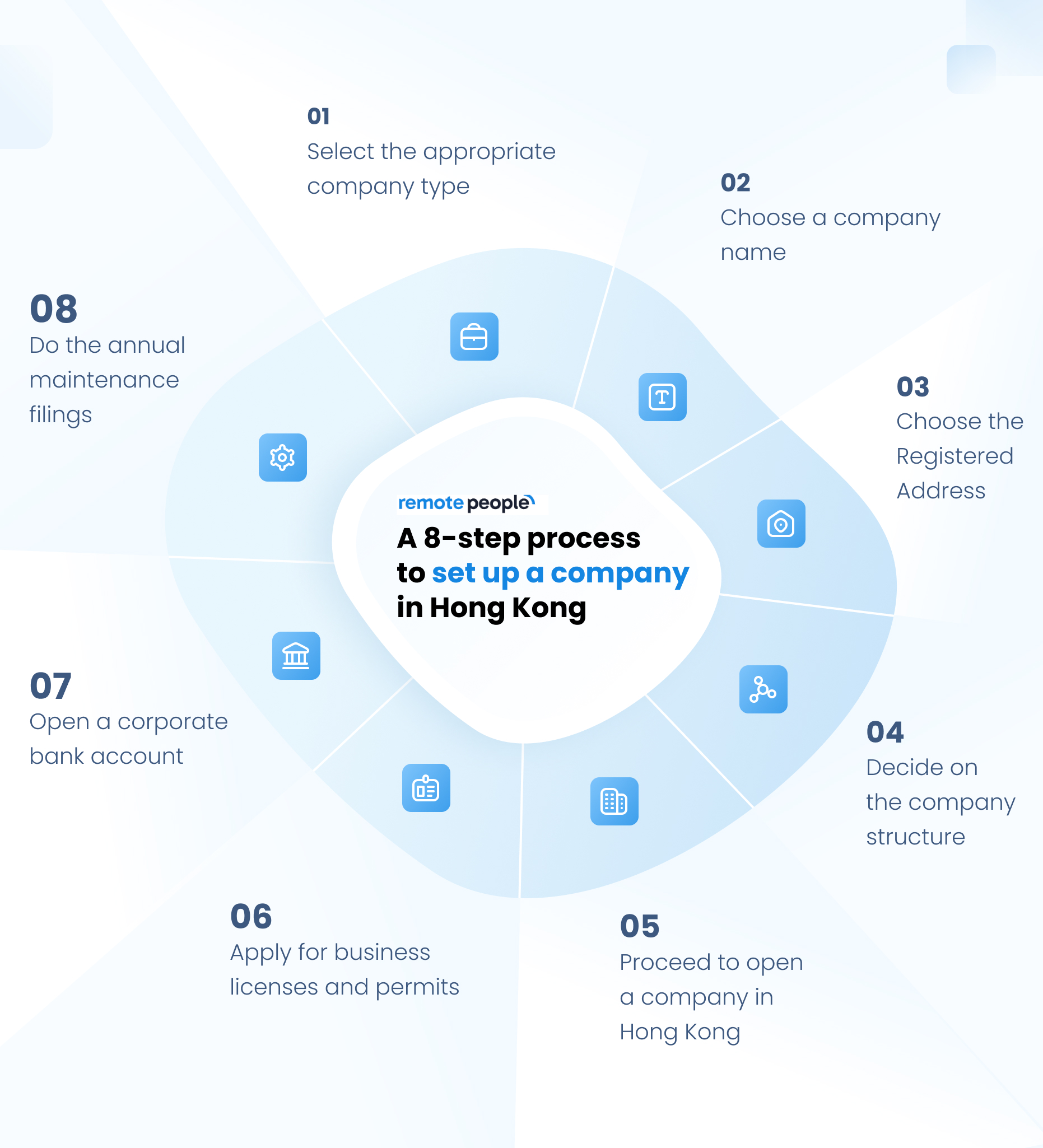
That’s why we’re here to walk you through the key steps to setting up your company and what you need to know about Hong Kong company registration services.
Preparation Phase
Before beginning the registration process, preparation is key to laying a strong foundation. This phase involves the following steps:
1
Select the Appropriate Company Type
Choosing the right company type is crucial as it impacts your legal obligations, tax responsibilities, and operational flexibility. In Hong Kong, the most common types of companies include:
Private Limited Company: Ideal for small to medium-sized businesses; offers limited liability to shareholders.
Sole Proprietorship: Simplest structure but exposes the owner to unlimited liability.
Partnership: Suitable for businesses with multiple owners; can be a general or limited partnership.
Selecting the right business structure—whether a private limited company, partnership, or another entity—depends on your goals, liability preferences, and operational requirements. Each structure has its own legal and tax implications, so it’s worth understanding which best suits your plans.
Professional Hong Kong company registration services can assist with these preparatory steps, offering guidance tailored to your needs.
2
Choose a Company Name
Your company name must comply with local regulations and be unique within the Companies Registry. It’s wise to check the availability of your desired name early in the process to avoid potential conflicts or delays.
Refer to the Guideline on Registration of Company Names for Hong Kong Companies for important considerations when choosing a company name.
Choosing a company name requires careful consideration to avoid conflicts with third-party intellectual property rights (IPR). Violations can result in legal consequences, including criminal or civil penalties, not only in Hong Kong but potentially in other jurisdictions as well. To mitigate risks, conduct a thorough search using the Trademark Register, provided by the Intellectual Property Department, to verify the name’s availability and compliance with IPR regulations.
3
Choose a Registered Address
A registered address is mandatory for all companies in Hong Kong. The address:
- Must be a physical location in Hong Kong (P.O. boxes are not allowed).
- Will be used for official correspondence and legal notices.
Virtual office providers can assist if you do not have a physical presence in Hong Kong.
4
Decide on the Company Structure
Define the internal framework of your company, including:
Shareholders: Minimum of one; can be an individual or a corporation.
Directors: Minimum of one; must be a natural person and can be non-residents.
Company Secretary: Mandatory and must reside in Hong Kong or be a Hong Kong-based corporate entity.
Share Capital: No minimum requirement, but at least one share must be issued.
Registration Process
Once the preparation phase is complete, proceed to the formal registration steps:
5
Submit Documents to the Companies Registry
To incorporate your company, submit the following:
- Articles of Association: This outlines the company’s rules and regulations. Templates and samples are readily accessible on the e-Services Portal for your convenience.
- Incorporation Form: Use Form NNC1 for new companies and NNC1G for branches.
Ensure all documents are accurately completed to avoid rejection. Online submission via the e-Registry platform is the fastest method.
6
Apply for Business Licenses and Permits
Depending on your industry, you may need specific licenses or permits to operate legally in Hong Kong. Common examples include:
Food License: For food and beverage businesses.
Import/Export License: For trading businesses.
Consult the Hong Kong Business License Information Service to identify the permits required for your business.
Registering for a Business Registration Certificate (BRC)
This step with the Inland Revenue Department formalizes your ability to conduct business in Hong Kong.
7
Open a Corporate Bank Account
A corporate bank account is essential for managing your company’s finances. When opening an account:
Prepare necessary documents such as the Certificate of Incorporation, Business Registration Certificate, and proof of identity for directors and shareholders.
Research banks to find one that aligns with your needs. Hong Kong’s major banks include HSBC, Standard Chartered, and Bank of China.
Some banks may require an in-person meeting to finalize the process.
7
Perform Annual Maintenance Filings
Once your company is operational, you must meet annual compliance requirements to maintain its legal status. These include:
Renewing the Business Registration Certificate (BRC) annually.
Filing the Annual Return (Form NAR1) with the Companies Registry.
Audited Financial Statements: Submit these if your company is a limited company.
Timeline and Costs
The entire registration process typically takes 5–10 working days, provided all documents are in order. Initial costs include:
- Registration Fees: Approximately HKD 1,720 for most companies.
- Annual Maintenance Costs: Vary depending on the services used (e.g., company secretary, accounting, or office rental).
For further information regarding key service fees imposed by the Companies Registry, refer to this resource.
For a comprehensive breakdown of fees for all services offered, please consult the Schedules to the Companies (Fees) Regulation (Cap. 622K).
Compliance Requirements for Companies in Hong Kong
As with any country, your Hong Kong business will need to comply with local requirements and regulations. Failing to do so can be a surefire way to set your company up for fines, if not get it shut down.
Here’s what to keep in mind.
- Annual Returns: Companies must file annual returns with the Companies Registry to confirm or update their company details. This step is mandatory and requires paying a filing fee to remain in good standing.
- Audited Financial Statements: All companies, regardless of size, must prepare audited financial statements annually. These are required for tax filings and provide transparency in financial reporting.
- Tax Filing: Businesses are obligated to submit corporate tax returns each year to the Inland Revenue Department. Hong Kong’s tax system is clear, but missing deadlines or providing inaccurate information can result in penalties.
- Licenses and Permits: Depending on your industry, specific licenses or permits may be required. For example, financial services, food and beverage, and retail operations all have unique compliance requirements.
To simplify these processes, many entrepreneurs turn to Hong Kong company registration services for expert assistance. These professionals can help with everything from filing returns to securing the necessary permits. For companies not ready to register locally, leveraging a Hong Kong Employer of Record (EOR) provides another avenue, allowing businesses to hire employees in Hong Kong without establishing a legal entity. This option is especially useful for testing new markets or managing operations with minimal overhead.
Compliance doesn’t have to be overwhelming when you have the right resources to guide you through each step.
Advantages of Using Hong Kong Company Registration Services
Getting professional help for your business setup can make the process far easier and can help you avoid headaches or red tape. Here’s why:
- Time-Saving: Professionals take care of the administrative tasks, allowing you to focus on growing your business.
- Expert Guidance: Assistance with understanding legal requirements, setting up a bank account, and meeting compliance standards.
- Tailored Solutions: Services are customized to meet the unique needs of overseas entrepreneurs.
While it’s possible to handle registration yourself, the process can be complicated and time-consuming, especially for those unfamiliar with local laws and requirements. Choosing professional services makes the process easier and helps you avoid costly mistakes.
For businesses exploring options without forming a legal entity, overseas company registration in Hong Kong isn’t your only route. A China Employer of Record (EOR) allows companies to hire employees in Hong Kong legally through a third-party organization. The EOR handles employment contracts, payroll, and compliance, making it a flexible solution for testing markets or running limited operations.
Challenges in Setting Up a Company in Hong Kong
While it is possible to set up a company in Hong Kong and grow it into a thriving business, the process is not without its challenges. And those challenges extend far beyond the process of simply getting the company set up and registered.
- Working Through Legal and Tax Regulations: Understanding Hong Kong’s legal and tax framework can be complex, especially for those unfamiliar with local compliance standards. Missing key requirements may lead to delays or penalties.
- Language Barriers: Although many business services operate in English, some interactions, particularly with local authorities or service providers, may require knowledge of Cantonese or Mandarin.
- Banking Requirements: Opening a business bank account often involves detailed documentation, including proof of identity for directors and the nature of your business. Banks may require in-person meetings, further complicating the process for overseas entrepreneurs.
Taxation and Banking in Hong Kong
We touched on this a bit earlier, but it’s worth digging into the taxation and banking requirements in Hong Kong a bit further. Yes, Hong Kong is what is commonly referred to as a low-tax system with no VAT, sales tax, or capital gains tax, but that doesn’t mean there are no taxes to manage.
As we shared earlier, the profits tax rate is 16.5% for incorporated companies on taxable income, with a reduced rate of 8.25% on the first $2 million of profits. Unincorporated businesses pay 7.5% on the first $2 million and 15% thereafter. While there are no taxes on capital gains, dividends, or sales, businesses must still meet their annual tax filing requirements with the Inland Revenue Department.
When it comes to banking, opening a local business account can be a challenging process. Many banks require proof of your business activities, directors’ identities, and in some cases, in-person meetings. Entrepreneurs may need to travel to Hong Kong more than once to complete account setup and fulfill compliance checks.
Hong Kong’s extensive Double Taxation Agreements (DTAs) benefit international businesses by preventing income from being taxed in multiple jurisdictions. The city has 40 agreements globally, categorized into:
- Comprehensive DTAs: Cover income taxes in all forms.
- Airline and Shipping Income DTAs: Address income specific to these industries.
- Airline Income and Shipping Income DTAs: Separate treaties for airline or shipping-specific taxes.
- Exchange of Information Agreements: Facilitate tax information sharing for transparency.
Hong Kong as a Gateway for Overseas Companies
While the low-tax system is definitely a big draw for companies who want to get their start in Hong Kong, there is far more to it. Setting up a regional headquarters or branch in Hong Kong offers unmatched access to the Guangdong-Hong Kong-Macau Greater Bay Area, a rapidly growing economic region. This area connects businesses to over 70 million people and provides opportunities to collaborate within a major hub of commerce and innovation.
Hong Kong is also an appealing place for many entrepreneurs and their families to live. Despite its high cost of living, the city offers low crime rates, excellent healthcare, and a highly reliable public transportation system, including the MTR, which makes commuting convenient and efficient. Its diverse culture and strong economy add to its appeal, offering a rich experience for those relocating for work or business.
Businesses in Hong Kong benefit from access to a highly educated workforce. The average schooling level in Hong Kong is 12.2 years, ranking it 36th globally. In 2023, 67.89% of residents aged 25 and older had completed upper secondary education. This means that you’ll be able to tap into a highly educated and skilled workforce, ready to get the job done.
Costs of Incorporating a Company in Hong Kong
A recent study surveying 120 entrepreneurs who have successfully incorporated companies in Hong Kong provides valuable insights into the expenses and key considerations involved in this endeavor. This paragraph breaks down the essential findings and factors to help prospective business owners understand the costs of setting up a company in Hong Kong.
1
Average Incorporation Cost
The typical cost to incorporate a company in Hong Kong is approximately HKD 9,053. This average figure can vary based on the specific services and options selected during the setup process. Entrepreneurs should be aware that while this serves as a general benchmark, individual business needs and circumstances may result in variations in the total expenditure required for incorporation.
2
Impact of Mandatory Fees
Mandatory fees are a significant component of the overall cost of incorporation. Essential fees, such as the business registration fee, are compulsory and must be included in the budget. These fees vary depending on the chosen application method and often require annual renewals to maintain the company’s good standing. Understanding these mandatory costs is crucial for accurate financial planning and compliance with local regulations.
3
Digital vs. Traditional Secretary Services
A significant cost factor in company incorporation is the service of a company secretary. On average, digital company secretary services cost around HKD 7,773, whereas traditional services cost approximately HKD 10,703. Digital solutions provide a more cost-effective alternative by offering online management of documentation and filings, which can lead to significant savings compared to traditional, paper-based methods.
4
Budget for Complex Needs
Entrepreneurs should budget for complex business structures or specific services their companies may require. Businesses with intricate operational frameworks or specialized needs will encounter higher costs. Proper budgeting ensures that all necessary services are accounted for, preventing unexpected financial burdens during incorporation.
5
Benefits of Digital Solutions
Opting for digital services can result in substantial cost savings and streamline business operations. Digital company secretary services reduce expenses and simplify the management of business processes through online platforms. This approach aligns with the global trend towards digitalization, offering convenience and efficiency for modern businesses.
6
Choosing the Right Company Secretary
Selecting the appropriate company secretary is pivotal for a business’s success. Factors to consider include the company’s size, budget constraints, and preferred communication methods. A company secretary in Hong Kong ensures compliance with local laws, manages filings, and liaises with government bodies such as the Inland Revenue Department and Companies Registry. Choosing the right service provider can enhance operational efficiency and legal compliance.
What Is the Role of a Company Secretary in Hong Kong
Under Hong Kong’s Companies Ordinance, every business must appoint a company secretary from the date of incorporation. The company secretary ensures that the business adheres to all local regulations, manages necessary filings, and communicates with government authorities. The secretary must be a Hong Kong resident or a corporate entity with a registered office in Hong Kong. Failure to appoint a company secretary can result in fines or legal complications, making this role essential for every incorporated business.
Types of Company Secretary Services
There are two main types of company secretary services in Hong Kong:
Digital Company Secretary Services: These services are entirely online, allowing for the digital handling of documentation, filings, and communication. They offer a quick and convenient experience and are often cheaper than traditional methods.
Traditional Company Secretary Services: These services rely on mail or in-person interactions and provide limited online access. They are suitable for businesses that prefer face-to-face support or paper-based processes but tend to be more time-consuming and expensive.
Overall Average Costs
The survey reveals that the average cost to create a company in Hong Kong is around HKD 9,053, with an average annual maintenance cost of approximately HKD 9,008. Annual maintenance covers essential services required to keep the company in good standing, including business registration fees, provision of a registered office address, a nominee company secretary, statutory compliance representation, and mandatory filings like the Annual Return and tax declarations.
Costs by Type of Company Secretary Service
| Service Type | Creation Cost | Annual Maintenance Cost |
|---|---|---|
| Digital Company Secretary Services | Approximately HKD 7,403 | Around HKD 8,142 |
| Traditional Company Secretary Services | About HKD 11,195 | Approximately HKD 10,211 |
These figures highlight a clear cost advantage for digital services over traditional ones, making digital solutions an attractive option for cost-conscious entrepreneurs.
Typical Expenses for Establishing a Company in Hong Kong
Establishing a company in Hong Kong involves various fees, which can vary based on business type, complexity, and specific needs. The fundamental expenses include:
- Company Registration Fee: A one-time payment to the Companies Registry, approximately HKD 1,500 for electronic applications and HKD 1,700 for hard copy submissions.
- Business Registration Fee: An annual fee paid to the Inland Revenue Department, costing around HKD 2,000. This certificate must be renewed annually.
- Company Secretary: This position is mandatory for all Hong Kong companies, and the cost varies depending on the level of support required.
- Registered Address: Every company must have a registered address in Hong Kong, which can be obtained through service packages if no residential address is available.
Factors Influencing Hong Kong Company Formation Price
Several factors can influence the cost of company formation in Hong Kong:
- Service Selection: Different service packages and levels can significantly affect prices. Essential registration services are cheaper, while comprehensive packages offering additional features like registered addresses, bank account assistance, and legal advisory services cost more.
- Hidden Fees: Additional costs may arise from document preparation, filing, retrieval, alterations to company information, and late submissions.
- Market Trends: The growing preference for digital solutions aligns with global digitalization trends, offering cost-effective and efficient company management options.
- Company Complexity: Businesses with complex structures or requiring additional licenses and permits will face higher costs. For example, retail businesses needing licenses from the Trade and Industry Department must adhere to specific regulations, increasing overall expenses.
Choosing the Right Service Provider
Selecting the right service provider is crucial for successful incorporation. Key considerations include:
- Budget: Align service costs with your financial plan, ensuring value for money rather than simply choosing the cheapest option. Selecting a provider that offers a comprehensive package covering essential incorporation documents, such as Articles of Association, Incorporation, and Business Registration Certificate, Certificate of is recommended.
- Communication: To facilitate smooth operations, ensure the provider offers clear and responsive communication, preferably in your preferred language.
- Company Size: Larger organizations may need providers experienced in handling complex structures, while smaller firms might benefit from more customized services.
Budgeting for Incorporation
When planning to incorporate in Hong Kong, it is essential to account for potential costs. While some entrepreneurs may manage to keep expenses low, it is prudent to prepare for higher costs, especially for businesses requiring complex services. Proper budgeting helps avoid unexpected financial challenges and covers all necessary services.
Embracing Digital Solutions
Adopting digital service providers offers several advantages, including cost savings and the convenience of managing applications online. Digital platforms allow business owners to track application progress, access documents remotely, and receive online support, contributing to a smoother and more efficient incorporation process.
Conclusion
Incorporating and maintaining a company in Hong Kong involves diverse costs influenced by service choices, business complexity, and digitalization trends. Digital solutions provide significant cost and efficiency benefits, making them an attractive option for modern entrepreneurs. By understanding the various cost components and making informed decisions on service providers and budgeting, potential business owners can ensure a smooth and successful incorporation process in Hong Kong’s dynamic business environment.
How the Study Was Conducted
The insights presented are based on a comprehensive survey conducted with 120 clients from diverse industries and business sizes. Participants reported their costs for incorporating and maintaining companies in Hong Kong, allowing for a comparison between traditional and digital company secretary services. The study maintained strict confidentiality and adhered to ethical standards, ensuring reliable and representative results for understanding the financial aspects of company formation in Hong Kong.
Why Now is the Right Time to Register a Company in Hong Kong
Hong Kong offers unmatched opportunities for businesses, from its low-tax system and world-class infrastructure to its role as a gateway to Mainland China and Asia-Pacific markets. With a highly educated workforce and a business-friendly environment, it’s an ideal location for international entrepreneurs seeking growth.
Ready to get started? Engage with trusted Hong Kong company registration services or explore the flexibility of a Hong Kong EOR service with RemotePeople.
FAQs about Company Registration in Hong Kong
We know we have thrown a lot of information at you. So, let’s take some time to review some of the most common questions about setting up a company in Hong Kong.
There is no minimum capital requirement for setting up a company in Hong Kong. Businesses can start with as little as HKD 1 in share capital, making it accessible for entrepreneurs of all sizes. This flexibility allows companies to allocate their resources strategically without being burdened by large upfront capital investments.
Yes, foreigners can own 100% of a company in Hong Kong. The city’s open business environment supports full foreign ownership, meaning entrepreneurs from overseas can set up and operate without requiring local partners or shareholders. This policy is a significant advantage for global businesses seeking complete control of their operations. In fact, over 85% of new businesses registered in Hong Kong are foreign-owned.
Yes, setting up a company in Hong Kong is generally safe. The city has low crime rates compared to many other regions worldwide. However, awareness and vigilance are always important. Like any location, theft is the most common crime globally, and serious offenses, such as assault, occur in higher-risk countries like Venezuela, Afghanistan, and South Africa, underscoring the relative safety of Hong Kong.
No, a local director is not required to register a company in Hong Kong. However, it is mandatory to appoint a company secretary who is either a local resident or a corporate entity based in Hong Kong. The company secretary plays a key role in maintaining compliance with local regulations.
The company registration process in Hong Kong typically takes five to ten working days, provided all required documents are complete and accurate. This quick turnaround time allows businesses to start their operations promptly, making Hong Kong an attractive choice for entrepreneurs seeking efficiency.




