
 Recruit
Employer of Record (EOR) in Hong Kong
-
 Drew Donnelly
- Published
- September 27, 2026
RemotePeople’s employer of record in Hong Kong lets you hire employees in Hong Kong with MPF enrollment. We handle 5% Mandatory Provident Fund contributions, employee enrollment within 60 days, and tax deductions.
Hire in Hong Kong — book a free 30-minute demo
Tell us what you need. You'll get a tailored, transparent proposal within 24 hours, plus a free call to walk through it.
Tell us about your company
So we can match you with a specialist who knows your market — and unlock volume pricing tiers.
* All fields are required.
Where and when are you hiring?
Tell us the geography and timing and we'll quote each country line by line, with onboarding timelines.
* All fields are required.
Help us beat your current setup
We'll benchmark your current deal and send a line-by-line proposal in 24 hours — showing exactly where we cut cost, time, or risk. After you submit, you can book a call to walk through it together.
* All fields are required.
Thanks! Your proposal is on its way.
Expect a tailored, line-by-line proposal in your inbox within 24 hours. In the meantime…
Want to walk through it together?
Book a free 30-minute call with one of our specialists. We'll explain every line, answer your questions, and tailor the proposal further if you need.
No obligation. Pick a time that works for you.








- Hire in Hong Kong — book a free 30-minute demo
- Tell us about your company
- Where and when are you hiring?
- Help us beat your current setup
- Thanks! Your proposal is on its way.
- How an Employer of Record Works in Hong Kong
- Start hiring with a Hong Kong EOR
- Employment Laws and Regulations in Hong Kong
- Work Permits and Visas in Hong Kong
- Payroll, Taxes, and Social Security in Hong Kong
- Cost of Hiring Through an EOR in Hong Kong
- Benefits of Using an EOR in Hong Kong
- Termination and Offboarding in Hong Kong
- EOR vs. Other Hiring Models in Hong Kong
- Public Holidays in Hong Kong
- How to Get Started with an EOR in Hong Kong
- Where companies hiring in Hong Kong expand next
- Frequently Asked Questions
- Related EOR Destinations
Start hiring in Hong Kong
Let RemotePeople handle payroll, compliance, and HR admin worldwide so you can focus on building your team.

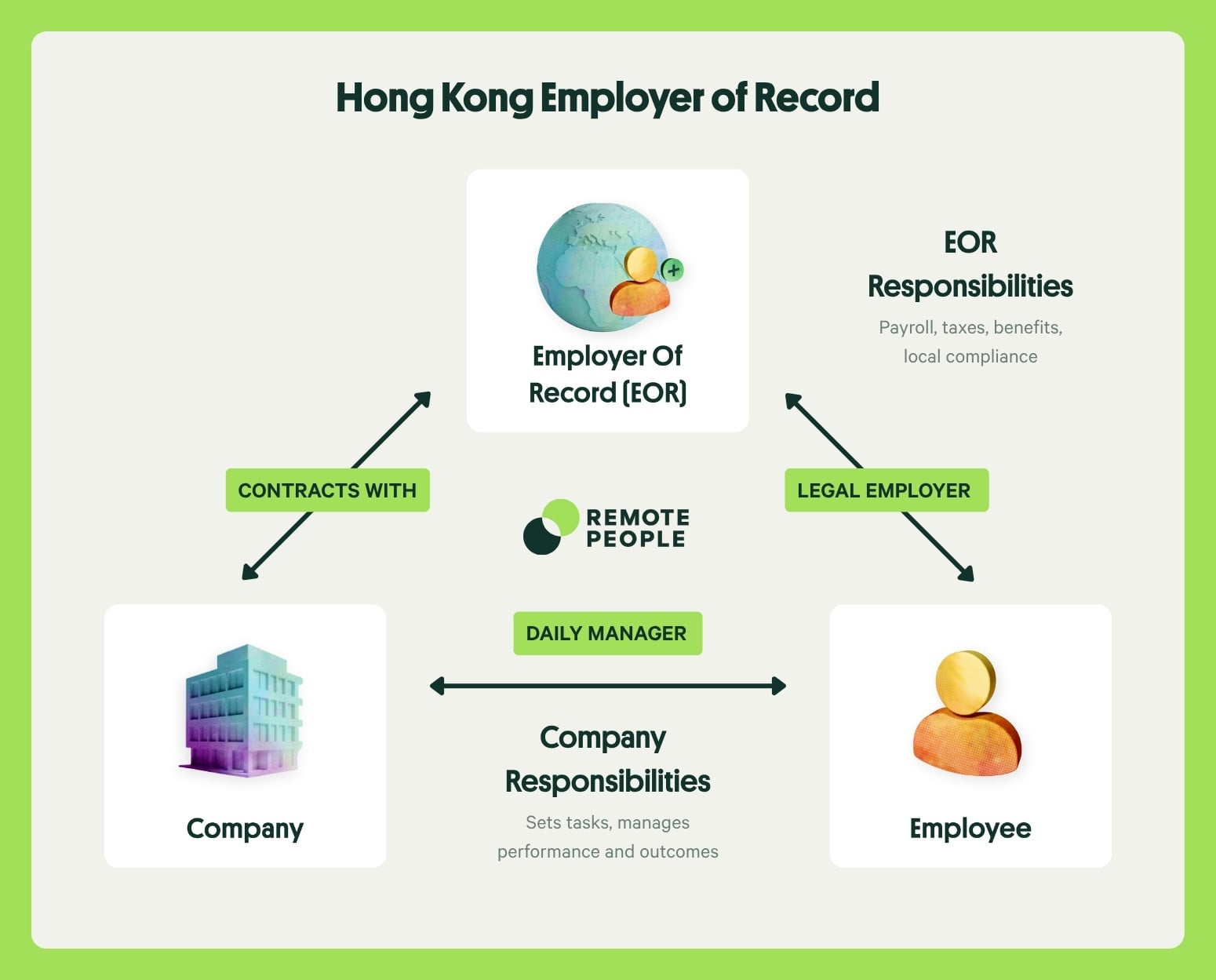
Hong Kong’s low tax rates, English-speaking workforce, and proximity to mainland China make it a top hiring destination for international companies. If you want to hire employees there without setting up a local entity, an employer of record in Hong Kong handles compliance, payroll, benefits, and employment law on your behalf. The EOR becomes the legal employer while you keep full control over day-to-day work.
This guide walks through how EOR hiring works in Hong Kong in 2026 – employment regulations, tax obligations, visa options, and typical service costs of $300 to $600 per month.
How an Employer of Record Works in Hong Kong
An employer of record lets you hire teams in Hong Kong without setting up your own legal entity. Hong Kong employment law the Employment Ordinance (Cap. 57), Mandatory Provident Fund contributions, statutory holidays has enough moving parts that most companies prefer to hand compliance and payroll to a local specialist.
That is what an EOR does: it takes on the legal employer role so you can focus on running your business.
If you’d like to learn more about how Employer of Record (EOR) services work, read our What Is an Employer of Record (EOR)? guide for a complete overview of the model, its benefits, and when to use it.
If you’re comparing providers, our Best Employer of Record (EOR) Providers guide reviews the leading platforms to help you choose the right solution for your business.
Who Uses an EOR in Hong Kong?
EOR services in Hong Kong are used by companies that want to hire locally without incorporating. The most common profiles:
- Startup Companies: Early-stage firms establishing their first international presence without the capital or infrastructure for a full subsidiary.
- Multinational Corporations: Large organizations needing rapid workforce deployment in Hong Kong while their legal and HR teams handle other regions.
- Remote-First Companies: Organizations building distributed teams across multiple countries and requiring a unified employment and payroll platform.
- Project-Based Firms: Companies hiring staff for specific initiatives or temporary expansions without committing to permanent local operations.
Typical Onboarding Timeline
Expect 3–6 weeks from first contact to the employee’s first payroll run. The timeline breaks down roughly like this: information gathering takes 3–5 business days; contract drafting and signing takes another 5–7 business days; payroll setup and MPF enrollment happen in parallel, usually within 7–10 days. Work permit applications (GEP, ASMTP, TTPS) add 2–4 weeks if the employee needs a visa.
The biggest variable is how fast you provide documentation – the EOR side runs on a predictable clock once everything is submitted.
Start hiring with a Hong Kong EOR
A globally connected finance hub with MPF contributions, a common law legal framework, and straightforward local employment requirements.
We handle employment contracts, payroll, MPF contributions, and full Hong Kong compliance.
No local entity needed. Your team can start in days.
Employment Laws and Regulations in Hong Kong
The Employment Ordinance (Cap. 57) is the backbone of Hong Kong employment law, covering contracts, wages, leave, termination, and most day-to-day compliance obligations.
Other statutes handle workers’ compensation, retirement contributions, and immigration. Here are the areas that matter most when hiring through an EOR.
Employment Contracts
Hong Kong law does not require written employment contracts; oral agreements are legally valid. That said, almost every employer and EOR puts terms in writing because a written contract is your only real protection in a dispute. The contract should cover compensation, job title, reporting structure, notice periods, termination conditions, and any non-compete or confidentiality clauses.
Even though the Employment Ordinance does not mandate it, skipping a written agreement is a risk most companies are not willing to take.
Working Hours and Overtime
Hong Kong has no statutory maximum working hours or mandatory overtime regulations under the Employment Ordinance (Cap. 57). This means working hours, including overtime arrangements, are determined entirely by contract between employer and employee. Rest days are the primary statutory protection: employees must receive at least one rest day per seven-day period, typically paid at the employee’s average daily wage.
Overtime compensation is contractual and not mandated by law, though market practice in Hong Kong commonly provides overtime rates of 1.5 times regular pay for weekday overtime and 2 times regular pay for work on rest days or statutory holidays.
The following table outlines typical overtime and rest day compensation practices in Hong Kong:
Overtime and Rest Day Compensation Practices in Hong Kong | ||
Category | Statutory Requirement | Common Market Practice |
|---|---|---|
Standard Working Hours Maximum | None (contractual) agreement | 40–48 hours per week |
Rest Day (1 per 7 days) | Minimum 1 per 7-day period (Employment Ordinance s.17) | Usually Sunday or agreed day; paid at average daily wage |
Weekday Overtime | Not mandated – contractual | 1.5x regular hourly rate |
Rest Day Work | Not mandated – contractual | 2x regular hourly rate or replacement rest day |
Statutory Holiday Work | Not mandated – contractual | 2x regular daily wage or replacement holiday |
Minimum Wage
Hong Kong establishes a statutory minimum wage that applies to all employees regardless of sector or contract type. As of 1 May 2025, the minimum wage is HKD 42.10 per hour, with an increase to HKD 43.10 per hour effective 1 May 2026 (Labour Department). This minimum applies to ordinary working hours and is calculated on an hourly basis regardless of whether an employee is paid daily, weekly, or monthly.
All benefits, bonuses, and allowances must be in addition to the minimum wage; they cannot be used to offset or substitute the minimum wage requirement. Employers must ensure all employees earn at least the applicable minimum wage for each hour worked, or they face enforcement action by the Labour Department.
Probation Period
There is no statutory cap on probation length. Employers and employees can agree on any duration. In practice, three months is the most common.
During the first month of probation, either side can walk away without notice or payment in lieu. After that first month, at least seven days’ notice (or whatever the contract specifies, minimum seven days) is required to terminate.
Leave Entitlements
Leave entitlements in Hong Kong are set by the Employment Ordinance and scale with length of service. Getting these calculations wrong is one of the most common compliance mistakes employers make, so here is how each type of leave works.
Annual Leave
Employees are entitled to annual leave that increases with years of continuous service, starting at 7 days for the first year and increasing to 14 days from the ninth year onwards. The annual leave accrual schedule under the Employment Ordinance is: Years 1–2: 7 days; Year 3: 8 days; Year 4: 9 days; Year 5: 10 days; Year 6: 11 days; Year 7: 12 days; Year 8: 13 days; Year 9+: 14 days. Annual leave is paid at the employee’s average daily wage and must be taken, or compensation paid, by the end of the contract year.
Unused annual leave cannot be carried forward without employee consent and must be paid upon termination of employment.
Sick Leave
Sick leave accumulates at two paid days per month during the first 12 months of employment, and four paid days per month thereafter, up to a maximum of 120 days total. Employees may accumulate unused sick leave for future use. Sick leave is paid at four-fifths of the employee’s average daily wages.
Medical certification is typically required, particularly for absences exceeding a certain period as specified in company policy or contract.
Maternity Leave
Female employees with continuous contracts are entitled to 14 weeks of maternity leave at four-fifths of average daily wages, provided they give notice and meet eligibility requirements. To qualify, the employee must have been employed under a continuous contract for at least 40 weeks before the expected date of delivery. Employers must not assign heavy, hazardous, or harmful work to pregnant employees, and dismissal of a pregnant employee on confirmed maternity leave is unlawful.
Paternity Leave
Male employees are entitled to five days of paternity leave at four-fifths of average daily wages following the birth of a child. The employee must have been employed under a continuous contract for at least 40 weeks before the expected date of delivery and must notify the employer at least three months in advance. Paternity leave must be taken within four weeks beginning on the actual date of delivery.
Other Statutory Leave
Employees are entitled to one rest day per seven-day period, typically paid at average daily wage. Statutory holidays (listed below) must be paid and are not deductible from annual leave. Bereavement leave and marriage leave are not statutorily mandated in Hong Kong, though some employers provide these as contractual benefits.
The leave entitlements table below summarizes annual leave, sick leave, maternity leave, and paternity leave requirements under Hong Kong law:
Hong Kong Statutory Leave Entitlements | |||
Leave Type | Entitlement | Rate of Pay | Eligibility |
|---|---|---|---|
Annual Leave (Year 1–2) | 7 days per year | Average daily wage | All employees with continuous contract |
Annual Leave (Year 3) | 8 days per year | Average daily wage | Continuous employment 3+ years |
Annual Leave (Year 4) | 9 days per year | Average daily wage | Continuous employment 4+ years |
Annual Leave (Year 5) | 10 days per year | Average daily wage | Continuous employment 5+ years |
Annual Leave (Year 6) | 11 days per year | Average daily wage | Continuous employment 6+ years |
Annual Leave (Year 7) | 12 days per year | Average daily wage | Continuous employment 7+ years |
Annual Leave (Year 8) | 13 days per year | Average daily wage | Continuous employment 8+ years |
Annual Leave (Year 9+) | 14 days per year | Average daily wage | Continuous employment 9+ years |
Sick Leave (Months 1–12) | 2 days per month (max 12 months) | 4/5 of average daily wage | All employees |
Sick Leave (After 12 months) | 4 days per month (max 120 total) | 4/5 of average daily wage | Continuous employment 12+ months |
Maternity Leave | 14 weeks | 4/5 of average daily wage | Continuous contract + proper notice |
Paternity Leave | 5 days | 4/5 of average daily wage | Continuous contract + proper notice |
Rest Day (per 7-day period) | 1 day per 7-day period | Average daily wage | All employees |
Statutory Holidays | 15 days in 2026 | Average daily wage | All employees |
Statutory Employee Benefits
Beyond wages and leave, employers in Hong Kong must provide several statutory employee benefits. The biggest is the Mandatory Provident Fund (MPF), a retirement savings scheme covering all employees aged 18–65 who earn HKD 7,100 or more per month. Both employer and employee contribute 5% of relevant income, capped at HKD 1,500 per month each.
One major change: the MPF offset was abolished on 1 May 2025, meaning employers can no longer use accrued MPF credits to reduce severance or long service payments. This has meaningfully increased the direct cost of terminations.
Employee compensation insurance is also mandatory under the Employees’ Compensation Ordinance (Cap. 282), covering workplace injuries and illnesses. Health insurance is not legally required, but nearly all employers provide it as a market-standard benefit.
Recent Regulatory Updates (2026)
Two changes stand out in 2026. First, Easter Monday became a statutory holiday, bringing the total to 15. Second, the minimum wage rose from HKD 42.10 to HKD 43.10 per hour on 1 May 2026.
The MPF offset abolition from May 2025 also continues to affect employer costs. Severance and long service payments can no longer be reduced by accrued MPF contributions, so termination expenses are higher than they were before mid-2025.
Work Permits and Visas in Hong Kong
Foreign nationals need a work visa to be employed in Hong Kong, and the right visa scheme depends on the candidate’s nationality, qualifications, and salary. An EOR can handle the application process, but you should know what options exist and how long each takes.
Work Permit Requirements
The Immigration Department runs several visa schemes: the General Employment Policy (GEP) for overseas professionals, the Arrangement for Mainland Talents and Professionals (ASMTP) for mainland Chinese candidates, the Top Talent Pass Scheme (TTPS) for high earners and top university graduates, and TechTAS for technology workers. Each has different eligibility rules, salary thresholds, and processing times.
General Employment Policy (GEP)
The GEP is Hong Kong’s primary visa scheme for overseas professionals and skilled workers. Eligibility typically requires a recognized tertiary qualification or equivalent professional experience relevant to the position, with preference given to positions that cannot be filled by local talent. Processing time is typically 2–3 weeks from submission of a complete application.
Visas are usually issued for an initial two-year period, renewable subject to continued eligibility. There is no fixed salary threshold, though the offered salary should be commensurate with the position and Hong Kong market rates. An EOR can assist with GEP application preparation, documentation, and submission to the Immigration Department.
Arrangement for Mainland Talents and Professionals (ASMTP)
The ASMTP scheme targets professionals from mainland China, including holders of mainland degrees, technical experts, and highly skilled workers. Processing typically takes 4 weeks, with initial visas valid for two years. While there is no fixed salary minimum, the salary should reflect Hong Kong market rates for the role.
This scheme has been expanded in recent years to attract mainland talent and includes quotas for specific sectors. An EOR experienced with ASMTP applications can streamline the process and ensure compliance with the arrangement’s requirements.
Top Talent Pass Scheme (TTPS)
The TTPS is a streamlined scheme for high-earning overseas professionals and graduates from recognized top universities globally. Applicants must have an annual salary of at least HKD 2.5 million or be graduates from the top 100 universities worldwide (as ranked by major international rankings). Processing time is approximately 4 weeks, and visas are issued for two years.
This scheme is designed to attract global talent quickly and is particularly attractive to executives, senior professionals, and early-career graduates from prestigious institutions. An EOR can verify eligibility and prepare applications for TTPS consideration.
Technology Talent Admission Scheme (TechTAS)
TechTAS is a specialized visa scheme for technology professionals, supporting Hong Kong’s goal to develop as a regional tech hub. It includes quota allocations for approved tech companies and covers roles in software development, data science, artificial intelligence, and other technology areas. Eligibility and processing follow similar timelines to GEP (2–3 weeks), with initial visa validity of two years.
Sponsored employers must be approved by the Innovation and Technology Commission. An EOR supporting a tech company can coordinate TechTAS sponsorship and visa applications.
Common Visa Types
Hong Kong offers multiple visa categories beyond employment visas, including working holiday visas, visas for entrepreneurs and investors, and family/dependent visas. The following table summarizes the main work-related visa types and their key requirements:
Hong Kong Work Visa Types and Requirements (2026) | |||
Visa Scheme | Eligibility | Processing Time | Initial Validity |
|---|---|---|---|
General Employment Policy (GEP) | Tertiary qualification or relevant professional experience; position cannot be readily filled by local talent | 2–3 weeks | 2 years |
Arrangement for Mainland Talents and Professionals (ASMTP) | Mainland Chinese professional; relevant qualification or skilled experience | 4 weeks | 2 years |
Top Talent Pass Scheme (TTPS) | Annual salary HKD 2.5M+ OR top 100 university graduate | 4 weeks | 2 years |
Technology Talent Admission Scheme (TechTAS) | Tech professional; company must be approved by Innovation and Technology Commission | 2–3 weeks | 2 years |
Work Holiday Visa | Age 18–30 from participating countries; intends to take holidays and work incidentally | Variable | 1 year |
Investment as Entrepreneur | Business founder investing in Hong Kong business; typically HKD 1.2M+ initial investment | Variable | 2 years |
How an EOR Handles Work Permits
An EOR can manage the visa process end to end: assessing which scheme fits the candidate, preparing documentation (qualifications, contracts, sponsor declarations), submitting the application to the Immigration Department, and handling any follow-up requests. The EOR also coordinates timelines so visa approval lines up with the employee’s planned start date. For companies hiring their first person in Hong Kong, this avoids the most common delays: incomplete applications, wrong visa category, or mismatched documentation.
Payroll, Taxes, and Social Security in Hong Kong
Hong Kong’s payroll and tax system is simpler than most. There is no VAT, no sales tax, and no separate social security withholding.
The only mandatory contribution is the Mandatory Provident Fund (MPF) and a progressive salaries tax. That simplicity makes compliance easier, but the numbers still need to be right. Here is how payroll works.
Employer Contributions
Employers in Hong Kong are required to contribute to the Mandatory Provident Fund at 5% of relevant income for each eligible employee. The relevant income is capped at HKD 30,000 per month, meaning the maximum monthly MPF contribution per employee is HKD 1,500. Employees must earn at least HKD 7,100 per month to be included in the MPF scheme; those earning below this threshold are exempt from employer contributions.
Additionally, employers must maintain employee compensation insurance, the cost of which varies by industry but typically ranges from 0.5% to 2% of payroll.
Severance pay and long service payments, calculated upon qualifying terminations after 24 or 60 months of service respectively, represent significant one-time employer costs. These payments cannot now be offset by accrued MPF contributions, as the MPF offset was abolished effective 1 May 2025. The following table summarizes employer statutory contribution requirements:
Hong Kong Employer Statutory Contributions (2026) | ||
Contribution Type | Rate | Details |
|---|---|---|
Mandatory Provident Fund (MPF) | 5% of relevant income | Capped at HKD 1,500/month (income cap HKD 30,000/month). Applies to employees earning HKD 7,100+/month. |
Employee Compensation Insurance | Variable by industry | Mandatory under Employees’ Compensation Ordinance (Cap. 282). Premium typically 0.5%–2% of payroll depending on risk classification. |
Severance Pay (qualifying termination) | 2/3 × last month’s wage × years of service | After 24+ months continuous service. Wage capped at HKD 22,500/month (max HKD 15,000 per year of service; total cap HKD 390,000). MPF offset abolished as of 1 May 2025. |
Long Service Payment (qualifying termination/retirement) | 2/3 × last month’s wage × years of service | After 5+ years continuous service. Same formula and caps as severance. Cannot receive both severance and long service payment. |
Employee Contributions
Employees in Hong Kong also contribute to the Mandatory Provident Fund at 5% of relevant income, subject to the same monthly cap of HKD 1,500 and income floor of HKD 7,100. This contribution is deducted from the employee’s salary and remitted to the MPF scheme by the employer. Unlike some other jurisdictions, Hong Kong does not have a separate social security or unemployment insurance withholding; all employee payroll deductions are limited to income tax (salaries tax) and the MPF contribution.
The following table shows the structure of employee statutory contributions:
Hong Kong Employee Statutory Contributions (2026) | ||
Contribution Type | Rate | Details |
|---|---|---|
Mandatory Provident Fund (MPF) | 5% of relevant income | Capped at HKD 1,500/month (income cap HKD 30,000/month). Applies to employees earning HKD 7,100+/month. Deducted from salary. |
Salaries Tax (income tax) | Progressive rates 2%–17% or 15% standard rate (see tax brackets table) | Withheld by employer monthly. Standard basic personal allowance HKD 132,000 annually. |
Income Tax
Hong Kong’s salaries tax runs on a tax year from 1 April to 31 March. Every employee gets a basic personal allowance of HKD 132,000 per year.
Income above that is taxed at progressive rates from 2% to 17%. There is also a flat-rate alternative: 15% on the first HKD 5,000,000 and 16% on the rest. Taxpayers pay whichever calculation produces the lower bill.
The following table shows the 2025/26 progressive brackets:
Hong Kong Salaries Tax Brackets (2025/26 Tax Year) | |
Taxable Income (HKD) | Tax Rate |
|---|---|
First 50,000 | 2% |
Next 50,000 (50,001–100,000) | 6% |
Next 50,000 (100,001–150,000) | 10% |
Next 50,000 (150,001–200,000) | 14% |
Over 200,000 | 17% |
Standard rate (alternative calculation) | 15% on first HKD 5,000,000; 16% on excess |
Employers withhold salaries tax monthly based on each employee’s income and allowances. The basic personal allowance of HKD 132,000 reduces taxable income for the year. An EOR handles the monthly withholding calculations and submits quarterly or annual payments to the Inland Revenue Department on your behalf.
Employees can also claim additional allowances (spouse, children, dependent parents, etc.) that further reduce their tax bill.
Payroll Cycle
Hong Kong employers typically process payroll monthly, though twice-monthly or fortnightly cycles are also common. Salaries are usually paid by the end of each month for work performed during that month. When payroll is processed, the employer withholds salaries tax and MPF contributions from the employee’s gross salary and remits these amounts to the relevant government authorities.
MPF contributions are typically submitted to the fund within a specified timeframe (usually 10 days of month-end), while salaries tax is withheld and either submitted monthly or in quarterly installments depending on employer registration and arrangements with the Inland Revenue Department. An EOR manages all these timing and remittance obligations, ensuring on-time payments and accurate reconciliation of taxes and contributions across all employees.
13th Month Salary and Bonus Pay
A 13th month bonus is not required by law, but it is deeply embedded in Hong Kong’s business culture. Most larger employers pay one month’s extra salary around Lunar New Year (February) as a discretionary bonus. Since it is discretionary, you are not legally obligated unless the employment contract says otherwise, but skipping it in a market where competitors pay it can hurt retention.
Your EOR can advise on local norms and handle the accounting and tax withholding if you decide to offer one.
Cost of Hiring Through an EOR in Hong Kong
What you actually pay to hire someone through an EOR in Hong Kong comes down to three things: the employee’s gross salary, mandatory employer contributions (MPF and insurance), and the EOR’s monthly fee. Here is how those costs break down.
EOR Service Fees
Most EOR providers in Hong Kong charge USD 300 to USD 600 per employee per month. At the lower end, you get payroll processing, MPF registration, employee compensation insurance, and standard contract templates. At the higher end, expect dedicated HR support, visa application management, benefits consulting, and compliance reporting.
Some providers charge a flat fee; others scale with salary or tack on extra charges for visa sponsorship. Before signing, ask exactly what is included, and what costs extra.
Total Employment Cost Breakdown
The total monthly cost of employing someone through an EOR in Hong Kong includes the employee’s gross salary, employer statutory contributions (MPF and employee compensation insurance), and the EOR service fee. The following table illustrates the cost breakdown for an example employee earning USD 5,000 gross monthly salary (USD 5,000 gross salary).
Sample Monthly Employment Cost Through an EOR in Hong Kong (USD 5,000 Gross Salary) | ||
Cost Component | Amount (USD) | Calculation |
|---|---|---|
Employee Gross Salary | 5,000 | USD 5,000 gross monthly salary |
Employer MPF Contribution (5%) | 192 | 5% of salary, capped at HKD 1,500/month (USD 192) |
Employee Compensation Insurance (est. 1.5%) | 75 | Approximately 1.5% of gross salary (varies by industry) |
EOR Service Fee | 300–600 | Flat monthly fee per employee |
Total Employer Monthly Cost | 5,567–5,867 | Salary + MPF + Insurance + EOR fee |
Employee Monthly Deductions (estimated) | 344 | MPF 5% (USD 192 capped) + Salaries tax estimate (USD 152 based on 2025/26 rates) |
Employee Net Monthly Take-Home | 4,656 | Gross salary minus withholdings |
So for a USD 5,000/month employee, total employer cost lands at USD 5,567 to USD 5,867 per month, a 11–17% premium over the base salary. The employee takes home about USD 4,656 after MPF and tax withholdings. These numbers scale with salary: higher-paid employees mean higher absolute costs but a smaller percentage premium, while lower-paid roles may see the EOR fee represent a larger share of total cost.
Run the math for your expected headcount before committing.
Ready to hire in Hong Kong? Get started with RemotePeople. We handle employment contracts, payroll, tax withholding, and full Hong Kong compliance.
No local entity needed.
Benefits of Using an EOR in Hong Kong
Here is what you actually gain by using an EOR instead of setting up your own entity or going it alone in Hong Kong.
An EOR lets you launch hiring in Hong Kong within 1–2 weeks without establishing a local legal entity. This rapid onboarding means you can seize market opportunities faster than traditional entity setups, which typically take 4–12 weeks.
Your EOR partner assumes responsibility for compliance with the Employment Ordinance (Cap. 57), statutory holidays, MPF contributions, and tax withholding. This eliminates the risk of costly violations and penalties that come with managing Hong Kong employment law independently.
The cost savings are significant. You avoid the HKD 10,000–50,000 upfront investment and HKD 20,000–50,000 annual overhead of setting up a subsidiary. EOR fees are typically flat and predictable at $300–$600 per employee per month.
Your EOR handles Hong Kong’s tax system, payroll regulations, and labor law nuances so you do not have to. This local knowledge protects your business and reduces administrative overhead.
Scaling is straightforward. Add or reduce headcount without restructuring a local entity. The EOR absorbs the administrative complexity of onboarding and offboarding, including notice periods, final pay, and MPF account management.
Your team gets locally compliant employment contracts, statutory benefits, and payroll processed on time. This professional employment experience helps you attract and retain top talent in Hong Kong’s competitive labor market.
Using an EOR eliminates the risk of permanent establishment (PE) classification that can arise when operating through a local subsidiary. Your company maintains its foreign status while the EOR serves as the legal employer on the ground.
Ready to hire in Hong Kong? Get in touch to discuss how we can support your hiring goals.
Termination and Offboarding in Hong Kong
Notice Periods
Notice periods in Hong Kong are governed by the Employment Ordinance (Cap. 57) and depend on the stage of employment and what the contract specifies. Either party may terminate an employment contract by giving the required notice or by making payment in lieu of notice (Labour Department).
The following table outlines notice period requirements for different employment situations in Hong Kong:
Hong Kong statutory notice periods by employment stage · Per Employment Ordinance (Cap. 57) | |||
Position Level | Notice Period | During Probation | Notes |
|---|---|---|---|
All employees (contract specifies notice) | As per contract (minimum 7 days) | As per contract | Parties are bound by agreed terms; minimum 7 days statutory floor |
All employees (contract silent on notice) | 1 month | N/A | Statutory default under Employment Ordinance s.6 |
Probationary employee (first month) | N/A | No notice required | Either party may terminate without notice during first month of probation |
Probationary employee (after first month) | N/A | 7 days or per contract (minimum 7 days) | Payment in lieu of notice is permitted |
Summary dismissal (gross misconduct) | No notice required | No notice required | Applies to willful disobedience, fraud, habitual neglect of duties |
Payment in lieu of notice (terminating employment immediately and paying wages for the notice period) is permitted under Hong Kong law. Fixed-term contracts expire automatically at the end of the agreed term without requiring notice, unless otherwise specified in the contract.
Severance Pay
Severance pay in Hong Kong is mandatory when an employee with 24 or more months of continuous employment is dismissed due to redundancy or laid off. The calculation follows a statutory formula set out in the Employment Ordinance (Labour Department – Severance Payment Guide).
The following table shows severance pay calculations based on years of service, using the statutory monthly wage cap of HKD 22,500:
Hong Kong severance pay schedule by years of service · Per Employment Ordinance (Cap. 57) | |||
Years of Service | Severance Amount | Base Salary | Notes |
|---|---|---|---|
2 years | HKD 30,000 | HKD 22,500 (monthly cap) | Minimum eligibility: 2/3 × HKD 22,500 × 2 |
3 years | HKD 45,000 | HKD 22,500 (monthly cap) | 2/3 × HKD 22,500 × 3 |
5 years | HKD 75,000 | HKD 22,500 (monthly cap) | 2/3 × HKD 22,500 × 5 |
10 years | HKD 150,000 | HKD 22,500 (monthly cap) | 2/3 × HKD 22,500 × 10 |
26 years (cap) | HKD 390,000 | HKD 22,500 (monthly cap) | Maximum statutory cap reached |
Calculation Method
The severance pay formula is: 2/3 × last month’s wages × years of continuous employment. The “last month’s wages” is capped at HKD 22,500 per month, which translates to a maximum annual severance accrual of HKD 15,000 per year of service. Employees may also elect to use their average wages over the preceding 12 months for the calculation.
Caps and Exceptions
The total severance payout is capped at HKD 390,000, regardless of how many years of service the employee has accumulated. An employee qualifies for severance only if dismissed due to redundancy after 24 months of continuous employment; dismissal for misconduct does not trigger severance entitlement.
Long service payment (available to employees with 5+ years of service who are dismissed for reasons other than misconduct, whose contracts are not renewed, or who resign due to health) follows the same formula and caps as severance. An employee cannot receive both severance and long service payment for the same separation (Labour Department – MPF Offset Abolition).
The MPF offset mechanism was abolished effective 1 May 2025. Employers can no longer use accrued benefits from mandatory MPF contributions to offset severance or long service payments for employment commencing on or after that date. For employees whose employment straddled the transition date, a split calculation applies.
Grounds for Termination
Under Hong Kong law, an employer may terminate employment on several lawful grounds: expiration of a fixed-term contract, redundancy due to business restructuring, poor performance documented through a fair process, and mutual agreement. Summary dismissal without notice is permitted only for serious misconduct such as willful disobedience, fraud, or habitual neglect of duties.
The Employment Ordinance prohibits termination of pregnant employees who have given notice of pregnancy, and employees on paid sick leave. Unreasonable or unlawful dismissal may result in reinstatement orders or compensation awards under the Employment (Amendment) Ordinance 2018 (Labour Department – Employment Protection).
EOR vs. Other Hiring Models in Hong Kong
EOR vs. Setting Up a Local Entity
An EOR allows you to hire employees in Hong Kong immediately without establishing a subsidiary, while setting up a local entity gives you more direct control and eligibility for government contracts. The choice depends on your team size, timeline, and long-term commitment to the Hong Kong market.
The following table compares EOR hiring to establishing a Hong Kong limited company:
Hong Kong EOR vs local entity comparison · Setup time, cost, risk and best-fit | ||
Comparison | Employer of Record | Own Entity |
|---|---|---|
Setup time | 1–2 weeks | 2–4 weeks |
Upfront cost | $0 | $1,300–$6,400 |
Ongoing cost | $300–$600/employee/month | $2,600–$6,400/year maintenance |
Local partner required | No (EOR is the local entity) | No (Hong Kong allows 100% foreign ownership) |
Social insurance registration | Handled by EOR | You manage it |
Payroll & tax filing | Handled by EOR | You manage it (or outsource) |
Best for team size | 1–15 employees | 15+ employees |
Scale down / exit | Easy, no entity to unwind | Moderate, company deregistration required |
Government contracts | Not eligible | Eligible (requires local entity) |
An EOR is ideal if you want to test the Hong Kong market, hire a small team without overhead, or avoid upfront incorporation costs. The EOR acts as the legal employer, manages all payroll and compliance, and allows you to exit quickly if market conditions change.
Setting up a local limited company makes sense if you plan to hire 15 or more employees, need to bid on government contracts, or want full control over hiring and IP management. While entity setup takes longer and costs more upfront, per-employee costs decrease significantly as your team grows.
Many businesses start with an EOR to validate the market, then transition to a local entity as the team scales. Your EOR partner can advise when that transition makes financial and operational sense.
EOR vs. Hiring Independent Contractors
Independent contractors offer flexibility and lower direct costs, but they lack the employment relationship that provides legal protection and compliance certainty. Hong Kong regulators closely examine contractor relationships for misclassification risk under the Employment Ordinance.
The following table contrasts EOR hiring with contractor arrangements in Hong Kong:
Hong Kong EOR vs independent contractors · Compliance, cost, and risk | ||
Comparison | EOR (Full-Time Employee) | Independent Contractor |
|---|---|---|
Legal relationship | Employee of the EOR | Self-employed, no employment relationship |
Compliance risk | Low, EOR ensures local labor law compliance | High, misclassification risk if relationship resembles employment |
Payroll & tax | EOR handles withholding, contributions, filings | Contractor invoices you; they handle their own taxes |
Benefits & leave | Statutory benefits, paid leave, social security | No entitlement to employee benefits |
IP protection | Stronger, employment contract assigns IP by default | Weaker, requires explicit IP assignment clause |
Termination | Subject to local notice periods and severance | Contract can be ended per agreement terms |
Best for | Long-term, core team roles | Short-term projects, specialized tasks |
Cost structure | Salary + employer contributions + EOR fee | Contractor fee (typically higher gross, lower total cost) |
If a contractor works exclusively for you, follows your instructions, uses your equipment, or works regular hours, Hong Kong authorities may deem them an employee. This exposes you to retroactive payroll taxes, MPF contributions, and statutory benefit claims.
An EOR avoids this risk by establishing a clear employment relationship with statutory protections built in. For specialized, short-term assignments, consider using RemotePeople’s contractor hiring solution alongside EOR services for core team members.
EOR vs. PEO
A Professional Employer Organization (PEO) shares employment responsibilities with you through a co-employment arrangement, whereas an EOR assumes full legal employer status. Hong Kong does not have a formal, regulated PEO framework, making the EOR model the standard path for companies without a local entity.
The following table outlines the key differences between EOR and PEO models as they apply in Hong Kong:
Hong Kong EOR vs PEO comparison · Legal employer, liability, and setup | ||
Comparison | Employer of Record (EOR) | PEO |
|---|---|---|
Legal employer | EOR is the legal employer | You remain the legal employer (co-employment) |
Local entity required | No, the EOR is the local entity | Yes, you must have your own entity in Hong Kong |
Best for | Companies without a local entity | Companies that already have a local entity |
Compliance liability | EOR assumes compliance responsibility | Shared liability between you and the PEO |
Setup time | 1–2 weeks | Depends on your entity setup (weeks to months) |
Control over HR policies | EOR manages within local law framework | More direct control, PEO advises |
Typical use case | Market entry, small remote teams, testing new markets | Established local operations needing HR outsourcing |
Since Hong Kong does not regulate PEOs, the EOR model is the standard way to hire employees without establishing your own subsidiary. If you already own a Hong Kong entity and need to outsource HR administration, you can engage HR service providers while remaining the legal employer.
For most companies hiring in Hong Kong without a local presence, the EOR path is faster, lower-cost, and lower-risk than establishing your own entity or navigating co-employment arrangements.
Public Holidays in Hong Kong
Hong Kong observes 15 statutory holidays in 2026, an increase from 14 in 2025 following the addition of Easter Monday. All employees covered by the Employment Ordinance are entitled to these holidays with pay, regardless of their length of service (Labour Department).
The following table lists all statutory holidays for 2026 in chronological order:
Hong Kong public holidays · 2026 calendar year | ||
Date | Holiday | Type |
|---|---|---|
1 January | New Year’s Day | Statutory Holiday |
17 February | Lunar New Year’s Day | Statutory Holiday |
18 February | Second day of Lunar New Year | Statutory Holiday |
19 February | Third day of Lunar New Year | Statutory Holiday |
5 April | Ching Ming Festival | Statutory Holiday |
17 April | Easter Monday | Statutory Holiday (new from 2026) |
1 May | Labour Day | Statutory Holiday |
15 May | Birthday of the Buddha | Statutory Holiday |
9 June | Tuen Ng Festival | Statutory Holiday |
1 July | HKSAR Establishment Day | Statutory Holiday |
1 October | National Day | Statutory Holiday |
7 October | Day following Chinese Mid-Autumn Festival | Statutory Holiday |
9 October | Chung Yeung Festival | Statutory Holiday |
25 December | Christmas Day (or Chinese Winter Solstice at employer’s option) | Statutory Holiday |
28 December | First weekday after Christmas Day | Statutory Holiday |
If an employee is required to work on a statutory holiday, the employer must provide an alternative holiday within 60 days or pay additional holiday pay. These holidays affect payroll calculations, leave scheduling, and project timelines, so your payroll system should account for them throughout the year.
How to Get Started with an EOR in Hong Kong
Getting started takes 1–2 weeks once you have your candidate identified. Here are the five steps.
- First, define your hiring needs, including job title, responsibilities, salary range, and start date. Clarify whether the role is full-time or part-time and whether you need a fixed-term or indefinite contract.
- Second, select an EOR provider with local expertise in Hong Kong employment law, transparent pricing, and proven compliance practices. Confirm they handle payroll, statutory benefits, MPF registration, and Inland Revenue Department filings.
- Third, complete the EOR’s onboarding process, which typically includes company verification, job description details, and relevant background information about the employee candidate.
- Fourth, finalize the employment contract aligned with the Employment Ordinance (Cap. 57). Your EOR will draft or review the contract, incorporating statutory notice periods, benefits, and termination clauses compliant with Hong Kong law.
- Fifth, execute the contract and begin payroll processing. Your EOR registers the employee with the Mandatory Provident Fund, handles tax registration with the Inland Revenue Department, and sets up recurring payroll so your employee receives salary on schedule.
Throughout, the EOR manages regulatory filings and statutory obligations. You keep full control over work assignments and team management. The EOR handles the paperwork, not the people.
Ready to hire in Hong Kong? Contact RemotePeople to get a customized proposal for your team size and requirements.
Where companies hiring in Hong Kong expand next
Employers with teams in Hong Kong often extend across Northeast Asia, where advanced manufacturing and deep tech ecosystems cluster together. After building a team in Hong Kong, employers often look to operations in Japan for the Asia-Pacific gateway with multilingual workforce, then South Korea for access to pan-Asian talent and supply-chain clusters. Hiring in Taiwan follows with deep Asian tech and services talent, and an EOR partner in China typically closes the regional footprint via Asia-Pacific connectivity and English-proficient hires.
Frequently Asked Questions
EOR services in Hong Kong typically cost $300 to $600 per employee per month as a flat fee. That covers payroll processing, MPF registration and contributions, tax compliance, statutory benefits administration, and employment contract management. There are no upfront setup fees, and the flat-fee model means your costs stay the same even as salaries go up, which makes budgeting straightforward compared to setting up a local subsidiary.
No. The EOR serves as your local legal employer in Hong Kong, eliminating the need to establish your own company. This saves you the HKD 10,000–50,000 incorporation cost and HKD 20,000–50,000 annual maintenance overhead. The EOR handles all statutory registrations, employment contracts, payroll, and compliance with the Employment Ordinance (Cap. 57) on your behalf.
The primary employer contribution in Hong Kong is the Mandatory Provident Fund (MPF) at 5% of the employee’s relevant income, capped at HKD 1,500 per month (based on a monthly income ceiling of HKD 30,000). Employers must also carry mandatory employee compensation insurance under the Employees’ Compensation Ordinance (Cap. 282), with premiums varying by industry risk classification, typically 0.5%–2% of payroll (MPFA).
Onboarding through an EOR in Hong Kong typically takes 1–2 weeks from the time you provide job details and candidate information. The process includes employment contract drafting, MPF scheme enrollment, tax registration with the Inland Revenue Department, and payroll setup. If the employee requires a work visa (such as under the General Employment Policy), processing may add 2–4 additional weeks depending on the visa category and documentation completeness.
An EOR handles employee hiring exclusively and does not manage contractor engagements. If you need to work with independent contractors in Hong Kong, RemotePeople offers a dedicated contractor management solution that handles payments, compliance, and contract administration. Be aware that Hong Kong authorities scrutinize contractor relationships closely; if the arrangement resembles employment (exclusive work, set hours, employer-provided equipment), the contractor may be reclassified as an employee with full statutory entitlements.
Intellectual property created by an EOR employee during the course of their employment is assigned to the client company (you), not the EOR. Under Hong Kong common law and standard employment contract terms, work product created within the scope of employment belongs to the employer. Since the EOR acts as the legal employer on your behalf, employment contracts explicitly assign all IP rights to the client company (you). For roles involving software development, design, or innovation, ensure the employment agreement includes a clear IP assignment clause to eliminate any ambiguity.
Hong Kong’s statutory minimum wage is HKD 42.10 per hour (effective 1 May 2025), increasing to HKD 43.10 per hour effective 1 May 2026 under the Minimum Wage Ordinance (Cap. 608). There is no monthly minimum wage; the rate is calculated on an hourly basis across total hours worked in a wage period. Your EOR ensures all compensation meets or exceeds this statutory floor (Labour Department – Statutory Minimum Wage).
When you decide to end an employment relationship, you notify your EOR partner of your intent and the grounds for termination. The EOR manages the process in compliance with the Employment Ordinance, including providing statutory notice (typically 1 month unless the contract specifies otherwise) or payment in lieu of notice. If the employee has 24 or more months of continuous service and is dismissed for redundancy, the EOR calculates and pays severance (2/3 of last month’s wages per year of service, capped at HKD 390,000). The EOR also processes final salary, accrued annual leave, and any outstanding statutory entitlements.
Employer of Record in
Employer of Record in
Employer of Record in
Employer of Record in
Employer of Record in
Employer of Record in
Employer of Record in
Employer of Record in




