
 Recruit
Israel Payroll and Income Tax Guide
-
 Drew Donnelly
- Published
- August 29, 2026
- 5 ★ on G2








Let RemotePeople handle payroll, compliance, and HR admin worldwide so you can focus on building your team.
If you’re looking for a good place to hire highly-skilled talent or expand your team, Israel is your best bet – and for solid reasons, too. This country (often called the Startup Nation) is home to over 6,000 high-tech companies and startups, ranking second after Silicon Valley!
However, to do business successfully in Israel and attract quality talent, you must first understand its payroll and tax obligations.
As an employer, you need to:
- Register with the Israeli Tax Authority and National Insurance Institute,
- Withhold the correct income tax, social contributions, and health tax from your employees’ salaries, and
- Ensure all payments are made accurately and on time.
While the payroll tax system in Israel is pretty straightforward, the Government has strict compliance laws. For instance, failure to pay the national insurance contributions by the due date incurs monetary fines for each period of delay.
In this article, we’ve distilled all you need to know about Israeli tax laws to help you budget accordingly, attract quality talent, and, most importantly, stay compliant.
Let’s get started.
What is the Payroll Tax in Israel?
Payroll tax is the amount of money deducted from an employee’s gross salary and paid to the Government to finance public programs such as health insurance, unemployment benefits, disability benefits, etc.
This tax is usually split between the employer and employee, and the employer’s share is paid on the employee’s salary.
Definition and Purpose of Payroll Tax
Israel does not have a specific “payroll tax” like other countries do. The closest equivalent is the mandatory National Insurance contributions that employees and employers are required to pay based on the employee’s gross salary.
These contributions are used to finance public welfare programs, including:
- Unemployment benefits,
- Disability allowances
- Maternity leave
- Old age pensions
- Healthcare insurance, etc
However, keep in mind that the payroll tax (or National Insurance Contribution) is different from income tax. The Israeli government levies income tax on the employer’s/employee’s income, including residents and non-residents. This tax is used to fund social welfare programs, public healthcare, social protection programs, and other related initiatives.
Income tax in Israel is split into two:
- Personal income tax: This is levied on an individual’s salary and other sources of income.
- Corporate income tax: This is levied on business profits.
In Israel, you’re responsible for deducting personal income tax from your employees’ salaries and paying it to the Government.
Health Tax
According to the Israeli State Health Insurance Law, every resident employee aged 18 and above must pay health insurance contributions to the National Insurance Institute (NII or Bituach Leumi).
This payment is called the health tax and is used to provide universal healthcare services to all Israeli residents. This tax is calculated based on your employee’s gross salary, and as an employer, you’re mandated to deduct the tax from your employee’s salary when due. We’ll share more details on this later.
Employer and Employee Responsibilities
According to Israeli law, all residents (including employers and employees) must pay national insurance contributions to the National Insurance Institute. Taxes in Israel are tiered and progressive, meaning the tax rate increases as income increases.
Employees contribute a percentage of their salary, which is deducted automatically by the employer at source. Employers are also required to contribute their quota on top of the employee’s salary.
In addition, you and your employees are mandated to pay health insurance and pension funds to the National Insurance Institute (Bituach Leumi).
| Employee Salary | National Insurance Contribution | Health Insurance Rate | Pension Fund | Total |
|---|---|---|---|---|
| Up to 60% of the average wage (first ILS 7,522) | 1.04% | 3.23% | 6% | 10.27% |
| Above 60% of the average wage (ILS 7,522–50,695) | 7% | 5.17% | 6% | 18.17% |
In total, the payroll contributions for residents in Israel range between 10.27% and 18.17% per month.
| Employee Salary | National Insurance Contribution | Health Insurance Rate | Pension Fund | Total |
|---|---|---|---|---|
| Up to 60% of the average wage (first ILS 7,522) | 0.1% | 6% | 6.01% | |
| Above 60% of the average wage (ILS 7,522–50,695) | 0.87% | 6% | 6.87% |
In total, the payroll contributions for non-resident employees in Israel range between 6.01% and 6.87% per month.
Want a clearer picture of earnings in Israel? Read more about average wages in Israel.
Employer Payroll Tax Rates in Israel
Employers in Israel are also required to contribute to the country’s social security system. This fee is usually paid on top of the employee’s gross salary. The National Insurance Institute is responsible for collecting and distributing these contributions to the appropriate bodies for social amenities in Israel.
In addition to the social insurance contributions, you’re also mandated to contribute to severance pay (Pitzuim) and pension funds to provide security for your employees’ future. The severance pay is equivalent to one month’s salary for each year of service. This means that if your employee has worked for your company for 5 years on an ILS 5,000 salary, the total severance pay is ILS 25,000.
| Employee Salary | Social Security Rate | Pension Fund | Severance Fund |
|---|---|---|---|
| First 7,122 ILS | 4.51% | 6.50% | 8.33% |
| 7,122 ILS – 47,465 ILS | 7.60% | 6.50% | 8.33% |
Overview of Income Tax in Israel
Income tax in Israel is levied based on residency status and income level. The Israeli Tax Authority administers it and applies to both individuals and corporations.
Personal Income Tax (PIT)
Personal income tax is the amount of money deducted from a worker’s income by the employer and paid to the Government. This tax applies to employment income (salary) as well as other types of income, such as income from dividends, rent, and capital gains.
Resident employers are taxed on their worldwide income, while non-residents are taxed on their income sourced in Israel.
Israel operates a progressive tax system, which means the tax rates increase with the income bracket. Here’s a breakdown of the personal income tax in Israel:
| Monthly Income (ILS) | Tax Rate (%) |
|---|---|
| Up to 7,010 | 10% |
| 7,011 – 10,060 | 14% |
| 10,061 – 16,150 | 20% |
| 16,151 – 22,440 | 31% |
| 22,441 – 46,690 | 35% |
| 46,691 and more | 47% |
Corporate Income Tax (CIT)
Corporate income tax in Israel is imposed on the profits of companies and is administered by the Israel Tax Authority (ITA). Israeli resident companies are taxed on their worldwide income, whereas non-resident companies are taxed only on income earned in Israel. Unlike the PIT, CIT is a fixed rate of 23%.
If you own a small private company (called a closely held company) managed by five people or fewer and use it to provide services to another company, the Israeli tax law may treat your company’s income as personal income. Specific exclusions apply, though.
Employee Tax Free Allowances and Deductions
Tax-Free Allowances and Deductions
Israel offers several tax deductions to reduce the payment burden on the payees. Some of them include:
- Tax credits: Every Israeli resident is entitled to several tax credit points, which are 2 ¼ for males and 2 ¾ for females. These points are allocated based on several factors, including marital status, number of children, immigration status, and others.
- Business expenses: Employees are entitled to deductions for expenses directly related to their job, such as travel, training, and professional license fees.
- Pension funds: Employee contributions to pension funds are tax-deductible, but up to a certain limit.
Withholding Tax on Foreign Income
Under Israeli tax law, when money is sent abroad (to a foreign person or company) as income earned from Israeli sources (say dividends, interest, or royalties), tax must be withheld before the payment is made. The default withholding tax rate is 23%, which is the same as the corporate tax rate.
Here’s a breakdown of the withholding taxes for resident companies and individuals:
| Recipient | Dividends | Interest | Royalties |
|---|---|---|---|
| Resident company | 23% (0% for transactions between Israeli companies) | 23% | 30% |
| Resident individual | 25% (23% if paid by a foreign resident company) | 25% | 30% |
These rates can be reduced if a tax treaty exists between Israel and the recipient’s country of residence.
Double Taxation Agreements
Double tax treaties are agreements between two countries to avoid double taxation. These treaties often include lower WHT rates, but to use them, the recipient must:
- Not have a permanent establishment (PE) in Israel.
- Be the rightful owner of the income.
- Check the reduced Withholding Tax (WHT) rate for the specific country and the applicable rules and regulations for the use case.
Some of the countries with which Israel has a DTA include:
- Albania
- Belarus
- Belgium
- Japan
- Mexico
- Norway
- Vietnam
- United States
Also, Israel adopted the Multilateral Instrument (MLI) amendments to tax treaties. For context, the MLI is an agreement developed by the OECD to strengthen Double Tax Treaties (DTTs) between countries and prevent tax avoidance and profit shifting. The MLI only applies to a treaty if both countries involved signed the MLI and agreed that the treaty should be modified by it.
Therefore, when you wish to apply a tax treaty to reduce or eliminate withholding taxes on income paid from Israel, you must also verify whether both countries (Israel and the receiving country) have signed and ratified the MLI.
Israel Payroll Tax Calculator
Calculating your payroll in Israel is easy peasy! Simply use the RemotePeople Global Payroll Calculator to get started:
How the Calculator Works
To use the RemotePeople Global Payroll Calculator, follow these steps:
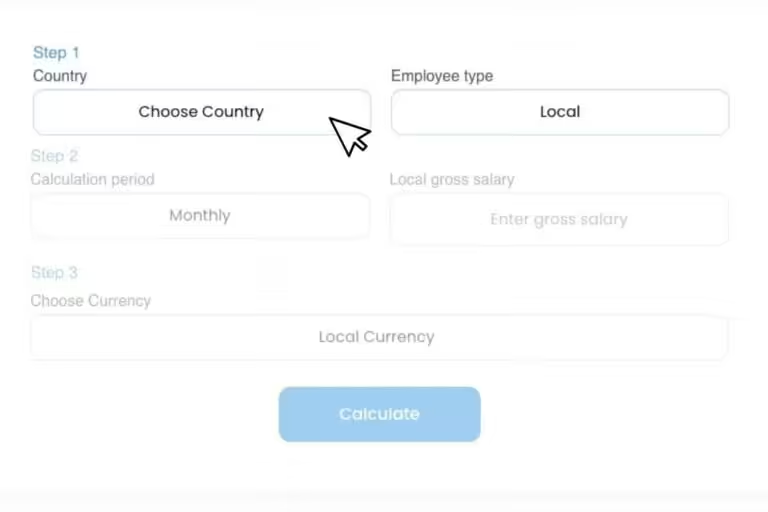
Step 1: Choose the country and employment type, i.e., either local or expat.
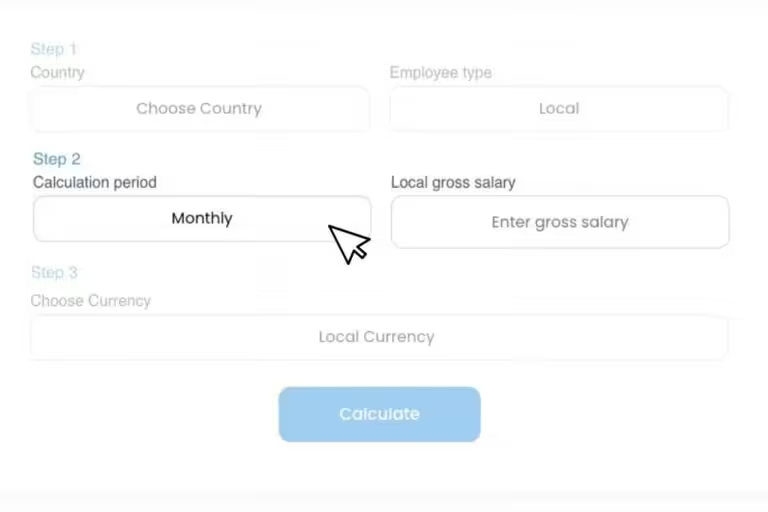
Step 2: Input the employee’s gross salary in the local currency (€) and the calculation period. The calculation period can be monthly or annually.
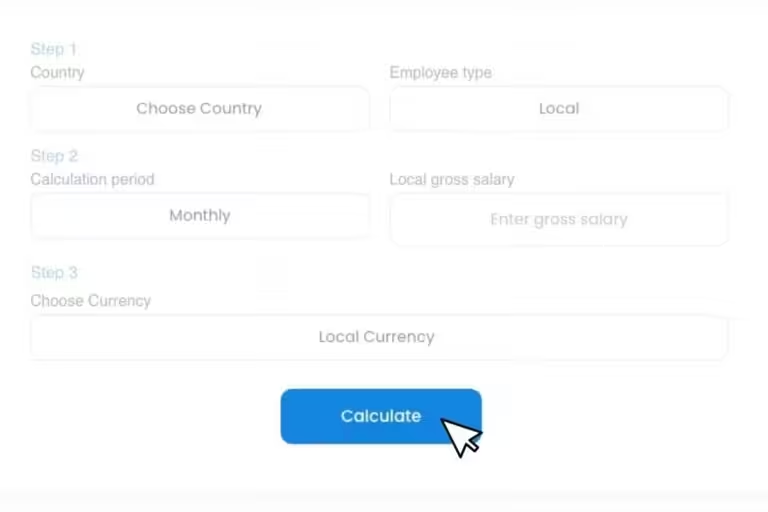
Step 3: Click calculate, and the tool automatically gives you a detailed breakdown of your net salary, tax deductions, and employee costs in real time!
Simplify Payroll and Tax Compliance in Israel
Israel offers a structured yet simple payroll and tax system that enables companies to handle employee compensation and fulfill their legal obligations efficiently.
Employers must register with the Israeli Tax Authority and the National Insurance Institute (Bituach Leumi) to ensure proper contribution and compliance. They are responsible for deducting income tax (Mas Hachnasa), social security, and health insurance contributions from employees’ salaries every month, according to the income brackets.
To simplify compliance, you can use the RemotePeople Global Payroll Calculator to estimate taxes and generate payslips, or seek guidance from a certified Israeli Employer of Record consultant to stay compliant with the Israeli tax laws.