
 Recruit
Average Salary in Malta
-
 Drew Donnelly
- Published
- September 6, 2026
- 5 ★ on G2








- Malta Services
- What is the Average Salary in Malta?
- Wage Growth Trends in Malta
- Salary Comparisons in Malta
- How Much is Minimum Wage in Malta?
- Gender Pay Gap in Malta
- Cost of Living and Purchasing Power in Malta
- Average Salary in Malta vs. the Rest of the World
- What are the Most Common Outsourced Industries in Malta?
- Conclusion

Let RemotePeople handle payroll, compliance, and HR admin worldwide so you can focus on building your team.
Malta’s cost-effective labor and skilled workforce make it an ideal destination for outsourcing. Employers seeking to hire in the country may wonder, What is the average salary in Malta? This information will help them prepare a competitive job offer.
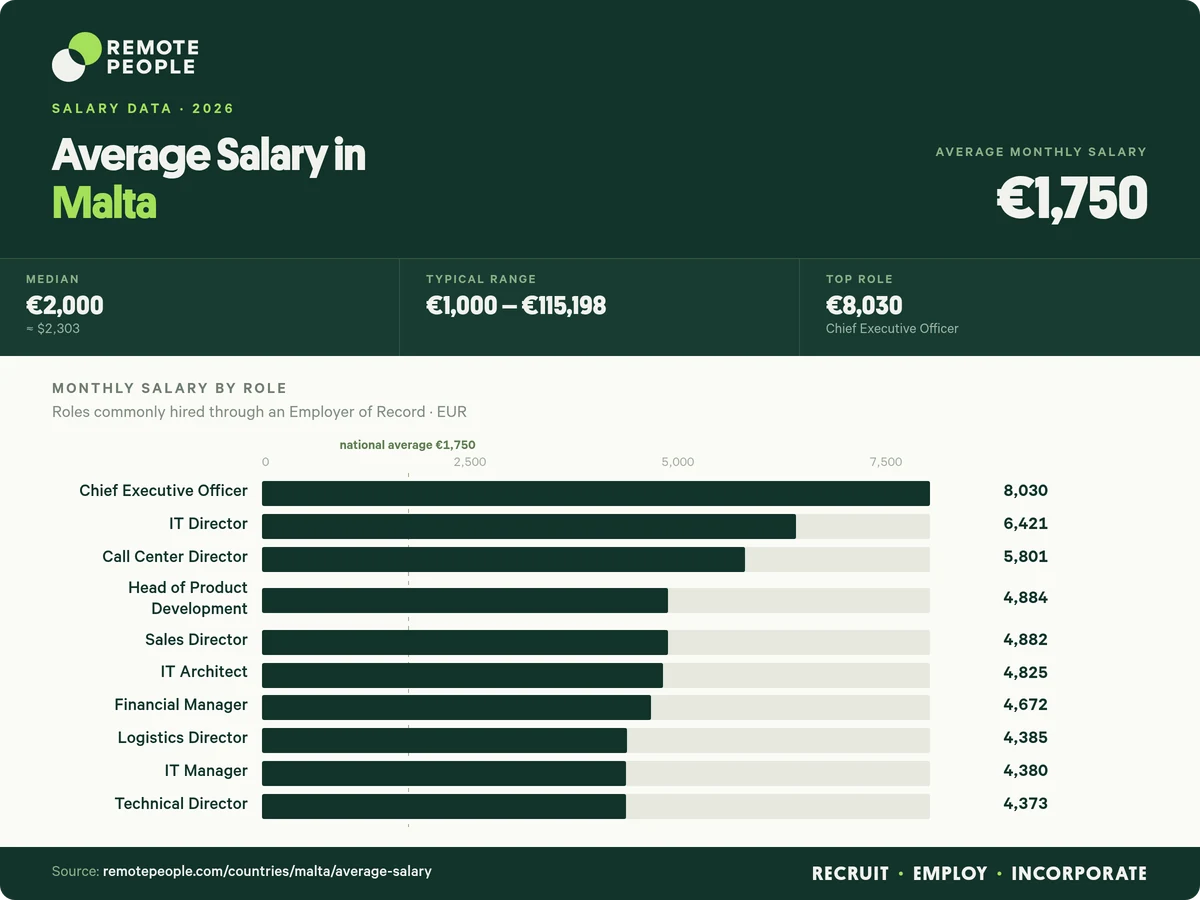
The average salary in Malta is approximately EURO 1,750, equivalent to USD 2,015. However, wages vary by experience, education, location, position, and industry. You must also consider how earnings in the country compare to wages worldwide.
This guide will explore all aspects of salaries in Malta, preparing you for your hiring journey.
What is the Average Salary in Malta?
The average salary in Malta is approximately € 1,750, or $2,015. Salaries are relatively low for a European nation, and fail to keep up with inflation and living costs. Experts believe the discrepancy may be due to the large influx of foreign labor and the resulting stagnation caused by the COVID pandemic.
Median Income
The median salary in Malta is €2,000, equivalent to approximately $ 2,303. Half the population earns higher wages, and the other half earns less.
Salary Range
Salary range spans from the lowest to the highest wages in the country. In Malta, low earners earn around €1,000 per month, equivalent to approximately $ 1,151, while high earners earn closer to €115,198, or about $100,000 per month.
Wage Growth Trends in Malta
Wage growth in recent years has been a mixed bag in Malta. Although the trajectory has been generally positive, especially when it comes to the median and average wage growth, not all Maltese have benefited from inflation-beating wage rises. In 2025, nominal wage growth per employee is forecast at 4.1% 2025 and 3.6% in 2026.
The Central Bank of Malta has noted that, like the rest of the economy, wage growth is expected to moderate in the years to come. The original projection of 6% in 2024 is expected to slow to a pace of 3.5% in 2027, indicating stability in this respect for at least the next few years.
Maltese wage rises have been significant if we zoom out of the short-term timeline. An analysis by the Times of Malta found that the average in 2013 was 1,300 Euros monthly, but by 2023 it had risen to 1,800 Euros, a rise of 43%. Unfortunately, this is also having an impact on low-income families, widening income inequality across the islands.
The government has been forced to act, unveiling a 48 million Euro package of income support for the poorest families. Despite concerns over the cost of living and the widening gap between the average and median wages, the economy remains robust, which should continue to put upward pressure on wages.
Projections from the Central Bank have remained broadly unchanged, from the 6% growth in GDP in 2024 to 4% in 2025 and 3.3% in 2027. Some downward revisions have occurred due to the anticipated impact of U.S. tariffs on the European Union (EU). Still, the economy is expected to remain in the black and growth to moderate toward the end of the decade.
In short, wage trends are expected to trend upward, but the increase in the cost of living and the relatively uneven growth remain a concern for the Maltese government.
Salary Comparisons in Malta
The average salary provides some insight, but you must also consider how wages vary by position, industry, education, experience, and location. The following sections will explore how these factors impact earnings.
Salary by Position
This salary comparison chart reveals how wages vary by position.
Position | Average Monthly Salary (€) |
|---|---|
Chief Executive Officer | 8,030 |
IT Director | 6,421 |
Call Center Director | 5,801 |
Head of Product Development | 4,884 |
Sales Director | 4,882 |
IT Architect | 4,825 |
Financial Manager | 4,672 |
Logistics Director | 4,385 |
IT Manager | 4,380 |
Technical Director | 4,373 |
Banking Cashier | 1,200 |
Clothing Technologist | 1,188 |
Packer | 1,156 |
Tailor | 1,120 |
Seamstress | 1,140 |
Porter | 1,067 |
Medical Records Clerk | 1,064 |
Social Counselor | 1,033 |
Nursery School Teacher Assistant | 930 |
Average Wage in Malta Based on Education
Education plays a significant role in wage determination for Maltese employees. Research reveals:
Education Level | Salary Premium |
|---|---|
Post-secondary / Short-cycle tertiary | 6–7% |
Bachelor’s degree | 21% |
Master’s degree or doctorate | 32% |
Salary Comparison by Experience
Experience also impacts earnings, as experienced workers typically earn more than entry-level workers, and employees become eligible for raises with increasing tenure in their field. The same statistics that reveal the benefits of education show these benefits become more significant with age, which is typically commensurate with experience.
For example, workers 15-24 with a master’s or doctoral degree earn 16% more than similarly aged employees with lower or upper secondary education. This number rises to 34% among employees aged 35-44 and to 45% among employees aged 45 and above. The increases suggest improved wages with experience, especially in skilled industries.
Salary Comparison by Location
Location is another factor to consider when determining wages, as workers in urban areas tend to earn more than those in rural areas due to higher living costs and proximity to large companies offering high-paying job opportunities.
This situation applies in Malta; however, because it’s such a small island (just 122 square miles), there isn’t much disparity. Experience, education, and position play more significant roles.
Nonetheless, individuals in economic hubs like Sliema, Valletta, and St. Julian’s tend to make more than those in rural areas.
How Much is Minimum Wage in Malta?
The minimum wage in Malta varies by age as follows:
Employees | Weekly Wage (€) | Weekly Wage (USD) |
|---|---|---|
18 and over | 229.44 | 268 |
Aged 17 | 222.66 | 260 |
Under 17 | 219.82 | 257 |
On January 1, 2026, all salaries in Malta increased due to the annual COLA, with the minimum wage for adults rising from €221.78 to €229.44 per week.
Gender Pay Gap in Malta
Malta has made strides to address its gender pay gap. Like in other EU countries, Malta does have laws that require both genders to be paid equally for the same work. According to an International Monetary Fund (IMF) analysis, Malta’s adjusted gender pay gap was 11.1% in 2013, but this narrowed to 5.8% in 2023. However, it’s important to mention that when unadjusted for similar roles, the overall gap remains prevalent.
Currently, there’s no provision for mandatory gender pay gap reporting, but all that is about to change as a result of the EU Pay Transparency Directive. This law requires EU member states to introduce a series of measures, including pre-employment pay transparency and the right to information during employment.
Malta is partially transposing this law via Legal Notice 112/2025, focusing on providing access to information for employees during the hiring process and while engaged in active employment. From August 2025, employers must provide pay level information to all applicants before employment. It will also give employees the right to request detailed pay information about their own salary and the salaries of colleagues performing the same work.
The islands have chosen not to fully align their new legislation with the EU directive, though. Instead of focusing on the right to information for work of equal value, Malta’s law is more restrictive, with it focusing on “the same work.” Essentially, this limits who employees can ask for pay information about.
Plus, all companies with 150 or more employees must begin filing gender pay gap reports, which include finding pay gaps within their teams and stating the steps they’ll take to close them. It’s widely expected that this will help drive down the gender pay gap, but traditional gender inequalities in specific sectors are likely to pose continuing challenges in the years ahead.
Cost of Living and Purchasing Power in Malta
Malta’s inflation rate has slowed considerably recently. As recently as 2023, Malta’s inflation rate surpassed 7% throughout the year, whereas it sits at under 3% in 2025. Moderate inflation in line with most of the rest of the EU has eased pressures on consumers, but families still face a significant cost-of-living crisis, due to the uneven pace of wage growth.
It’s why the 2025 government budget included a Cost-of-Living Adjustment (COLA) of 5.24 Euros per week for low and middle-income households. These measures have been brought in to support pensioners and those receiving the minimum wage to ensure they keep their heads above water.
So, what does the cost of living in Malta look like in 2025?
According to an analysis of the cost of living by DZ Advisory, they found that an estimated monthly breakdown for a single person living a mid-range lifestyle would look like this in Euros:
Expense Category | Estimated Monthly Cost (USD) |
|---|---|
Accommodation | $800–$850 |
Utilities | $80 |
Food | $350–$400 |
Transportation | $50–$100 |
These costs don’t consider entertainment, personal expenses, and other optional expenses. Generally, it’s possible for a single person to live for well under 2,000 Euros a month on the island today. This estimate can also be extrapolated to families, where a family of four may spend anywhere from 2,800 to 3,500 monthly.
But how much purchasing power does a Maltese citizen enjoy?
In 2025, the GDP per capita of the country was $45,730, but when adjusted for purchasing power parity (PPP), this figure rose to $76,710. In global terms, Malta’s position is 274% of the world’s average in terms of purchasing power.
It’s also important to remember that despite these high figures and Malta’s position as one of the more expensive countries to live in in the EU, there’s still an enormous difference in incomes across the island. Due to its previous position as a tax haven and popular vacation destination, the island’s average GDP is artificially pushed higher due to a comparatively small number of wealthy individuals.
Nevertheless, its above-average performance among EU nations is down to its robust economy, which directly supports its high purchasing power. Factors cited in Malta’s success include a well-diversified economy, a highly educated workforce, and an ecosystem that strongly favors businesses.
Average Salary in Malta vs. the Rest of the World
The following charts compare salaries in Malta to those in developed, developing, and undeveloped countries, providing more insight.
Malta vs. Developed Countries
Country | Average Salary | Comparison to Average Malta Salary |
|---|---|---|
Japan | 379,434 Yen (approx. $2,635) | – 30% |
United Kingdom | 3,000 euros (approx. $3,116) | – 55% |
Norway | 50,790 kroner (approx. $4,700) | – 135% |
Germany | 4,300 euros (approx. $4,467) | – 125% |
Austria | 3,500 euros (approx. $3,636) | – 80% |
Malta vs. Developing Countries
Country | Average Salary | Comparison to Average Malta Salary |
|---|---|---|
Romania | 4,000 RON (approx. $835) | 138% |
Russia | 73,709 Rubles (approx. $700) | 185% |
Albania | 1,500 Euros (approx. $1,550) | 29% |
Kazakhstan | 342,082 Tenge (approx. $645) | 207% |
Ukraine | 18,000 Hryvnia (approx. $500) | 300% |
Malta vs. Undeveloped Countries
Country | Average Salary | Comparison to Average Malta Salary |
|---|---|---|
Afghanistan | 30,000 Afghanis (approx. $419) | 376% |
Philippines | 18,423 PHP (approx. $875) | 127% |
Cambodia | 1,000,027 KHR (approx. $250) | 700% |
Egypt | 13,244 EGP (approx. $263) | 669% |
Pakistan | 45,000 PKR (approx. $150) | 1233% |
Malta is a developed country with a high-income economy. Its work economy is service-oriented with a strong focus on tourism, financial services, and iGaming. It offers a well-regulated business environment that’s open to trade and investment.
The combination of low-cost skilled labor and a business-friendly environment makes Malta an ideal outsourcing destination. It offers a strategic location for businesses targeting the European market. The country is supported by a robust digital infrastructure, including 5G and fiber optic connectivity.
What are the Most Common Outsourced Industries in Malta?
Employers who wish to form remote partnerships in Malta will benefit most when focusing on the following industries:
IT Services
Malta is positioning itself as a Mediterranean tech hub with a strong focus on emerging technologies and a growing startup ecosystem. The government actively supports the sector through investments in infrastructure, digital transformation initiatives, and a business-friendly environment. Emerging technologies include blockchain, artificial intelligence (AI), and the Internet of Things (IoT).
An IT manager in Malta earns around € 4,380 per month, approximately $ 4,945, while their American counterparts earn closer to $ 5,045, leading to significant cost savings for employees who outsource.
Financial Services
Malta’s financial industry plays a significant role in its economy, contributing 11% to the GDP. It offers strength in asset management, insurance, banking, private wealth, and Fintech. The country has gained recognition as a reputable financial sector due to its robust regulatory framework, English-speaking workforce, and innovative approach to Fintech technologies.
iGaming
The country is a hub for online gaming, primarily due to its robust regulatory framework, spearheaded by the Malta Gaming Authority (MGA). The industry is a significant contributor to Malta’s economy, accounting for about 12% of its GDP. The country was the first to regulate online gambling and is making advancements in mobile gaming, virtual reality, and cryptocurrency payments.
Conclusion
Malta’s relatively low average salary, skilled workforce, and sense of innovation make it an ideal destination for outsourcing. Employers who form remote partnerships in the country can benefit from cost savings and access to exceptional products and services, while helping workers improve their economic situations, leading to favorable outcomes for all parties involved.




