
 Recruit
Average Salary in Mexico
-
 Drew Donnelly
- Published
- September 21, 2026
- 5 ★ on G2








Let RemotePeople handle payroll, compliance, and HR admin worldwide so you can focus on building your team.
Mexico’s cost-effective labor, skilled workforce, and nearshoring advantages make it a convenient outsourcing destination. Employers seeking to hire in the country may wonder, “What is the average salary in Mexico?” This information will help them prepare a competitive job offer.
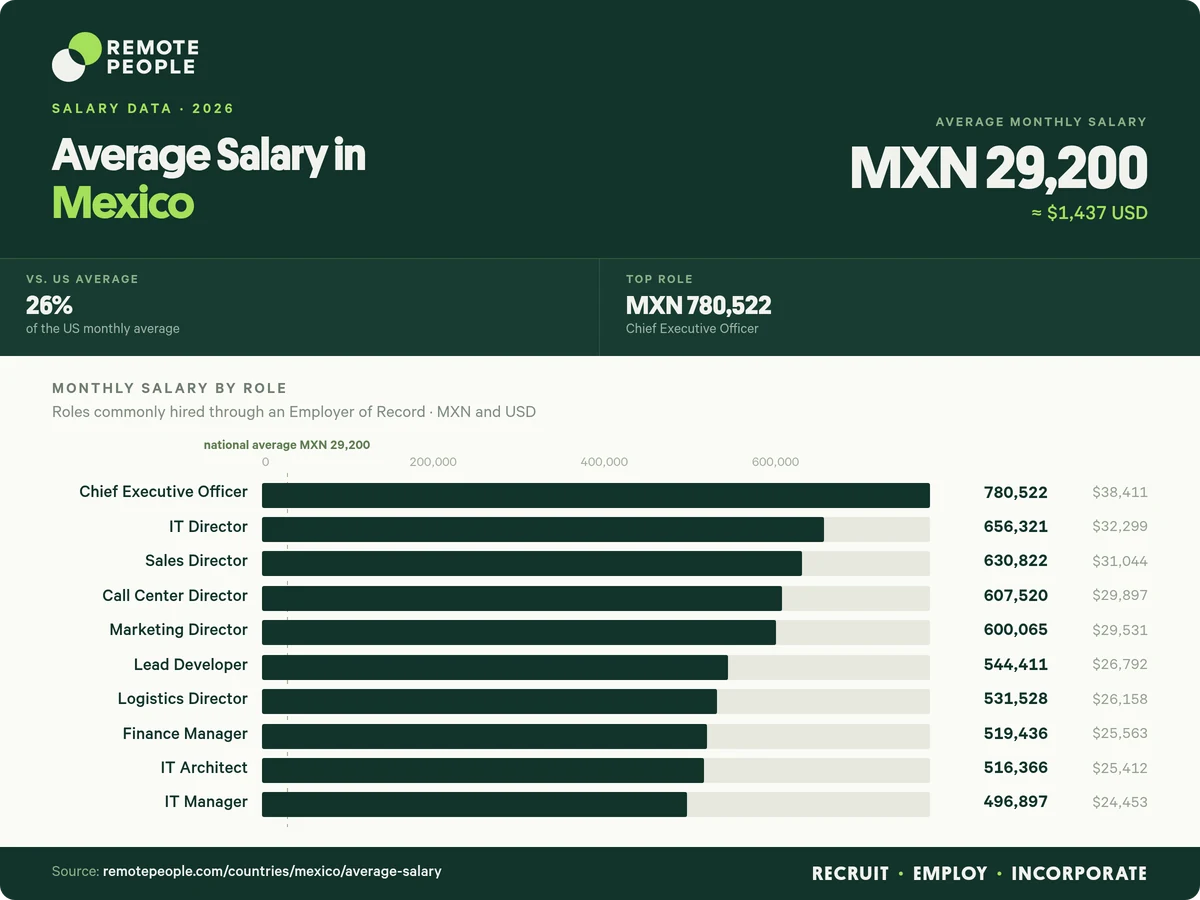
The average monthly salary in Mexico is 29,200 Mexican Pesos (MXN), approximately USD 1437. However, wages vary depending on location, education, experience, industry, and position. You must also consider how wages in the country compare to those in other economies worldwide.
This guide will examine Mexico’s average salary, preparing you to start hiring there.
What is the Average Salary in Mexico?
The average salary in Mexico is 29,200 MXN, about $1437. Wages are low in the country due to an informal economy, a history of economic instability, and labor market issues. Mexico also has a lower cost of living than developed countries.
Median Income
The median salary can also be considered the middle salary. Mexico’s median monthly income is $28,275 (about $1391). Half the population earns more than this amount; the other half earns less.
Salary Range
The salary range spans from the country’s lowest to the highest. Low earners make around 15,000 MXN monthly (about $738), while upper-class workers have an average income of 77,000 pesos (approximately $3790).
Salary Comparison by Profession
Average salaries provide some insight, but wages vary depending on experience, education, location, industry, and position. The following sections will explore how these factors impact earnings.
Position | Average Monthly Wages (MXN) |
|---|---|
Chief Executive Officer | 780,522 |
IT Director | 656,321 |
Sales Director | 630,822 |
Call Center Director | 607,520 |
Marketing Director | 600,065 |
Lead Developer | 544,411 |
Logistics Director | 531,528 |
Finance Manager | 519,436 |
IT Architect | 516,366 |
IT Manager | 496,897 |
Fabric Cutter | 124,248 |
Clothing Technologist | 123,707 |
Banking Cashier | 123,595 |
General Laborer | 122,959 |
Packer | 121,164 |
Porter | 117,987 |
Seamstress | 115,682 |
Medical Records Clerk | 111,436 |
Tailor | 110,573 |
Average Wage in Mexico by Education
Education typically impacts earnings, with workers with higher education qualifying for higher-paying work. This situation holds in Mexico; however, the country suffers from a skills mismatch. Workers often find it challenging to find the work they are qualified for and must accept lower-paying work.
Researchers find that workers see higher returns on education when they can find work in the fields that match their degree.
Salary Comparison by Experience
Experience also has a direct relationship with salary, with experienced workers earning more than entry-level workers, and people qualifying for raises with tenure in their positions.
For example, an entry-level customer service rep might start at $14,000 per year but earn as much as $17,000 or more in wages with experience. Similarly, IT professionals typically start at around $2000 per month but will see salaries closer to $3500 upon attaining mid-level roles and up to $7500 in senior roles.
Salary Comparison by Location
Location is another factor to consider in wage determination. Generally, workers who live near the U.S. border, AKA the northern border zone, tend to earn higher wages due to their proximity to more prominent companies offering more high-paying job opportunities.
Lucrative work is also available in Mexico City, Monterrey, and Guadalajara, which are considered economic hubs. Yucatan and Queretaro are prosperous areas with higher wage increases than the national average.
Tourist areas like Cancun offer various job opportunities in the service sector, but they tend to be low-paying. States like Nuevo León, Coahuila, and Tamaulipas have a high share of minimum-wage workers.
How Much is Minimum Wage in Mexico?
Mexico’s minimum wage was updated in January 2026, increasing to 315.04 MXN per day (about $17.27) from the previous 278.80 MXN, a 13% increase. The minimum wage is higher in the northern border area at 440.87 per day (about $24.11), a 5% increase from the previous MXN 419.88.
Average Salary in Mexico vs. the Rest of the World
These charts will compare salaries in Mexico to those in developed, developing, and undeveloped countries to provide more insight.
Mexico vs. Developed Countries
Country | Average Salary | Comparison to Average Mexico Salary |
|---|---|---|
United Kingdom | 3,000 euros (approx. $3,116) | – 121% |
United States | $5,677 | – 307% |
Norway | 50,790 kroner (approx. $4,700) | – 235% |
Germany | 4,300 euros (approx. $4,467) | – 221% |
Austria | 3,500 euros (approx. $3,636) | – 157% |
Mexico vs. Developing Countries
Country | Average Salary | Comparison to Average Mexico Salary |
|---|---|---|
Romania | 4,000 RON (approx. $835) | 66% |
Russia | 73,709 Rubles (approx. $700) | 100% |
Albania | 1,500 Euros (approx. $1,550) | – 10% |
Kazakhstan | 342,082 Tenge (approx. $645) | 115% |
Ukraine | 18,000 hryvnia (approx. $500) | 180% |
Mexico vs. Undeveloped Countries
Country | Average Salary | Comparison to Average Mexico Salary |
|---|---|---|
Thailand | 97,500 Baht (approx. $2,772) | – 100% |
Philippines | 18,423 PHP (approx. $875) | 59% |
Vietnam | 8.5 million dong (approx. $360) | 388% |
Egypt | 13,244 EGP (approx. $263) | 438% |
Pakistan | 45,000 PKR (approx. $150) | 833% |
Mexico is considered a developing country despite its large and growing economy. Although it is the 12th largest economy globally and the second largest economy in Latin America, its human development index falls slightly short of the threshold for developed nations. It also has high levels of poverty, systemic corruption, and crime.
The country is a popular outsourcing destination due to its skilled workforce and cost-effective labor. It offers a strong IT infrastructure and a favorable business environment. Its location provides nearshoring advantages and time zone alignment with U.S. companies.
What are the Most Common Outsourced Industries in Mexico?
Companies that partner with Mexico on remote opportunities will see the most advantages in the following sectors.
IT Services
Mexico’s IT sector is growing rapidly and becoming a key player in the global technology landscape. Significant sectors include software development, data analytics, and cybersecurity. The government has embraced digital adoption and supports the industry through initiatives like tech parks and research projects.
Entry-level tech workers in Mexico earn around $2000 a month, while their American counterparts earn closer to $3500. This could lead to significant cost savings for companies that outsource.
Customer Service
Mexico’s thriving tourist industry means many workers have developed a keen sense of quality customer service. It is a popular outsourcing choice due to employees’ English proficiency, cost-effective labor, and nearshoring and time zone advantages. The growing trend toward digital adoption enhances communication and customer satisfaction.
Customer service reps in the country typically see a starting salary of around $1166 per month, while American workers earn closer to $2500, giving employers plenty of bargaining power.
Manufacturing
Mexico’s strategic location, competitive labor costs, and skilled workers make it an ideal destination for manufacturing. Significant industries include automotive, aerospace, electronics, and medical devices. The country attracts substantial foreign direct investment.
Conclusion
Mexico’s low-cost labor, skilled workforce, and convenient location make it an ideal outsourcing destination. Employees who hire in the area can benefit from cost savings and quality products and services while helping the country overcome economic challenges, resulting in positive outcomes for everyone involved.