
 Recruit
Average Salary in Montenegro
-
 Drew Donnelly
- Published
- September 21, 2026
- 5 ★ on G2








Let RemotePeople handle payroll, compliance, and HR admin worldwide so you can focus on building your team.
Montenegro’s cost-effective labor and skilled workforce make it an excellent outsourcing destination. Employers seeking to hire in the country may wonder, What is the average salary in Montenegro? This information will help them make competitive hiring offers.
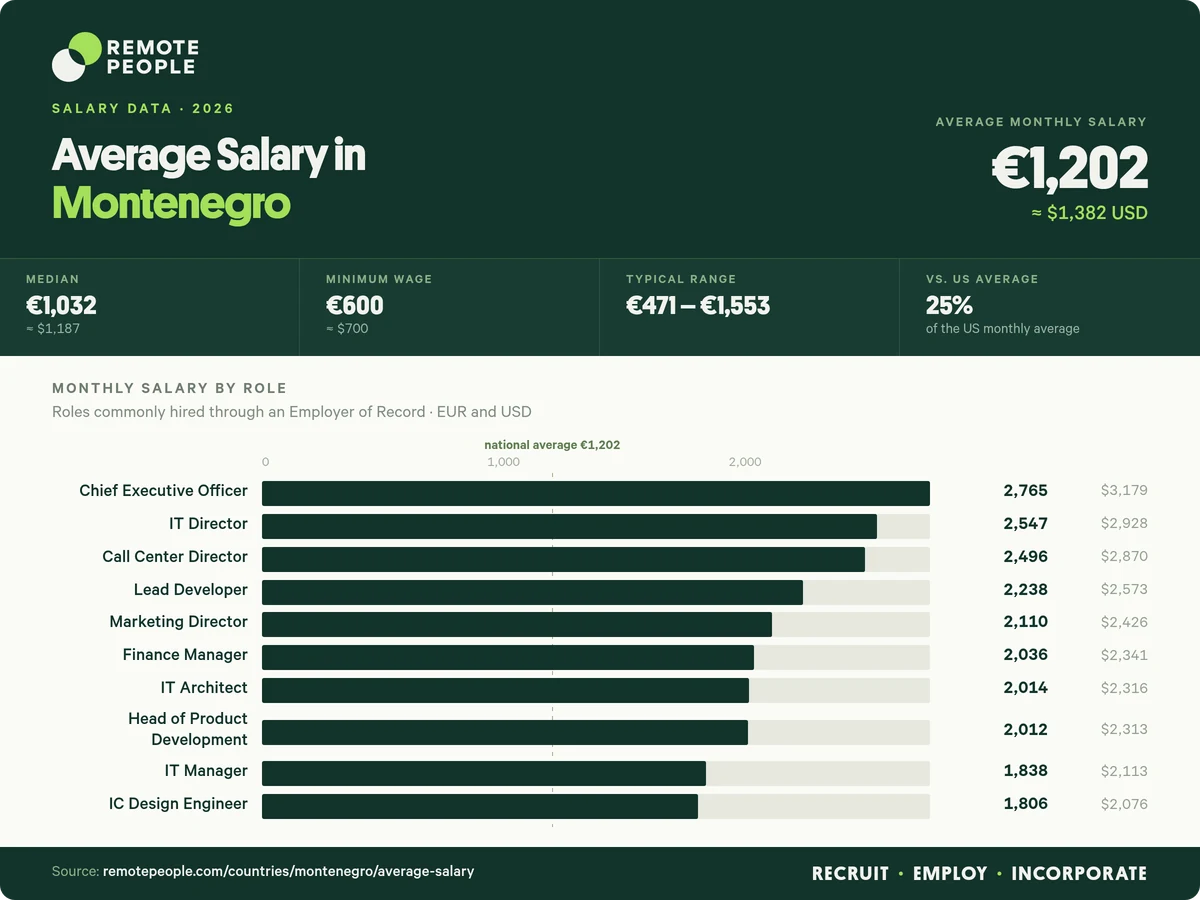
The average salary in Montenegro is approximately EURO 1,202, or USD 1,382. However, you must consider how wages are affected by education, experience, location, position, and industry. Comparing earnings in the country to wages worldwide provides additional insight.
This guide will explore all aspects of wages in Montenegro, preparing you for your outsourcing journey.
What is the Average Salary in Montenegro?
The average salary in Montenegro is approximately €1,202, or $1,382. A small economy contributes to low average productivity and high employment in low-paying sectors. The country is also plagued by income inequality.
Median Income
The median salary in Montenegro is approximately €1,032, or $1,187. Half the workers in the country earn higher wages, and the other half earn less.
Salary Range
Salary range spans from the lowest to the highest paid wages in the country. In Montenegro, low earners earn approximately €471, or around $541 per month, while high earners earn closer to €1,553, or around $1,786.
Salary Comparisons in Montenegro
The average salary provides some insight, but it’s essential to consider how wages vary by experience, education, location, industry, and job position. The following sections will explore how these factors impact earnings.
Salary by Position
The following salary comparison chart reveals how wages vary by position.
Position | Average Monthly Wages (€) |
|---|---|
Chief Executive Officer | 2,765 |
IT Director | 2,547 |
Call Center Director | 2,496 |
Lead Developer | 2,238 |
Marketing Director | 2,110 |
Finance Manager | 2,036 |
IT Architect | 2,014 |
Head of Product Development | 2,012 |
IT Manager | 1,838 |
IC Design Engineer | 1,806 |
Banking Cashier | 511 |
Fabric Cutter | 510 |
Clothing Technologist | 508 |
General Laborer | 502 |
Packer | 497 |
Seamstress | 487 |
Porter | 459 |
Medical Records Clerk | 457 |
Tailor | 454 |
Average Wage in Montenegro Based on Education
Education has a significant impact on salaries, as workers with higher levels of education tend to earn more than those with lower levels of education.
In Montenegro, this situation is especially prevalent within the private sector. Additionally, workers with higher levels of schooling qualify for a higher minimum wage. However, education isn’t everything.
The government has recently introduced a program to provide college graduates with vocational training, preparing them for the workforce. This indicates that practical skills are also essential.
Salary Comparison by Experience
Experience also plays a crucial role in wage determination, as experienced workers typically earn more than entry-level workers, and employees generally earn more with increasing tenure in their field. Workers with experience can negotiate for higher salaries, thereby securing a higher starting pay.
Salary Comparison by Location
Location is another factor to consider, as workers in urban areas, such as Podgorica, and coastal towns, like Budva and Kotor, tend to offer higher salaries due to stronger infrastructure, higher living costs, and increased economic activity.
How Much is Minimum Wage in Montenegro?
The minimum wage in Montenegro is set at €600 per month (approximately $700) for workers with a high school diploma or lower, and €800 per month (approximately $932) for workers with a university degree or higher. This dual-tier system, which came into force on October 1, 2024, aligns take-home pay with the level of professional qualification while significantly reducing the tax burden on labor.
Average Salary in Montenegro vs. the Rest of the World
The following charts compare salaries in Montenegro to those in developed, developing, and undeveloped countries, providing more insight.
Montenegro vs. Developed Countries
Country | Average Salary | Comparison to Average Montenegro Salary |
|---|---|---|
Japan | 379,434 Yen (approx. $2,635) | – 85% |
United Kingdom | 3,000 Euros (approx. $3,116) | – 121% |
Norway | 50,790 Kroner (approx. $4,700) | – 235% |
Germany | 4,300 Euros (approx. $4,467) | – 221% |
Austria | 3,500 Euros (approx. $3,636) | – 157% |
Montenegro vs. Developing Countries
Country | Average Salary | Comparison to Average Montenegro Salary |
|---|---|---|
Romania | 4,000 RON (approx. $835) | 66% |
Russia | 73,709 Rubles (approx. $700) | 100% |
Albania | 1,500 Euros (approx. $1,550) | 10% |
Kazakhstan | 342,082 Tenge (approx. $645) | 115% |
Ukraine | 18,000 Hryvnia (approx. $500) | 180% |
Montenegro vs. Undeveloped Countries
Country | Average Salary | Comparison to Average Montenegro Salary |
|---|---|---|
Afghanistan | 30,000 Afghanis (approx. $419) | 233% |
Philippines | 18,423 PHP (approx. $875) | 59% |
Cambodia | 1,000,027 KHR (approx. $250) | 460% |
Egypt | 13,244 EGP (approx. $263) | 438% |
Pakistan | 45,000 PKR (approx. $150) | 833% |
Montenegro is a developing country with an upper-middle-income economy. It is transitioning towards a market economy, with ongoing reforms aimed at improving its business environment and attracting foreign investors. However, it still exhibits lower economic performance compared to fully developed countries.
Despite obstacles, the country has the potential to grow through outsourcing opportunities. It offers cost-effective labor, a skilled workforce, and a rapidly developing infrastructure. Its strategic location near Western Europe facilitates easy communication and collaboration for nearshoring purposes.
What are the Most Common Outsourced Industries in Montenegro?
Employers looking to outsource in Montenegro will benefit most when focusing on the following industries.
IT Services
Montenegro’s IT industry is experiencing rapid growth as it transitions into a regional tech hub. Software development, fintech, and cybersecurity are primary focuses.
The government supports the industry with various initiatives, including the innovation in law project, which allows companies to invest in startups in exchange for equity.
An IT manager in Montenegro earns around €1,838, approximately $2,114, while their American counterparts earn closer to $8,500, leading to significant cost savings for companies that outsource.
BPO
The country is also experiencing a surge in BPO processes, particularly in the ICT (information and communication technology) sector. The growing demand for services fuels annual growth.
The government supports the industry’s development through various strategies and initiatives. With so many BPO positions available, it’s difficult to estimate how much companies can stand to save, but expense reductions are considerable.
Tourism/ Construction
Montenegro’s diverse landscape and wide range of tourist attractions contribute to its thriving tourism economy. The industry is developing rapidly, with high-end resorts attracting international visitors.
The government is working to diversify the sector beyond the coast, focusing on rural, cultural, and ecotourism. Companies can partner with Montenegro to save money on various tourist-related services.
Conclusion
Montenegro’s low average salaries and skilled workforce make it an ideal destination for outsourcing. Companies can partner with local workers to benefit from financial savings while helping the country overcome economic challenges, producing positive outcomes for all parties involved.