
 Recruit
Average Salary in Puerto Rico
-
 Drew Donnelly
- Published
- September 21, 2026
Curious about salaries in Puerto Rico? This guide breaks down the average wages, compares professions, highlights minimum wage figures, and explores how Puerto Rico’s earnings measure up internationally.
- 5 ★ on G2








Let RemotePeople handle payroll, compliance, and HR admin worldwide so you can focus on building your team.
Puerto Rico’s cost-effective labor, bilingual workforce, and nearshoring advantages with the United States make it a prime outsourcing destination. Employers seeking remote partnerships in the area may wonder, What is the average salary in Puerto Rico? This information will help them prepare a competitive offer.
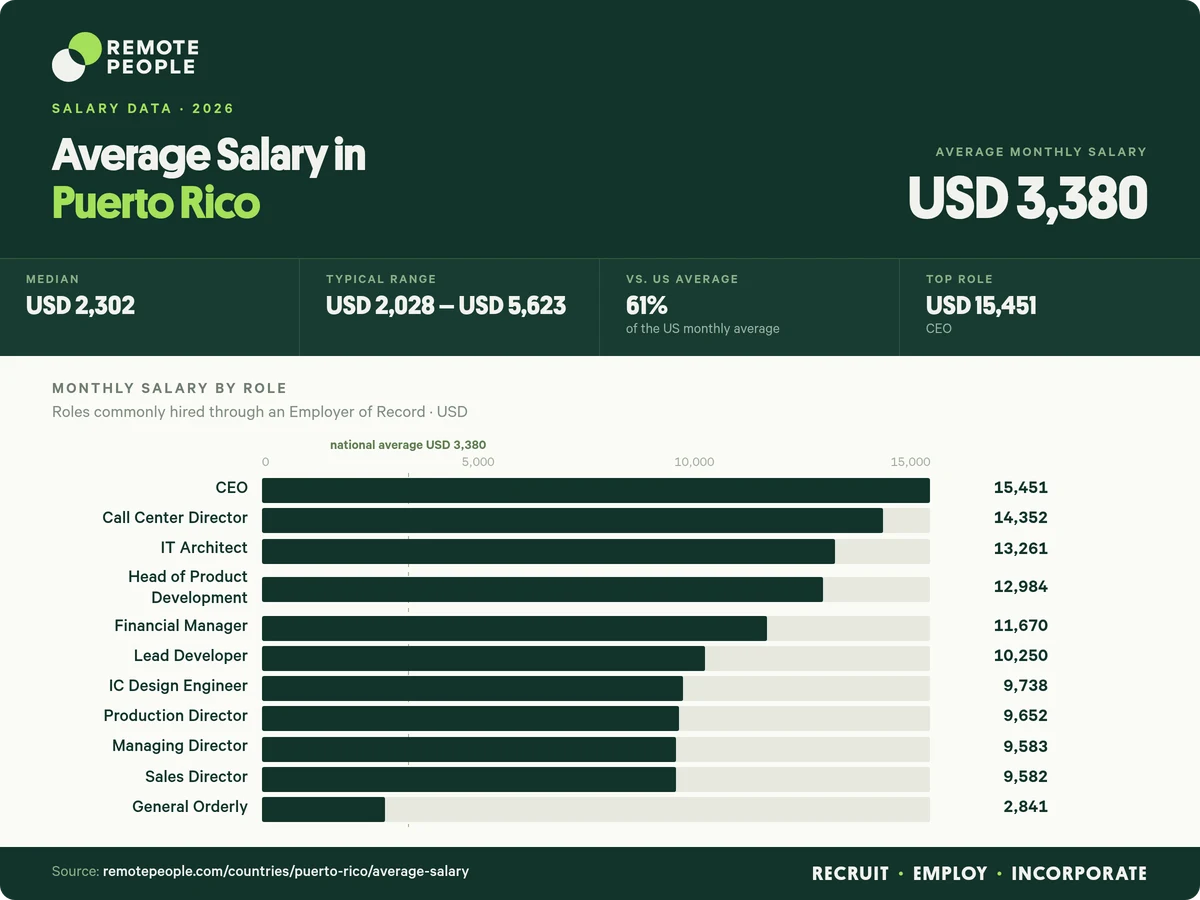
The average monthly salary in Puerto Rico is about USD 3380. However, salaries vary according to profession, location, education, income, and industry. You must also consider how salaries in Puerto Rico compare to wages worldwide.
This guide will explore salaries in the territory to provide a comprehensive overview of the economic system.
What is the Average Salary in Puerto Rico?
The average salary in Puerto Rico is $3380. Wages are high compared to many other developed countries and regions, but lower than most of the United States due to a lower minimum wage and a work economy dominated by low-paying service-oriented jobs. Puerto Rico’s labor system is also less flexible than American employment, negatively impacting wage growth and bargaining power.
Median Income
Puerto Rico’s median monthly income is $2302. When comparing average vs median salary, the average salary is much higher due to wage inequalities in the country. People in urban areas and migrant workers earn much more than the rest.
Salary Range
The salary range spans from the lowest to the highest in the country. In Puerto Rico, low earners make around $2028 monthly, while high earners make nearly $5623.
Salary Comparisons in Puerto Rico
Average salaries provide some insight, but wages vary by experience, education, location, industry, and position. The following sectors will explore how these factors impact earnings.
Salary by Profession
This salary comparison chart reveals how wages vary by profession.
Profession | Average Monthly Salary |
|---|---|
CEO | $15,451 |
Call Center Director | $14,352 |
IT Architect | $13,261 |
Head of Product Development | $12,984 |
Financial Manager | $11,670 |
Lead Developer | $10,250 |
Sales Director | $9,582 |
IC Design Engineer | $9,738 |
Production Director | $9,652 |
Managing Director | $9,583 |
General Orderly | $2,841 |
Packer | $2,802 |
Banking Cashier | $2,798 |
Social Counselor | $2,531 |
Porter | $2,507 |
Seamstress | $2,431 |
Tailor | $2,469 |
Medical Records Clerk | $2,426 |
Cleaner | $2,358 |
Average Wage in Puerto Rico by Education
Education is a significant factor in wage determination, with educated workers qualifying for high-paying positions. In Puerto Rico, education plays a massive role in why workers in the territory earn so much less than those in the United States. Schools face challenges remaining open due to weather conditions on the island. High poverty levels cause many students to drop out and get a job before earning a diploma, and prevent them from going to college.
The mainland is much better equipped for education systems, and workers on that part of the territory can earn twice as much as those in rural areas.
Salary Comparison by Experience
Education is a significant factor in wage determination, with educated workers qualifying for high-paying positions. In Puerto Rico, education plays a massive role in why workers in the territory earn so much less than those in the United States. Schools face challenges remaining open due to weather conditions on the island. High poverty levels cause many students to drop out and get a job before earning a diploma, and prevent them from going to college.
The mainland is much better equipped for education systems, and workers on that part of the territory can earn twice as much as those in rural areas.
Salary Comparison by Experience
Experience plays a prominent role in wages, with experienced workers earning more than entry-level workers. Workers who hold positions for a long time become eligible for raises. Additionally, bonuses enhance corporate packages for employees, and those with industry experience are eligible for more significant bonuses.
Salary Comparison by Location
Location has a massive impact on salaries, with workers on the mainland earning up to twice as much as those in rural areas due to higher living costs and proximity to major companies offering high-paying job opportunities. San Juan is among the wealthiest cities in the territory, followed by Guaynabo, Bayamon, and Trujillo.
How Much is Minimum Wage in Puerto Rico?
The minimum wage in Puerto Rico is $10.50 an hour. The new wage went into effect on July 1, 2024, increasing from $9.50 an hour. The wage applies to everyone except:
- Employees covered by collective bargaining agreements may earn higher wages
- Tipped employees- however, employers must ensure their wages equal minimum wage, with tips
- Agricultural and administrative workers—Although these workers generally earn the minimum wage, Department of Labor regulations may impact their wages.
Average Salary in Puerto Rico vs. the Rest of the World
The following charts reveal how salaries in Puerto Rico compare to earnings in developed, developing, and least developed countries.
Puerto Rico vs. Developed Countries
Country | Average Salary | Comparison to Average Portugal Salary |
|---|---|---|
United Kingdom | €3,000 (approx. $3,116) | 9% |
United States | $5,677 | – 68% |
Norway | 50,790 NOK (approx. $4,700) | – 39% |
Germany | €4,300 (approx. $4,467) | – 33% |
Austria | €3,500 (approx. $3,636) | – 6% |
Puerto Rico vs. Developing Countries
Country | Average Salary | Comparison to Average Portugal Salary |
|---|---|---|
Romania | 4,000 RON (approx. $835) | 302% |
Russia | 73,709 Rubles (approx. $700) | 382% |
Albania | €1,500 (approx. $1,550) | 117% |
Kazakhstan | 342,082 Tenge (approx. $645) | 420% |
Ukraine | 18,000 Hryvnia (approx. $500) | 576% |
Puerto Rico vs. Undeveloped Countries
Country | Average Salary | Comparison to Average Portugal Salary |
|---|---|---|
Thailand | 97,500 Baht (approx. $2,772) | 20% |
Philippines | 18,423 PHP (approx. $875) | 284% |
Vietnam | 8.5 million VND (approx. $360) | 839% |
Egypt | 13,244 EGP (approx. $263) | 1,200% |
Pakistan | 45,000 PKR (approx. $150) | 2,153% |
Puerto Rico is a high-income territory with a very high Human Development Index. Its manufacturing sector dominates its work economy, with strength in pharmaceuticals, medical devices, textiles, and electronics. Other thriving industries include tourism, finance, and real estate.
The territory is considered a good outsourcing destination due to its proximity to the U.S., skilled workforce, and cost-effective labor costs. It offers tax incentives, potentially reducing operating expenses. Its compliance with U.S. copyright and patent laws ensures intellectual property protection.
What are the Most Common Outsourced Industries in Puerto Rico?
Employers who outsource to Puerto Rico will see the most significant benefits by partnering in the following industries:
IT Services
Puerto Rico’s IT industry has grown significantly in the past few years. Key areas of focus include AI, cybersecurity, and greentech. Several major tech companies have invested in the territory’s tech sector.
Tech workers in Puerto Rico typically make around $3000 while their counterparts in other parts of the United States earn closer to $5000, leading to significant savings.
Customer Service and Call Centers
Puerto Rico is a prime destination for customer service and call center outsourcing due to its bilingual workforce, cost-effective labor, and nearshoring advantages with the United States. The region’s political stability ensures a reliable operating environment for international companies. Call center agents possess a strong educational background, contributing to better customer service.
Call center agents in Puerto Rico earn around $2000 compared to workers in other Western countries who earn closer to $3500, giving employers plenty of bargaining power.
Pharmaceutical and Medical Device Manufacturing
Puerto Rico’s advanced pharmaceutical and medical device manufacturing industry has earned it the nickname “The Medicine Cabinet of the USA”. Many top global pharmaceutical companies have established operations in the territory, making it a cornerstone of the country’s economy. Manufacturers focus on pacemakers, biologics, and small-molecule drugs.
Tax incentives and low-cost labor reduce expenses for pharmaceutical companies that outsource in the region.
Conclusion
Puerto Rico’s cost-effective labor, skilled workforce, and nearshoring advantages make it a prime outsourcing destination. Businesses that form remote partnerships in the country can take advantage of cost savings and quality products and services while helping workers overcome economic challenges, producing a positive work environment for all involved parties.




