
 Recruit
Employer of Record in Puerto Rico
-
 Drew Donnelly
- Published
- September 22, 2026
Puerto Rico’s labor law includes SINOT, CFSE, and unique local employment rules beyond US federal law, and a Puerto Rico EOR handles all local compliance with no local entity needed.
Hire in Puerto Rico — book a free 30-minute demo
Tell us what you need. You'll get a tailored, transparent proposal within 24 hours, plus a free call to walk through it.
Tell us about your company
So we can match you with a specialist who knows your market — and unlock volume pricing tiers.
* All fields are required.
Where and when are you hiring?
Tell us the geography and timing and we'll quote each country line by line, with onboarding timelines.
* All fields are required.
Help us beat your current setup
We'll benchmark your current deal and send a line-by-line proposal in 24 hours — showing exactly where we cut cost, time, or risk. After you submit, you can book a call to walk through it together.
* All fields are required.
Thanks! Your proposal is on its way.
Expect a tailored, line-by-line proposal in your inbox within 24 hours. In the meantime…
Want to walk through it together?
Book a free 30-minute call with one of our specialists. We'll explain every line, answer your questions, and tailor the proposal further if you need.
No obligation. Pick a time that works for you.








- Hire in Puerto Rico — book a free 30-minute demo
- Tell us about your company
- Where and when are you hiring?
- Help us beat your current setup
- Thanks! Your proposal is on its way.
- How an Employer of Record Works in Puerto Rico
- Employment Laws and Regulations in Puerto Rico
- Work Permits and Visas in Puerto Rico
- Payroll, Taxes, and Social Security in Puerto Rico
- Cost of Hiring Through an EOR in Puerto Rico
- Benefits of Using an EOR in Puerto Rico
- Termination and Offboarding in Puerto Rico
- EOR vs. Other Hiring Models in Puerto Rico
- Public Holidays in Puerto Rico
- How to Get Started with an EOR in Puerto Rico
- Where companies hiring in Puerto Rico expand next
- Frequently Asked Questions
- Related EOR Destinations

Start hiring in Puerto Rico
Let RemotePeople handle payroll, compliance, and HR admin worldwide so you can focus on building your team.

Puerto Rico offers a bilingual, U.S.-trained workforce, a dual tax framework under Internal Revenue Code §933, and generous incentives under Act 60-2019. For companies looking to hire employees in Puerto Rico, the commonwealth’s hybrid legal system, blending U.S. federal law with Spanish-derived civil statutes like Act 80-1976 and Act 4-2017, creates compliance exposure that most U.S. payroll providers are not built to handle. An employer of record in Puerto Rico becomes the legal employer of your team, handling contracts, payroll, SINOT disability insurance, CFSE workers’ compensation, Hacienda withholdings, and the statutory Christmas Bonus under Act 148-1969, so your team can start within two weeks without establishing a Puerto Rico entity.
How an Employer of Record Works in Puerto Rico
What Is an EOR?
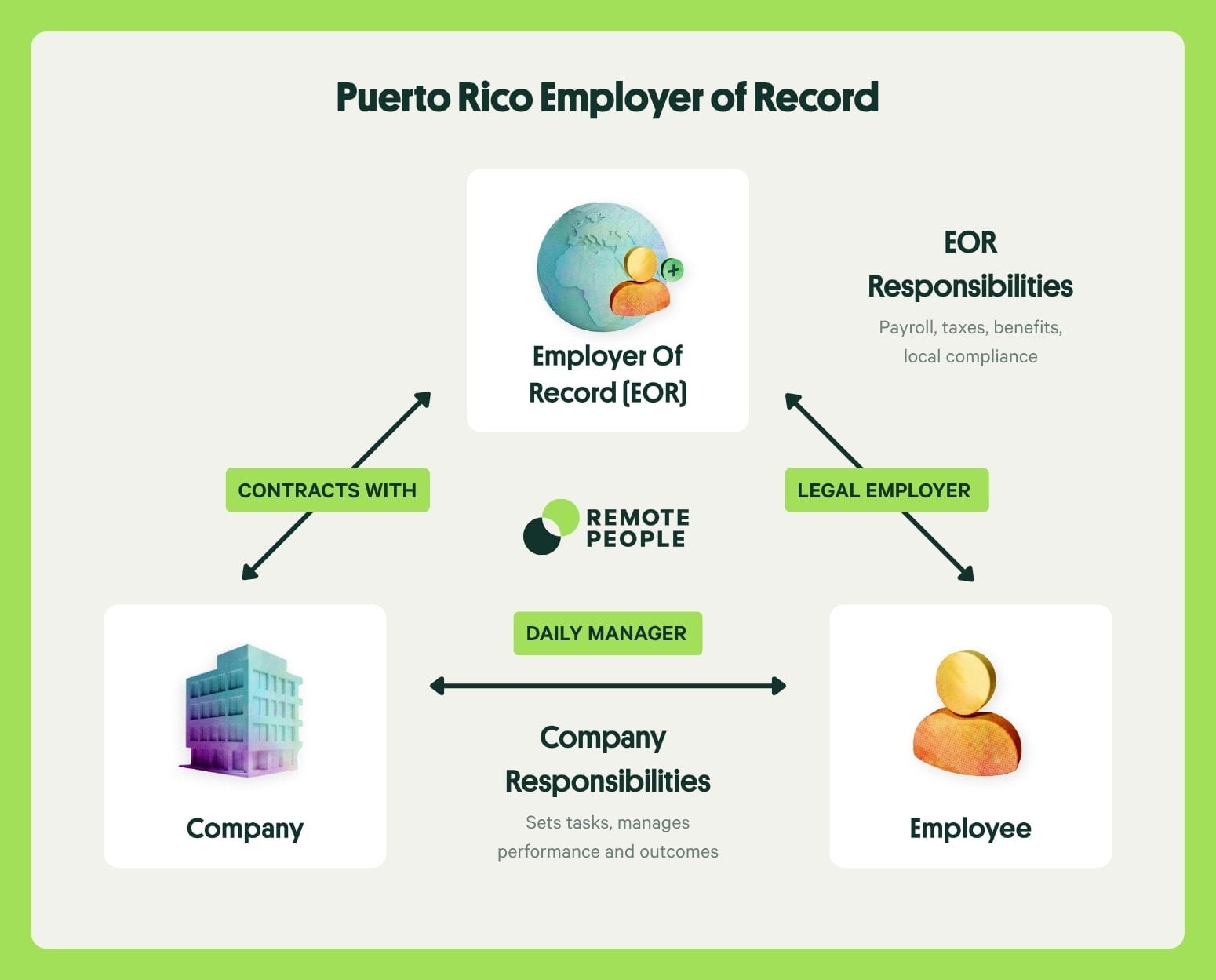
Who Uses an EOR in Puerto Rico?
A Puerto Rico EOR fits companies at multiple stages of Caribbean or U.S. territory expansion. The common thread is a need to hire compliantly without absorbing the fixed cost of a local corporation.
EORs in Puerto Rico serve four recurring use cases. First, companies testing the Puerto Rico market often hire one or two people through an EOR before committing to Hacienda merchant registration and a CFSE policy. Second, U.S. mainland employers hiring remote Puerto Rico residents need a Puerto Rico-registered withholding agent because a Puerto Rico-resident earning Puerto Rico-source wages owes Puerto Rico income tax rather than U.S. federal income tax under Internal Revenue Code §933. Third, companies that need fast onboarding avoid the six-to-twelve weeks required to incorporate in Puerto Rico, secure CFSE coverage, and register with the Department of the Treasury. Fourth, companies hiring foreign nationals who need H-1B or L-1 sponsorship benefit from the EOR’s existing USCIS Federal Employer Identification Number, since Puerto Rico operates under U.S. federal immigration law.
Companies that reach 15 or more full-time employees in Puerto Rico often transition to their own entity and a global payroll partner, but the EOR route remains the most efficient path through the first year of hiring.
Typical Onboarding Timeline
Onboarding a Puerto Rico hire through an EOR follows a predictable schedule. Most of the delay sits in the employee’s document collection (tax residency certification, CFSE medical questionnaire, and Act 4-2017 signed acknowledgements) rather than in the EOR’s internal process.
- EOR agreement and employee details: 1–2 business days to sign the master services agreement and transmit candidate offer details.
- Employment contract drafting (Spanish and English): 2–3 business days for the EOR to produce the bilingual Act 4-2017-compliant contract and the employee to review and sign.
- Hacienda, CFSE, and SINOT registrations: 3–5 business days when the EOR is already registered as the employer (standard case).
- Payroll setup, direct deposit, and benefits enrollment: 2–3 business days for banking verification and health plan enrollment.
- Employee onboarding and first day: 1 business day.
- Total: Most EOR providers can onboard an employee in Puerto Rico within 7–10 business days.
Hires that require an H-1B or other USCIS work visa add 2–6 months to the timeline because of federal immigration processing, independent of anything the EOR controls.
Hire in Puerto Rico
U.S. federal law coverage, a bilingual talent pool, no entity required, and Act 60-2019 tax advantages make Puerto Rico one of the smartest places to hire in the Americas.
We handle bilingual employment contracts, bi-weekly payroll, Hacienda tax withholding, SINOT, CFSE, and full Puerto Rico compliance.
No local entity needed. Your team can start in 7-10 business days.
Employment Laws and Regulations in Puerto Rico
Employment Contracts
Employment relationships in Puerto Rico are governed by the Labor Transformation and Flexibility Act, known as Act 4-2017, together with Act 80-1976 (Discharge Without Just Cause), Act 379-1948 (Working Hours), Act 180-1998 (Minimum Wage, Vacation, and Sick Leave), and Law 3-1942 (Working Mothers Protection Act). Federal statutes (the FLSA, FMLA, Title VII, the ADEA, the ADA, and IRCA) apply to Puerto Rico employers exactly as they apply on the U.S. mainland. The Puerto Rico Department of Labor and Human Resources (Departamento del Trabajo y Recursos Humanos) is the primary enforcement authority, with federal oversight from the U.S. Department of Labor.
Under Act 4-2017 Article 2.12, written employment contracts are strongly recommended and, for fixed-term and probationary arrangements, effectively required to rebut the presumption of indefinite employment. A contract should state the position, classification (exempt or non-exempt under the FLSA), base salary or hourly rate, work schedule, probation period, and applicable benefits. Contracts may be in English or Spanish, but Spanish-language versions govern in disputes heard by Puerto Rico courts (Littler). Fixed-term contracts are allowed under Act 4-2017 but convert to indefinite status if renewed beyond legitimate business justification.
Working Hours and Overtime
Puerto Rico’s standard workweek is 40 hours, typically eight hours per day over five days, as set by Act 379-1948. Under Act 4-2017, employers and non-exempt employees may agree in writing to alternative weekly schedules of up to ten hours per day over four days without triggering daily overtime. Any hours worked beyond eight per day or 40 per week trigger overtime at 1.5 times the regular rate for employees hired on or after January 26, 2017, the effective date of Act 4-2017 (Jackson Lewis). Employees hired before that date retain a double-time (2.0x) overtime rate under the pre-reform Act 379-1948 framework.
A meal period of one hour is required after the second and before the sixth hour of the workday. If the employee works through the meal period without written mutual agreement reducing it to 30 minutes, the penalty for post-2017 hires is an additional half hour at overtime rate; for pre-2017 hires, the penalty remains double time.
Puerto Rico overtime and premium pay rates · Per Act 4-2017 and Act 379-1948 | |||
Hour Type | Rate Multiplier | Weekly/Daily Cap | Notes |
|---|---|---|---|
Daily overtime (post-2017 hires) | 1.5x | After 8 hours/day | Act 4-2017 standard rate for employees hired on or after Jan 26, 2017 |
Weekly overtime (post-2017 hires) | 1.5x | After 40 hours/week | Matches federal FLSA; triggered only if no daily overtime already paid |
Daily and weekly overtime (pre-2017 hires) | 2.0x | After 8 hours/day or 40 hours/week | Grandfather rate under Act 379-1948 for employees hired before Jan 26, 2017 |
Seventh consecutive day of rest | 1.5x (post-2017) / 2.0x (pre-2017) | Applies to entire 7th day | Day of rest protected under Act 289-1946 |
Meal period violation (post-2017) | 0.5x extra | Per violated meal period | Applies if employer fails to provide the 1-hour meal break between hours 2 and 6 |
Meal period violation (pre-2017) | 2.0x | Per violated meal period | Double-time penalty under Act 379-1948 as originally enacted |
Source: Act 379-1948 (PR OMB) and Littler Puerto Rico guidelines | |||
Overtime must be paid on the regular payroll date for the period in which it was worked. There is no statutory cap on monthly overtime hours, but employers must still comply with health and safety rest standards. Overtime does not enter the base salary for the purpose of calculating the Act 148-1969 Christmas Bonus, which is capped at $600 regardless of overtime earnings.
Minimum Wage
The Puerto Rico minimum wage is $10.50 per hour, effective July 1, 2024, under Act 47-2021 (the Puerto Rico Minimum Wage Act). The statutory increase from $9.50 to $10.50 was the final scheduled step under Act 47-2021, and no further increase has taken effect in 2025 or 2026 (Jackson Lewis). The Minimum Wage Review Commission may recommend further increases, but any change requires affirmative legislative action.
Puerto Rico’s Act 47-2021 minimum wage is structured in three tiers. The general private-sector rate is $10.50 per hour for all non-exempt employees, effective July 1, 2024. Tipped employees receive a cash wage of $2.13 per hour under the federal FLSA tip-credit rules, but the employee’s combined cash wage plus tips must equal or exceed $10.50 per hour. Certain agricultural workers and narrowly defined occupations excluded from Act 47-2021 remain covered by the federal FLSA floor of $7.25 per hour.
The rate applies across all 78 municipalities and does not vary by industry. Federal tipped-wage rules apply unless Puerto Rico enacts a higher cash wage floor.
Probation Period
Under Act 4-2017 Article 2.4, the automatic statutory probation period is nine months for non-exempt employees and twelve months for employees classified as exempt under the FLSA (executive, administrative, and professional) (Littler). Because the probation period is automatic by statute, it applies by default even if the employment contract is silent. During probation, the employee may be dismissed without the Act 80 just-cause analysis and without Mesada severance, but anti-discrimination and retaliation protections still apply. Parties may agree in writing to waive or shorten probation, but they cannot extend it beyond the statutory maximum.
Leave Entitlements
Puerto Rico’s statutory leave framework combines commonwealth-specific entitlements under Act 4-2017 and Law 3-1942 with federal minimums under the FMLA. The rules for vacation and sick leave accrual differ sharply between employees hired before January 26, 2017 (who retain the more generous pre-reform accruals) and those hired after that date.
Annual Leave
For employees hired on or after January 26, 2017 working for employers with 12 or more employees, Act 4-2017 sets a tenured accrual schedule: 0.5 days per month during the first year, 0.75 days per month from the second through fifth year, 1.0 days per month from the sixth through fifteenth year, and 1.25 days per month from year sixteen onward. The eligibility threshold is 130 hours worked per month. Small employers (12 or fewer employees) grant 0.5 days per month regardless of tenure. Pre-2017 hires retain the older 1.25 days per month (15 days per year) entitlement from Act 180-1998. Unused vacation accrues and is payable on separation.
Sick Leave
Act 4-2017 sets statutory sick leave at 1 day per month (12 days per year) for employees who work at least 130 hours in the month and work for an employer with 12 or more employees. Sick leave is paid at 100% of the regular wage and does not require medical certification unless the absence exceeds two consecutive days. Unused sick leave accumulates up to 15 days; excess may be paid out annually at the employer’s discretion (Act 180-1998).
Maternity Leave
Puerto Rico’s Working Mothers Protection Act (Law 3-1942) grants pregnant employees eight weeks of paid maternity leave (four weeks before birth and four weeks after) at 100% of regular salary, funded entirely by the employer, with job reinstatement protection (Law 3-1942). A medical certificate can authorize an additional 12 weeks of extended leave if the pregnancy or recovery presents complications. Adoption of a child under six years of age entitles the adoptive mother to the same 8 weeks of paid leave under Act 184-2004.
Paternity Leave
Puerto Rico has no private-sector statutory paternity leave for biological fathers. Public-sector fathers receive 15 days under Act 165-2014. In the private sector, fathers rely on the federal FMLA for up to 12 weeks of unpaid, job-protected leave, provided the employer has 50 or more employees within a 75-mile radius and the employee has worked 1,250 hours in the preceding 12 months.
Other Statutory Leave
- Breastfeeding leave (Act 87-2025): One paid hour per workday for up to twelve months after return from maternity leave, applicable to both full-time and part-time employees; replaces Law 427-2000 effective August 1, 2025 (DLA Piper).
- Domestic violence leave (Law 217-2006): Up to 15 days of paid leave to address domestic violence, sexual assault, or stalking; employer may request supporting documentation.
- Jury duty leave: Paid leave for the full period of jury service; no retaliation permitted.
- Military leave: Unpaid but job-protected under the federal USERRA and Puerto Rico’s Military Code.
- Voting leave: Two hours of paid time off for general election voting under Puerto Rico Electoral Code Law 58-2020.
- Special athletic leave (Act 49-1991): Paid leave for employees participating in sanctioned international sporting events representing Puerto Rico.
Under Act 4-2017 and Law 3-1942, the following table summarizes every statutory leave entitlement applicable to private-sector employees in Puerto Rico. The most important takeaway is that pre-2017 hires retain substantially more vacation than post-2017 hires, which can create side-by-side disparities inside the same team.
Puerto Rico statutory leave entitlements · Per Act 4-2017 and Law 3-1942 | ||
Leave Type | Duration | Eligibility & Notes |
|---|---|---|
Annual vacation (post-2017 hires, large employers) | 6–15 days/year | Tenured accrual: 0.5/mo first year, 0.75/mo years 2-5, 1.0/mo years 6-15, 1.25/mo 16+. Requires 130 hrs/mo worked. |
Annual vacation (pre-2017 hires) | 15 days/year | 1.25 days/month grandfathered under Act 180-1998; payable on separation |
Sick leave | 12 days/year | 1 day/month; 130 hrs/mo eligibility; accumulates up to 15 days; paid at 100% by employer |
Maternity leave | 8 weeks paid | 4 weeks pre-birth + 4 weeks post-birth; 100% employer-paid; extension available with medical certificate |
Paternity leave (private sector) | Unpaid FMLA only | Up to 12 weeks under federal FMLA; no commonwealth paid paternity benefit for private sector |
Adoption leave | 8 weeks paid (child <6) / 5 weeks paid (child 6+) | Under Act 184-2004 with advance notice and adoption documentation |
Breastfeeding leave | 1 hour/day for 12 months | Act 87-2025 effective Aug 1, 2025; paid; applies to full- and part-time |
Domestic violence leave | Up to 15 days | Law 217-2006; paid; employer may require documentation |
Jury duty | Full duration | Paid; no retaliation permitted |
Military leave (USERRA) | Up to 5 years | Unpaid but job-protected under federal USERRA |
Voting leave | 2 hours | Paid; general election days under Electoral Code Law 58-2020 |
Source: Law 3-1942 (PR OMB) and Littler Puerto Rico guide | ||
Statutory Employee Benefits
Beyond paid leave, Puerto Rico imposes several mandatory benefit programs that run alongside the federal Social Security and Medicare framework. These programs are administered by commonwealth agencies, not by the U.S. Social Security Administration, and a Puerto Rico EOR must maintain each account in good standing.
Commonwealth-mandated employee benefits fall into five categories, each with its own funding mechanism. SINOT (Seguro por Incapacidad No Ocupacional Temporal) is the non-occupational disability insurance funded jointly at 0.6% of the first $9,000 in annual wages, split 0.3% employer and 0.3% employee under Act 139-1968. CFSE workers’ compensation is the sole occupational injury coverage in Puerto Rico and a monopoly program; rates vary by industry classification from roughly 1.5% to 4.5% of payroll and are set annually. Chauffeurs’ Social Security under Law 428-1950 is a supplementary disability and life insurance program for covered drivers, truck operators, and delivery personnel, with contributions set at $0.50 per week from each side.
The Christmas Bonus under Act 148-1969 is an employer-funded annual bonus equal to 2% of eligible wages, capped at $600 for employers with 21 or more employees and $300 for smaller employers, paid between November 15 and December 15. Health insurance is not commonwealth-mandated for private employers under 50 full-time employees; employers of 50 or more are covered by the federal ACA employer mandate. A retirement plan is not mandatory for the private sector, but the common voluntary benefit is a Puerto Rico-qualified 1081.01(d) plan, the local equivalent of a 401(k).
The exact employer percentages flow through the contribution tables in the Payroll section; this list is the regulatory scope, not a duplicate of those rates.
Recent Regulatory Updates (2026)
Puerto Rico’s employment framework has been largely stable since 2017, with two material changes in 2023–2025 worth noting. First, in November 2023, the U.S. District Court for the District of Puerto Rico struck down Act 41-2022 (a labor reform that would have rolled back parts of Act 4-2017) as a violation of PROMESA §204(a)(2). The First Circuit Court of Appeals affirmed the nullity in August 2023, and as a result the Act 4-2017 framework remains fully in force, including the nine-month probation, the Mesada cap, and the reduced vacation accrual schedule (Jackson Lewis).
Second, effective August 1, 2025, Puerto Rico enacted Act 87-2025 (the Lactation Code), which repealed Law 427-2000 and established a unified framework for workplace lactation rights: one paid hour per workday for 12 months after return from maternity leave, with no medical certificate requirement and equal treatment of full- and part-time employees. No further significant reforms have been enacted for 2026.
Work Permits and Visas in Puerto Rico
Work Permit Requirements
Who Needs a Work Permit
Puerto Rico is a U.S. commonwealth under Article IV of the U.S. Constitution, which means U.S. federal immigration law applies in full. U.S. citizens, lawful permanent residents (green card holders), and individuals born in Puerto Rico are U.S. citizens by birth and require no work authorization. Foreign nationals need a valid U.S. work visa issued by United States Citizenship and Immigration Services (USCIS). Puerto Rico cannot issue its own work permits and cannot exempt foreign workers from the federal visa framework (USCIS).
Eligibility and Required Documents
Each visa category has distinct eligibility. Common requirements include a valid passport from the applicant’s home country, a signed employment contract or offer letter, evidence of the required qualifications (degree, specialty license, or extraordinary-ability documentation), a clean criminal background, and in many categories a labor condition application or PERM certification from the U.S. Department of Labor. Some categories (H-1B, PERM-based green cards) require the employer to first obtain a Labor Condition Application attesting to prevailing wage and no adverse effect on U.S. workers.
Processing Time and Validity
Processing times vary widely by category and by whether the applicant uses premium processing (available for H-1B, L-1, and O-1 at an extra $2,805 fee). Standard processing typically runs 3–8 months; premium processing brings that down to 15 calendar days for the USCIS petition, though consular processing abroad can add further weeks. Initial visa validity is typically one to three years depending on category, with extensions available. Delays often stem from the annual H-1B cap lottery (60,000 new petitions per fiscal year plus 20,000 for U.S. master’s-degree holders) or RFE (Request for Evidence) issuance.
Renewal Process
Most employment-based visas can be extended in the U.S. while the employee continues working. H-1B renewals can extend up to six years total (plus additional extensions during a pending green card application under AC21). L-1 renewals can extend to five years for L-1B specialized knowledge or seven years for L-1A managerial. Renewal petitions should be filed 4–6 months before the current visa expires. If the extension is properly filed before expiration, the employee may continue working for up to 240 days while USCIS adjudicates.
Common Visa Types for Foreign Workers
Because Puerto Rico follows the federal immigration framework, the visa categories available in Puerto Rico are identical to those on the U.S. mainland. The U.S. Department of State issues the visa stamp at an embassy or consulate, and USCIS adjudicates petitions filed by the employer. A Puerto Rico EOR with a valid Federal Employer Identification Number can serve as the petitioning employer for most employment-based categories.
Puerto Rico work visa types for foreign workers · 2026 | ||||
Visa Type | Duration | Best For | Leads to APT? | Processing |
|---|---|---|---|---|
H-1B Specialty Occupation | 3 years, extendable to 6 | Workers in specialty roles requiring a bachelor’s degree | Yes | 3–8 months (or 15 days premium) |
L-1A/L-1B Intracompany Transferee | L-1A up to 7 yrs; L-1B up to 5 yrs | Managers (L-1A) or specialized-knowledge staff (L-1B) transferred from a foreign affiliate | Yes | 2–5 months (or 15 days premium) |
O-1 Extraordinary Ability | Up to 3 years, renewable indefinitely | Individuals with extraordinary ability in sciences, arts, business, or athletics | Yes | 2–4 months (or 15 days premium) |
E-2 Treaty Investor | Up to 5 years, renewable | Nationals of treaty countries investing substantial capital in a Puerto Rico business | No (non-immigrant) | 2–4 months at consulate |
TN (USMCA) | 3 years, renewable | Canadian and Mexican professionals in listed occupations | No (non-immigrant) | Same-day at port of entry (Canadians) |
EB-5 Immigrant Investor | Permanent resident status | Investors placing $800,000–$1,050,000 in a U.S. commercial enterprise | Yes | 24–48 months |
- B-1/B-2 visitor visas do not permit employment; they allow short business trips or tourism only.
- F-1 student visas do not permit general employment except in narrow on-campus or CPT/OPT categories.
- J-1 exchange visitor visas permit employment only within the sponsor’s specific program and may trigger a two-year home-country residency requirement.
How an EOR Handles Work Permits
A Puerto Rico EOR can serve as the petitioning employer for H-1B, L-1, O-1, and TN classifications because each requires a U.S. employer of record with a valid FEIN and a genuine employer-employee relationship. The EOR files the Labor Condition Application with the U.S. Department of Labor, files the USCIS Form I-129 petition (or I-140 for green card sponsorship), and carries the wage and working-conditions attestations. The employee, for their part, must supply the passport, educational credentials, prior visa history, and any required translations. A visa-dependent hire typically adds 2–6 months to the onboarding timeline described in H3 1.4, since the EOR does not shorten federal processing times. For E-2 investor visas, the EOR route is usually not appropriate because the visa requires the investor to own and direct the business, which conflicts with the EOR’s status as legal employer.
Payroll, Taxes, and Social Security in Puerto Rico
Employer Contributions
Puerto Rico employers fund a blend of U.S. federal programs (Social Security, Medicare, federal unemployment) and commonwealth programs (SUTA, SINOT, CFSE workers’ compensation, Chauffeurs’ Social Security where applicable). The combined employer cost typically runs 12–18% of gross payroll, depending heavily on the CFSE classification rate for the job type.
Puerto Rico employer social security contributions · 2026 rates | ||
Contribution | Rate | Notes |
|---|---|---|
FICA Social Security (OASDI) | 6.2% | On wages up to the 2026 wage base of $184,500; administered by SSA |
FICA Medicare | 1.45% | On all wages; no wage cap |
FUTA (federal unemployment) | 0.6% | Effective rate after the 5.4% FUTA credit for timely PR SUTA payments; applies to first $7,000 of wages |
Puerto Rico SUTA (state unemployment) | 3.3% (new employer) | Range 1.0%–5.4%; experience-rated; on first $7,000 of wages per employee |
SINOT (non-occupational disability) | 0.3% | Employer share only; on first $9,000 of wages; under Act 139-1968 |
CFSE workers’ compensation | 1.5%–4.5% (varies) | Industry-specific rate set annually by CFSE; monopoly provider |
Typical employer cost | 13.35% (approx.) | Sum of FICA 7.65% + FUTA 0.6% + SUTA 3.3% + SINOT 0.3% + CFSE mid-range 1.5%; excludes Christmas Bonus and voluntary benefits |
Source: SSA 2026 wage base and IRS Topic 903 | ||
Employee Contributions
Employees in Puerto Rico pay FICA Social Security and Medicare at the same federal rates as mainland workers, a small SINOT contribution, and Puerto Rico income tax withholding (not U.S. federal income tax, in most cases, under Internal Revenue Code §933). Employees who earn U.S.-source income in addition to Puerto Rico wages may owe federal income tax on that portion and file a U.S. Form 1040 in parallel with Puerto Rico Form 482.
Puerto Rico employee payroll deductions · 2026 monthly withholdings | ||
Deduction | Rate | Notes |
|---|---|---|
FICA Social Security | 6.2% | On wages up to $184,500 in 2026 |
FICA Medicare | 1.45% | On all wages |
Additional Medicare surtax | 0.9% | On wages above $200,000 single / $250,000 married filing jointly |
SINOT (non-occupational disability) | 0.3% | Employee share; on first $9,000 of wages |
Puerto Rico income tax withholding | 0%–33% | Progressive brackets per Section 1021.01 of the PR Internal Revenue Code; see Income Tax table |
Employee FICA subtotal | 7.65% | Excludes PR income tax withholding (depends on bracket) |
Source: IRS Publication 1321 and PwC PR tax summary | ||
Income Tax
Puerto Rico maintains its own progressive income tax system under the Puerto Rico Internal Revenue Code of 2011, administered by the Department of the Treasury (Hacienda). Resident employees are taxed on worldwide income; bona fide Puerto Rico residents generally exclude Puerto Rico-source income from U.S. federal income tax under Internal Revenue Code §933. The brackets below apply to single filers and to individual income under joint-filing arrangements; married couples filing jointly may use doubled thresholds under Hacienda rules (PwC Worldwide Tax Summaries).
Puerto Rico income tax brackets · 2026 | |
Bracket (annual taxable income, USD) | Tax Calculation |
|---|---|
Up to $9,000 | 0% |
$9,001 – $25,000 | 7% of excess over $9,000 |
$25,001 – $41,500 | $1,120 + 14% of excess over $25,000 |
$41,501 – $61,500 | $3,430 + 25% of excess over $41,500 |
Over $61,500 | $8,430 + 33% of excess over $61,500 |
Source: PwC PR tax summary and Hacienda (PR Treasury) | |
High earners over $500,000 face a gradual adjustment that phases out the benefit of lower brackets, producing an effective top rate of approximately 33% plus the adjustment. Qualified Section 1081.01 retirement contributions are deductible within the code’s annual limits, up to $15,000 in elective deferrals for 2026.
Payroll Cycle
Under Act 379-1948, Puerto Rico employers must pay wages at intervals no longer than 15 calendar days. The standard practice is bi-weekly (every two weeks) or semi-monthly (15th and last day). Wages must be paid in U.S. dollars via cash, check, or direct deposit to a Puerto Rico bank account. Each pay statement must itemize gross wages, hours worked, each deduction (FICA, Medicare, SINOT, PR income tax), and the net amount. Employers file Form 499R-2/W-2PR annually by January 31 for every employee, a quarterly Form 941-PR with the IRS, monthly SINOT contributions with the PR Department of Labor, and quarterly SUTA returns. The Christmas Bonus must be paid between November 15 and December 15 each year.
13th Month Salary and Bonus Pay
Puerto Rico’s equivalent of a 13th month salary is the statutory Christmas Bonus under Act 148-1969, as amended by Act 4-2017 and restored after the invalidation of Act 41-2022. For employees hired on or after January 26, 2017, the bonus equals 2% of earned wages during the qualifying period (October 1 of the prior year through September 30 of the current year), capped at $600 for employers with 21 or more employees and $300 for employers with 20 or fewer (Jackson Lewis). Eligibility requires the employee to have worked at least 1,350 hours during the qualifying period. Employees hired before January 26, 2017 retain the original Act 148-1969 formula: 6% of wages for employers with 21+ employees (max $600) or 3% for smaller employers (max $300), with a 700-hour eligibility threshold. Payment must be delivered between November 15 and December 15. No 14th month salary or vacation bonus is mandated in Puerto Rico.
Cost of Hiring Through an EOR in Puerto Rico
EOR Service Fees
Puerto Rico EOR service fees typically range from $300 to $600 per employee per month, depending on the provider and the scope of services. The fee generally covers payroll processing and pay-slip issuance, Hacienda and CFSE filings, SINOT and SUTA remittance, Christmas Bonus administration, leave tracking, benefits enrollment, and first-line HR support in English and Spanish. Fees at the higher end include work visa sponsorship support, expanded health and retirement plan options, and in-country HR advisory access. Setup fees, if charged, are usually one-time and fall between $500 and $1,500 per new hire. RemotePeople’s EOR fee includes all statutory compliance and end-to-end onboarding without separate setup charges.
Total Employment Cost Breakdown
The cost example below illustrates the total employer cost of hiring a mid-level Puerto Rico employee at a gross annual salary of $60,000 (roughly $5,000 per month, in line with typical Puerto Rico salary benchmarks). All figures are in USD because Puerto Rico’s official currency is the U.S. dollar. The table sums FICA, FUTA, PR SUTA, SINOT, and a mid-range CFSE workers’ compensation rate, plus a representative EOR fee and the statutory Christmas Bonus.
Puerto Rico employer cost example · USD 60,000 gross · 2026 | ||
Employer Cost | Amount (USD) | % of Gross |
|---|---|---|
Gross annual salary | $60,000.00 | 100.00% |
FICA Social Security (6.2%) | $3,720.00 | 6.20% |
FICA Medicare (1.45%) | $870.00 | 1.45% |
FUTA (0.6% of first $7,000) | $42.00 | 0.07% |
PR SUTA (3.3% of first $7,000) | $231.00 | 0.39% |
SINOT (0.3% of first $9,000) | $27.00 | 0.05% |
CFSE workers’ comp (1.5% mid-range) | $900.00 | 1.50% |
Christmas Bonus (Act 148-1969, 2% capped at $600) | $600.00 | 1.00% |
EOR service fee (est. $500/mo × 12) | $6,000.00 | 10.00% |
Total employer cost | $72,390.00 | 120.65% |
Source: SSA 2026 wage base and IRS Topic 903 | ||
The approximately 20.65% markup above gross represents the minimum-case scenario. Adding voluntary health insurance, a Puerto Rico-qualified 1081.01(d) retirement plan match, or a higher CFSE classification rate for construction or manufacturing roles can push the total to 25–30% above gross.
Ready to hire in Puerto Rico? Get started with RemotePeople, which handles employment contracts, payroll, Hacienda withholding, CFSE registration, and full Puerto Rico compliance. No local entity needed. Contact us to scope your Puerto Rico hiring plan.
Benefits of Using an EOR in Puerto Rico
Puerto Rico’s overlapping federal and commonwealth frameworks make it one of the more compliance-heavy U.S. jurisdictions. An EOR reduces that complexity to a single monthly invoice while preserving your full operational control over your team.
A Puerto Rico EOR delivers speed to market: because it is already registered with Hacienda, CFSE, and the Department of Labor, a first Puerto Rico hire can start within 7–10 business days rather than the 8–12 weeks needed to incorporate a local entity and secure merchant registration. It also delivers Act 4-2017 compliance assurance because missteps on the Mesada calculation, the 1,350-hour Christmas Bonus threshold, or the nine-month probation can generate statutory damages; the EOR tracks each rule and applies the correct formula based on whether the employee was hired before or after January 26, 2017.
Cost efficiency follows the same logic. Incorporating a Puerto Rico entity runs $3,000–$8,000 in setup plus $5,000–$15,000 per year in ongoing maintenance (registered agent, CRIM filings, annual report), while an EOR at $300–$600 per employee per month is cheaper until headcount approaches 15 or more. Beyond cost, the EOR offers local expertise in dual jurisdictions, navigating both federal rules (FLSA, FMLA, FICA, USCIS) and commonwealth rules (Act 4-2017, Act 80, Act 148, Law 3, SINOT, CFSE) that most U.S. payroll providers are not equipped to handle.
Flexibility and risk mitigation round out the benefits. Adding or removing a hire requires only a contract amendment rather than a corporate restructuring, and winding down a Puerto Rico market test is a 30-day process rather than a 6–12 month legal dissolution. On the risk side, Act 80-1976’s narrow just-cause standard and the Mesada formula create litigation exposure on every involuntary separation; the EOR carries the legal employer role and manages the statutory separation process end-to-end. Finally, bilingual Spanish and English contracts, pay stubs, and HR support reduce friction with local hires and demonstrate cultural fluency from day one.
For most companies hiring their first 1–15 people in Puerto Rico, the EOR route is both faster and cheaper than setting up a local subsidiary, and it preserves the option to convert to your own entity later.
Termination and Offboarding in Puerto Rico
Notice Periods
Puerto Rico does not mandate advance notice for individual terminations because employment is presumed indefinite and protected by the just-cause standard of Act 80-1976. Where just cause exists (see H3 7.3), the employer may terminate without notice; where it does not, the employer must pay the Mesada indemnity described below in lieu of notice. The primary notice rule in Puerto Rico is the federal WARN Act for mass layoffs. A Puerto Rico-specific mini-WARN provision under Act 80 extends protections in certain reorganization scenarios.
Puerto Rico statutory notice periods by termination type · Per Act 80-1976 and federal WARN Act | |||
Termination Type | Notice Period | During Probation | Notes |
|---|---|---|---|
Individual termination with just cause | None required | None | Act 80 defines just cause narrowly; final paycheck due on regular payday |
Individual termination without just cause | None (Mesada paid in lieu) | Not applicable (no Mesada during probation) | Employer pays Mesada instead of providing notice |
Mass layoff or plant closing (federal WARN) | 60 calendar days | Applies regardless of probation status | Applies to employers with 100+ full-time employees affecting 50+ workers at a single site within 30 days |
Resignation by employee | Not statutory | None | Contractual notice typical (2 weeks); no statutory penalty for shorter period absent contract term |
Fixed-term contract expiration | None | Not applicable | Contract ends on stated date; repeated renewals may convert to indefinite |
Source: Act 80-1976 (PR OMB) and U.S. DOL WARN Act | |||
Final wages (accrued vacation, unpaid regular wages, and the pro-rated Christmas Bonus if the employee worked at least the hours threshold) must be paid on the regular payday following separation. Mutual agreement terminations reduce litigation risk, and fixed-term contracts avoid Mesada liability if the contract genuinely terminates on the stated end date.
Severance Pay
Puerto Rico’s statutory severance indemnity, known locally as the Mesada, is owed under Act 80-1976 to any indefinite-term employee discharged without just cause. Just-cause terminations carry no severance obligation. The Mesada is a fixed formula based on tenure and, for employees hired on or after January 26, 2017, is capped at nine months’ salary (Lexology: PR termination guide). Employees hired before that date have no cap and use the pre-reform formula based on their highest salary during the preceding three years.
Puerto Rico severance pay schedule by years of service · Per Act 80-1976 | |||
Years of Service | Severance Amount (post-2017 hires) | Base Salary | Notes |
|---|---|---|---|
1 year | 3 months + 2 weeks = ~3.5 months salary | Highest monthly salary in previous 30 days | At $60,000/yr gross = ~$17,308 |
3 years | 3 months + 6 weeks = ~4.4 months salary | Highest monthly salary in previous 30 days | At $60,000/yr gross = ~$21,923 |
5 years | 3 months + 10 weeks = ~5.3 months salary | Highest monthly salary in previous 30 days | At $60,000/yr gross = ~$26,538 |
10 years | 3 months + 20 weeks = ~7.6 months salary | Highest monthly salary in previous 30 days | At $60,000/yr gross = ~$38,077 (3 mo + 20 wk at $1,153.85/wk) |
15+ years | 6 months + 3 weeks per year = 9 months cap | Highest monthly salary in previous 30 days | At $60,000/yr gross = $45,000 (9-month cap) |
Source: Act 80-1976 (PR OMB) and Lexology: PR termination guide | |||
Calculation Method
The Mesada formula for employees hired on or after January 26, 2017 is three months of base salary plus two weeks of base salary for each completed year of service during the first fifteen years of tenure, shifting to six months plus three weeks per year for tenures beyond fifteen years, subject to a hard cap of nine months’ salary. Base salary is defined as the highest monthly salary the employee earned in any 30-day period within the year preceding the termination. Overtime, bonuses, and the Christmas Bonus are excluded from the base salary calculation. Table 13 illustrates four worked examples at a $60,000 annual salary.
Caps and Exceptions
The nine-month Mesada cap applies only to employees hired on or after January 26, 2017. Employees hired before that date are not capped and use the pre-reform schedule: two months salary plus one week per year of service for up to 5 years, three months plus two weeks per year for 5–15 years, and six months plus three weeks per year thereafter, with no upper limit. Mesada is not owed for just-cause terminations, fixed-term contract expirations, probation dismissals, or mutual separation agreements signed with consideration. Under Section 1062.01 of the Puerto Rico Internal Revenue Code, Mesada payments up to the statutory formula are exempt from Puerto Rico income tax withholding.
Grounds for Termination
Act 80-1976 defines “just cause” narrowly. Valid grounds include repeated violations of workplace rules, employee conduct causing serious harm to the business, inefficiency or unsatisfactory performance despite warnings, patterns of unjustified absenteeism or tardiness, full or partial closure of operations, technological changes, and economic reorganization. Ordinary disagreement or subjective dissatisfaction does not meet the standard. Puerto Rico’s Supreme Court has consistently held that the employer carries the burden of proving just cause and must document warnings, progressive discipline, and the precise business justification. Terminations of employees in protected categories (pregnant employees, employees on workers’ compensation leave, employees who recently filed a discrimination or retaliation claim) carry heightened scrutiny and additional statutory damages if unjustified.
EOR vs. Other Hiring Models in Puerto Rico
EOR vs. Setting Up a Local Entity
Setting up a Puerto Rico entity makes sense for committed long-term operations but carries meaningful time and cost overhead. Incorporating a Puerto Rico corporation or LLC, securing CFSE coverage, registering with Hacienda as a withholding agent, and obtaining the Department of State Certificate of Good Standing typically takes six to twelve weeks and $3,000–$8,000 in legal and filing fees. The table below contrasts the EOR and direct-entity routes on timing, cost, compliance burden, and scalability.
Puerto Rico EOR vs local entity comparison · Setup time, cost, risk and best-fit | ||
Comparison | Employer of Record | Own Entity |
|---|---|---|
Setup time | 1–2 weeks | 8–12 weeks (Hacienda, CRIM, CFSE, DoL registrations) |
Upfront cost | $0 | $3,000–$8,000 (incorporation, legal, registrations) |
Ongoing cost | $300–$600/employee/month | $5,000–$15,000/year entity maintenance (registered agent, annual report, CRIM) |
Local partner required | No (EOR is the local entity) | Not required, but local counsel and CPA recommended |
Social insurance registration | Handled by EOR (SINOT, CFSE, SUTA, Chauffeurs) | You manage each agency registration individually |
Payroll and tax filing | Handled by EOR (Hacienda 499R-2, Form 941-PR, SINOT, SUTA) | You manage it directly or outsource to a Puerto Rico payroll bureau |
Best for team size | 1–15 employees | 15+ employees |
Scale down or exit | Easy, with no entity to unwind | Costly: legal dissolution, CRIM cancellation, and final filings required |
Government contracts | Not eligible | Eligible (requires local entity and PR vendor registration) |
Source: PR DDEC and PR Department of Treasury | ||
For most companies hiring fewer than fifteen employees in Puerto Rico, the EOR route is dramatically faster and cheaper. Incorporating a local entity makes sense once the team is large enough that the $300–$600 per employee monthly fee exceeds the fixed cost of entity maintenance and local payroll, typically somewhere between 15 and 25 employees depending on average salary.
Companies pursuing Puerto Rico government contracts or Act 60-2019 tax incentives (the Individual Resident Investor and Export Services regimes) generally need their own entity because those incentive grants require the beneficiary to be a Puerto Rico-resident corporation or LLC. The EOR route preserves the option to set up an entity later without losing your existing team.
EOR vs. Hiring Independent Contractors
Contractor engagement in Puerto Rico is legally permitted but narrowly policed under Act 4-2017’s economic-reality test. Misclassifying an employee as a contractor exposes the engaging company to back wages, retroactive payroll taxes (FICA, FUTA, SUTA, SINOT), and potential Mesada liability if the relationship is later found to be employment. The table below compares the EOR and contractor routes on control, cost, tax treatment, and classification risk.
Puerto Rico EOR vs independent contractors · Compliance, cost, and risk | ||
Comparison | EOR (Full-Time Employee) | Independent Contractor |
|---|---|---|
Legal relationship | Employee of the EOR | Self-employed; no employment relationship |
Compliance risk | Low; EOR ensures Act 4-2017 and federal compliance | Moderate; Puerto Rico applies the Act 4-2017 ABC-style test, and misclassification triggers back wages, Mesada, and Christmas Bonus liability |
Payroll and tax | EOR handles Hacienda withholding, FICA, SINOT, and filings | Contractor invoices you; they file their own Hacienda Form 482 and self-employment tax |
Benefits and leave | Vacation, sick leave, Christmas Bonus, SINOT, and health insurance options | No entitlement to employee benefits |
IP protection | Stronger; employment contract assigns IP by default under work-for-hire doctrine | Weaker; requires explicit IP assignment clause in the services agreement |
Termination | Subject to Act 80 just-cause analysis and Mesada | Contract can be ended per agreement terms, subject to notice provisions |
Best for | Long-term, core team roles | Short-term projects, specialized deliverables, independent consultants |
Cost structure | Salary + employer contributions + EOR fee | Contractor fee (typically higher gross, lower total burden) |
Source: Act 80-1976 and IRS contractor vs employee | ||
Contractor engagements are only appropriate for genuinely independent service relationships. Puerto Rico applies the Act 4-2017 economic-reality test, which considers control over work, integration into the business, exclusivity of services, and duration. If the relationship fails that test, the contractor can be reclassified as an employee, triggering retroactive payroll taxes, SINOT and CFSE back payments, Christmas Bonus liability, and potential Mesada if the relationship is later terminated.
For roles that are integrated into your team’s daily operations (full-time developers, sales staff, customer-support reps), the EOR is the compliant choice. Genuine contractor engagements (specialized consultants, freelance designers on discrete projects) remain a valid option but should be documented with a project-scope contract and treated as self-employed for tax purposes. RemotePeople offers a separate contractor management service for organizations that want disciplined documentation and payment flows for their contractor relationships.
EOR vs. PEO (Professional Employer Organization)
PEOs and EORs are often confused, but they serve different purposes under Puerto Rico and U.S. federal rules. A PEO is a co-employment arrangement that requires the client to have its own U.S. entity and Federal Employer Identification Number, whereas an EOR is a sole employer of record that replaces the need for a local entity entirely. The table below compares the two models on legal-employer status, entity requirement, Puerto Rico compliance scope, and typical fee structure.
Puerto Rico EOR vs PEO comparison · Legal employer, liability, and setup | ||
Comparison | Employer of Record (EOR) | PEO |
|---|---|---|
Legal employer | EOR is the legal employer | You remain the legal employer (co-employment) |
Local entity required | No; the EOR is the local entity | Yes; you must have your own Puerto Rico entity |
Best for | Companies without a local entity | Companies that already have a Puerto Rico entity |
Compliance liability | EOR assumes compliance responsibility | Shared liability between you and the PEO |
Setup time | 1–2 weeks | Depends on your entity setup (weeks to months) |
Control over HR policies | EOR manages within Act 4-2017 and federal framework | More direct control; PEO advises |
Typical use case | Market entry, small remote teams, testing Puerto Rico | Established Puerto Rico operations needing HR outsourcing |
Source: SHRM PR employment overview and U.S. DOL FLSA guide | ||
The core distinction is the legal employer role. With an EOR, the provider is the legal employer in Puerto Rico and carries the full statutory liability for payroll, leave, and termination. With a PEO, the client company remains the legal employer, and the PEO acts as a co-employer for administrative functions while the client retains ultimate responsibility. A PEO therefore requires the client to already have a Puerto Rico entity; an EOR does not.
Puerto Rico has no separate regulatory framework for PEOs; they operate under general contract law and federal co-employment doctrine. Companies with an existing Puerto Rico corporation can use either model, but most choose the EOR when their first hires are 1–15 employees and switch to in-house HR or a PEO once the team size justifies the entity overhead.
Public Holidays in Puerto Rico
Puerto Rico observes both U.S. federal holidays and commonwealth-specific holidays declared by the Office of the Governor and the Puerto Rico Legislative Assembly. Under Act 379-1948, non-exempt employees who work on a public holiday are entitled to premium pay at 1.5 times the regular rate for post-2017 hires. The combined calendar usually totals 19–20 paid holidays per year, giving Puerto Rico one of the most holiday-rich calendars in the United States.
Puerto Rico public holidays · 2026 calendar year | ||
Date | Holiday | Type |
|---|---|---|
Thursday, January 1, 2026 | New Year’s Day | Federal + Commonwealth |
Tuesday, January 6, 2026 | Three Kings Day (Día de los Reyes) | Commonwealth |
Monday, January 12, 2026 | Eugenio María de Hostos Day | Commonwealth |
Monday, January 19, 2026 | Martin Luther King Jr. Day | Federal |
Monday, February 16, 2026 | Presidents’ Day | Federal |
Sunday, March 22, 2026 | Abolition of Slavery Day | Commonwealth (observed Monday) |
Friday, April 3, 2026 | Good Friday | Commonwealth |
Thursday, April 16, 2026 | José de Diego Day | Commonwealth |
Monday, May 25, 2026 | Memorial Day | Federal |
Friday, June 19, 2026 | Juneteenth | Federal |
Saturday, July 4, 2026 | Independence Day | Federal |
Friday, July 17, 2026 | Luis Muñoz Rivera Day | Commonwealth |
Saturday, July 25, 2026 | Puerto Rico Constitution Day | Commonwealth |
Monday, July 27, 2026 | José Celso Barbosa Day | Commonwealth |
Monday, September 7, 2026 | Labor Day | Federal |
Monday, October 12, 2026 | Columbus Day / Día de la Raza | Federal + Commonwealth |
Wednesday, November 11, 2026 | Veterans Day | Federal |
Thursday, November 19, 2026 | Discovery of Puerto Rico Day | Commonwealth |
Thursday, November 26, 2026 | Thanksgiving Day | Federal |
Friday, December 25, 2026 | Christmas Day | Federal + Commonwealth |
Holidays falling on Sunday are typically observed on the following Monday. Holiday premium pay applies only to non-exempt employees actually worked; salaried exempt employees do not earn additional pay for working a holiday.
How to Get Started with an EOR in Puerto Rico
Launching a Puerto Rico hire through an EOR service follows a clear sequence. Each step builds on the previous one, and delays at the employee-documentation stage are the most common cause of schedule slippage.
- First, scope the role and confirm Puerto Rico is the right fit. Align on the position, salary, classification (exempt or non-exempt under the FLSA), and any visa considerations if the candidate is not a U.S. citizen or green card holder. RemotePeople’s team can confirm whether the role qualifies under Act 4-2017’s exempt classifications before any contract is drafted.
- Second, sign the EOR Master Services Agreement. The MSA sets the commercial terms, fee structure, indemnification, and scope of services. Signing typically takes 1–2 business days once terms are agreed.
- Third, provide the candidate and compensation details. Share the candidate’s name, contact information, start date, base salary, any variable compensation, and the reporting structure. The EOR uses this to prepare the bilingual employment contract that meets Act 4-2017 disclosure requirements.
- Fourth, review and countersign the bilingual employment contract. The EOR issues the Spanish and English contract for employee and client review. Once signed, the EOR completes Hacienda, CFSE, SINOT, and SUTA registrations.
- Fifth, onboard the employee on day one. The EOR sets up payroll direct deposit, enrolls the employee in health and retirement plans as applicable, issues the bilingual welcome pack, and confirms the first pay date. The EOR then runs payroll on the bi-weekly schedule, files all statutory returns, and manages Christmas Bonus processing in December.
Ready to start hiring in Puerto Rico? Contact RemotePeople to scope your first hire and receive a full-cost quote within one business day.
Where companies hiring in Puerto Rico expand next
Employers with operations in Puerto Rico often extend across the Caribbean and nearby US-adjacent markets. Most teams start with an EOR partner in the Bahamas — the nearby Caribbean talent corridor. The Dominican Republic typically follows, with aligned Caribbean mobility and business rhythm. A team in the United States is a natural addition for the parent jurisdiction’s framework extending to this market, and operations in Jamaica completes the regional picture with shared Caribbean labor and trade norms.
Frequently Asked Questions
Employer of Record in
Employer of Record in
Employer of Record in
Employer of Record in
Employer of Record in
Employer of Record in
Employer of Record in
Employer of Record in




