Recruit
Employer of Record in Romania
-
 Drew Donnelly
- Published
- May 29, 2026
RemotePeople’s employer of record in Romania lets you hire employees in Romania with full compliance to Romanian labor standards. We handle CAS social security contributions, CASS health insurance deductions, and CAM labor insurance contributions.

Hiring in Romania at a glance
RON
Romanian
~$1,400/mo
Monthly
6.25%
20 days
3 months
1 month
Not mandatory
40 hrs/wk








- Romania Services
- Start hiring in Romania
- How an Employer of Record Works in Romania
- Employment Laws and Regulations in Romania
- Work Permits and Visas in Romania
- Payroll, Taxes, and Social Security in Romania
- Cost of Hiring Through an EOR in Romania
- Benefits of Using an EOR in Romania
- Termination and Offboarding in Romania
- EOR vs. Other Hiring Models in Romania
- Public Holidays in Romania
- How to Get Started with an EOR in Romania
- Where companies hiring in Romania expand next
- Frequently Asked Questions
- Related EOR Destinations

Start hiring in Romania
Let Remote People handle payroll, compliance, and HR admin worldwide so you can focus on building your team.

How an Employer of Record Works in Romania
What Is an EOR?
An employer of record is a Romanian company that legally employs workers on behalf of a foreign business. In Romania, the EOR signs an indefinite or fixed-term individual employment contract (contract individual de muncă) under the Labour Code, registers the employee in the REGES-Online electronic register before the first working day, withholds CAS (pension), CASS (health) and personal income tax through Form 112 filed with ANAF, and issues a compliant payslip in Romanian leu. The client company directs the day-to-day work, approves timesheets and leave, and pays a single monthly invoice that covers gross salary, employer contributions and a service fee.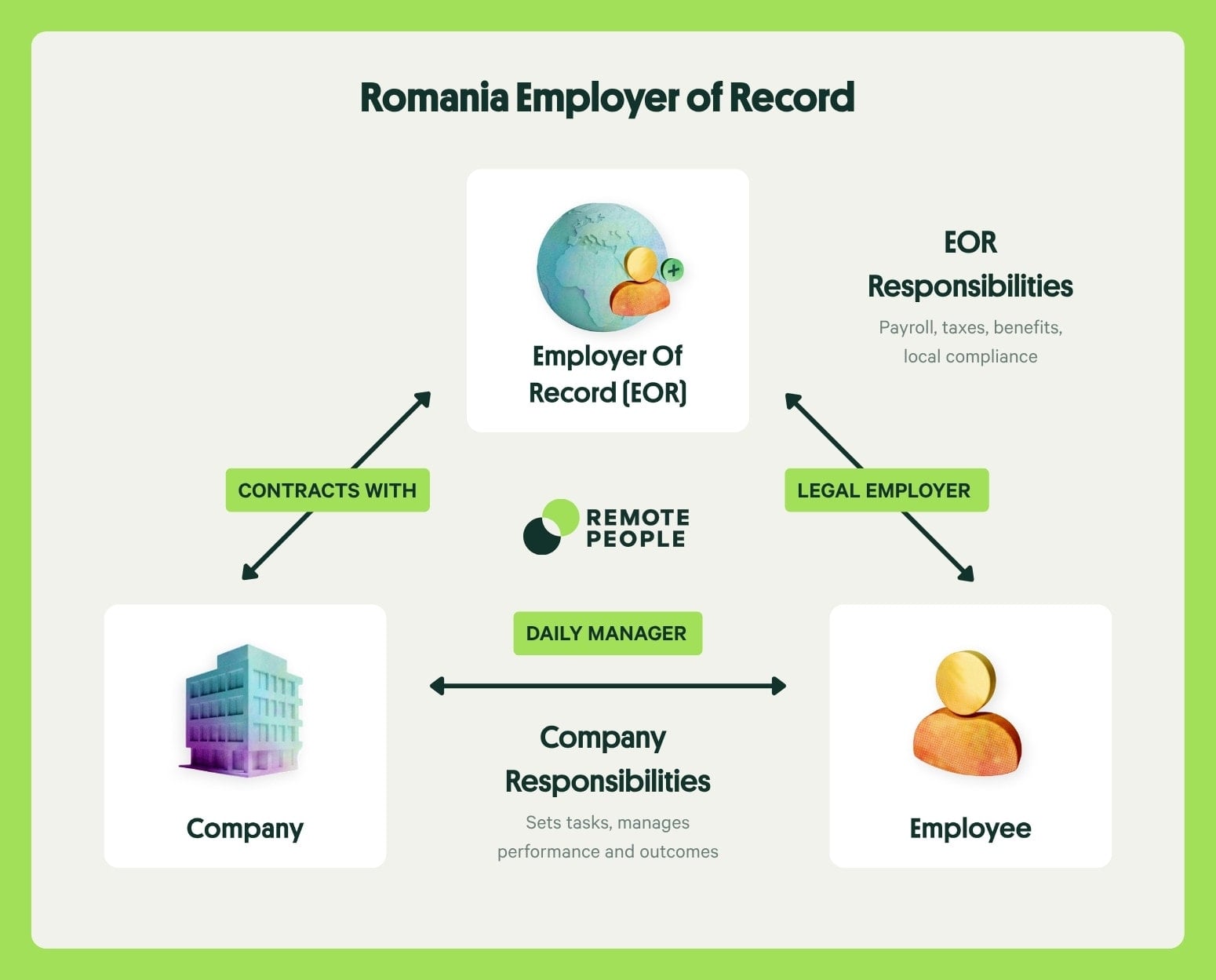
What Does an EOR Handle?
A Romanian employer of record takes on every statutory obligation that would otherwise fall to a locally incorporated SRL (societate cu răspundere limitată). The scope is broader than payroll processing and covers the entire employment lifecycle, from hire through offboarding.
- Employment contracts: Drafts Romanian-language contracts that include the mandatory terms under Article 17 of the Labour Code, including job function, workplace, working time, remuneration, leave entitlement and notice period.
- Payroll processing: Calculates gross-to-net each month in Romanian leu, applies the personal deduction for dependants, and pays salaries through a Romanian IBAN account.
- Tax withholding: Withholds personal income tax at the flat 10% rate and files Form 112 monthly with the National Agency for Fiscal Administration (ANAF).
- Social security registration: Registers each employee in REGES-Online before the first working day, remits the 25% CAS pension share, the 10% CASS health share, the 2.25% CAM labour insurance contribution, and manages sickness and maternity benefit claims through the National House of Health Insurance (CNAS) (CNAS).
- Benefits administration: Enrols employees in statutory health insurance, the Pillar II private pension fund at the 5.25% rate effective 1 January 2026, and any supplementary benefits the client wants to offer, including meal vouchers up to RON 45 per working day.
- Leave tracking: Accrues the statutory 20 working days of annual leave from day one, coordinates the first five days of employer-paid sick leave, and manages maternity, paternity and parental benefit filings with CNAS.
- Work permits: Applies to the General Inspectorate for Immigration (IGI) for Single Permits, EU Blue Cards and intra-company transfer permits, and manages the annual foreign worker quota set by Government Decision.
- Termination compliance: Issues the 20 working days’ minimum notice under Article 75 of the Labour Code, coordinates any contractual or collective severance, and deregisters the employee in REGES-Online within the statutory deadline.
Who Uses an EOR in Romania?
Romania’s combination of competitive payroll costs, a 200,000-strong ICT workforce and EU legal certainty makes it a frequent first Eastern European hire for expanding companies. The four most common EOR use cases in the Romanian market are set out below.
- Testing the market before committing to a Romanian SRL: Setting up a private limited company in Romania takes three to six weeks and requires share capital of at least RON 200, a registered office, a local administrator and registration with the National Trade Register Office (ONRC). An EOR lets a company hire the first two or three employees immediately and re-evaluate after six to twelve months.
- Hiring a small team without entity overhead: Running a Romanian SRL includes monthly Form 112 payroll filings, the D101 corporate tax return, annual financial statements to ONRC and VAT administration once the RON 300,000 turnover threshold is crossed. For teams of one to fifteen employees, the EOR model is typically cheaper than carrying that fixed cost.
- Onboarding quickly when a hire can’t wait: An EOR can have a Romanian-compliant individual employment contract in place within five to ten working days. Companies that need a developer, finance lead or customer-success manager on payroll by month-end use this path to avoid losing the candidate during the four-to-eight-week SRL incorporation process.
- Hiring foreign nationals who need a work permit: Non-EU hires require a Single Permit issued by the General Inspectorate for Immigration, and the sponsoring employer must be registered in Romania. The EOR acts as that sponsor, files the application, and manages the annual quota set each year by Government Decision under the rules of Government Emergency Ordinance 194/2002.
The model suits any business that wants a Romanian team without the multi-quarter project of incorporating locally, and it is particularly useful for US and UK buyers who are unfamiliar with Eastern European payroll and the monthly ANAF filing cycle.
Typical Onboarding Timeline
An EOR in Romania can move from signed proposal to a fully onboarded employee in one to two weeks for EU, EEA and Swiss nationals. The typical sequence is set out below.
- EOR agreement and employee details (1–2 days): Client signs the EOR services agreement and shares the candidate’s identification, contact details and agreed compensation.
- Employment contract drafting and review (2–3 days): The EOR prepares a bilingual Romanian/English contract with the Article 17 mandatory terms and circulates it for employee signature.
- REGES-Online and ANAF registration (1–3 days): The EOR registers the employee in the electronic employment register before the first working day, as required by Government Decision 905/2017, and files the ANAF enrolment so the correct tax and social security positions are opened.
- Payroll setup and benefits enrolment (2–3 days): Bank details, Pillar II pension election and any supplementary benefits such as private health insurance or meal vouchers are entered into the payroll system, and a test payslip is produced.
- Employee onboarding and first day (1 day): The employee starts work under the EOR’s employment contract while reporting to the client’s managers.
Most EOR providers can onboard an employee in Romania within one to two weeks for EU, EEA and Swiss nationals. The timeline extends to six to ten weeks for non-EU hires who need a Single Permit or EU Blue Card, because the IGI processing window dominates everything downstream.
Employment Laws and Regulations in Romania
Employment Contracts
The governing statute is the Romanian Labour Code (Law No. 53/2003), which was republished in the Official Gazette No. 345 of 18 May 2011 and has been amended multiple times since, most recently through the fiscal and employment package contained in Law 239/2025. The lead regulator is the Ministry of Labour, Family, Youth and Social Solidarity, with enforcement by the Labour Inspectorate (Inspecția Muncii).
Under Article 17 of the Labour Code, every individual employment contract must be concluded in writing in Romanian and must record the place of work, job function, job description, specific occupational risks, start date, duration, annual leave entitlement, notice periods, remuneration and working time. Contracts are concluded for indefinite duration by default. Fixed-term contracts are capped at 36 months and cannot be renewed more than twice between the same parties. Part-time, temporary agency, apprenticeship and teleworking contracts are recognised as separate contract types under the Labour Code and Law 81/2018. The contract must be registered in the REGES-Online electronic register operated by the Labour Inspectorate before the first working day.
Working Hours and Overtime
The statutory working week in Romania is 40 hours, with a daily cap of 8 hours, set by Articles 112 and 115 of the Labour Code. Including overtime, working time may not exceed an average of 48 hours per seven-day period over a four-month reference period. Rest periods are at least 12 consecutive hours per day and 48 consecutive hours per week, normally on Saturday and Sunday. Managers and employees with autonomous working time may be subject to modified arrangements under collective labour agreements.
Overtime must be requested by the employer, and employees under 18 or pregnant women are expressly excluded. Under Article 122 of the Labour Code, overtime is compensated primarily with paid time off within 60 calendar days following performance. Where compensatory rest cannot be granted within that window, Article 123 requires a cash premium of at least 75% of base salary on top of the regular hourly rate. The premium multipliers applied by most Romanian employers are set out below.
Romania overtime and premium pay rates · Per Labour Code Articles 122, 123 and 142 | |||
Hour Type | Rate Multiplier | Weekly/Daily Cap | Notes |
|---|---|---|---|
Weekday overtime (cash premium) | 1.75× base hourly rate (minimum) | 48-hour weekly average over 4 months | Applies only if compensatory rest cannot be granted within 60 calendar days |
Weekday overtime (time off in lieu) | Equivalent paid rest hours | Must be taken within 60 days of overtime worked | Default compensation method under Article 122 |
Night work (22:00–06:00) | 1.25× base hourly rate OR 1 hour of rest per night worked | 8-hour daily average over 3 months | Applies whether scheduled or overtime; medical check-up required |
Weekly rest day work | Equivalent paid rest within 30 days, or cash premium per collective agreement | Rest day work limited to exceptional cases | Governed by Article 137; double rest period owed if displaced |
Public holiday work | 2.0× base hourly rate or equivalent rest | Holiday rest deferred within 30 days | Compensatory rest is the default; cash premium applies if rest cannot be granted |
Overtime worked is normally settled with paid time off rather than cash, so the 1.75× minimum premium only applies if the employer cannot grant compensatory rest within 60 days. Maximum sustained working time, including overtime, is 48 hours per week averaged over four months. Overtime is excluded from Pillar II pension calculations because Pillar II is based on gross salary declared in Form 112, and it does not generate a statutory 13th-month right since Romania has no mandatory 13th-month regime.
Minimum Wage
The national gross minimum wage in Romania is RON 4,050 per month for full-time employees, in force from 1 January 2026 to 30 June 2026. Starting 1 July 2026, the minimum wage rises to RON 4,325 per month, a 6.8% increase approved by Government Decision 146/2026 (L&E Global). The construction sector retains a separate statutory minimum wage of RON 4,582 gross per month under Article 71 of Emergency Ordinance 114/2018.
The minimum wage applies to the 165.33 monthly working hours that make up the 40-hour statutory week. Work classified as skilled under the employee’s job description must be paid above the minimum. Collective agreements at sector level may set higher floors, notably in construction, transport and healthcare, and must be registered with the Labour Inspectorate to be enforceable.
Probation Period
Probation is optional and must be recorded in the employment contract under Article 31 of the Labour Code. The maximum probation period is 90 calendar days for non-managerial positions on indefinite-term contracts, rising to 120 calendar days for management positions and limited to 30 calendar days for employees with disabilities (Accace: Romania Labour Law 2026 Guide). For fixed-term contracts shorter than three months, the probation period is capped at five working days; for contracts of three to six months, it is capped at 15 working days. During probation, either party may terminate the contract with simple written notice, without the standard 20 working days’ notice and without stating grounds (Article 31(3)). Annual leave accrues from the first day of employment, including the probation period, so a dismissal during probation still triggers a prorated leave payout.
Leave Entitlements
Romania’s statutory leave framework is set out in Chapter III of Title III of the Labour Code and in specific statutes on sickness and maternity insurance. Most leave benefits outside annual leave are funded by the social insurance budget (CNAS or the state budget) rather than by the employer, which keeps the direct payroll cost of absence moderate for Romanian employers.
Annual Leave
Employees are entitled to a minimum of 20 working days of paid annual leave per calendar year under Article 145 of the Labour Code. The entitlement is prorated for the first year of employment based on actual working time. Employees working in difficult, hazardous or special conditions, employees with disabilities and young workers under 18 are entitled to at least three additional working days. Leave accrues from the first day of employment, including during probation. Unused leave must be taken by 30 June of the following year or, if not, compensated in cash only on termination of the employment contract.
Sick Leave
Sickness benefit in Romania is regulated by Emergency Ordinance 158/2005. The first five calendar days of sick leave are paid by the employer. Effective 1 August 2025 under the reform implemented by CNAS, the replacement rate for ordinary illness was reduced for short certificates, with medical certificates of up to seven days paid at 55% of the calculation base. From the sixth calendar day onward, and for longer certificates, benefits are paid by the National Health Insurance Fund (CNAS) at 75% of the calculation base for ordinary illness and 100% for serious conditions, work-related accidents and occupational diseases (CNAS). The calculation base is the average gross salary over the six months preceding the month of the certificate. Eligibility requires at least six months of sickness insurance within the previous 12 months, and a medical certificate issued by an accredited physician through the CNAS electronic system.
Maternity Leave
Maternity leave is 126 calendar days, split equally as 63 days before birth and 63 days after birth, under Emergency Ordinance 158/2005. The maternity benefit is paid by CNAS at 85% of the calculation base, using the average gross salary over the six months preceding the month of leave. The leave may be redistributed between the antenatal and postnatal periods based on a doctor’s recommendation, subject to a minimum of 42 postnatal days. Dismissal during pregnancy, maternity leave and the first six months after return to work is prohibited except in cases of employer insolvency or dismissal for serious disciplinary reasons (PwC Worldwide Tax Summaries: Romania).
Paternity Leave
Fathers are entitled to 10 working days of paid paternity leave under Law 210/1999, extended by five additional working days if the father has completed a recognised childcare course. The leave must be taken within the first eight weeks of the child’s birth. Paternity leave is paid at 100% of the father’s base salary and funded directly by the employer, who may then recover part of the cost through the sickness and maternity insurance system. Paternity leave is non-transferable to the mother and is independent of the parental childcare leave that follows.
Parental Childcare Leave
Either parent can take parental childcare leave until the child is two years old, or three years for a child with a disability, under Emergency Ordinance 111/2010. The monthly benefit is paid by the state budget at 85% of the calculation base, subject to a floor of RON 1,495 and a ceiling of RON 8,500. At least two months of the leave are reserved on a use-or-lose basis for the parent who did not request the main entitlement. Job protection is absolute during parental leave, and dismissal is only permitted in cases of employer liquidation.
Other Statutory Leave
Additional paid and unpaid leave entitlements round out the Romanian leave framework and are set out in Article 152 of the Labour Code together with specific collective agreements and employer internal regulations.
- Bereavement leave: Three working days of paid leave on the death of a spouse, parent, child, parent-in-law, grandparent, sibling or in-law.
- Marriage leave: Five working days of paid leave for the employee’s own marriage, taken at the time of the ceremony.
- Child marriage leave: Two working days of paid leave on the marriage of the employee’s child.
- Child birth leave for fathers: Five working days in addition to the 10-working-day paternity leave entitlement.
- Blood donation leave: One paid day off on the day of donation.
- Study leave: Paid leave of up to 10 working days per year for exams in state-recognised programmes, provided the studies are relevant to the employer’s activity.
- Carer’s leave: Up to five working days per year to care for a seriously ill family member, under Law 283/2022 transposing EU Directive 2019/1158.
Under the Labour Code and related statutes, the full suite of statutory leave entitlements available to Romanian employees is summarised in the table below. Most benefits are funded by CNAS or the state budget rather than the employer, which limits the direct payroll cost of absences to the first five sick days and the 10-day paternity leave. The most important takeaway for foreign employers is that annual leave accrues from the first day of employment, so a dismissal during probation still produces a small prorated payout.
Romania statutory leave entitlements · Per Labour Code and CNAS benefit rules | ||
Leave Type | Duration | Eligibility & Notes |
|---|---|---|
Annual leave | 20 working days per year (minimum) | Accrues from day one. +3 days for hazardous work, disability or under-18 employees. Employer-paid at average base salary. |
Sick leave (short certificate) | Up to 7 calendar days | 55% of calculation base. First 5 days paid by employer, days 6–7 by CNAS. Requires 6 months of insurance in the past 12. |
Sick leave (longer certificate) | Up to 183 days per year | 75% of calculation base for ordinary illness, 100% for serious conditions or work accidents. Paid by CNAS from day 6. |
Maternity leave | 126 calendar days (63 pre-natal + 63 post-natal) | 85% of calculation base, paid by CNAS. Dismissal prohibited during pregnancy and the first 6 months after return. |
Paternity leave | 10 working days, +5 if childcare course completed | 100% of base salary, paid by employer. Must be taken within 8 weeks of birth. |
Parental childcare leave | Up to 2 years (3 years for disabled child) | 85% of calculation base; floor RON 1,495, ceiling RON 8,500. 2 months reserved for the non-primary parent. |
Bereavement leave | 3 working days | Spouse, parent, child, parent-in-law, grandparent, sibling. Employer-paid. |
Marriage leave | 5 working days | Paid by employer. Two additional days for marriage of employee’s child. |
Carer’s leave | 5 working days per year | Under Law 283/2022. Unpaid unless the collective agreement provides otherwise. |
Statutory Employee Benefits
Beyond leave and the contributions declared in Form 112, Romanian employers must provide or administer the following statutory benefits. Contribution rates are detailed in the Payroll, Taxes and Social Security section further down; the list below covers coverage and structural obligations.
- Public health insurance: Mandatory coverage through the National Health Insurance Fund (CNAS). Employees contribute 10% CASS from gross salary, which the EOR withholds and remits via Form 112. There is no additional direct employer CASS charge in the standard regime.
- State pension (Pillar I): 25% of gross salary is withheld from the employee as CAS and paid to the National House of Public Pensions (CNPP). Employers with employees in difficult or special working conditions pay an additional 4% or 8% CAS on top of this.
- Private mandatory pension (Pillar II): For employees born after 1 July 1971, the Pillar II contribution is redirected from the employee’s 25% CAS into a privately administered pension fund. The rate rose to 5.25% from 1 January 2026 under the 2025 pension reform and will rise again to 6.00% in 2027 (KR Group: Romania Social Contributions 2026).
- Labour insurance contribution (CAM): A single 2.25% employer contribution that funds work accident, unemployment, medical leave and wage guarantee benefits.
- Occupational medicine: Employers must contract with an authorised occupational health provider for pre-employment, periodic and return-to-work medical examinations under Law 418/2004.
- Meal vouchers (optional but common): Not mandatory, but very common: the maximum value is RON 45 per working day in 2026, under Law 201/2025. Meal vouchers are exempt from CAS and CAM and attract the 10% income tax and 10% CASS (Pluxee Romania: meal voucher taxation 2026).
- Private supplementary health insurance: Not mandatory but commonly offered; premiums up to EUR 400 per year per employee are tax-deductible under Article 76 of the Fiscal Code.
Recent Regulatory Updates (2026)
The biggest employment-related change in force in 2026 is the fiscal and budgetary package adopted as Law 239/2025, published in the Official Gazette on 18 December 2025. The law increased the Pillar II mandatory private pension contribution from 4.75% to 5.25% effective 1 January 2026, raised the CASS ceiling for self-employed income from 60 to 72 minimum wages, and converted the dividend tax from 10% to 16% for distributions from 2026 profits (EY Global: Romanian tax changes 2026).
In parallel, the minimum wage was frozen at RON 4,050 for the first six months of 2026 and raised to RON 4,325 from 1 July 2026 under Government Decision 146/2026, ending the earlier practice of annual increases each January. The CNAS reform that took effect on 1 August 2025 reduced the sickness-benefit replacement rate for short medical certificates (up to seven days) from 75% to 55% of the calculation base and kept the first five days as an employer cost, so short absences are now measurably cheaper to fund for the social insurance system and marginally more expensive for employees.
Separately, the sectoral income-tax exemption for IT, construction and agri-food workers (which previously shielded monthly gross salary up to RON 10,000 from the 10% PIT) was fully abolished for income earned from January 2025. IT salaries are now fully taxed at the same rates as any other employment income, and Pillar II contributions are now paid on the entire gross salary rather than the portion above RON 10,000.
Work Permits and Visas in Romania
Work Permit Requirements
Who Needs a Work Permit
Citizens of the European Union, European Economic Area countries (Iceland, Liechtenstein and Norway) and Switzerland do not need a work permit to work in Romania and enjoy free movement of labour under the Treaty on the Functioning of the European Union. They register their residence with the Romanian Immigration Authority if staying longer than 90 days. All other nationals, including UK, US, Canadian, Australian, Turkish, Serbian and Moldovan citizens, require a Single Permit (permis unic) issued by the General Inspectorate for Immigration (IGI) before starting work. Short-term business visits of up to 90 days in any 180-day period do not require a work permit but do not allow salaried activity. Annual quotas for non-EU work permits are set each year by Government Decision, with 100,000 permits allocated for 2026.
Eligibility and Required Documents
The employer, rather than the employee, files the Single Permit application with IGI. The standard documentation is extensive and the list below is not exhaustive.
- Passport valid for at least six months beyond the permit expiry date.
- Valid employment offer or signed individual employment contract on an IGI-approved template.
- Proof of recognised qualifications for the position, including degree certificates and professional experience.
- Criminal record certificate from the country of residence, legalised or apostilled.
- Medical certificate confirming fitness for the proposed role.
- Proof of Romanian-accommodation arrangement for the initial period of stay.
- Company documentation showing the employer’s legal standing and financial capacity.
- Proof of payment of the state fee, currently RON 100 for the Single Permit and RON 500 for the EU Blue Card.
Processing Time and Validity
The General Inspectorate for Immigration has a statutory processing time of 30 calendar days for Single Permit applications, extendable by a further 15 days where additional documentation is requested. In practice, processing takes four to eight weeks once the file is complete. After approval, the employee must apply for a long-stay visa for employment (D/AM) at a Romanian consulate, with additional processing of two to four weeks. After arrival in Romania, the IGI issues a temporary residence permit valid for up to 12 months for standard employment, or for the duration of the employment contract up to a maximum of two years for the EU Blue Card.
Renewal Process
Applications for renewal must be filed with IGI at least 30 days before the current permit expires. Renewal requires a continuing valid employment contract, up-to-date social security and tax payments declared via Form 112, and a fresh medical certificate. The employee may continue working during the renewal process provided the application was filed in time. The Single Permit leads to long-term residence after five years of continuous legal stay, and EU Blue Card holders benefit from reduced intra-EU mobility requirements.
Common Visa Types for Foreign Workers
Romania’s work permit framework is governed by Government Emergency Ordinance 194/2002 on the regime of aliens and is administered by the General Inspectorate for Immigration within the Ministry of Internal Affairs. An EOR can sponsor most standard employment-based categories because it is a Romanian employer registered at ONRC with active tax and social security accounts. The principal categories for non-EU hires are summarised below.
Romania work visa types for foreign workers · 2026 | ||||
Permit Type | Duration | Best For | Leads to Long-Term Residence? | Processing |
|---|---|---|---|---|
Single Permit (permanent worker) | Up to 12 months, renewable | Non-EU professionals hired on a Romanian contract | Yes, after 5 years of continuous residence | 4–8 weeks for IGI approval |
EU Blue Card | Duration of contract + 3 months, up to 2 years | Highly qualified workers (degree + salary at ≥1× average gross wage) | Yes, after 5 years EU-wide cumulative stay | 4–6 weeks for IGI approval |
Intra-company transfer (ICT) permit | Up to 3 years (managers/specialists); up to 1 year (trainees) | Employees transferred from a non-EU group company to a Romanian branch or subsidiary | Limited, counts partially toward long-term residence | 4–8 weeks for IGI approval |
Seasonal worker permit | Up to 180 days per 12-month period | Agriculture, hospitality and tourism | No | 3–6 weeks for IGI approval |
Digital nomad visa | 12 months, renewable once | Remote employees and freelancers earning at least 3× the Romanian average gross salary from non-Romanian sources | No | 4–6 weeks for consular approval |
- Short-stay Schengen visa (C): Up to 90 days in any 180-day period for tourism, business meetings or conferences. Does not permit salaried employment.
- Student visa (D/SD): Allows study at a Romanian university, with limited part-time work up to four hours per day for EU and non-EU students alike.
- Family reunification visa (D/VF): For family members of Romanian citizens or permit holders. Work authorisation is granted automatically with most categories.
How an EOR Handles Work Permits
The EOR is the Romanian sponsor of record for every non-EU permit it files. It prepares and submits the Single Permit or EU Blue Card application to IGI, pays the state fees and monitors the statutory 30-day review period. The EOR also coordinates the long-stay visa step at the Romanian consulate once the work permit is approved, issues the IGI-compliant employment contract, and handles the REGES-Online and ANAF registrations as soon as the employee arrives. The employee remains responsible for personal documents such as the criminal-record certificate, notarised translations and medical check-ups, and for the in-country biometric appointment. A work permit extends the onboarding timeline set out earlier in this guide from one to two weeks to a realistic six to ten weeks, because the IGI processing window is the binding constraint.
Payroll, Taxes, and Social Security in Romania
Employer Contributions
Romanian employer contributions are lower than in most Western European markets because the bulk of social security is funded from the 25% CAS and 10% CASS withheld from the employee’s gross salary. The only standard employer-side contribution is the 2.25% Labour Insurance Contribution (CAM), with supplements for difficult or special working conditions. The table below reflects the rates in force for 2026 under Law 239/2025.
Romania employer social security contributions · 2026 rates | ||
Contribution | Rate | Notes |
|---|---|---|
Labour Insurance Contribution (CAM) | 2.25% of gross salary | Funds work accident, unemployment, medical leave and wage-guarantee benefits. Flat rate with no ceiling. |
CAS supplement, difficult working conditions | +4% of gross salary | Applies only to workplaces classified as difficult under Labour Code Article 147 and Law 263/2010. |
CAS supplement, special working conditions | +8% of gross salary | Applies to mining, defence and aviation workplaces certified under the law on the public pension system. |
Total employer contribution (standard workplace) | 2.25% | No CAS supplement in normal working conditions. |
Employee Contributions
Employee contributions are withheld from gross salary by the employer each month and remitted through Form 112. The employee bears the pension (CAS), health (CASS) and income tax load; the 2026 rates are shown below.
Romania employee payroll deductions · 2026 monthly withholdings | ||
Deduction | Rate | Notes |
|---|---|---|
Social Insurance Contribution (CAS, pension) | 25% of gross salary | Includes 5.25% Pillar II for employees born after 1 July 1971 (effective 1 January 2026). |
Health Insurance Contribution (CASS) | 10% of gross salary | No upper cap on salary income. Funds access to the public health system via CNAS. |
Personal Income Tax (PIT) | 10% on salary after CAS and CASS | Flat rate. Monthly personal deduction of up to RON 600 may apply for lower earners and dependants. |
Total employee deductions (before personal deduction) | ~41.5% of gross salary | Applied sequentially: CAS then CASS then 10% PIT on the reduced base. |
Income Tax
Romania applies a flat personal income tax rate on employment income, which makes the calculation of net take-home pay considerably simpler than in progressive-tax systems such as France or Germany. The 2026 rate structure for employment income is shown below. Non-employment income categories (dividends, capital gains, cryptocurrency) are now taxed at 16% under Law 239/2025, but the rates below are those that matter for payroll.
Romania income tax brackets · 2026 | |
Income Type | Tax Calculation |
|---|---|
Employment income (all levels) | Flat 10% on gross salary after CAS (25%) and CASS (10%) are deducted |
Personal deduction, single taxpayer earning below RON 4,050 × 2.5 | Up to RON 600 monthly deduction applied before 10% PIT |
Personal deduction, one dependant | Additional RON 120 monthly deduction |
Self-employed (PFA) income | Flat 10% on net activity income after deductible expenses |
Dividend income (from 2026) | Flat 16% (was 10% through 2025) |
Payroll Cycle
Romanian payroll runs on a monthly cycle. Salaries must be paid at least once a month in Romanian leu by bank transfer to the employee’s IBAN, following the prohibition on cash wage payments introduced by Law 12/2015. The employer is responsible for producing and archiving a payslip for each payment, showing gross salary, CAS, CASS, PIT, net salary and any other deductions. Payslips may be issued electronically if the employee gives written consent.
Form 112, the consolidated monthly return for employer contributions, employee withholdings and declared workforce, is filed with ANAF by the 25th of the month following the reference month. Payment of the amounts declared is due on the same date. The REGES-Online register must be updated each time a contract is concluded, modified or terminated. Corporate income tax returns (D101) are filed annually by 25 March.
13th Month Salary and Bonus Pay
A 13th-month salary is not mandatory in Romania. The Labour Code does not require either an annual extra month’s pay or a statutory vacation bonus. Many Romanian employers, particularly in IT services, banking and manufacturing, choose to pay a 13th or even 14th month as a contractual bonus to remain competitive, either as a fixed percentage of base salary or as a performance-linked payment. Where an employer commits to a 13th-month payment through the individual employment contract, internal regulation or collective agreement, the commitment becomes legally enforceable. Any discretionary or contractual bonus is subject to full CAS (25%), CASS (10%) and PIT (10%) at the moment of payment, on the same terms as regular salary.
Cost of Hiring Through an EOR in Romania
EOR Service Fees
Employer of record service fees in Romania typically range from $300 to $600 per employee per month, charged as a flat fee on top of the employee’s gross salary and employer contributions. The fee covers contract drafting, payroll processing, ANAF and REGES-Online filings, benefits administration, and ongoing compliance. Some providers charge a percentage of payroll, typically 10%–15%, but flat fees are more predictable and are what Remote People uses. Volume discounts apply for teams of five or more employees. Fees do not include statutory employer contributions (the 2.25% CAM), mandatory occupational medicine costs, or optional benefits such as private health insurance and meal vouchers, which pass through at cost.
Total Employment Cost Breakdown
The example below sets out the monthly employer cost of hiring a mid-level professional in Romania at a gross salary of USD 3,000 per month (approximately RON 13,800 at 2026 exchange rates). Because Romania’s employer social security burden is unusually low for the EU, the total loaded cost stays close to gross salary.
Romania employer cost example · USD 3,000 gross · 2026 | ||
Employer Cost | Amount (USD) | % of Gross |
|---|---|---|
Gross salary (employee) | $3,000.00 | 100.00% |
Labour Insurance Contribution (CAM, 2.25%) | $67.50 | 2.25% |
Occupational medicine (estimated) | $8.00 | 0.27% |
EOR service fee (flat, est.) | $450.00 | 15.00% |
Total monthly employer cost | $3,525.50 | 117.52% |
Source: PwC Worldwide Tax Summaries: Romania and ANAF | ||
Figures converted at 1 USD ≈ RON 4.60, April 2026. Exchange rates fluctuate; confirm current rates at the time of hire.
In this example the employer’s loaded cost is 17.5% above the employee’s gross salary, unusually low by EU standards, because the bulk of social security funding sits on the employee side. Meal vouchers at RON 45 per working day would add approximately $200 per month at no additional CAS or CAM cost but with 10% CASS and 10% PIT applied at the employee level. Private supplementary health insurance is typically another $30–$60 per month depending on the plan.
Ready to hire in Romania? Get started with Remote People, we handle employment contracts, payroll, tax withholding and full Romania compliance. No local entity needed. Talk to us.
Benefits of Using an EOR in Romania
An employer of record in Romania lets a foreign company hire without setting up an SRL, running a monthly Form 112 filing, or carrying the fixed cost of a Romanian accountant. The seven benefits below are the ones buyers consistently cite when they choose the EOR model over incorporation, and they apply specifically to the Romanian regulatory environment.
- Speed to market: An EOR can have a Romanian individual employment contract signed, registered in REGES-Online and ready to onboard within five to ten working days. Incorporating a Romanian SRL through ONRC typically takes three to six weeks before payroll can start, and every additional work permit adds another four to eight weeks at IGI.
- Compliance assurance: The EOR bears primary responsibility for the monthly Form 112 declaration to ANAF, the annual D100 and D112 reconciliations, occupational medicine coverage, and full Labour Code compliance including Articles 17, 31, 75 and 122. Any inspection by the Labour Inspectorate or ANAF lands on the EOR first.
- Cost efficiency vs a local entity: Romania’s employer-side contribution is only 2.25% CAM, which keeps the EOR premium over direct employment modest, typically $300–$600 per employee per month, much lower than the $1,500–$3,000 monthly run-rate of a Romanian SRL with one accountant, one HR advisor and one corporate-law adviser.
- Local expertise: A Romanian EOR has current working knowledge of Law 239/2025, the 2026 Pillar II rate increase, the CNAS sick-pay reform that took effect on 1 August 2025 and the new IGI quotas for non-EU workers. Foreign HR teams rarely have that depth on a country where they have only one or two employees.
- Flexibility to scale up or down: Adding the fourth, fifth or sixth employee through an EOR takes a week; unwinding a three-person team takes another. A Romanian SRL carries a multi-month liquidation process through ONRC and ANAF, plus corporate income tax and VAT close-out obligations.
- Risk mitigation: The EOR shoulders misclassification risk, wage-guarantee obligations under Law 200/2006, and the administrative burden of defending a Labour Inspectorate audit. For a foreign buyer used to common-law at-will employment, the Romanian Labour Code’s strict dismissal regime is the single biggest source of operational risk, and outsourcing it is genuinely valuable.
- Employee experience: Romanian employees join on a local-format contract in Romanian, receive a proper Romanian payslip, accrue to the national pension system, and get access to CNAS healthcare from day one. That is very different from being engaged as a contractor on a foreign-law services agreement and helps with retention in the Romanian market.
For companies hiring one to fifteen employees in Romania, an EOR typically produces a lower total cost of ownership than incorporation for at least the first 18–24 months. Remote People handles the contracts, filings and benefits so your team can focus on the work.
Termination and Offboarding in Romania
Notice Periods
Termination rules are tightly regulated in Romania, and employers must follow both procedural and substantive requirements set out in Articles 55–81 of the Labour Code. The statutory floor is 20 working days’ notice for dismissal of a non-managerial employee without fault (for example on redundancy or medical incapacity grounds), with no statutory upper limit and no distinction between tenure tiers below the managerial level. Employee-initiated resignations carry the same 20-working-day notice for non-managerial roles and 45 working days for managerial roles. Notice can be paid in lieu by written agreement between the parties. The 20-day floor is the minimum, and longer periods set in the individual contract or collective agreement are enforceable provided they do not exceed the statutory ceiling for resignations.
Romania statutory notice periods by position level · Per Labour Code Articles 75 and 81 | |||
Position Level | Notice Period | During Probation | Notes |
|---|---|---|---|
Non-managerial, employer-initiated dismissal without fault | 20 working days (minimum) | None, simple written notice | Article 75. Floor set by law; collective agreement can extend. |
Non-managerial, employee-initiated resignation | 20 working days (maximum) | None, simple written notice | Article 81. Can be shorter by mutual agreement. |
Managerial, employee-initiated resignation | 45 working days (maximum) | None, simple written notice | Article 81. Protects employer continuity for senior staff. |
Disciplinary dismissal (all levels) | No notice required | Not applicable | Requires prior disciplinary investigation under Article 251. |
Collective redundancy (10+ employees or 10% of workforce) | 30 calendar days’ consultation with employees + 20 working days’ individual notice | Not applicable | Articles 68–72. Notification to Labour Inspectorate required. |
Disciplinary dismissal under Article 61(a) does not require notice but must follow a formal disciplinary investigation under Article 251, including a written summons, a hearing, and a reasoned decision issued within 30 days. Mutual agreement under Article 55(b) can end the contract on any agreed date and is frequently used in place of formal dismissal. Fixed-term contracts end automatically on the agreed date and do not trigger the 20-day notice.
Severance Pay
There is no statutory severance pay obligation under the Labour Code for standard dismissals in Romania. Unlike France, Germany or Spain, Romanian law does not require a minimum payment on termination for either redundancy or unfair-dismissal risk management. Severance becomes payable only where it is contractually promised in the individual employment contract, internal regulation or applicable collective agreement. Many multinational employers voluntarily offer one to three months of gross salary as a redundancy package, but this is a commercial decision, not a legal obligation.
Romania severance pay schedule by years of service · Per Labour Code and typical contractual practice | |||
Years of Service | Statutory Severance | Base Salary | Notes |
|---|---|---|---|
Less than 1 year | None (Labour Code) | Gross monthly salary | Voluntary: typically 0–1 month’s gross salary if contract provides. |
1 year of service (example) | None (Labour Code) | Gross monthly salary | Voluntary: typically 1 month’s gross salary if contract provides. |
3 years of service (example) | None (Labour Code) | Gross monthly salary | Voluntary: typically 1–2 months’ gross salary if contract provides. |
5 years of service (example) | None (Labour Code) | Gross monthly salary | Voluntary: typically 2–3 months’ gross salary if contract provides. |
10 years of service (example) | None (Labour Code) | Gross monthly salary | Voluntary: typically 3–6 months’ gross salary if contract provides. |
Calculation Method
Romania does not operate a per-year-of-service severance formula under the Labour Code. Where a contractual or collective obligation exists, the calculation is whatever the relevant document specifies, most commonly expressed as X months of gross base salary. “Base salary” normally means the contractually stated gross monthly salary excluding bonuses and overtime, unless the contract specifies otherwise. The figures shown above are typical commercial examples, not statutory entitlements, and should be read together with the contract or collective agreement that governs the particular employment relationship.
Caps and Exceptions
Because there is no statutory severance, there is no statutory cap either. Contractual packages are the product of negotiation and are subject to the standard tax treatment, severance paid on termination is generally subject to 25% CAS, 10% CASS and 10% PIT in the month of payment, unless it qualifies for a specific exemption under the Fiscal Code. Disciplinary dismissal under Article 61(a) normally extinguishes any contractual severance unless the contract explicitly provides otherwise. Fixed-term contracts that end on their agreed expiry date do not trigger severance.
Grounds for Termination
Romanian employment contracts can only be terminated on the grounds listed in the Labour Code. Employer-initiated dismissals fall into two broad categories: dismissal for reasons related to the employee (Articles 61–64), which includes disciplinary dismissal, medical incapacity and professional inadequacy, and dismissal for reasons not related to the employee (Articles 65–67), which covers redundancy, restructuring and economic necessity. Collective redundancies of 10 or more employees (or 10% of the workforce for employers of 100–300 staff) trigger additional consultation, notification and selection-criteria obligations under Articles 68–72. Protected categories include pregnant employees, employees on maternity or parental leave, employees on annual leave, trade union representatives acting in their official capacity, and employees on military service leave. Dismissal of a protected employee outside the narrow statutory exceptions can be overturned by the labour courts with reinstatement and full back pay.
EOR vs. Other Hiring Models in Romania
EOR vs. Setting Up a Local Entity
For companies choosing between an EOR and a Romanian SRL, the decision usually comes down to team size and time horizon. The table below summarises the two models across the dimensions that matter most for a one-to-fifteen-person Romanian team.
Romania EOR vs local entity comparison · Setup time, cost, risk and best-fit | ||
Comparison | Employer of Record | Own Romanian SRL |
|---|---|---|
Setup time | 1–2 weeks | 3–6 weeks (ONRC incorporation, ANAF and REGES-Online registration) |
Upfront cost | $0 | $2,500–$5,000 (share capital, notary, registration fees, initial legal) |
Ongoing cost | $300–$600/employee/month | $15,000–$30,000/year maintenance (accounting, HR, legal, corporate tax compliance) |
Local partner required | No (EOR is the local entity) | No, but an EU resident administrator or local legal representative simplifies banking and ONRC filings |
Social insurance registration | Handled by EOR | You manage REGES-Online and Form 112 filings |
Payroll and tax filing | Handled by EOR | You manage it (or outsource to a Romanian accountant) |
Best for team size | 1–15 employees | 15+ employees |
Scale down or exit | Easy, no entity to unwind | Costly, ONRC liquidation, ANAF deregistration and final audit |
Government contracts | Not eligible | Eligible (requires Romanian-registered entity and VAT number) |
The EOR model wins on speed and flexibility: a client who signs a proposal on Monday can typically have an employee on payroll by Friday of the following week, without opening a bank account, renting office space or engaging a local administrator. It also wins on ongoing predictability, with a single monthly invoice replacing a corporate tax return, an annual financial statement at ONRC and a monthly Form 112 reconciliation.
Setting up a Romanian SRL is the stronger option past roughly 15 employees, when the fixed cost of local accounting becomes proportionally smaller and when the business needs its own VAT number, its own cash-pooled balance sheet, or direct access to Romanian public tenders. The break-even calculation depends heavily on the composition of the team and the weight of the sector-specific minimums that apply, particularly in construction and IT.
EOR vs. Hiring Independent Contractors
Romania has a well-developed self-employment regime (Persoană Fizică Autorizată, or PFA) and many foreign buyers consider engaging Romanian contractors instead of hiring employees. The table below compares the two models on the compliance dimensions that matter most.
Romania EOR vs independent contractors · Compliance, cost, and risk | ||
Comparison | EOR (Full-Time Employee) | Independent Contractor (PFA) |
|---|---|---|
Legal relationship | Employee of the EOR | Self-employed, no employment relationship |
Compliance risk | Low, EOR ensures full Labour Code compliance | High, Article 7 of the Fiscal Code contains a seven-criterion test for requalification |
Payroll and tax | EOR handles withholding, contributions and filings | Contractor invoices you; they handle their own CAS, CASS and 10% PIT via PFA filings |
Benefits and leave | Statutory benefits, paid leave, CNAS healthcare | No entitlement to employee benefits |
IP protection | Stronger, employment contract assigns IP by default under Law 8/1996 | Weaker, requires explicit IP assignment clause in services agreement |
Termination | Subject to Labour Code notice periods and dismissal grounds | Contract can be ended per agreement terms |
Best for | Long-term, core team roles | Short-term projects, specialised tasks |
Cost structure | Salary + employer contributions + EOR fee | Contractor fee (typically higher gross, lower total cost) |
Engaging a PFA is only appropriate when the working relationship genuinely looks like self-employment. Article 7 of the Romanian Fiscal Code sets out seven criteria that ANAF uses to decide whether a contractor is in fact a disguised employee, looking at factors such as exclusivity, the contractor’s use of their own tools, the ability to set their own schedule and the right to subcontract. If the relationship fails at least four of the seven criteria, ANAF may requalify it as an employment contract, and the client company becomes liable for back CAS, CASS, CAM and PIT plus interest and penalties. This risk is meaningful for foreign buyers whose PFAs work exclusively for one client on a full-time basis.
The EOR path is typically the right choice for a long-term, full-time hire, because it eliminates the Article 7 risk entirely. The contractor path works well for specialist projects with a clearly defined scope, deliverable and duration, particularly when the contractor has multiple clients and operates through a stable PFA registration.
EOR vs. PEO (Professional Employer Organization)
The Professional Employer Organization (PEO) model is not formally recognised in Romanian law, and most providers marketed as PEOs in Romania are in practice either outsourced payroll bureaus or full EORs. The comparison below highlights the key structural differences between the two concepts for readers familiar with US terminology.
Romania EOR vs PEO comparison · Legal employer, liability, and setup | ||
Comparison | Employer of Record (EOR) | PEO |
|---|---|---|
Legal employer | EOR is the legal employer | You remain the legal employer (co-employment concept, not recognised in Romanian law) |
Local entity required | No, the EOR is the local entity | Yes, you must have your own SRL or branch in Romania |
Best for | Companies without a local entity | Companies that already have a Romanian entity |
Compliance liability | EOR assumes compliance responsibility | Shared liability between you and the provider |
Setup time | 1–2 weeks | Depends on your SRL setup (weeks to months) |
Control over HR policies | EOR manages within Romanian law framework | More direct control, PEO advises |
Typical use case | Market entry, small remote teams, testing new markets | Established Romanian operations needing HR outsourcing |
The simplest way to think about the difference is that an EOR means you do not need a Romanian company, while a PEO means you already have one and just want to outsource the payroll and HR administration. Romania has no statutory concept of co-employment, so US-style PEO arrangements do not map cleanly onto Romanian law. Most buyers choosing between the two options are really choosing between an EOR (no entity) and a Romanian payroll-outsourcing provider (already have an SRL).
For foreign buyers who have not yet opened a Romanian SRL, the EOR is almost always the right starting point. Once the Romanian team grows past roughly fifteen employees, many clients migrate to an SRL with an outsourced payroll provider, which is closer in shape to the US PEO model but without the legal co-employment overlay.
Public Holidays in Romania
Romania has 16 paid public holidays in 2026 under Article 139 of the Labour Code. Employees who work on a public holiday are entitled either to compensatory rest within 30 days or, where rest cannot be granted, to a cash premium of at least 100% of base salary on top of the regular pay for those hours. Orthodox Easter and Pentecost dates move each year; the 2026 dates follow the Julian calendar used by the Romanian Orthodox Church.
Romania public holidays · 2026 calendar year | ||
Date | Holiday | Type |
|---|---|---|
Thursday, 1 January 2026 | New Year’s Day (Anul Nou) | National public holiday |
Friday, 2 January 2026 | Day after New Year | National public holiday |
Tuesday, 6 January 2026 | Epiphany (Boboteaza) | Religious public holiday |
Wednesday, 7 January 2026 | Saint John the Baptist (Sfântul Ion) | Religious public holiday |
Saturday, 24 January 2026 | Unification Day (Unirea Principatelor Române) | National public holiday |
Friday, 10 April 2026 | Orthodox Good Friday | Religious public holiday (moveable) |
Sunday, 12 April 2026 | Orthodox Easter Sunday (Paștele) | Religious public holiday (moveable) |
Monday, 13 April 2026 | Orthodox Easter Monday | Religious public holiday (moveable) |
Friday, 1 May 2026 | Labour Day (Ziua Muncii) | National public holiday |
Sunday, 31 May 2026 | Orthodox Pentecost (Rusalii) | Religious public holiday (moveable) |
Monday, 1 June 2026 | Pentecost Monday and Children’s Day | Religious and national public holiday |
Saturday, 15 August 2026 | Dormition of the Mother of God (Adormirea Maicii Domnului) | Religious public holiday |
Monday, 30 November 2026 | Saint Andrew’s Day (Sfântul Andrei) | Religious public holiday |
Tuesday, 1 December 2026 | National Day (Ziua Națională) | National public holiday |
Friday, 25 December 2026 | Christmas Day (Crăciunul) | Religious public holiday |
Saturday, 26 December 2026 | Second Day of Christmas | Religious public holiday |
Payroll cycles should factor in the double public holidays at New Year (1 and 2 January), Pentecost weekend (31 May and 1 June) and Christmas (25 and 26 December), because each of those clusters produces a four-day weekend that shifts payroll cut-off dates and banking operations. Public holidays that fall on a weekend are not automatically rolled forward in Romania, so in 2026 Saturday 24 January, Saturday 15 August and Saturday 26 December are paid holidays but do not generate an additional day off.
How to Get Started with an EOR in Romania
Moving from a decision to a fully onboarded Romanian team is a five-step process when an EOR handles the execution.
- First, confirm the role and compensation: Agree the candidate’s job function, gross salary in Romanian leu, working hours, probation period and any planned benefits such as meal vouchers or private health insurance. Check the sector-specific minimum wage if hiring in construction.
- Second, sign the EOR services agreement: Remote People countersigns the master services agreement and issues a country-specific schedule for Romania. This step typically takes one to two working days.
- Third, issue the individual employment contract: The EOR drafts a Romanian-compliant individual employment contract containing the Article 17 mandatory terms, sends it to the employee for signature, and registers it in REGES-Online before the first working day.
- Fourth, complete registrations and payroll setup: The EOR registers the employee with ANAF, enrols them in the chosen Pillar II pension fund if they were born after 1 July 1971, arranges the pre-employment occupational medical check, and prepares a test payslip for the first month.
- Fifth, go live on day one: The employee starts work under the EOR’s Romanian contract while reporting to the client’s managers. The first monthly invoice covers gross salary, 2.25% CAM, any occupational medicine or voucher costs, and the flat EOR service fee.
Remote People can have your first Romanian employee onboarded within 1–2 weeks of kickoff. We handle the Labour Code compliance, REGES-Online and ANAF registrations, Pillar II pension setup, and the monthly Form 112 filings so you can focus on the work. Contact us to get started.
Where companies hiring in Romania expand next
Teams hiring in Romania commonly expand across Central and Eastern Europe, where competitive labor costs and EU market access anchor regional growth. Many companies add operations in the Czech Republic first, drawing on aligned compensation ranges and delivery speed. Hungary follows as matching cost-to-quality tier, while hiring in Slovakia offers similar cost profile and comparable hiring speed. An EOR partner in Poland is often the fourth step, valued for parallel labor-cost tier and talent supply.
Frequently Asked Questions
EOR services in Romania typically cost between $300 and $600 per employee per month, charged as a flat service fee on top of the employee's gross salary and the 2.25% employer CAM contribution (PwC). Total loaded employer cost is normally 17%–20% above gross salary, because Romania has one of the lowest employer social security burdens in the EU, most social security is funded from the 25% CAS and 10% CASS withheld from the employee.
Remote People can onboard a Romanian employee within 1–2 weeks once the signed offer, ID, bank details, and Pillar II pension choice are provided. The critical step is REGES-Online registration, which must happen at least one day before the first working day.
No. An EOR lets you hire, pay, and manage Romanian employees without registering a local entity. The EOR is the legal employer under Romanian law; you direct the work, pay a flat fee plus the employee cost, and avoid the 3–6 month process of setting up a Romanian SRL and registering with ANAF, ITM and REGES-Online.
Employees pay 25% CAS (pension), 10% CASS (health), and 10% flat income tax, all withheld monthly. Employers pay a 2.25% CAM (work insurance) on gross salary; for construction, agriculture, food and IT there are sector-specific rules, including a higher 4% or 8% employer pension contribution for hazardous or special conditions. Employers also file Form 112 monthly (PwC).
Contractors suit short projects and specialised roles with no employment overhead, but they skip paid leave, social security and benefits. For long-term core roles, EOR employees are more stable and avoid misclassification risk under Romanian tax and labour authorities. Remote People offers dedicated contractor solutions with clear frameworks to prevent misclassification.
The client company owns IP created within scope of employment, not the EOR. Under the Romanian Labour Code and Law 8/1996 on copyright, work created during employment belongs to the employer by default, and the EOR contract assigns IP to the client company. For computer programs, Article 74 of Law 8/1996 transfers economic rights to the employer unless otherwise agreed. The EOR acts as the legal employer for payroll and compliance while IP flows to your company via the services agreement.
The EOR manages termination under the Romanian Labour Code. Notice periods are 20 working days for non-management (Article 75) and 45 working days for management roles, plus statutory severance where applicable. Disciplinary dismissals require a formal investigation and written decision within 30 days of the offence. The EOR prepares the REGES-Online deregistration and final payslip; the client simply confirms the business reason.
Yes, and many clients do. Converting a contractor to an EOR employee eliminates misclassification risk with ANAF and the Labour Inspectorate, gives the worker full benefits and paid leave, and allows them to accrue CAS pension rights. Remote People can draft a Labour Code-compliant contract, register the employee in REGES-Online, and run the first payroll in parallel so you can scale your Romanian team and add more hires in parallel as you need them.
Employer of Record in
Employer of Record in
Employer of Record in
Employer of Record in
Employer of Record in
Employer of Record in
Employer of Record in
Employer of Record in