Recruit


With the rise of remote work, independent contractors play a crucial role in modern business operations. They provide companies with specialized skills, cost savings, and workforce flexibility without the long-term commitments of traditional employment. However, distinguishing between an independent contractor and an employee is essential to ensure legal compliance and avoid misclassification risks.
Independent contractors, often called 1099 workers or 1099 contractors, freelancers, and project-based specialists, work for multiple clients without being tied to a single employer. This arrangement gives businesses access to top talent without long-term commitments or overhead costs. However, engaging 1099 contractors comes with legal considerations and best practices that must be carefully navigated.
This guide provides an in-depth look at independent contracting in international remote work, examining the opportunities and challenges.
Whether you’re a business looking to expand your talent pool or an individual ready to venture into self-employment, this guide will help you navigate the future of work.
Independent Contractor
Independent contractors are self-employed and offer services to businesses or clients under a contractual agreement. Unlike traditional employees, independent contractors have the freedom to determine:
- How they work: They choose their methods and processes.
- When they work: They set their schedules.
- Where they work: They select their work environment.
The employer’s schedules or methods do not bind them, and they are often engaged for their specialized skills or expertise in a particular field. Independent contractors can be found across various industries, including:
- Writing, Graphic Design, Web Development, Consulting, Healthcare, Legal Services…
They operate their businesses, market their services, and negotiate their terms of service directly with clients.
In many countries, the term “contractor” carries significant legal implications concerning taxation and labor laws. Independent contractors are typically classified as self-employed, meaning they are responsible for:
- Managing their taxes
- Handling social security contributions
- Securing their benefits
This classification distinguishes them from employees who have taxes and contributions withheld and managed by their employers.
Independent contractors make up approximately 15% of the workforce, nearly double previous estimates.
— Upjohn Institute
What is a 1099 Independent Contractor? Key Responsibilities & Tax Obligations
“1099 worker” and “1099 contractor” are commonly used to describe independent contractors in the United States.
These designations originate from IRS Form 1099-NEC, which businesses use to report payments made to self-employed individuals and freelancers. Unlike W-2 employees, 1099 independent contractors are responsible for paying their own taxes, managing health insurance, and securing benefits.
Correctly identifying and classifying workers as 1099 contractors ensures compliance with tax laws and helps avoid potential legal issues related to worker misclassification.
Independent Contractor vs. Employee: How to Determine the Right Fit for Your Business
Understanding the differences between independent contractors and employees is critical for businesses looking to stay compliant with labor laws and for workers who want to choose the best employment model for their needs. Independent contractors typically have more control over their schedules and work processes, whereas employees operate under direct supervision and company guidelines.
Misclassifying a worker can lead to severe legal and financial consequences, including penalties and fines. Employees work under an employment contract and are subject to the company’s policies, procedures, and supervision.
They have set working hours, perform tasks assigned by their employer, and are often provided with the necessary tools and equipment to complete their work.
| Category | Independent Contractor | Employee |
|---|---|---|
| Employment Relationship | Engaged to provide specific services without becoming part of the workforce. | Part of the company’s workforce, subject to its policies. |
| Control and Flexibility | Greater autonomy in completing tasks. | Set working hours and direct supervision. |
| Compensation and Benefits | Negotiates own rates; responsible for tax payments. | Receives salary with taxes withheld; eligible for benefits. |
| Legal Protections | Rights must be defended through contracts, and fewer labor law protections should exist. | Covered by labor laws guaranteeing minimum wage, overtime, etc. |
Hiring International Independent Contractors: Benefits & Challenges
Hiring international independent contractors allows businesses to tap into a global talent pool while saving on costs associated with full-time employment. However, managing international tax laws, labor regulations, and payment systems requires careful planning to ensure compliance.
These are independent contractors based in a different country from the hiring company. Engaging international contractors allows businesses to access a global talent pool, tapping into specialized skills and expertise that may need to be more readily available locally. It also enables companies to operate around the clock, leveraging time zone differences to their advantage.
However, hiring international contractors introduces additional complexities, such as navigating different legal systems, understanding international tax obligations, and managing currency exchanges.
Businesses save in average 30% by hiring independent contractors over full-time employees.
— Velocity Global, 2024 Survey
One key consideration when engaging international contractors is ensuring compliance with the hiring company’s and the contractor’s country’s regulations. This is crucial to avoid legal issues related to misclassification, taxation, and labor laws.
Rights and Responsibilities of Independent Contractors
Independent contractors possess specific rights and responsibilities that set them apart from employees. They have the right to control how they deliver their services, including setting their schedules and choosing the methods and tools they use. This autonomy allows them to work with multiple clients simultaneously, expanding their opportunities and income potential.
On the responsibility side, independent contractors must fulfill the terms outlined in their contracts. They must deliver the agreed-upon services or products within the specified time frames and quality standards. They are also responsible for managing their business operations, including invoicing clients, maintaining financial records, and paying taxes. They must also secure any licenses or certifications required in their field and ensure compliance with industry regulations.
For international contractors, the added responsibility is comprehending and adhering to their home country’s laws and any relevant international regulations. This includes understanding tax treaties, visa requirements, and any limitations on foreign business activities.
Pros and Cons of Hiring Independent Contractors
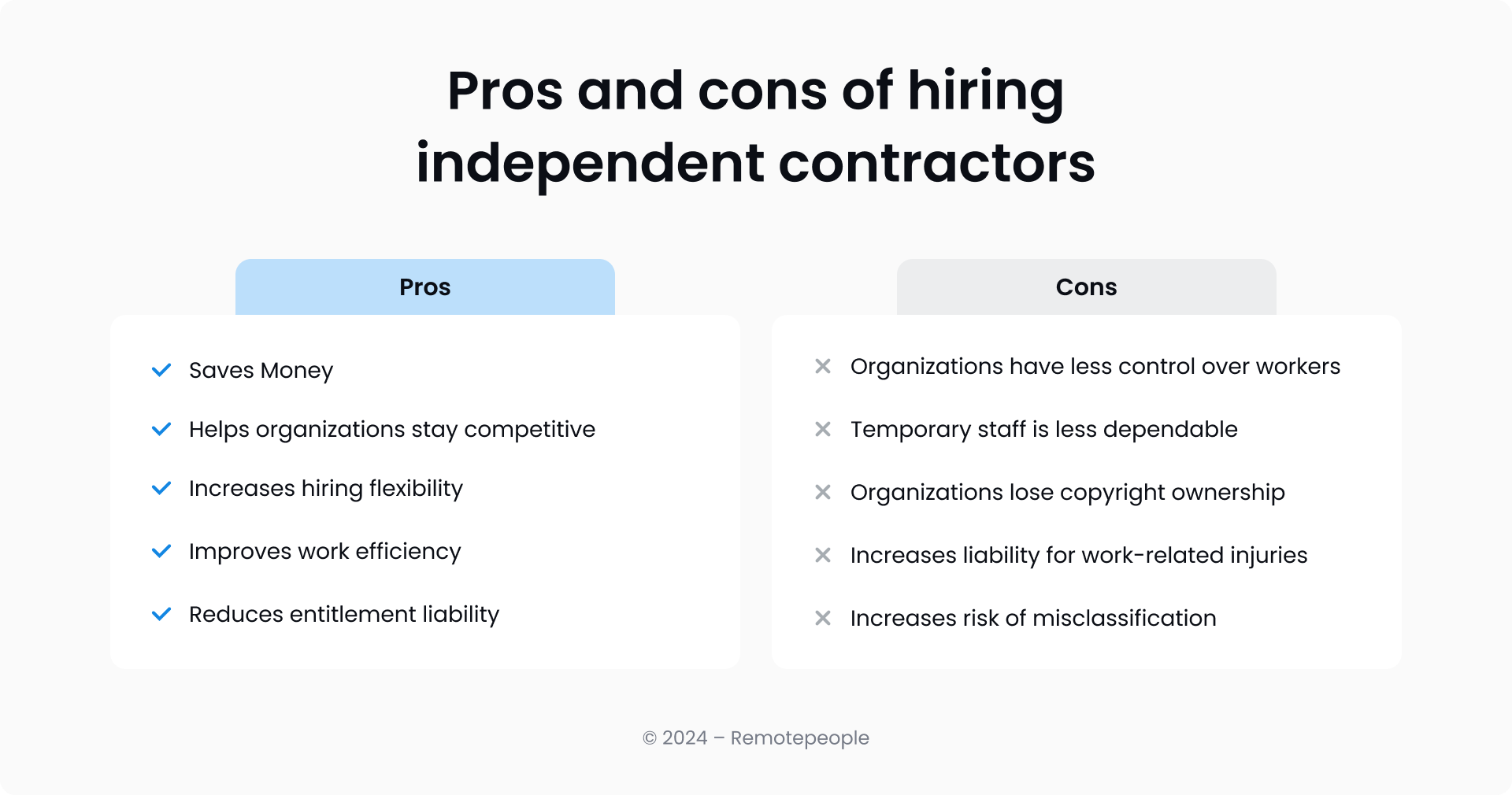
There are lots of reasons why businesses choose to hire independent contractors over employees. These include:
Benefits of Hiring Independent Contractors
Hiring independent contractors offers several advantages for businesses. One significant benefit is access to a broader talent pool, including international contractors with diverse skills and perspectives. This global reach allows companies to find the best experts for specific projects without geographical limitations.
Another advantage is cost savings. While independent contractors may charge higher hourly or project rates than employees, businesses save on expenses related to benefits, payroll taxes, and overhead costs associated with full-time staff. Companies are not required to provide health insurance, retirement plans, or paid leave to independent contractors, resulting in significant financial savings.
Flexibility and speed are also key benefits. Independent contractors can be hired quickly to meet immediate business needs without the long-term commitment of employing full-time staff. This agility allows companies to scale their workforce up or down based on project demands, market conditions, or strategic priorities.
Furthermore, independent contractors often possess unique and specialized skills or expertise that may not be available within the company. Engaging these professionals allows businesses to leverage their knowledge for specific projects, inspiring the quality and innovation of their offerings.
Potential Downsides of Hiring Independent Contractors
Despite the benefits, there are potential downsides when hiring independent contractors. Retention and focus can be challenges, as contractors are not bound to the company beyond their contractual agreements. They may work with competitors in the future or prioritize other clients over your projects.
Misclassification risk is a significant concern. Incorrectly classifying employees as independent contractors can lead to legal issues, including fines, back taxes, and penalties. Companies must thoroughly understand the criteria distinguishing an independent contractor from an employee to avoid these risks.
Security and liability risks are also important considerations. Contractors using their equipment may introduce security vulnerabilities, such as inadequate cybersecurity measures. Additionally, if contractors lack proper insurance, the company could be liable for work-related injuries, damages, or legal disputes arising from the contractor’s actions.
These risks can be amplified for international contractors due to differing legal systems, cultural norms, and regulatory environments. Companies must exercise due diligence when engaging international contractors to ensure compliance and protect their interests.
Legal Considerations in the United States
Several federal agencies, including the U.S. Department of Labor and the Internal Revenue Service (IRS), have established criteria for determining a worker’s employment status in the United States. Proper classification is essential to complying with labor laws and tax obligations and avoiding legal repercussions.
Fair Labor Standards Act
The Fair Labor Standards Act (FLSA) is a federal law that establishes minimum wage, overtime pay, recordkeeping, and youth employment standards affecting employees.
Independent contractors are not covered under the FLSA, which means they are not entitled to minimum wage, overtime pay, or other protections afforded to employees. Misclassifying an employee as an independent contractor can lead to violations of the FLSA, resulting in back pay, penalties, and legal action.
Department of Labor's Economic Reality Test
The U.S. Department of Labor employs the economic reality test to determine whether a worker is economically dependent on the employer (indicating employee status) or is in business for themselves (indicating independent contractor status).
This test examines factors such as the degree of control exercised by the employer, the worker’s opportunity for profit or loss, investment in equipment or materials, skill required for the work, permanence of the relationship, and whether the work is an integral part of the employer’s business.
Internal Revenue Service Guidelines
The IRS uses its criteria to assess worker classification, focusing on three main categories: behavioral control, financial control, and the parties’ relationship. Behavioral control refers to whether the company can direct how the worker does the task. Financial control examines how the worker is paid, whether expenses are reimbursed, and who provides tools and supplies. The relationship aspect looks at written contracts and whether the worker receives benefits typically associated with employment.
Misclassification can result in the employer being held liable for employment taxes, including income tax withholding and the employer’s share of FICA taxes (Social Security and Medicare taxes). Penalties and interest may also be imposed.
State Laws and Regulations
In addition to federal laws, state laws may have their criteria and tests for worker classification, sometimes more stringent than federal guidelines. For example, some states use the ABC test, which presumes a worker is an employee unless the employer can demonstrate that the worker is free from control, performs work outside the usual course of the employer’s business, and is customarily engaged in an independently established trade or occupation.
Businesses must comply with federal and state laws to avoid legal issues and financial penalties.
Tax Implications for Independent Contractors
Self-Employment Taxes
Independent contractors are responsible for paying their own taxes, including self-employment taxes covering Social Security and Medicare contributions.
The self-employment tax rate is calculated based on the net earnings from self-employment and is currently set at 15.3% (12.4% for Social Security and 2.9% for Medicare).
Contractors must diligently track their income and expenses to calculate their tax obligations accurately.
Estimated Tax Payments
Independent contractors must handle their own tax payments, including self-employment tax. They should track income, expenses, and tax deductions while making quarterly estimated payments to the IRS and state tax authorities to avoid penalties.
Failure to make timely payments can result in penalties and interest charges. Contractors should consult with tax professionals or use tax software to ensure compliance with tax laws.
IRS Forms and Reporting
Clients who pay independent contractors $600 or more during the year must issue an IRS Form 1099-NEC (Nonemployee Compensation) to the contractor and the IRS.
This form reports the total amount paid, and the contractor uses it to report income on their tax returns.
To file their taxes correctly, contractors must maintain accurate records of all income received and expenses incurred.
International Tax Considerations
Tax obligations can be more complex for international contractors. Contractors must be aware of tax treaties between their country and the United States (or the hiring company’s country) that may affect their tax liability.
They may need to file additional forms, such as the IRS Form W-8BEN, to claim treaty benefits and avoid double taxation.
Workers' Compensation and Benefits
Employees are typically covered by workers’ compensation insurance provided by the employer, which offers benefits in the event of work-related injuries or illnesses. Independent contractors, however, are generally not eligible for workers’ compensation through the hiring company. Contractors must secure their insurance policies to protect themselves against potential risks.
Similarly, independent contractors do not receive employer-provided benefits such as health insurance, retirement plans, paid leave, or unemployment insurance. They must plan and provide for these needs independently.
Insurance Needs for Independent Contractors
| Type of Insurance | Description |
|---|---|
| Professional Liability Insurance (Errors and Omissions Insurance) | Protects contractors against claims of negligence, mistakes, or inadequate work. It is crucial for professionals whose advice or services could cause financial loss to clients. |
| General Liability Insurance | Covers third-party claims for bodily injury, property damage, or personal and advertising injury. Contractors need to interact with clients or the public in physical spaces. |
| Health Insurance | It is essential to cover medical expenses. Contractors should explore options available through private insurers, government marketplaces, or professional associations. |
| Disability Insurance | Provides income protection if the contractor cannot work due to illness or injury. Without employer-provided coverage, securing individual disability insurance is a critical consideration. |
Retirement Planning and Benefits
Independent contractors must proactively plan for their financial future without access to employer-sponsored retirement plans. Several retirement savings options are available:
- Individual Retirement Accounts (IRAs): Both Traditional and Roth IRAs offer tax advantages for retirement savings.
- Solo 401(k) Plans: These plans allow for higher contribution limits and potential tax benefits for self-employed individuals.
- Simplified Employee Pension (SEP) IRAs: SEP IRAs, with their easy setup and flexible contribution options, are particularly well-suited for independent contractors with varying income levels.
Contractors should consult financial advisors to select the retirement plan that best fits their needs and financial goals.
The Role of Written Contracts
A well-drafted written contract is essential in establishing a clear and legally binding relationship between the independent contractor and the client. The contract should detail the scope of work, including specific tasks, deliverables, deadlines, and quality standards. It should outline payment terms, specifying the compensation amount, payment schedule, invoicing procedures, and any expenses to be reimbursed.
Confidentiality and non-disclosure agreements are essential to protect sensitive information and trade secrets. The contract should also address intellectual property rights, clarify ownership of any work produced, and grant appropriate licenses if necessary.
Including provisions for dispute resolution, termination clauses, and compliance with applicable laws adds further protection for both parties. For international contractors, contracts should consider jurisdictional issues and may need to include provisions that address international legal considerations.
How to Avoid the Risks of Misclassified Contractors
Businesses should take several proactive steps to mitigate the risks associated with misclassification. First, they must understand the legal definitions and criteria established by the Department of Labor, the IRS, and relevant state agencies. This understanding helps them make informed decisions when classifying workers.
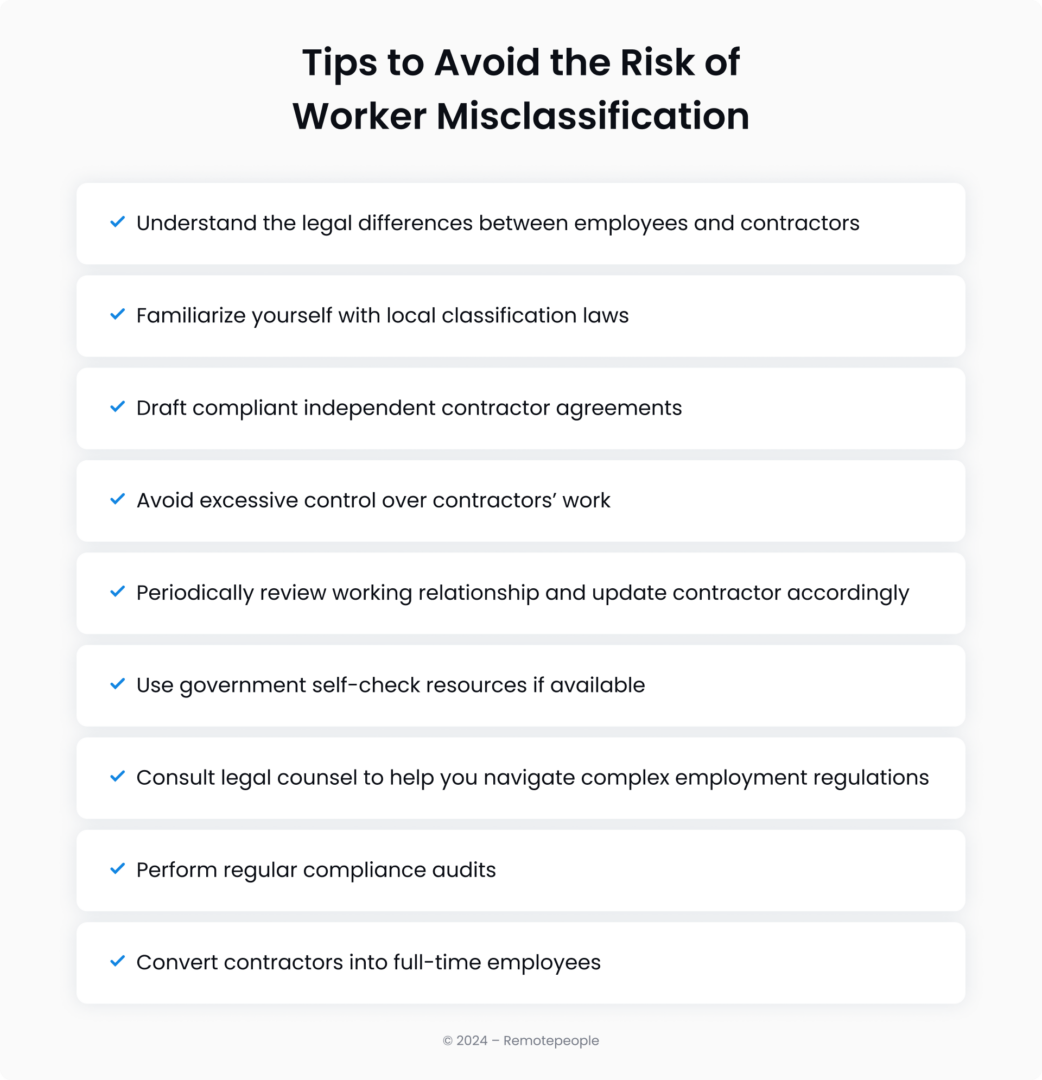
Conducting a thorough assessment of the working relationship is crucial. Businesses should evaluate the degree of control over the worker, the financial aspects of the relationship, and how integrated the worker is into the company’s operations.
Using clear and detailed contracts that emphasize the independent nature of the relationship can provide evidence of the parties’ intent. The contract should avoid language that suggests an employment relationship, such as specifying work hours or providing extensive training.
Businesses should avoid exerting employer-like control over independent contractors. They should focus on the work’s results rather than the means by which it is accomplished. Providing tools, equipment, or office space can blur the lines and suggest an employment relationship.
Consulting with legal professionals specializing in employment law is advisable to ensure compliance with all applicable laws and regulations. Regular reviews and updates to policies and contracts can help maintain contractor compliance as laws and business needs evolve.
Common Mistakes to Avoid When Hiring Independent Contractors
Businesses often make mistakes that can lead to legal complications when hiring independent contractors. One common error is failing to have a written contract or using a generic agreement that does not address the specifics of the relationship. This oversight can lead to misunderstandings and disputes over scope, payment, or intellectual property rights.
Another mistake is exerting too much control over the contractor’s work process. Providing detailed instructions on how to perform tasks, requiring set work hours, or integrating the contractor into team meetings and activities can indicate an employment relationship.
Neglecting to verify the contractor’s qualifications, licenses, or compliance with industry regulations can expose the business to risks, especially in fields that require professional certifications or adherence to safety standards.
Ignoring state laws and assuming that federal guidelines are sufficient can result in non-compliance. Some states have stricter criteria for worker classification, and businesses must ensure they meet all legal requirements at both the federal and state levels.
How to Hire an Independent Contractor
To help you hire a contractor, we’ve outlined a step-by-step guide:
Define Your Project
Before hiring an independent contractor, define your project requirements, expected deliverables, and preferred skill set. Using clear project descriptions and competitive pay rates will help attract top-tier talent.Search for Qualified Contractors
Once you understand your project requirements, begin searching for qualified contractors. Look for potential candidates using professional networks, online platforms, or industry associations. To attract suitable contractors, create a job posting that clearly outlines the project requirements and expectations.Review Portfolios and Proposals
As you receive applications from potential contractors, evaluate their portfolios, references, and experience. Based on their previous work and client feedback, assess their expertise and suitability for the project.Conduct Interviews or Consultations
After shortlisting the most qualified candidates, schedule interviews or consultations to discuss the project in detail. Use this opportunity to gauge the contractor’s understanding of the project, communication skills, and cultural fit. Address their availability, deadlines, and any concerns they may have.Negotiate Terms
Once you have identified the most suitable contractor for your project, negotiate the terms of the engagement. Agree on compensation, payment schedules, milestones, and deliverables. Ensure that both parties clearly understand the scope of work and any contingencies that may arise.Draft an Independent Contractor Agreement
Draft a comprehensive independent contractor agreement to formalize the relationship. The contract should cover essential aspects such as the scope of work, payment terms, confidentiality, intellectual property rights, and dispute resolution mechanisms. Seek legal advice to ensure the contract is legally sound and protects both parties’ interests.Complete Necessary Paperwork
Before the contractor begins work, complete any necessary paperwork. If required, obtain a Federal Employer Identification Number (EIN) and register with your state departments to ensure compliance with regulations. Have the contractor complete the proper tax forms, such as W-9 for U.S. citizens or W-8BEN for foreign contractors.
How to Pay Independent Contractors
Payment arrangements with independent contractors can vary based on the nature of the work and industry standards. Common methods include:
- Time-Based Rates: Contractors charge an hourly or daily rate. This method is suitable when the scope of work is variable or ongoing.
- Project-Based Rates: A fixed price is agreed upon for the entire project. This approach clarifies costs and is standard for defined projects with clear deliverables.
- Measurement-Based Rates: Contractors charge based on measurable units, such as per word for writers or per design for graphic artists.
- Retainer Agreements: Contractors are paid a regular fee to provide ongoing services over a set period.
When working with international contractors, businesses must consider currency exchange rates, payment methods that support international transactions, and compliance with both countries’ laws.
Secure and efficient payments can be facilitated by platforms like PayPal, Wise, or specialized international contractor management services like Horizons or Deel.
Establishing clear invoicing and payment procedures, including any requirements for documentation, tax forms, or receipts, is important.
Transitioning from Employee to Independent Contractor
For individuals considering a shift from traditional employment to independent contracting, several factors need careful consideration. Legally, they must establish themselves as self-employed, which may involve registering a business entity, obtaining necessary licenses, and setting up business banking accounts.
Financial planning is crucial, as income can be irregular, and there are additional responsibilities like paying self-employment taxes and securing insurance. Building a financial cushion and budgeting for fluctuations in income can help manage these challenges.
Developing a client base may require marketing efforts, networking, and leveraging existing professional relationships. It’s important to have a clear value proposition and to differentiate oneself in the marketplace.
Adjusting to the entrepreneurial mindset involves embracing autonomy, self-motivation, and accountability. Independent contractors must manage all aspects of their business, from service delivery to administrative tasks.
Transitioning from Independent Contractor to Employee Using Employer of Record Services
Sometimes, a business may convert an independent contractor to a full-time employee to better align with long-term strategic goals, ensure compliance, or deepen the working relationship.
This transition can be complex, especially when dealing with international contractors due to varying labor laws and regulations. Utilizing an Employer of Record (EOR) service can streamline this process.
An Employer of Record is a third-party organization that becomes the legal employer of the worker on behalf of the company.
The EOR handles all employment-related administrative tasks, including payroll, tax withholding, benefits administration, and compliance with local employment laws. This allows the company to onboard the contractor as an employee without establishing a legal entity in the contractor’s country.
Benefits of Using an EOR Service
- Compliance Assurance: The EOR ensures that all employment practices comply with local labor laws, reducing the risk of misclassification and legal penalties.
- Simplified Onboarding: The EOR manages the paperwork and administrative requirements of hiring an employee, making the transition smoother.
- Payroll and Benefits Management: The EOR handles salary payments and tax deductions and can offer competitive benefits packages to the employee.
- Focus on Core Business: By outsourcing employment administration, the company can focus on strategic initiatives and the employee’s integration into the team.
Steps to Convert a Contractor to an Employee Using an EOR
- Assess the Need
Determine whether converting the contractor to an employee aligns with business objectives and the contractor’s willingness to transition. - Select a Reputable EOR
Choose an EOR service with expertise in the contractor’s country and a track record of compliance and reliability. - Engage the EOR
Enter into an agreement with the EOR, outlining the terms of the employee’s role, compensation, and responsibilities. - Coordinate the Transition
Work with the EOR to handle the necessary legal and administrative steps, including terminating the contractor agreement and initiating the employment contract. - Onboard the Employee
Integrate the new employee into the company’s team, providing necessary training, resources, and support.
By leveraging an Employer of Record service, companies can seamlessly transition contractors to employees, expanding their global workforce while mitigating legal risks and administrative burdens.
Impact of Technology on Independent Contracting
Advancements in technology have significantly influenced the landscape of independent contracting. Remote work tools like video conferencing software (Zoom, Microsoft Teams) and collaboration platforms (Slack, Asana) facilitate communication and project management across distances.
Cloud-based services allow contractors to access and share files securely with clients, enhancing efficiency and flexibility. Online payment systems streamline invoicing and financial transactions, making it easier to manage finances.
For international contractors, technology bridges geographical gaps, enabling them to work with clients worldwide. However, it also introduces challenges related to cybersecurity, data privacy, and the need to stay current with evolving technologies.
Gig Workers and the Modern Workforce
The rise of remote work has expanded opportunities for independent contractors, offering flexibility and the ability to work from anywhere. Platforms like Upwork, Freelancer, and Fiverr connect remote workers directly with clients, enabling them to provide their services on a project basis.
While remote contracting provides convenience and autonomy, it has also raised concerns about job security, income stability, and access to benefits. Debates continue over how best to support remote contractors and ensure fair compensation for their work.
Businesses engaging remote contractors must be mindful of these issues and ensure compliance with relevant laws and regulations regarding worker classification. For remote contractors, establishing clear communication channels, setting realistic expectations, and continually updating their skills are essential for success in a competitive remote work market.
Industry-Specific Considerations
Different industries present unique considerations for independent contractors. In construction, contractors must adhere to licensing requirements, safety regulations, and may need to provide bonds or insurance. Compliance with building codes and obtaining necessary permits are also critical.
In healthcare, contractors such as nurses, therapists, or consultants must maintain professional certifications, comply with health regulations, and ensure patient confidentiality under laws like HIPAA in the United States.
Information Technology contractors face challenges related to data security, intellectual property, and the rapid pace of technological change. They must stay updated with the latest developments and may need to comply with regulations like GDPR for data protection.
Understanding industry-specific laws, standards, and best practices is essential for both contractors and businesses to avoid legal issues and maintain professional integrity.
Legal Disputes and Case Studies
High-profile legal cases highlight the importance of proper worker classification. Companies like Uber and Lyft have faced lawsuits alleging that their drivers are misclassified as independent contractors rather than employees. These cases have led to legal challenges, legislative proposals, and settlements that impact business models and labor laws.
Similarly, FedEx Ground settled multiple lawsuits involving drivers classified as independent contractors, resulting in substantial financial penalties. These cases underscore businesses’ risks when misclassifying workers and the importance of adhering to legal standards.
Analyzing these cases provides valuable lessons for businesses in structuring their relationships with independent contractors and emphasizes the need for ongoing legal compliance.
Resources and Support for Independent Contractors
Various organizations and resources are available to support independent contractors in managing their businesses and professional development.
The Freelancers Union offers benefits, resources, and advocacy for freelancers, including insurance options and educational materials. The Small Business Administration (SBA) provides guidance on starting and managing a business, access to funding, and training programs.
Professional associations related to specific industries offer networking opportunities, certifications, and access to industry-specific resources. Engaging with these organizations can enhance credibility, visibility, and knowledge.
Checklist for Independent Contractors
To manage their businesses effectively, independent contractors should consider the following steps:
- Register Your Business: Choose an appropriate business structure (sole proprietorship, LLC, etc.) and comply with registration requirements.
- Set Up Finances: Open dedicated business banking accounts, implement accounting systems, and plan for tax obligations.
- Maintain Records: Keep detailed records of income, expenses, contracts, and communications.
- Understand Tax Obligations: Be aware of tax deadlines and required filings, and make estimated tax payments.
- Secure Insurance: Obtain necessary insurance policies to protect against risks.
- Develop Contracts: Use clear and legally sound contracts for all client engagements.
- Plan for the Future: Establish retirement savings plans and consider succession or exit strategies.
Ethical Considerations and Best Practices
Maintaining high ethical standards is essential for building a reputable and sustainable business. Independent contractors should uphold integrity by being honest and transparent with clients, delivering on promises, and admitting mistakes when they occur.
Respecting confidentiality is critical, especially when handling sensitive client information. Contractors should adhere to non-disclosure agreements and implement measures to protect data.
Delivering quality work consistently enhances reputation and client satisfaction. Contractors should strive for excellence, stay updated with industry trends, and seek feedback for continuous improvement.
International Contractor Agreements
Engaging in international contracts introduces additional considerations. Understanding tax treaties can help contractors and businesses avoid double taxation and comply with international tax laws.
Managing currency exchange rates is important for financial planning. Contractors and businesses should agree on the currency for payment and consider using hedging strategies to mitigate exchange rate risks.
Cultural sensitivity and effective communication are vital for successful international collaborations. Awareness of cultural differences, time zones, and communication styles enhances relationships and project outcomes.
Ensuring legal compliance involves understanding the laws in both the contractor’s and client’s countries, including labor laws, intellectual property rights, and data protection regulations.
Engaging an International Contractor Management Service
Businesses can simplify hiring and managing international contractors using services like Horizons, Deel, or Remote. These platforms offer solutions such as:
- Compliance Assurance: Ensuring adherence to local labor laws, tax regulations, and classification criteria.
- Localized Contracts: Providing contract templates tailored to specific countries and legal requirements.
- Streamlined Payment Processing: Handling multi-currency payments, tax withholdings, and invoicing.
- Time Savings: Automating administrative tasks, allowing businesses to focus on strategic initiatives.
By leveraging these services, companies can mitigate risks, reduce administrative burdens, and efficiently manage a global workforce.
Importance of Compliance with Employment Laws
Compliance with employment laws is critical to avoid legal disputes, financial penalties, and reputational damage. Companies must stay informed about changes in laws and regulations at the federal, state, and international levels.
Regular audits of employment practices, worker classifications, and contractual agreements help identify potential issues. Engaging legal professionals for advice and updates ensures that policies and practices align with current laws.
Understanding and complying with foreign laws requires additional diligence for international operations. Businesses should consider cultural norms, legal systems, and enforcement practices in the countries where they engage contractors.
Conclusion
Independent contractors offer businesses unparalleled flexibility, cost savings, and access to diverse specialized skills, including the ability to engage with international talent. Understanding the distinctions between contractors and employees is essential for legal compliance and effective management.
By employing best practices, such as using clear contracts, respecting the autonomy of contractors, and utilizing tools like contractor management software, businesses can successfully integrate independent contractors into their operations. Additional considerations related to legal compliance, cultural differences, and communication are vital for international contractors.
Companies can consider converting the contractor into an employee when a contractor’s role evolves into a more permanent position. Utilizing an Employer of Record (EOR) service simplifies this transition, ensuring compliance with employment laws and facilitating global expansion without establishing legal entities in new countries.
Independent contractors must proactively manage their businesses, from legal and financial responsibilities to marketing and professional development. Awareness of rights and responsibilities, planning for the future, and maintaining ethical standards are vital components of a successful contracting career.
As the global economy continues to evolve, independent contracting is poised to play an increasingly significant role. Both businesses and contractors who embrace adaptability, continuous learning, and strategic planning will be well-positioned to thrive in this dynamic environment.
Frequently Asked Question
A remote independent contractor is a self-employed individual who provides services to businesses from a location outside of the company's physical office, often from their own home or another remote location. Unlike traditional employees, remote independent contractors operate under a contractual agreement rather than an employment relationship. They have the flexibility to choose their clients, set their own schedules, and determine how they complete their work.
Independent contractor management services streamline the administrative, legal, and operational aspects of working with contractors. They cover contract administration, payment processing, compliance management, onboarding, performance monitoring, data security, communication, and reporting. These services simplify the complexities of managing contractors, ensuring compliance and efficiency.
A U.S. company can hire a Canadian independent contractor by having them complete a W-8BEN form, signing a contract that clearly defines the scope of work and payment terms, and paying them as a contractor rather than an employee. The company should also ensure compliance with Canadian tax laws and regulations.