
 Recruit
Average Salary in Austria
-
 Drew Donnelly
- Published
- September 21, 2026
Curious about salaries in Austria? This guide breaks down the average wages, compares professions, explores how Austria’s earnings measure up internationally.
- 5 ★ on G2








Let RemotePeople handle payroll, compliance, and HR admin worldwide so you can focus on building your team.
Austria is an attractive outsourcing destination due to its highly skilled workforce and central European location. Employers considering hiring Austrian remote workers may wonder, what is the average salary in Austria. This article will tell you everything you need to know.
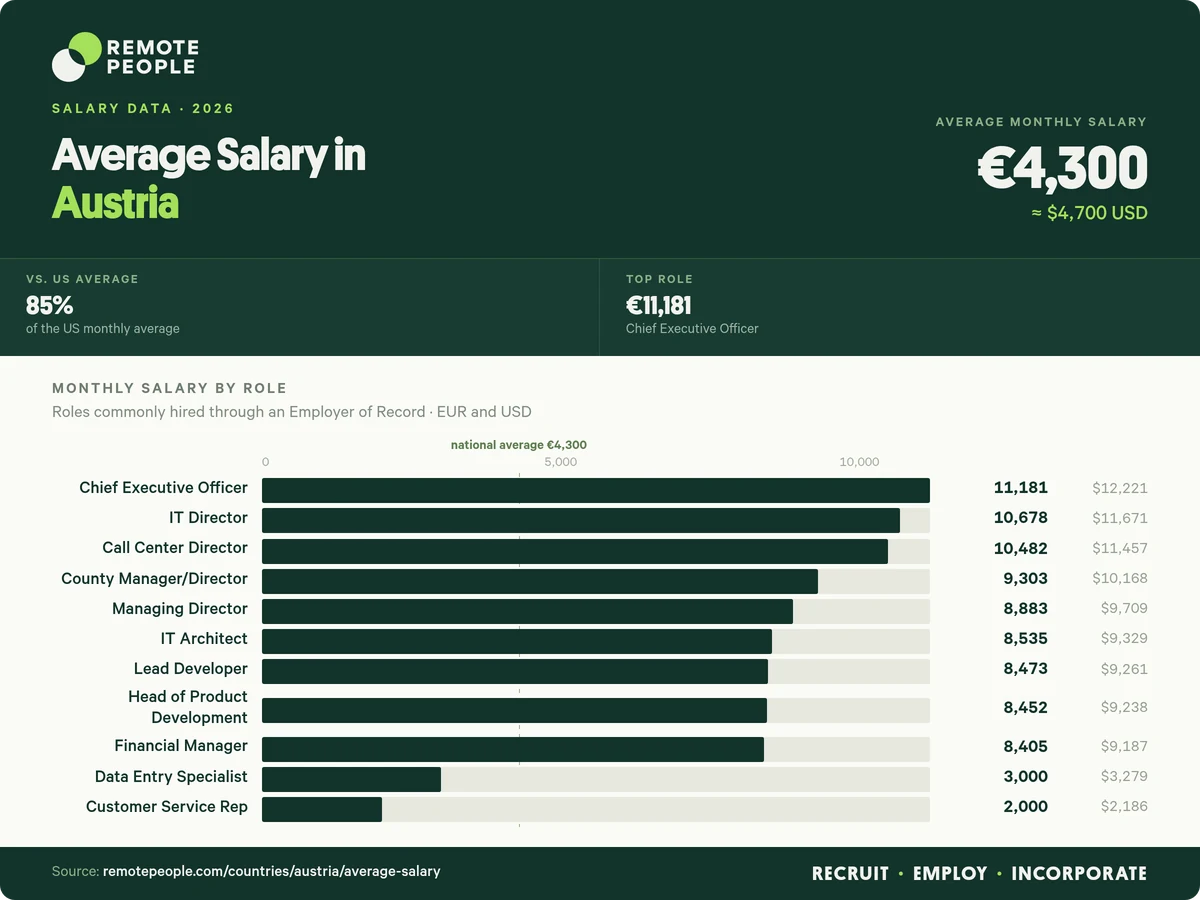
The average monthly salary in Austria is €4,300, which translates to USD 4,700. However, salaries vary depending on profession, location, education, and experience. To gain more insight, you must also consider average wages in other countries, median monthly income, and salary ranges.
Read on to learn more about the average salary in Austria, so you have the information you need to make a fair offer.
What is the Average Salary in Austria?
The average salary is calculated by adding salaries throughout the county and dividing the total by the number of workers. The average salary in Austria is €4,300, which translates to $4,700. Austrian median income and salary ranges provide additional insight.
Median Income
The median salary can also be considered the ‘middle salary.’ Austrian median income is €3,500. That means 50% of Austrians make more than €3,500, and 50% of workers make less.
Salary Range
The salary range spans the lowest to highest salaries in the country. Low-paid Austrian workers will make about €2,300 per month, while higher-paid employees make closer to €7,000.
Salary Comparison by Profession
Different professions offer different wages. For example, highly skilled workers usually make more than workers with basic skills. This salary comparison chart will break down salaries by profession to better understand the Austrian work economy.
Profession | Salary (€) |
|---|---|
Chief Executive Officer | 11,181 |
IT Director | 10,678 |
Call Center Director | 10,482 |
Plant Manager | 9,329 |
County Manager/Director | 9,303 |
Managing Director | 8,883 |
IT Architect | 8,535 |
Lead Developer | 8,473 |
Head of Product Development | 8,452 |
Financial Manager | 8,405 |
Data Entry Specialist | 3,000 |
Cashier | 2,128 |
General Laborer | 2,121 |
Packer | 2,090 |
Housekeeper | 2,049 |
Assistant Teacher | 2,040 |
Customer Service Rep | 2,000 |
Seamstress | 1,996 |
Cleaner | 1,981 |
Average Wage in Austria by Education
Education is another factor to consider when calculating average salaries in Europe. Individuals with a bachelor’s degree typically earn a starting wage of €3,300, which increases to €3,700 after three years, €4,100 after five years, and €4,900 after ten years.
Workers with a master’s degree can expect to earn €3,900 after graduation, while individuals with graduate or doctorate degrees often start the workforce with a €4,700 monthly salary.
Moreover, a degree can increase one’s chances of employment. Nearly four out of five Austrian college graduates are gainfully employed, resulting in a low unemployment rate of around 2.5%.
Salary Comparison by Experience
The section on education provides context for how experience impacts salary. Comparing engineer salaries in the country offers further insight. Entry-level engineers typically make around €3,300 monthly, while senior-level engineers can make €7,500 or more.
Salary Comparison by Location
Location also impacts salary. Due to the higher cost of living, people in urban areas expect to make more than rural workers. These workers also live closer to metropolitan hubs filled with established businesses.
This table reveals the salaries of workers in major Austrian cities.
City | Average Annual Salary (€) |
|---|---|
Vienna | 59,500 |
Salzburg | 54,200 |
Graz | 50,300 |
Linz | 51,000 |
Meanwhile, rural workers, such as farm workers, make closer to €40,500 per year.
Average Salary in Austria vs. the Rest of the World
Comparing Austrian salaries to other countries can give you more insight into the country’s wages. These charts compare Austria to various developed, undeveloped, and developing countries.
Austria vs. Developed Countries
Country | Average Salary | Comparison to Average Austria Salary |
|---|---|---|
United Kingdom | £3,000 (approx. $4,100) | − 1% |
United States | $5,220 | − 22% |
Norway | 50,000 NOK (approx. $4,700) | − 14% |
Germany | €4,300 (approx. $4,470) | − 9% |
Australia | 8,550 AUD (approx. $5,650) | − 30% |
Austria vs. Developing Countries
Country | Average Salary | Comparison to Average Austria Salary |
|---|---|---|
Romania | 4,000 RON (approx. $835) | 385% |
Russia | 73,700 RUB (approx. $700) | 479% |
Albania | 83,330 ALL (approx. $860) | 79% |
Kazakhstan | 342,082 Tenge (approx. $645) | 528% |
Ukraine | 18,000 Hryvnia (approx. $500) | 710% |
Austria vs. Undeveloped Countries
Country | Average Salary | Comparison to Average Austria Salary |
|---|---|---|
Thailand | 15,000 Baht (approx. $420) | 864% |
Philippines | 15,000 PHP (approx. $265) | 1,430% |
Vietnam | 7.5 million Dong (approx. $300) | 1,250% |
Egypt | 3,900 EGP (approx. $125) | 3,140% |
Pakistan | 60,000 PKR (approx. $210) | 1,830% |
Austrian workers make competitive salaries, so cost savings may not be the most significant benefit of outsourcing to the country. However, Austria is highly developed and has many skilled workers. It is also strategically located in Central Europe, with easy access to Western and Eastern Europe.
The country is known for its high-quality manufacturing, automotive, and engineering standards. It is also a top destination for innovation and research. Although the work economy is largely service-dominated, it boasts an impressive tech sector.
What are the Most Common Outsourced Industries in Austria?
Employers seeking to outsource to Austria can find highly skilled workers in the following industries.
Software Development
Austria has a thriving tech industry with rapidly growing startups and an education system that aims to develop talented specialists. The government supports tech research initiatives. The country is an ideal destination for mobile app development, software engineering, quality assurance, and other IT workers.
Austrian developers typically earn between €80,000 (approximately $87,000) and €100,000 (roughly $109,000) per year. This is compared to America’s median salary of $132,270 per year, which could mean cost savings for U.S. employers.
Financial Services
Austria’s banking sector is considered one of the most stable in the world. Government organizations oversee it. Austria is ideal for accountants, bookkeepers, payroll processors, and other financial services providers.
Austrian accountants earn between €45,000 (approximately $49,000) and €75,000 (roughly $82,000) annually, compared to the median salary of $79,880 in the United States.
Customer Support
Austria is a service-oriented country, so its workers tend to provide superior customer support. Many individuals are multilingual, a bonus in the customer support industry. The country’s workers may be suited for tech support, helpdesk services, and call center operations.
Customer service reps in Austria typically earn an average annual salary of €47,000 (approximately $51,000). Meanwhile, representatives in the U.S. make between $39,680 and $97,569, depending on the type of support they provide.
Conclusion
Austria may not be the most affordable outsourcing solution, but its highly skilled workforce, dedication to quality, and convenient location make it a desirable destination for remote work. The information in this article puts workers in an optimal position to make a competitive offer. A partnership can benefit all parties involved.