
 Recruit
Average Salary in Azerbaijan
-
 Drew Donnelly
- Published
- September 21, 2026
Curious about salaries in Azerbaijan? This guide breaks down the average wages, compares professions, explores how Azerbaijan’s earnings measure up internationally. Partnering with an Employer of Record (EOR) in Azerbaijan lets you employ staff there without establishing a legal entity of your own.
- 5 ★ on G2








Let RemotePeople handle payroll, compliance, and HR admin worldwide so you can focus on building your team.
Azerbaijan’s cost-effective labor, skilled workforce, and strategic location make it an ideal outsourcing destination. Employers wanting to hire in the area may wonder, What is the average salary in Azerbaijan? This information will help them prepare a fair hiring offer. Employers may also run background checks in Azerbaijan for certain roles, so it is worth knowing what is permitted before you hire.
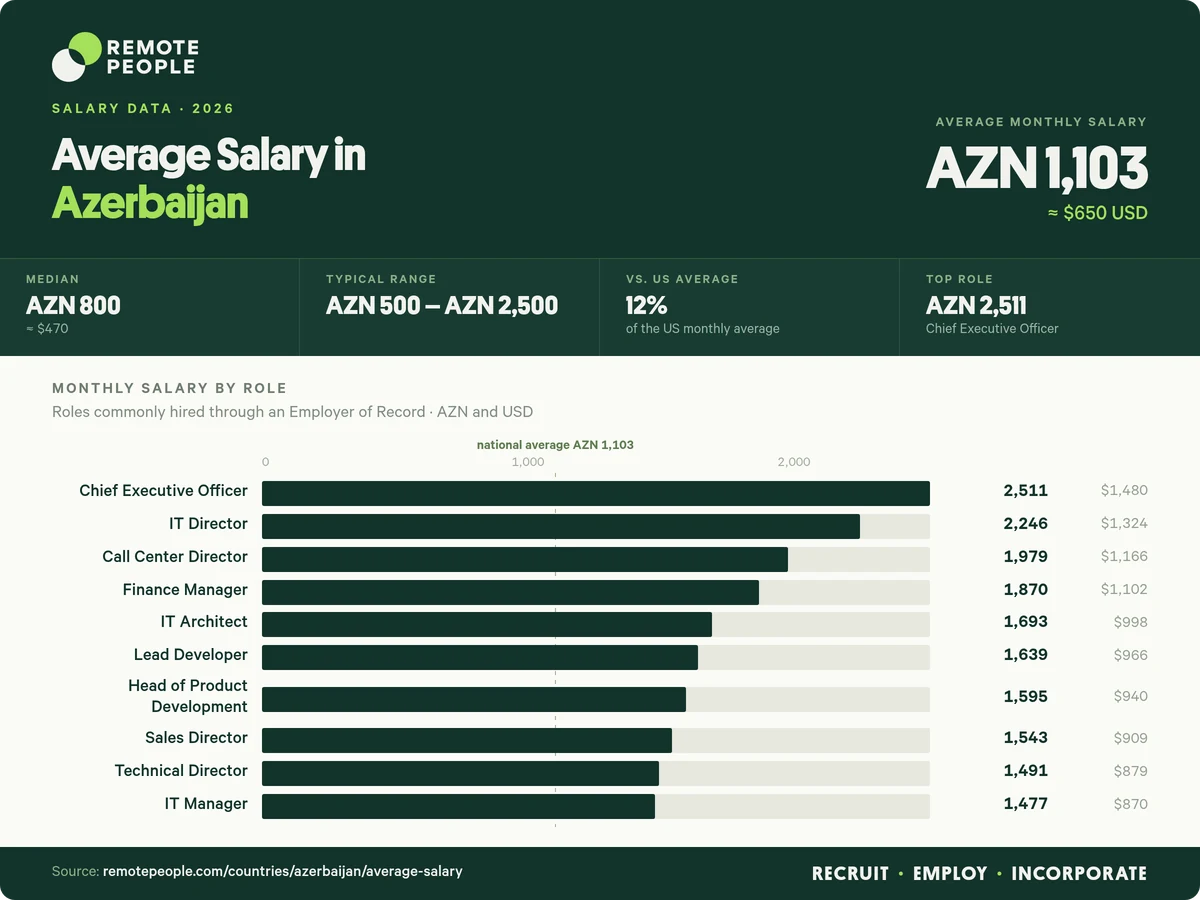
The average salary in Azerbaijan is 1,103 Azerbaijani Manat (AZN), about USD 650. However, wages vary by education, experience, location, position, and industry. Comparing wages to those in other countries will provide additional insight.
This guide will explore all aspects of Azerbaijan’s salaries to prepare you for your hiring journey.
What is the Average Salary in Azerbaijan?
The average monthly salary in Azerbaijan is 1,103 AZN, about $650. The country is plagued by inequality, as its oil industry puts wealth in the hands of a few. The rest of the workers rely on agriculture and other low-paying sectors.
Median Income
Azerbaijan’s median monthly income is 800 AZN, about $470. Half the country’s workers earn higher salaries; the other half earn less.
Salary Range
The salary range spans from the lowest to the highest in the country. In Azerbaijan, low earners make around 500 AZN, about $295 monthly, while high earners make closer to 2,500 AZN, about $1,475.
Salary Comparisons in Azerbaijan
Average salary provides some insight, but you must also consider how wages are affected by education, experience, location, position, and industry. The following sections will review how these factors impact earnings.
Salary by Position
This salary comparison chart reveals how wages in Azerbaijan vary by position.
Position | Average Monthly Salary (AZN) |
|---|---|
Chief Executive Officer | 2,511 |
IT Director | 2,246 |
Call Center Director | 1,979 |
Finance Manager | 1,870 |
IT Architect | 1,693 |
Lead Developer | 1,639 |
Head of Product Development | 1,595 |
Sales Director | 1,543 |
Technical Director | 1,491 |
IT Manager | 1,477 |
Banking Cashier | 505 |
Fabric Cutter | 504 |
Clothing Technologist | 503 |
Packer | 494 |
Seamstress | 476 |
Porter | 464 |
Medical Records Clerk | 463 |
Tailor | 460 |
Social Counselor | 452 |
Average Wage in Azerbaijan Based on Education
Education impacts salaries in Azerbaijan with a 6% return rate, meaning workers will see a 6% ROI on every dollar they invest in education. Returns are slightly higher for women, at 8%, and 9% for tertiary education.
Salary Comparison by Experience
Experience also contributes to earnings. Statistics show that experienced and educated Azerbajani workers can earn 33% more than their less educated and professional peers. However, women are less likely to see higher wages based on experience, as they tend to receive less training and leave the workforce by 35.
Salary Comparison by Location
Location is also considered in wage determination, as urban workers earn more than rural workers due to higher living costs and proximity to large companies offering higher-paying job opportunities. In Azerbaijan, workers in Baku, the capital city and central economic hub, earn higher salaries than those in smaller towns. Ganja and Sumqayit also offer competitive wages.
Although workers in rural areas tend to earn less, those with rich oil reserves in their area may benefit from higher wages.
Average Salary in Azerbaijan vs. the Rest of the World
To provide more insight, the following charts compare salaries in Azerbaijan to those in developed, developing, and least developed countries.
Azerbaijan vs. Developed Countries
Country | Average Salary | Comparison to Average Azerbaijan Salary |
|---|---|---|
Japan | 340,000 JPY (approx. $2,300) | 209% |
United Kingdom | £3,000 (≈ $4,100) | − 85% |
Norway | 50,000 NOK (≈ $4,700) | − 87% |
Germany | €4,300 (≈ $4,470) | − 87% |
Austria | 3500 euros (approx. $3636) | − 85% |
Azerbaijan vs. Developing Countries
|
Country
|
Average Salary
|
Comparison to Average Azerbaijan Salary
|
|---|---|---|
Romania |
4,000 RON (approx. $835) |
− 28% |
Russia |
73,700 RUB (approx. $700) |
− 14% |
Albania |
83,330 ALL (approx. $860) |
− 43% |
Kazakhstan |
342,000 KZT (approx. $645) |
− 7% |
Ukraine |
18,000 UAH (approx. $500) |
20% |
Azerbaijan vs. Undeveloped Countries
Country | Average Salary | Comparison to Average Azerbaijan Salary |
|---|---|---|
Afghanistan | 13,200 Afghanis (approx. $150) | 300% |
Philippines | 15,000 PHP (approx. $265) | 126% |
Cambodia | 1,150,000 Riel (approx. $280) | 114% |
Egypt | 3,900 EGP (approx. $125) | 380% |
Pakistan | 60,000 PKR (approx. $210) | 186% |
Azerbaijan is a developing country with an upper-middle income. It ranks highly on the Human Development Index. Although its economy heavily relies on oil and gas, it is working to diversify into other sectors.
The country’s low-cost labor, skilled workforce, and strategic location make it an ideal outsourcing destination. Located at the crossroads of Europe and Asia, it offers access to both markets. The government supports outsourcing, particularly in IT, with tax incentives, investments in tech parks, various grants, and a favorable business environment.
What are the Most Common Outsourced Industries in Azerbaijan?
Employers seeking remote opportunities in the country will benefit most when focusing on the following sectors.
IT Services
Azerbaijan’s IT sector is experiencing rapid growth, with a strong focus on telecommunications and software development. The government supports the industry with initiatives like Online Azerbaijan, which aims to bring the country 100% broadband internet access. It has also established tech parks that offer tax breaks and exemptions to those who invest in the sector.
An IT director in Azerbaijan earns about 2,500 AZN per month, compared to their American counterparts, who earn more than $12,500. This leads to significant savings for employers that outsource to the country.
Energy Services
Azerbaijan relies heavily on the gas and oil sector, accounting for a significant portion of its GDP. The country’s expertise in the industry could open up outsourcing opportunities related to equipment, services, and technology, refining, marketing, and distribution. It is also a major exporter of crude oil.
Manufacturing
Although Azerbaijan focuses on the oil and gas industry, it also diversifies into manufacturing with major sectors including engineering, metallurgy, defense, food, construction materials, and electro-energy. In addition to exporting, there is a potential for outsourcing production. It offers industrial zones designed to attract foreign investment.
Conclusion
Azerbaijan’s low average salaries lead to cost savings for employers. Companies that outsource can take advantage of reduced expenses and quality goods and services, while helping workers overcome income inequality, resulting in a favorable situation for everyone involved.