
 Recruit
Average Salary in Bosnia and Herzegovina
-
 Drew Donnelly
- Published
- September 21, 2026
Curious about salaries in Bosnia and Herzegovina? This guide breaks down the average wages, compares professions, highlights minimum wage figures, and explores how Bosnia and Herzegovina’s earnings measure up internationally.
- 5 ★ on G2








- Bosnia and Herzegovina Services
- What is the Average Salary in Bosnia and Herzegovina?
- Salary Comparisons in Bosnia and Herzegovina
- How Much is Minimum Wage in Bosnia and Herzegovina?
- Average Salary in Bosnia and Herzegovina vs. the Rest of the World
- What are the Most Common Outsourced Industries in Bosnia and Herzegovina?
- Conclusion

Let RemotePeople handle payroll, compliance, and HR admin worldwide so you can focus on building your team.
Bosnia and Herzegovina’s cost-effective labor, skilled workforce, and strategic location make it an ideal outsourcing destination. Employers looking to hire in the area may wonder, “What is the average salary in Bosnia and Herzegovina?” This information will help them develop a fair hiring offer.
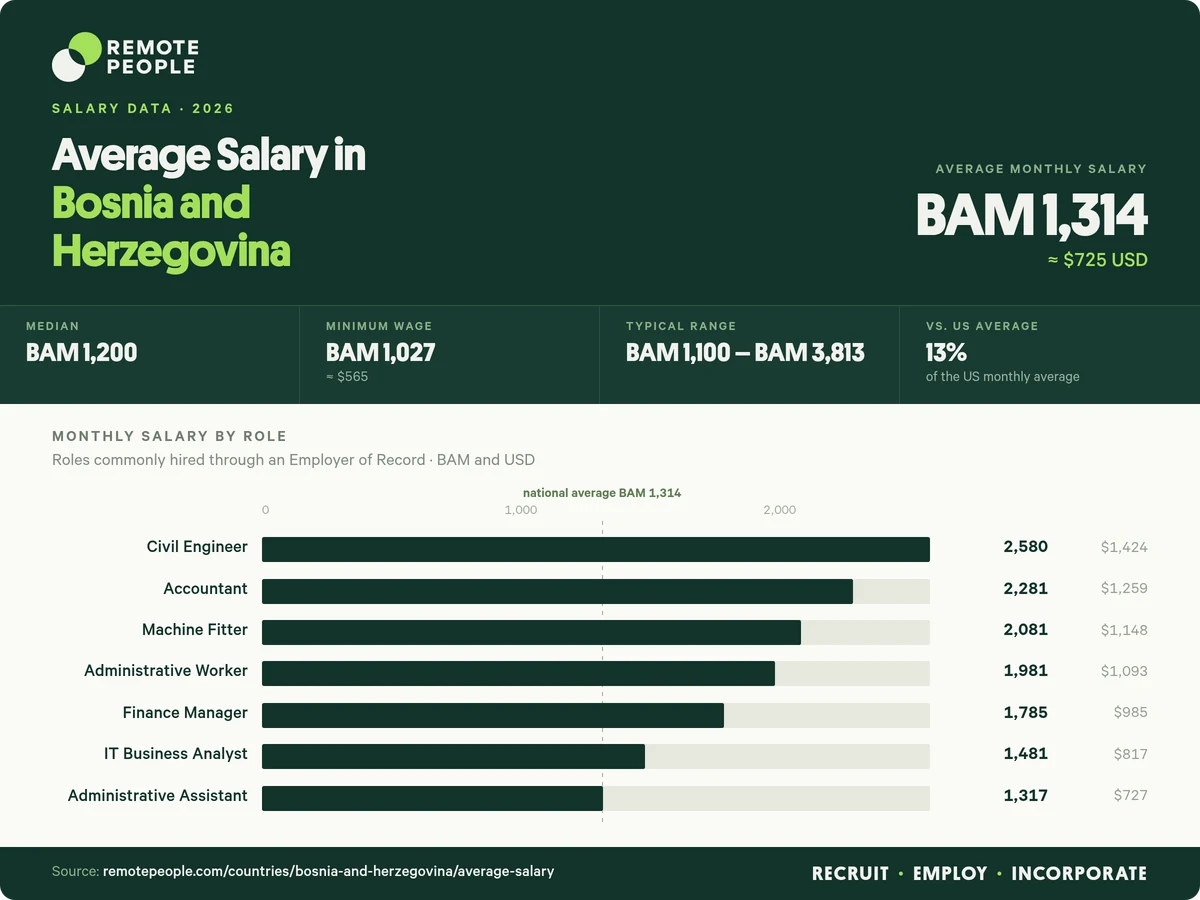
The average monthly salary in Bosnia and Herzegovina is 1,314 Bosnia-Herzegovina Convertible Marks (BAM), about USD 725. However, wages vary by profession, industry, experience, education, and location. Comparing wages in the country to earnings around the world provides additional insight.
This guide will explore all aspects of salaries in Bosnia and Herzegovina to prepare you for your hiring journey.
What is the Average Salary in Bosnia and Herzegovina?
The average salary in Bosnia and Herzegovina is 1,314 BAM, about $725. The country’s low wages are due to its consumption-based economy, which does not prioritize productivity.
However, a popular ‘envelope wages’ culture makes it difficult to estimate wages. Many employers pay their employees ‘in an envelope’ to avoid taxes, so take-home pay in the country is likely higher than statistics show.
Median Income
The median salary in Bosnia and Herzegovina is 1,200 BAM. Half the country’s population earns higher wages, and the other half earns less.
Salary Range
The salary range spans from the country’s lowest to the highest wages. In Bosnia and Herzegovina, low earners make around 1,100 BAM, about $605, while high earners make closer to 3,813 BAM, about $2,095.
Salary Comparisons in Bosnia and Herzegovina
Average salary provides insight, but you must consider how wages vary by industry, position, education, experience, and location. The following sections will explore these factors to provide additional insight.
Salary by Position
The following salary comparison chart reveals how wages vary by position.
Position | Average Monthly Salary (BAM) |
|---|---|
Accountant | 2,281 |
IT Business Analyst | 1,481 |
Civil Engineer | 2,580 |
Finance Manager | 1,785 |
Agricultural Technician | 1,190 |
Fast Food Worker | 1,190 |
Administrative Assistant | 1,317 |
Administrative Worker | 1,981 |
Machine Fitter | 2,081 |
Average Wage in Bosnia and Herzegovina Based on Education
Education can positively impact wages in Bosnia and Herzegovina. However, the country is plagued by a wage mismatch. Workers who attain high levels of education may struggle to find jobs suited to their degrees.
Statistics show that overeducated workers earn 13% less than their adequately educated counterparts, while undereducated workers earn 10% less. Experts feel that undereducated workers may work harder than their overeducated counterparts, supporting the percentage outcomes.
Salary Comparison by Experience
Experience also plays a role in wage determination, as experienced workers earn more than entry-level workers, and employees become eligible for raises with tenure. This situation generally rings true in Bosnia. However, in some positions, older workers, presumably with more experience, may earn less.
Experience also plays a role in wage determination, as experienced workers earn more than entry-level workers, and employees become eligible for raises with tenure. This situation generally rings true in Bosnia. However, in some positions, older workers, presumably with more experience, may earn less.
For example, administrative assistants aged 25–34 earn an average salary of USD 670, while 35–44-year-olds in the same position earn an average salary of $560.
Salary Comparison by Location
Employees will also see differences in wages based on their location. Workers in urban areas generally earn more than rural workers due to higher living costs and proximity to large companies offering high-paying job opportunities.
For example, Sarajevo, the capital city, and other major cities like Mostar and Tuzla have more robust economies than smaller towns in rural areas. Additionally, the Federation of Bosnia and Herzegovina and the Republic of Srpska have their own regulations and systems, which could impact salaries.
However, because the country relies so much on agriculture, programs ensure that rural farmers can earn decent wages.
How Much is Minimum Wage in Bosnia and Herzegovina?
As of January 2026, the minimum wage in the Federation of Bosnia and Herzegovina is BAM 1,027 net per month (about $565), up from BAM 1,000 in 2026. Republika Srpska uses a tiered system, with a minimum of BAM 1,000 net (about $550) for unskilled work and up to BAM 1,450 net (about $800) for jobs requiring higher education.
The country’s minimum wage is not far from its average salary, which is generally good. However, it has led to additional layoffs, as many employers cannot afford to pay such high wages. They are replacing workers with automation.
Average Salary in Bosnia and Herzegovina vs. the Rest of the World
The following charts will compare wages in Bosnia and Herzegovina to earnings in developed, developing, and undeveloped countries to provide additional insight.
Bosnia and Herzegovina vs. Developed Countries
Country | Average Salary | Comparison to Average Bosnia and Herzegovina Salary |
|---|---|---|
Japan | 340,000 JPY (approx. $2,300) | − 67% |
United Kingdom | £3,000 (approx. $4,100) | − 81% |
Norway | 50,000 NOK (approx. $4,700) | − 84% |
Germany | €4,300 (approx. $4,470) | − 83% |
Austria | €3,700 (approx. $4,050) | − 81% |
Bosnia and Herzegovina vs. Developing Countries
Country | Average Salary | Comparison to Average Bosnia and Herzegovina Salary |
|---|---|---|
Romania | 4,000 RON (approx. $835) | − 9% |
Russia | 73,700 RUB (approx. $700) | 9% |
Albania | 83,330 ALL (approx. $860) | − 19% |
Kazakhstan | 342,000 KZT (approx. $645) | 18% |
Ukraine | 18,000 UAH (approx. $500) | 52% |
Bosnia and Herzegovina vs. Undeveloped Countries
|
Country
|
Average Salary
|
Comparison to Average Bosnia and Herzegovina Salary
|
|---|---|---|
Afghanistan |
13,200 AFN (approx. $150) |
407% |
Philippines |
15,000 PHP (approx. $265) |
187% |
Cambodia |
1,150,000 Riel (approx. $280) |
171% |
Egypt |
3,900 EGP (approx. $125) |
508% |
Pakistan |
60,000 PKR (approx. $210) |
262% |