
 Recruit
Employer of Record (EOR) in Bosnia and Herzegovina
-
 Drew Donnelly
- Published
- September 27, 2026
RemotePeople’s employer of record in Bosnia and Herzegovina lets you hire employees in Bosnia with location-specific compliance. We handle employer contributions varying by entity from 0% in Republika Srpska to 10.5% to 32% depending on location, including pension, health, and unemployment insurance.
Hire in Bosnia and Herzegovina — book a free 30-minute demo
Tell us what you need. You'll get a tailored, transparent proposal within 24 hours, plus a free call to walk through it.
Tell us about your company
So we can match you with a specialist who knows your market — and unlock volume pricing tiers.
* All fields are required.
Where and when are you hiring?
Tell us the geography and timing and we'll quote each country line by line, with onboarding timelines.
* All fields are required.
Help us beat your current setup
We'll benchmark your current deal and send a line-by-line proposal in 24 hours — showing exactly where we cut cost, time, or risk. After you submit, you can book a call to walk through it together.
* All fields are required.
Thanks! Your proposal is on its way.
Expect a tailored, line-by-line proposal in your inbox within 24 hours. In the meantime…
Want to walk through it together?
Book a free 30-minute call with one of our specialists. We'll explain every line, answer your questions, and tailor the proposal further if you need.
No obligation. Pick a time that works for you.








- Hire in Bosnia and Herzegovina — book a free 30-minute demo
- Tell us about your company
- Where and when are you hiring?
- Help us beat your current setup
- Thanks! Your proposal is on its way.
- How an Employer of Record Works in Bosnia and Herzegovina
- Employment Laws and Regulations in Bosnia and Herzegovina
- Work Permits and Visas in Bosnia and Herzegovina
- Payroll, Taxes, and Social Security in Bosnia and Herzegovina
- Cost of Hiring Through an EOR in Bosnia and Herzegovina
- Benefits of Using an EOR in Bosnia and Herzegovina
- Termination and Offboarding in Bosnia and Herzegovina
- EOR vs. Other Hiring Models in Bosnia and Herzegovina
- Public Holidays in Bosnia and Herzegovina
- How to Get Started with an EOR in Bosnia and Herzegovina
- Where companies hiring in Bosnia and Herzegovina expand next
- Frequently Asked Questions About Employer of Record in Bosnia and Herzegovina
- Related EOR Destinations
Start hiring in Bosnia and Herzegovina
Let RemotePeople handle payroll, compliance, and HR admin worldwide so you can focus on building your team.

Bosnia and Herzegovina offers a skilled, multilingual workforce with strong technical and engineering traditions, competitive labour costs, and close cultural and commercial ties to the European Union. The country operates under a two-entity constitutional structure, with separate labour and tax rules in the Federation of Bosnia and Herzegovina (FBiH), Republika Srpska (RS), and the Brčko District, which makes compliance more demanding than in a single-regime jurisdiction. For companies looking to hire employees in Bosnia and Herzegovina, the primary challenge is navigating two parallel labour codes, different payroll contribution structures, and canton-level variations in benefits.
An employer of record in Bosnia and Herzegovina removes that complexity while keeping every hire fully compliant with the entity-specific labour law that applies to them. The EOR acts as the legal employer of record, handling employment contracts, payroll tax filings with both FBiH and RS authorities, statutory benefits, and work permit sponsorship. You keep full operational control while the EOR absorbs the dual-jurisdiction risk.
How an Employer of Record Works in Bosnia and Herzegovina
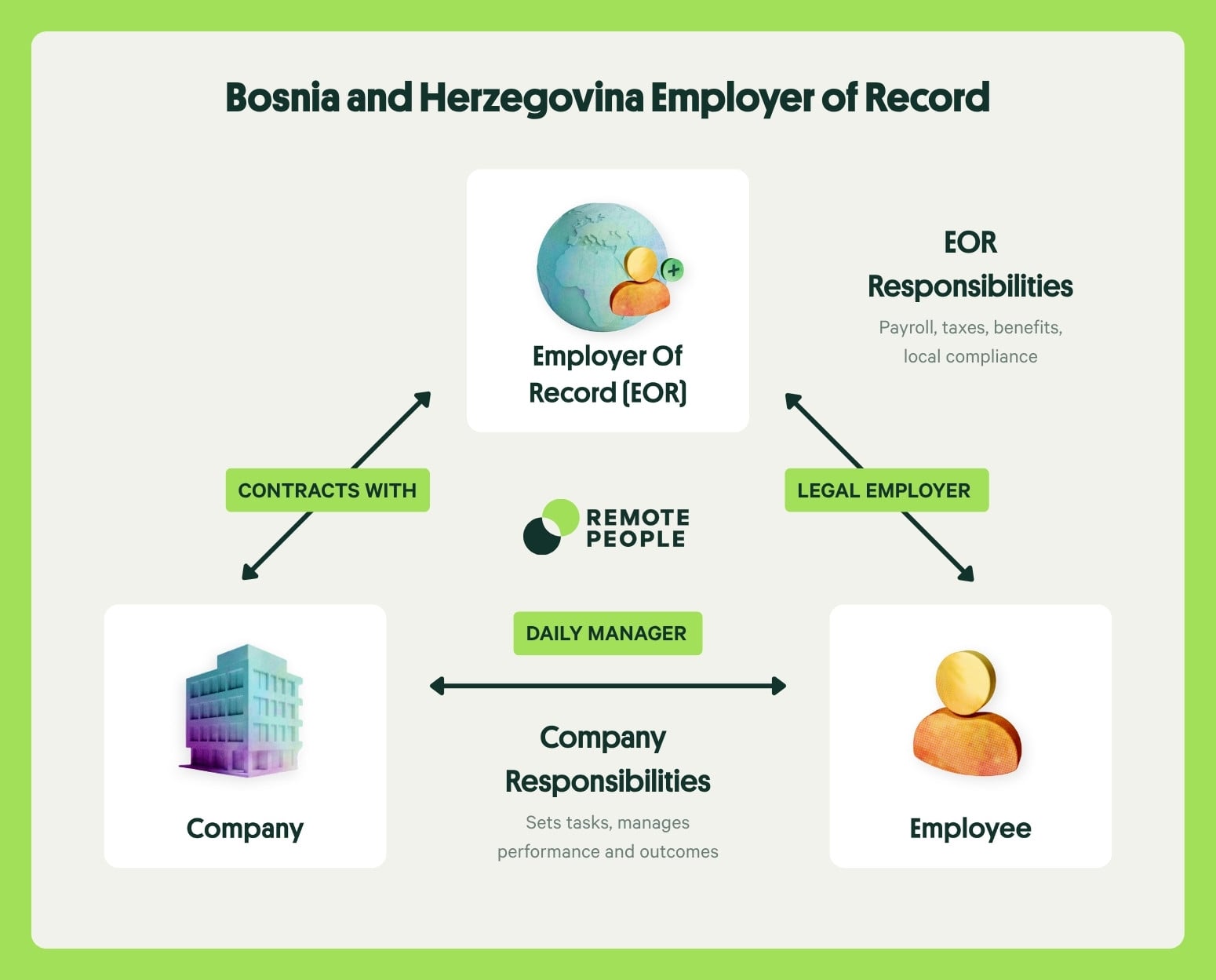
If you’d like to learn more about how Employer of Record (EOR) services work, read our What Is an Employer of Record (EOR)? guide for a complete overview of the model, its benefits, and when to use it.
If you’re comparing providers, our Best Employer of Record (EOR) Providers guide reviews the leading platforms to help you choose the right solution for your business.
Who Uses an EOR in Bosnia and Herzegovina?
Companies typically use an EOR in Bosnia and Herzegovina to test the market before committing to a full entity, to hire a small team of 1 to 15 people without dealing with the dual regulatory structure, or to onboard a single specialist developer or engineer in days instead of the weeks needed to incorporate. The model works well for businesses expanding across Southeast Europe that want a compliant Bosnia hire without adding another local entity to their corporate footprint. For any company expanding into Bosnia and Herzegovina, an EOR removes the legal, banking, and HR barriers to a fast start in either entity.
Typical Onboarding Timeline
The onboarding process typically takes 1 to 2 weeks for Bosnian and Herzegovinian nationals:
- First, sign the EOR service agreement and share the employee’s details and intended work location (1 to 2 days).
- Second, the EOR drafts a compliant employment contract in the local language and sends it for signature (2 to 3 days).
- Third, the EOR registers the employee with the correct PIO pension fund, health insurance fund, and tax authority in FBiH or RS (3 to 5 days).
- Fourth, payroll is configured, benefits enrolled, and a local payroll account set up (1 to 2 days).
- Fifth, the employee officially starts work and receives their first paycheck on the next monthly payroll cycle.
If the hire is a non-Bosnian national requiring a work permit, add 30 to 60 days for Service for Foreigners’ Affairs processing, or up to 6 months if the role requires diploma validation in FBiH. Background checks for regulated sectors can add a further 1 to 2 weeks.
Hire in Bosnia and Herzegovina
A dual-entity system where the Federation and Republika Srpska each have their own labor laws, tax rules, and social contribution structures.
We handle employment contracts, payroll, social contributions, and full Bosnian compliance.
No local entity needed. Your team can start in days.
Employment Laws and Regulations in Bosnia and Herzegovina
Employment Contracts
Employment in Bosnia and Herzegovina is governed by two parallel labour codes: the FBiH Labour Law for the Federation and the separate Republika Srpska Labour Law. Written employment contracts are mandatory in both entities, and must identify the parties, job title, work location, salary, working hours, leave entitlements, and notice periods. Contracts must be drafted in Bosnian, Croatian, or Serbian (the three official languages), and bilingual English translations are common practice.
Indefinite-term contracts are the default form in both entities. Fixed-term contracts are permitted for objectively justified reasons such as seasonal work, project-based roles, or temporary replacements, and are capped at a maximum aggregate duration of 3 years in FBiH and 2 years under the draft 2026 FBiH Labour Law reform. The Federal Ministry of Labour and Social Policy (FBiH Ministry of Labour) is the primary regulator in the Federation, while RS employment matters are administered by the RS Ministry of Labour and Veterans’ Affairs.
Working Hours and Overtime
The standard workweek in Bosnia and Herzegovina is 40 hours, typically arranged as 8 hours per day over 5 days, under both the FBiH and RS Labour Laws. Overtime is capped at 10 hours per week and must be compensated at a minimum of 150% of the regular hourly rate. Work on a public holiday or on a rest day is paid at double the regular rate, and employees are entitled to a continuous 24-hour weekly rest period.
Bosnia and Herzegovina’s two entity labour laws both treat overtime as exceptional: the FBiH Labour Law limits overtime to 8 hours per worker per week, while the Republika Srpska Labour Law allows a maximum of 10 hours per week, plus a further 10 voluntary hours, capped at 180 hours per calendar year. Statutory night work runs from 22:00 to 06:00 in both entities. Premium pay percentages are not fixed in the statutes themselves; they are set through the General Collective Agreement and sector rulebooks, which prescribe the minimum uplifts shown below.
Bosnia and Herzegovina overtime and premium pay rates · Per FBiH and RS Labour Laws | |||
Hour Type | Minimum Premium | Weekly or Daily Cap | Notes |
|---|---|---|---|
Weekday overtime | +30% of base hourly rate | FBiH: 8 hours per week. RS: 10 hours per week, max 180 hours per year. | Only permitted for force majeure, unusually high workload, or unforeseen events. Minors and pregnant women cannot be required to work overtime. |
Night work (22:00 to 06:00) | +30% of base hourly rate | No employee may work night shifts for more than one consecutive week under shift scheduling. | Night hours defined in both FBiH and RS Labour Laws as 22:00 to 06:00. Uplift stacks with the overtime premium if night hours are also overtime. |
Weekly rest day (usually Sunday) | +20% of base hourly rate | At least 24 consecutive hours of weekly rest must be preserved. | Weekly rest day work is permitted in principle but must be compensated at the higher rate set in the collective agreement. |
Public holiday work | +50% of base hourly rate | Applies to every public holiday listed in the relevant entity Law on Holidays. | Higher uplift than Sunday work. FBiH and RS maintain separate but largely overlapping holiday calendars. |
Source: CMS FBiH Labour Law Guide and CMS RS Labour Law Guide | |||
Minimum Wage
The 2026 net minimum wage in the Federation of Bosnia and Herzegovina is 1,027 KM per month (approximately $567 USD), effective January 1, 2026 under a FBiH Government decree adopted on December 30, 2025. The adjustment formula weights 50% of the consumer price index increase and 50% of GDP growth, and the rate is set annually by the Federation Government before December 31.
Republika Srpska applies a tiered minimum wage system based on the employee’s required level of education. For 2026, the base tier (no required education) is 1,000 KM net per month (approximately $552 USD), the secondary-education tier is 1,000 KM net, and the higher-education tier is 1,300 KM net (approximately $718 USD). For sector-level and cantonal variations, see the Bosnia minimum wage page.
Probation Period
The maximum probation period in the Federation of Bosnia and Herzegovina is 6 months under the FBiH Labour Law, and it cannot be extended or renewed once it has expired. In Republika Srpska, the standard probation is 3 months, which may be extended to a maximum of 6 months by mutual agreement between employer and employee.
During probation, either party may terminate the employment with a minimum 7-day written notice. For a full breakdown, see the Bosnia probation period page.
Leave Entitlements
Bosnia and Herzegovina provides a statutory leave framework through two separate labour codes, with core entitlements for annual leave, sick leave, and maternity leave guaranteed in both entities. The rules differ materially in maternity pay and paternity leave, where Republika Srpska offers stronger protections than the Federation. Leave accrues only after a qualifying service threshold, typically 6 months of continuous employment.
Annual Leave
Employees in Bosnia and Herzegovina are entitled to a minimum of 20 working days of paid annual leave per year after completing 6 months of continuous service with the employer. The draft 2026 FBiH Labour Law reform proposes raising the minimum to 4 weeks (20 working days) with no prescribed statutory maximum, giving collective agreements room to set higher thresholds. Employees who have not yet completed 6 months accrue leave on a pro-rata basis of 1 working day for every month worked.
Sick Leave
Paid sick leave in the Federation of Bosnia and Herzegovina is set at 42 continuous days of employer-funded pay at 80% of the regular salary, after which the Federal Health Insurance Fund takes over payments. In Republika Srpska, the employer funds only the first 30 days of sick leave, with the RS Health Insurance Fund covering longer absences for up to 12 months. Pay rises to 100% of salary for work-related injuries and during pregnancy in both entities, and a medical certificate is required from day one.
Maternity Leave
Female employees in the Federation of Bosnia and Herzegovina are entitled to 1 year of maternity leave, which may start 28 days before the expected date of delivery and must include at least 42 days after birth. Pay during FBiH maternity leave varies by canton and ranges from 50% to 80% of salary, with some cantons offering 100% pay for second and subsequent children. In Republika Srpska, maternity leave is also 1 year (extended to 18 months for a second or subsequent child), paid at 100% of the employee’s salary by the RS Public Fund for Child Protection.
Paternity Leave
Paternity leave is not a statutory entitlement in the Federation of Bosnia and Herzegovina. Fathers may take leave only if the mother waives part of her maternity entitlement after the mandatory 42-day post-birth period, paid at the applicable maternity rate for that canton. Republika Srpska grants a statutory paternity entitlement with pay at 100% of salary, making it one of the more protective regimes in Southeast Europe.
Other Statutory Leave
- Marriage leave: typically 2 to 3 paid days, at employer cost, governed by collective agreements.
- Bereavement leave: 2 to 5 paid days on the death of a close family member, varying by collective agreement.
- Study leave: up to 7 paid days for employees pursuing employer-approved education.
- Blood donation: 1 paid day per donation in both entities.
- Public holidays: 4 to 13 paid days per year depending on entity, canton, and religious observance (see holidays table).
Leave Entitlements Summary
Bosnia and Herzegovina’s labour code codifies every statutory leave type employers must grant, from annual leave to maternity, sick, and other protected absences (CMS FBiH Labour Law Guide). The table below summarises each statutory leave category with duration and eligibility so payroll and HR can plan accruals and cover without missing a mandatory entitlement.
Bosnia and Herzegovina statutory leave entitlements · Per FBiH and RS Labour Laws | ||
Leave Type | Duration | Eligibility & Notes |
|---|---|---|
Annual Leave | 20 working days | Minimum after 6 months of continuous service. Pro-rata for shorter tenure. Collective agreements may grant more. |
Sick Leave (FBiH) | Up to 12 months | Employer funds first 42 days at 80% salary; Federal Health Insurance Fund pays thereafter. 100% pay for work injuries or pregnancy. |
Sick Leave (RS) | Up to 12 months | Employer funds first 30 days at 80% salary; RS Health Insurance Fund pays thereafter. 100% pay for work injuries or pregnancy. |
Maternity Leave (FBiH) | 1 year | 28 days before due date + at least 42 days after birth. Pay 50%–80% of salary, varies by canton. 100% for second child in some cantons. |
Maternity Leave (RS) | 1 year (18 months for 2+ children) | Paid at 100% of salary by the RS Public Fund for Child Protection. |
Paternity Leave | FBiH: none (statutory); RS: granted at 100% pay | FBiH fathers can use part of maternity leave only if the mother waives it. RS provides a statutory entitlement. |
Public Holidays | 4–13 days/year | Varies by entity, canton, and religious observance. Work on a public holiday paid at 2x regular rate. |
Statutory Employee Benefits
The core mandatory benefits in Bosnia and Herzegovina are enrollment in the pension and disability insurance (PIO) fund, the entity-level health insurance fund, and the unemployment insurance fund. In the Federation, the combined rate is 36% of gross salary (5% paid by the employer, 31% paid by the employee), while in Republika Srpska the combined rate is 32.8%, entirely borne by the employee. These contributions fund old-age pensions, disability and survivor benefits, sickness and maternity benefits, work injury coverage, and unemployment insurance, which together form the statutory safety net for Bosnian and Herzegovinian workers.
Beyond the mandatory social insurance regime, employers are required to provide a meal allowance (topli obrok) and transportation reimbursement in the Federation, both of which are set by collective agreement and typically range from 6 to 10 KM per working day for meals and actual public transit cost for commuting. Neither entity mandates private health insurance, a 13th month salary, or a separate pension top-up on top of PIO contributions. For a complete breakdown of statutory and commonly offered voluntary benefits, see the Bosnia employee benefits page.
Recent Regulatory Updates (2026)
The most significant recent change in Bosnia and Herzegovina is the Federation of Bosnia and Herzegovina contribution reform that took effect on July 1, 2025, cutting the employer pension contribution from 6% to 2.5% and the employer health contribution from 4% to 2%, reducing the total employer burden from 10.5% to 5.0% (FBiH contribution amendment). The employee-side contribution rates were left unchanged, so the reform directly benefits employers and net cost of employment in the Federation.
A draft FBiH Labour Law reform is under parliamentary review and is expected to raise the statutory annual leave minimum to 4 weeks, cap fixed-term contracts at 2 years aggregate duration, and introduce a new “additional work” category allowing up to 8 hours per week of secondary employment on a separate contract. Parallel amendments to the Law on Foreigners are in the pipeline to simplify work permit procedures for shortage occupations and remove the labour market test requirement for designated professions, per the CMS FBiH Labour Law guide.
The FBiH 2026 minimum wage was set at 1,027 KM per month net, a 2.7% increase over 2025, while Republika Srpska increased its base tier to 1,000 KM net per month effective January 1, 2026. No changes to Republika Srpska contribution rates have been announced as of April 2026.
Work Permits and Visas in Bosnia and Herzegovina
Work Permit Requirements
Who Needs a Work Permit
Every non-citizen of Bosnia and Herzegovina who wishes to be employed in the country must hold a valid work permit, issued by the Service for Foreigners’ Affairs. Citizens of the European Union, the United Kingdom, the United States, and most other third countries all require a work permit to take up paid employment. There are limited exemptions for short-term business visits and intra-company transferees under certain bilateral agreements.
Eligibility and Required Documents
Work permit applications are employer-driven, meaning the prospective Bosnian employer (or the EOR acting as employer) submits the application on behalf of the foreign national. Required documents include a valid passport with at least 6 months remaining validity, a police clearance certificate from the country of residence, proof of academic or professional qualifications (often requiring diploma validation through the FBiH Ministry of Education), a signed employment contract, medical examination results, and payment of the applicable government fees. Labour market testing, proving that no qualified domestic candidate was available, is generally required, though draft amendments under review would waive this requirement for designated shortage occupations.
Processing Time and Validity
Standard work permits take 30 to 60 days to process through the Service for Foreigners’ Affairs, though FBiH applications requiring diploma validation can extend up to 6 months. Initial permits are typically valid for 1 year and tied to a specific employer and job title. Work and employment during the application period is not permitted; the employee may only start once the permit is issued.
Renewal Process
Work permit holders must file a renewal application at least 30 days before the current permit expires. Renewal requires an updated employment contract, confirmation that the employment relationship is ongoing, and payment of the annual fee. Processing for standard renewals takes 15 to 30 days, and the employee may continue working during renewal provided the application was filed before the expiry date.
Common Visa Types for Foreign Workers
- Standard work permit: the default category for full-time employees sponsored by a local employer or EOR, valid for 1 year and renewable.
- Temporary residence permit with work authorization: required in parallel with the work permit for stays longer than 90 days.
- Intra-company transfer permit: for managers or specialists transferring from a parent company abroad, with a simplified document review.
- Shortage occupation permit (proposed): would exempt employers from the labour market test for designated professions under pending Law on Foreigners amendments.
Work-authorising status in Bosnia and Herzegovina is built on three stacked documents: an entity-level work permit issued by the FBiH or RS Employment Service, a long-stay Visa D issued by a Bosnian embassy abroad, and a state-level temporary residence permit for work issued by the Service for Foreigners’ Affairs. Five visa routes are available to foreign professionals, each with different durations, processing times, and paths to longer-term residency.
Bosnia and Herzegovina work visa types for foreign workers · 2026 | ||||
Visa Type | Duration | Best For | Leads to Long-Term Residence? | Processing |
|---|---|---|---|---|
Standard work permit | Up to 1 year, renewable | Employer-sponsored full-time hires after a labour market test. | Yes, via 5 years of continuous temporary residence. | 30 to 60 days at the entity Employment Service. |
Long-stay Visa D | Up to 180 days single or multiple entry | Entry visa for workers abroad whose work permit has been approved. | No on its own. Prerequisite to applying for the temporary residence permit. | 15 to 30 days at the Bosnian embassy of residence. |
Temporary residence permit for work | Matches the work permit term, typically 1 year | Legalising stay after entry on Visa D or visa-free arrival. | Yes, renewable up to 5 years and then permanent residence. | 30 to 60 days at the Service for Foreigners’ Affairs. |
Intra-company transfer permit | Tied to the sending employer, typically 1 to 3 years | Managers, specialists, and trainees seconded from a foreign parent or affiliate. | Usually no. Stay is tied to the group assignment and ends when the posting ends. | 30 to 45 days with simplified document review. |
Shortage occupation permit (proposed) | 1 year initial, renewable | Designated shortage roles in IT, engineering, and healthcare once the Law on Foreigners amendments take effect. | Expected yes on the same 5-year track as the standard route. | Targeted 15 to 30 days once in force (not yet operational). |
How an EOR Handles Work Permits
An EOR acts as the official sponsoring employer on the work permit application, managing the Service for Foreigners’ Affairs paperwork, diploma validation, medical exam coordination, and fee payments on your behalf. The employee provides their personal documents; the EOR manages everything else end to end.
For a non-Bosnian hire, work permit sponsorship typically extends the standard 1 to 2 week onboarding timeline by an additional 30 to 60 days. See the Bosnia work visa and permit page for detailed document checklists.
Payroll, Taxes, and Social Security in Bosnia and Herzegovina
Employer Contributions
Employers hiring in Bosnia and Herzegovina owe mandatory contributions on top of gross salary, funding social security, health, pensions, and other statutory schemes (FBiH Law on Contributions amendment). The table below lists the employer-side contribution rates so you can calculate the true all-in cost of each hire.
Bosnia and Herzegovina employer social security contributions · 2026 rates | ||
Contribution | Rate | Notes |
|---|---|---|
Pension & Disability (PIO), FBiH | 2.5% | Reduced from 6.0% effective July 1, 2025. Funds old-age, disability, and survivor benefits. |
Health Insurance, FBiH | 2.0% | Reduced from 4.0% effective July 1, 2025. Funds the Federal Health Insurance Fund. |
Unemployment Insurance, FBiH | 0.5% | Funds the FBiH Employment Service and unemployment benefits. |
Total Employer Contributions, FBiH | 5.0% | Applied to gross salary. Republika Srpska employers pay 0%. All social contributions in RS are borne by the employee. |
Employers in the Federation of Bosnia and Herzegovina pay a combined 5.0% in social security contributions on gross salary, one of the lowest employer burden rates in Central and Southeast Europe after the July 2025 reform. In Republika Srpska, the employer-side contribution is 0% because all social security burdens are shifted entirely to the employee, so the gross-to-net conversion differs materially between the two entities. The EOR calibrates the correct calculation based on the employee’s registered work location and remits contributions to the right entity fund each month.
For detailed guidance on entity-specific payroll mechanics, see the Bosnia payroll and tax page.
Employee Contributions
Alongside income tax, employees in Bosnia and Herzegovina pay statutory payroll deductions that fund social security, health cover, and other state schemes (PwC Bosnia Individual Income Tax). The table below summarises the employee-side contribution rates payroll must withhold from gross pay each month.
Bosnia and Herzegovina employee payroll deductions · 2026 monthly withholdings | ||
Deduction | Rate | Notes |
|---|---|---|
Pension & Disability (PIO), FBiH | 17.0% | Deducted from gross salary. Funds old-age, disability, and survivor benefits. |
Health Insurance, FBiH | 12.5% | Funds the Federal Health Insurance Fund. |
Unemployment Insurance, FBiH | 1.5% | Funds unemployment benefits and the FBiH Employment Service. |
Total Social Contributions, FBiH | 31.0% | Combined employee-side social security burden in the Federation. |
Total Social Contributions, RS | 32.8% | RS employees bear all social security: 18.5% pension + 12% health + 0.8% unemployment + 1.5% child protection. |
Income Tax (FBiH) | 10% | Flat rate on taxable income after personal allowance (~300 KM/month). |
Income Tax (RS) | 8% | Flat rate on taxable income after personal allowance (~500 KM/month). |
Total Employee Deductions, FBiH | 31% + 10% tax | Social contributions deducted first; income tax applied to the remaining base. |
Employees in the Federation of Bosnia and Herzegovina contribute 31% of gross salary to social insurance: 17% to the PIO pension fund, 12.5% to the Federal Health Insurance Fund, and 1.5% to unemployment insurance. Income tax is then applied at a flat 10% on the remainder after the personal allowance, which is set at approximately 300 KM per month (around $166 USD). In Republika Srpska, employees bear the entire 32.8% social security contribution (no employer share) and pay an 8% flat income tax on earnings above the RS personal allowance.
Income Tax Brackets
Personal income tax in Bosnia and Herzegovina is levied on a progressive basis, with the rate rising as taxable income crosses statutory thresholds (PwC Bosnia Personal Income Tax). The table below sets out the current income-tax brackets that apply to resident employees so you can model net-of-tax compensation before making an offer.
Bosnia and Herzegovina income tax brackets · 2026 | |
Annual Taxable Income (USD) | Tax Calculation |
|---|---|
Up to $1,990 (FBiH) / $3,315 (RS) | 0% (covered by personal allowance) |
Above $1,990, Federation (FBiH) | Flat 10% on income exceeding personal allowance |
Above $3,315, Republika Srpska (RS) | Flat 8% on income exceeding personal allowance |
Small entrepreneurs (both entities) | Flat 2% on total annual revenue (special regime) |
Bosnia and Herzegovina applies a flat personal income tax: 10% in the Federation and 8% in Republika Srpska, with different personal allowances in each entity. The FBiH personal allowance is approximately 300 KM per month (3,600 KM per year, roughly $1,990 USD), while the RS personal allowance is approximately 500 KM per month (6,000 KM per year, roughly $3,315 USD). Dependents can raise the allowance further through the tax ID card (poreska kartica) filed with the entity tax authority.
Payroll Cycle
Monthly payroll is the standard in Bosnia and Herzegovina, with salaries paid by bank transfer to the employee’s local account by the last working day of the month or the 5th of the following month at the latest. Employers calculate gross salary, deduct social security and income tax, and remit contributions to the correct entity funds by the 10th of the following month. Payslips must itemize gross pay, each social security line item, income tax withheld, and net pay, and be issued for every pay period.
13th Month Salary and Bonus Pay
A 13th month salary is not mandatory under either the FBiH Labour Law or the RS Labour Law. Employers may voluntarily pay a holiday bonus (regres) for annual leave, typically equivalent to 70% to 100% of the minimum wage, though this is only mandatory where a collective agreement requires it. Meal allowance (topli obrok) and transportation reimbursement are required in the Federation for most industries, set by collective agreements at roughly 6 to 10 KM per working day for meals plus actual public transit cost for commuting.
Cost of Hiring Through an EOR in Bosnia and Herzegovina
EOR Service Fees
RemotePeople’s EOR service fee for Bosnia and Herzegovina is a flat monthly rate of USD $300 to $600 per employee, depending on payroll complexity, number of hires, and service tier. This covers legal employment contract drafting, registration with the correct entity’s PIO pension fund and health insurance fund, monthly payroll processing in both FBiH and RS, statutory benefits administration, and HR support. Work permit sponsorship for foreign hires incurs additional one-time fees of $500 to $1,500 per permit depending on complexity and whether diploma validation is required.
Total Employment Cost Breakdown
The all-in cost of employing someone in Bosnia and Herzegovina goes well beyond gross salary. The table below walks through a realistic cost build-up for a typical hire, layering mandatory employer social contributions, statutory benefits, and payroll taxes on top of base pay so finance teams can budget accurately before an offer goes out.
Bosnia and Herzegovina employer cost example · $1,200/month gross · 2026 | ||
Employer Cost | Amount (USD) | % of Gross |
|---|---|---|
Gross Salary | $1,200.00 | 100.00% |
PIO Pension (FBiH employer) | $30.00 | 2.50% |
Health Insurance (FBiH employer) | $24.00 | 2.00% |
Unemployment Insurance (FBiH employer) | $6.00 | 0.50% |
EOR Service Fee | $450.00 | 37.50% |
Total Monthly Employer Cost (FBiH) | $1,710.00 | 142.50% |
Source: FBiH Law on Contributions and PwC Bosnia Other Taxes | ||
The total employer cost for a $1,200 per month employee in the Federation of Bosnia and Herzegovina is approximately $1,710, representing roughly 42.5% overhead above the gross salary. The breakdown includes the $1,200 gross paid to the employee, $60 in FBiH employer social security (2.5% PIO pension, 2% health, 0.5% unemployment), and the EOR service fee of $450 per month covering legal, payroll, and compliance administration. All USD amounts are approximate conversions at $1 = 1.81 KM (April 2026 rate).
Republika Srpska employer cost for the same $1,200 gross is lower on the contribution side, approximately $1,650 total, since RS employers pay no social security at all and only the $450 EOR fee sits above gross. The trade-off is that RS employees pay a higher total deduction (32.8% plus 8% income tax) compared to FBiH employees (31% plus 10% income tax). Contact RemotePeople to discuss EOR pricing tailored to your team size and entity mix.
Ready to hire in Bosnia and Herzegovina without the entity headache? Talk to RemotePeople and onboard your first Bosnia employee within 1 to 2 weeks.
Benefits of Using an EOR in Bosnia and Herzegovina
An EOR in Bosnia and Herzegovina delivers instant compliance with two parallel labour codes and two tax regimes, without the capital outlay and multi-month timeline required to incorporate a local entity in the Federation or Republika Srpska. The EOR holds all statutory employer liability for wage disputes, wrongful dismissal claims, and social security compliance violations under both FBiH and RS rules, protecting your company from the dual-jurisdiction exposure that catches many first-time entrants off guard.
The EOR model also makes it practical to hire across both entities under a single commercial relationship, so a development team in Sarajevo and a support team in Banja Luka can coexist on one EOR contract without you running two local payrolls. You avoid opening a local bank account, obtaining a unique identification number, and building in-house HR expertise in a language you may not speak. For first-time employers in Bosnia, this removes the biggest operational barriers in the first 90 days of entry.
From a cash flow perspective, you gain predictable monthly costs with no surprise compliance fines, back-pay liabilities, or cantonal benefit shortfalls hidden on your balance sheet. Payroll and benefits are handled by the EOR’s local team with expertise in entity-specific wage calculations, canton-level maternity pay, and the different notice and severance rules in FBiH and RS. Employees receive professional payslips in the local language, have clear statutory protections, and can access the entity’s labour inspection service if needed, which reinforces trust in the employment relationship.
Termination and Offboarding in Bosnia and Herzegovina
Notice Periods
Notice periods in Bosnia and Herzegovina depend on the entity where the employee is based and their length of service. In the Federation of Bosnia and Herzegovina, the minimum notice period is 14 days for employees with less than 6 months of service, rising with tenure up to a statutory maximum of 3 months.
In Republika Srpska, the minimum notice period is 30 days regardless of tenure, with no statutory maximum, though collective agreements can extend the required notice. Either party may terminate without notice on grave breach of the employment contract, theft, assault, or similar just-cause grounds under the CMS Bosnia dismissals guide.
Both entity labour laws set statutory floors on how much advance notice an employer or worker must give to end an open-ended employment contract, with collective agreements and internal rulebooks free to extend these minimums up to a six-month cap. The FBiH Labour Law sets the shortest notice in the region at 7 days for workers and 14 days for employers, while the Republika Srpska Labour Law requires 15 days from workers and 30 days from employers. Notice during probation is always 7 days in both entities.
Bosnia and Herzegovina statutory notice periods by position level · Per FBiH and RS Labour Laws | |||
Termination Scenario | Notice Period | During Probation | Notes |
|---|---|---|---|
FBiH – employer-initiated | Minimum 14 days | 7 days | Collective agreements and rulebooks may extend up to 6 months. Worker retains full salary and benefits during notice. |
FBiH – worker-initiated (resignation) | Minimum 7 days | 7 days | Pay in lieu of notice is permitted by written agreement. No severance is owed for voluntary resignation. |
Republika Srpska – employer-initiated | Minimum 30 days | 7 days | Collective agreements and rulebooks may extend the period. Worker retains full salary and benefits during notice. |
Republika Srpska – worker-initiated (resignation) | Minimum 15 calendar days | 7 days | Employer may waive notice and release the worker earlier. No severance is owed for voluntary resignation. |
Summary dismissal for serious breach | None (immediate) | Not applicable | Permitted in both entities only for grave breaches of duty. Must be issued within 15 days of learning the facts (FBiH) or promptly under RS rules. |
Source: CMS FBiH Labour Law Guide and CMS RS Labour Law Guide | |||
Severance Pay
Calculation Method
Severance pay in Bosnia and Herzegovina is calculated identically in both FBiH and RS. The formula is one-third (1/3) of the employee’s average monthly salary multiplied by the number of years of service with the employer. Average monthly salary is calculated over the 3 months immediately preceding the termination date, and severance is due only to employees with 2 or more years of continuous service on an indefinite-term contract, per the FBiH severance rules.
Caps and Exceptions
The statutory cap on severance pay is 6 times the employee’s average monthly salary, calculated on the 3-month average preceding termination. Severance is not payable if the employee is terminated for just cause (gross misconduct, theft, repeated serious breach of duty), if they resign voluntarily, or if they are on a fixed-term contract that has expired. Employees terminated due to redundancy, business closure, or long-term incapacity receive both notice pay (or pay in lieu) and severance, so the total settlement can be significant for long-tenured workers.
Severance pay (otpremnina) is owed in both FBiH and Republika Srpska only when an employer terminates an open-ended contract after at least two years of continuous service, and never when termination is for serious breach or probation. The statutory minimum formula is identical in both entities: at least one-third of the worker’s average monthly salary from the last three months, for each full year of service, capped at six average monthly salaries total. A sample worker on $1,200 gross per month would see the schedule below.
Bosnia and Herzegovina severance pay schedule by years of service · Per FBiH and RS Labour Laws | |||
Years of Service | Statutory Minimum Severance | Example at $1,200 Gross Monthly | Notes |
|---|---|---|---|
Less than 2 years | Not entitled | $0 | Statute requires at least 2 years of continuous uninterrupted service with the same employer. |
2 years | 2/3 of average monthly salary (1/3 × 2 years) | $800 | Minimum threshold reached. Employer may pay more under the collective agreement. |
5 years | 5/3 of average monthly salary | $2,000 | Formula: 1/3 of average monthly salary from the last 3 months, multiplied by each full year of service. |
10 years | 10/3 of average monthly salary | $4,000 | Still below the 6-month statutory cap. Base salary includes regular bonuses paid in the last 3 months. |
18 years or more | 6 average monthly salaries (cap reached) | $7,200 | Statutory cap: severance may not exceed 6 average monthly salaries regardless of tenure. |
Source: CMS FBiH Labour Law Guide and CMS RS Labour Law Guide | |||
Grounds for Termination
Both the FBiH and RS Labour Laws recognise termination for just cause, including gross misconduct, repeated breaches of work duty, conviction for a crime incompatible with the job, and prolonged unjustified absence. Termination without cause is permitted for business reasons (redundancy, restructuring, business closure), but only after consultation with the works council where one exists, and with proper notice and severance. Protected categories include pregnant employees, employees on parental leave, and union representatives, who benefit from enhanced dismissal protection under both entity laws.
EOR vs. Other Hiring Models in Bosnia and Herzegovina
EOR vs. Setting Up a Local Entity
Choosing between an Employer of Record and setting up your own legal entity in Bosnia and Herzegovina comes down to timeline, upfront cost, ongoing administrative burden, and how quickly you can scale up or wind down. The table below lays out both paths side by side across setup time, cost, compliance risk, and flexibility so you can match the right model to the size and duration of your Bosnia and Herzegovina hiring plan.
Bosnia and Herzegovina EOR vs local entity comparison · Setup time, cost, risk and best-fit | ||
Comparison | Employer of Record | Own Entity |
|---|---|---|
Setup time | 1–2 weeks | 2–4 months (per entity) |
Upfront cost | $0 | $3,000–$8,000 per entity setup |
Ongoing cost | $300–$600/employee/month | $8,000–$15,000/year maintenance |
Local partner required | No (EOR is the local entity) | Yes (local director for most company forms) |
Social insurance registration | Handled by EOR | You manage it for FBiH and RS separately |
Payroll & tax filing | Handled by EOR | You manage it (or outsource) |
Best for team size | 1–15 employees | 15+ employees |
Scale down / exit | Easy. No entity to unwind | Costly. Legal dissolution required per entity |
Government contracts | Not eligible | Eligible (requires local entity) |
Incorporating a local company in Bosnia and Herzegovina typically takes 2 to 4 months per entity (FBiH, RS, or both), with upfront legal and registration costs of $3,000 to $8,000 and ongoing maintenance of $8,000 to $15,000 per year per entity for accounting, audit, and tax filings. If you want to hire across both entities with a direct model, you may need to register a branch or subsidiary in each, effectively doubling the overhead. A local entity gives you unlimited scalability, eligibility for public tenders, and direct control over HR, and is appropriate once your team exceeds 15 employees or requires government contracts.
An EOR requires no upfront incorporation, no local bank account, and no in-country legal representative. Monthly costs are fixed and predictable at $300 to $600 per employee, and a single contract covers hires in both FBiH and RS.
If you later decide to incorporate, the EOR can facilitate employee transfer with no interruption of service. For short-term market testing or teams under 15 people, the EOR model is faster, cheaper, and materially lower risk than running dual local entities.
EOR vs. Hiring Independent Contractors
Classifying a Bosnia and Herzegovina-based worker as an independent contractor rather than an employee can expose you to back-taxes, unpaid social contributions, and reclassification penalties if the working relationship looks like employment in practice. The table below contrasts EOR employment with contractor engagement across legal relationship, tax and benefits treatment, IP ownership, and misclassification risk so you can pick the right model role by role.
Bosnia and Herzegovina EOR vs independent contractors · Compliance, cost, and risk | ||
Comparison | EOR (Full-Time Employee) | Independent Contractor |
|---|---|---|
Legal relationship | Employee of the EOR | Self-employed, no employment relationship |
Compliance risk | Low. EOR ensures local labour law compliance | High. Misclassification risk if relationship resembles employment |
Payroll & tax | EOR handles withholding, contributions, filings | Contractor invoices you; they handle their own taxes |
Benefits & leave | Statutory benefits, paid leave, social security | No entitlement to employee benefits |
IP protection | Stronger. Employment contract assigns IP by default | Weaker. Requires explicit IP assignment clause |
Termination | Subject to local notice periods and severance | Contract can be ended per agreement terms |
Best for | Long-term, core team roles | Short-term projects, specialized tasks |
Cost structure | Salary + employer contributions + EOR fee | Contractor fee (typically higher gross, lower total cost) |
Source: CMS FBiH Labour Law and PwC Bosnia Income Determination | ||
Independent contractors in Bosnia and Herzegovina are only appropriate in some cases, such as short defined projects, specialist consulting work, or roles with genuine autonomy over how and when the work is delivered. For ongoing positions the entity tax authority or labour inspectorate may examine the working relationship and reclassify a contractor as an employee if the individual works under your direct supervision, uses company equipment, or follows a fixed schedule. Reclassification can trigger back-pay liability for social security contributions, unpaid income tax, and administrative penalties, so the default option for long-term roles is an EOR employee.
An employee hired through an EOR has full legal protection: written contract under the correct entity’s labour law, statutory leave, sick pay, maternity and paternity benefits where applicable, and severance entitlements. The EOR manages the compliance relationship on your behalf and handles all entity-specific payroll mechanics. When a contractor model is the right fit, RemotePeople’s Bosnia contractor management handles onboarding, compliant service agreements, and international payments in one place.
EOR vs. PEO (Professional Employer Organization)
EORs and PEOs both simplify international hiring, but only an EOR becomes the legal employer of record in Bosnia and Herzegovina — a critical distinction when you don’t have a local entity of your own. The table below maps the practical differences across legal employer status, entity requirement, liability allocation, and scope of coverage.
Bosnia and Herzegovina EOR vs PEO comparison · Legal employer, liability, and setup | ||
Comparison | Employer of Record (EOR) | PEO |
|---|---|---|
Legal employer | EOR is the legal employer | You remain the legal employer (co-employment) |
Local entity required | No. The EOR is the local entity | Yes. You must have your own entity in Bosnia and Herzegovina |
Best for | Companies without a local entity | Companies that already have a local entity |
Compliance liability | EOR assumes compliance responsibility | Shared liability between you and the PEO |
Setup time | 1–2 weeks | Depends on your entity setup (months) |
Control over HR policies | EOR manages within local law framework | More direct control, PEO advises |
Typical use case | Market entry, small remote teams, testing new markets | Established local operations needing HR outsourcing |
Source: PwC Bosnia Corporate Tax Administration and RemotePeople comparison of Central European EOR and PEO structures, April 2026. | ||
A Professional Employer Organization (PEO) in Bosnia and Herzegovina operates under a co-employment model where both the client company and the PEO share legal employer status. Bosnia does not have a fully developed statutory PEO framework like the United States, so most PEO-style arrangements in the country function as HR outsourcing to companies that already own a local entity in FBiH or RS. The fee model is typically a percentage of payroll (10% to 15%) rather than a flat monthly charge, and setup depends on how quickly the client can incorporate locally.
An EOR in Bosnia and Herzegovina is the more appropriate choice for companies without an existing local entity. The EOR absorbs all compliance risk, maintains its own registered entity in the country, and can onboard employees within 1 to 2 weeks for either FBiH or RS.
For companies hiring 1 to 25 people in Bosnia without a local presence, an EOR is both faster and materially cheaper than setting up a local entity and engaging a PEO on top. To benchmark costs against local market rates, see the Bosnia average salary page.
Public Holidays in Bosnia and Herzegovina
Bosnia and Herzegovina observes a defined set of official public holidays on which most private-sector employers must give staff a paid day off (timeanddate.com Bosnia 2026 holidays). The table below lists the statutory holidays employers need to build into payroll calendars and leave planning for the year, along with the date rule for each.
Bosnia and Herzegovina public holidays · 2026 calendar year | ||
Date | Holiday | Type |
|---|---|---|
Thursday, January 1 | New Year’s Day | National (both entities) |
Friday, January 2 | New Year’s Day (second day) | National (both entities) |
Friday, January 9 | Day of Republika Srpska | Entity (RS only) |
Sunday, March 1 | Independence Day | Entity (FBiH only) |
Friday, April 3 | Good Friday (Catholic) | Religious (Catholic observance) |
Monday, April 6 | Easter Monday (Catholic) | Religious (Catholic observance) |
Friday, April 10 | Good Friday (Orthodox) | Religious (Orthodox observance) |
Monday, April 13 | Easter Monday (Orthodox) | Religious (Orthodox observance) |
Friday, May 1 | Labour Day | National (both entities) |
Saturday, May 2 | Labour Day (second day) | National (both entities) |
Saturday, May 9 | Victory Day | Entity (RS only) |
Wednesday, March 18 | Eid al-Fitr (Ramadan Bayram) | Religious (Muslim observance) |
Wednesday, May 27 | Eid al-Adha (Kurban Bayram) | Religious (Muslim observance) |
Wednesday, November 25 | Statehood Day | Entity (FBiH only) |
Saturday, November 21 | Dayton Agreement Day | Entity (RS only) |
Friday, December 25 | Christmas Day (Catholic) | Religious (Catholic observance) |
Monday, January 7 | Christmas Day (Orthodox) | Religious (Orthodox observance) |
Bosnia and Herzegovina does not have a single unified national holiday calendar. The Federation of Bosnia and Herzegovina, Republika Srpska, and the Brčko District each observe their own mix of national, entity-level, and religious holidays, and employees can usually choose which religious holidays to observe based on their faith tradition. Work on a public holiday is paid at 200% of the regular rate, and employees who work on a religious holiday they do not observe are still entitled to overtime pay.
How to Get Started with an EOR in Bosnia and Herzegovina
Getting started with a RemotePeople EOR in Bosnia and Herzegovina is straightforward and typically takes 1 to 2 weeks for a Bosnian national hire.
- First, contact RemotePeople to discuss your hiring needs, the employee’s work location (FBiH or RS), and the applicable EOR service fee tier.
- Second, complete the EOR service agreement and provide the employee’s details: full name, date of birth, national ID (JMBG), address, job title, start date, and gross salary.
- Third, the EOR drafts a compliant employment contract in the local language under the correct entity labour law and sends it to you and the employee for signature.
- Fourth, the EOR registers the employee with the correct PIO pension fund, health insurance fund, and entity tax authority, and sets up the monthly payroll record.
- Fifth, the employee officially starts work and receives their first paycheck on the next monthly payroll cycle.
If the employee is a non-Bosnian national requiring a work permit, add 30 to 60 days for Service for Foreigners’ Affairs processing. The EOR manages all immigration paperwork, diploma validation, and fee payments so you do not need to interact with the Service for Foreigners’ Affairs directly. Once the permit is issued, the employee begins work and receives payroll as normal.
RemotePeople provides ongoing support including monthly payroll processing across both FBiH and RS, statutory leave tracking, benefits administration, and termination support when needed. If your team grows, you can add more employees under the same EOR agreement or transition to a local company setup in the future. Contact RemotePeople today to discuss your Bosnia and Herzegovina hiring plans and receive a customised quote.
Where companies hiring in Bosnia and Herzegovina expand next
Teams hiring in Bosnia and Herzegovina commonly expand across Central and Eastern Europe, where competitive labor costs and EU market access anchor regional growth. Most teams start with Hungary — similar cost profile and comparable hiring speed. A team in Poland typically follows, with parallel labor-cost tier and talent supply. Operations in the Czech Republic is a natural addition for aligned compensation ranges and delivery speed, and Romania completes the regional picture with matching cost-to-quality tier.
Frequently Asked Questions About Employer of Record in Bosnia and Herzegovina
EOR services in Bosnia and Herzegovina typically cost between $300 and $600 per employee per month as a flat USD fee. This covers employment contracts, social security registration with the correct entity fund, monthly payroll processing, statutory benefits administration, and HR support. Work permit sponsorship for foreign hires adds a one-time fee of $500 to $1,500 per permit. Beyond the EOR fee, the FBiH employer contribution burden is just 5% of gross salary since the July 2025 reform, while Republika Srpska employers pay 0%, and all social contributions in RS are borne by the employee. Total employer cost for a $1,200/month employee in FBiH is approximately $1,710/month.
For a Bosnian national, the standard onboarding timeline is 1 to 2 weeks. This includes signing the EOR agreement, drafting and signing the employment contract under the correct entity's labour law, registering the employee with the PIO pension fund and health insurance fund, and setting up payroll. For a non-Bosnian hire requiring a work permit, add 30 to 60 days for the Service for Foreigners' Affairs to process the application, or up to 6 months for FBiH roles requiring diploma validation.
No. The EOR assumes all legal employer obligations under the correct entity labour law (FBiH Labour Law or RS Labour Law), including employment contracts, statutory leave administration, notice periods, severance calculations, and social security compliance. The EOR holds the legal employment relationship and is liable for wage disputes, wrongful dismissal claims, and regulatory violations in the applicable entity. Your role is to direct the employee's work; the EOR handles all entity-specific compliance.
The 2026 net minimum wage in the Federation of Bosnia and Herzegovina is 1,027 KM per month (approximately $567 USD), effective January 1, 2026. Republika Srpska uses a tiered system: approximately $552 USD for unskilled and secondary-education tiers, and approximately $718 USD for the higher-education tier. For the latest rates and sector-level variations, see the Bosnia minimum wage page.
Termination procedures depend on the entity and the reason. In the Federation of Bosnia and Herzegovina, the minimum notice period is 14 days, rising with tenure up to a 3-month maximum. In Republika Srpska, the minimum notice period is 30 days. Severance pay is calculated identically in both entities as one-third of the average monthly salary multiplied by years of service, with a cap of 6 average monthly salaries, payable to employees with at least 2 years of continuous service on an indefinite-term contract. The EOR calculates and processes all notice and severance payments and handles the final settlement with the employee.
Independent contractors are only appropriate in some cases, such as defined short projects or specialist consulting work. For ongoing roles under your direct supervision, the entity tax authority or labour inspectorate may reclassify the contractor as an employee, triggering back-pay liability for social security contributions, income tax, and penalties. When a contractor model is the right fit, RemotePeople's Bosnia contractor management handles compliant service agreements, onboarding, and international payments end to end.
Under RemotePeople's EOR employment contracts, intellectual property created by the employee during the course of employment is assigned to the client company (you), not the EOR. The contract specifies that all work product, inventions, and IP generated within the scope of the job belong to the client company (you). You retain full operational and IP control over the employee; the EOR's role is solely to manage the legal employment relationship under FBiH or RS law.
The EOR acts as the official sponsoring employer and handles all immigration paperwork, diploma validation, and fee payments with the Service for Foreigners' Affairs. The employee provides their passport, police clearance, qualifications, and medical exam results. Standard processing takes 30 to 60 days for most roles and up to 6 months if FBiH diploma validation is required. The EOR manages every deadline to keep the process on track. See the Bosnia work visa and permit page for detailed guidance.
Employer of Record in
Employer of Record in
Employer of Record in
Employer of Record in
Employer of Record in
Employer of Record in
Employer of Record in
Employer of Record in