
 Recruit
Average Salary in Denmark
-
 Drew Donnelly
- Published
- September 21, 2026
- 5 ★ on G2








Let RemotePeople handle payroll, compliance, and HR admin worldwide so you can focus on building your team.
Denmark offers favorable outsourcing services due to its highly skilled workforce, innovative infrastructure, and transparent business environment. Employers considering hiring remote talent in the region may wonder, what is the average salary in Denmark? This information will help them prepare a competitive offer.
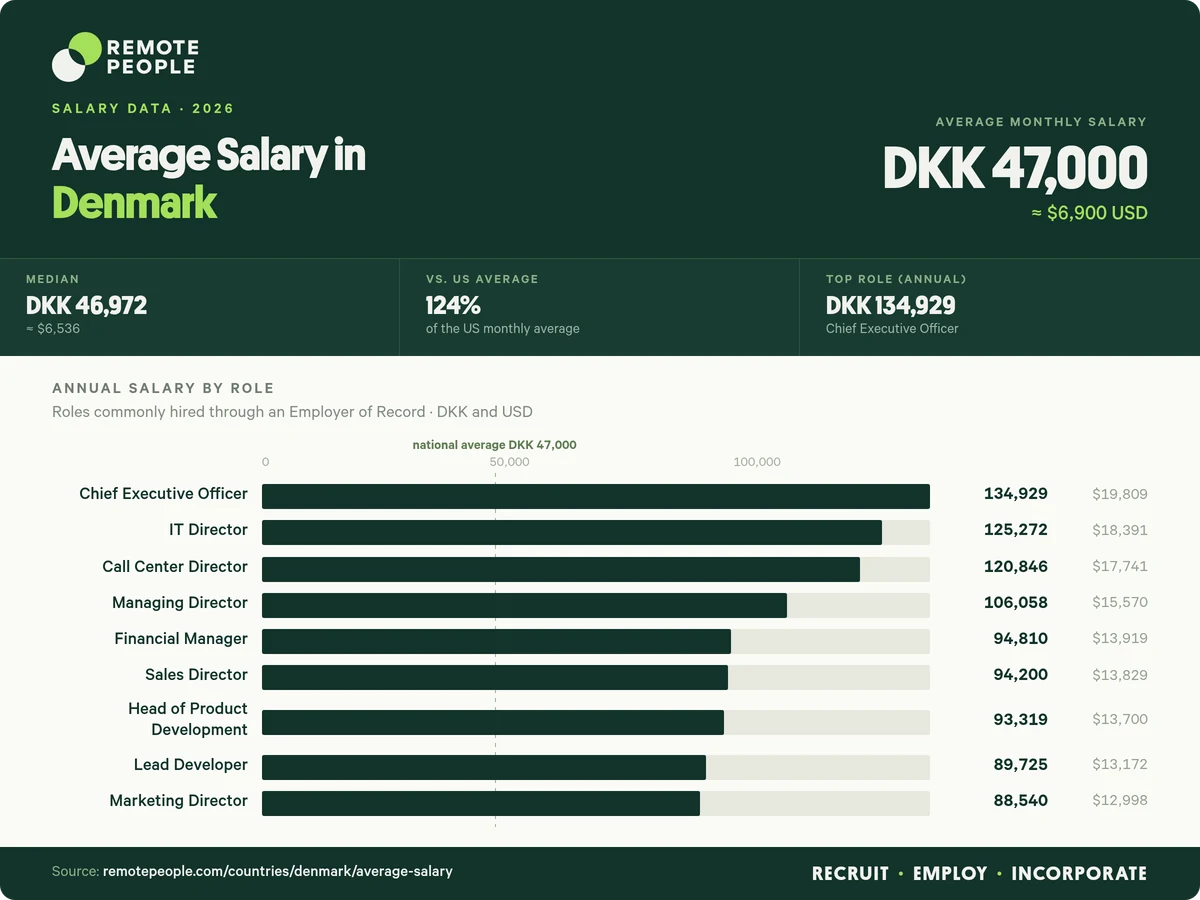
The average salary in Denmark is 47,000 kroner per month, which translates to USD 6,900. However, you must also consider how experience, education, industry, profession, and location impact salary.
This guide will explore various aspects of salaries in Denmark to provide the complete picture.
What is the Average Salary in Denmark?
The average salary in Denmark is 47,000 krones (approx. $6,900). The rate is relatively high due to the high cost of living. Denmark is one of the most expensive countries in the European Union. The cost of living is higher than in the U.S., excluding rent.
Median Income
The median salary can also be considered the ‘middle salary.’ Denmark’s median monthly income is 46,972 DKK (approximately $6536). Fifty percent of workers make more than this amount, and the other half earn less.
Salary Range
The salary range spans from the lowest to the highest. Low-earners in Denmark make around 23,553 DKK (approximately $3,450), while the average salary among highly paid workers is 74,143 DKK (roughly $10,900).
Salary Comparison by Profession
Earnings vary depending on industry and position. This salary comparison chart provides more insight by listing the average salaries of various workers in the country.
Position | Yearly Salary (DKK) |
|---|---|
Chief Executive Officer | 134,929 |
IT Director | 125,272 |
Call Center Director | 120,846 |
Plant Manager | 107,561 |
Managing Director | 106,058 |
Financial Manager | 94,810 |
Sales Director | 94,200 |
Head of Product Development | 93,319 |
Lead Developer | 89,725 |
Marketing Director | 88,540 |
Fabric Cutter | 24,715 |
Clothing Technologist | 24,607 |
General Laborer | 24,377 |
Packer | 24,101 |
Cleaner | 23,303 |
Seamstress | 23,011 |
Porter | 22,231 |
Medical Records Clerk | 22,166 |
Tailor | 21,995 |
Average Wage in Denmark by Education
Education plays a significant role in Danish salaries. 2022 statistics reveal PhD holders earn the highest salaries, on average, at 67,000 DKK. People with a Master’s degree earn an average of around 61,000 DKK. Individuals with only primary education receive the lowest earnings, at 34,000 DKK per month.
Salary Comparison by Experience
Experience also impacts salaries. Workers who are experienced in their industry can expect to earn more than entry-level workers. Moreover, workers who have been at their jobs for years will receive raises that increase their earnings.
Salary Comparison by Location
Workers in urban areas tend to earn more than workers in rural areas due to a higher cost of living and proximity to more job opportunities. In Denmark, workers in Copenhagen earn more than workers in rural areas.
How Much is Minimum Wage in Denmark?
Denmark does not have a statutory minimum wage. Instead, the minimum wage is determined through collective bargaining agreements between employers and unions. As a result, the minimum wage will vary based on industry and occupation.
However, available data shows the average Denmark minimum wage per hour is around 110 DKK (approximately $16.20).
Average Salary in Denmark vs. the Rest of the World
Comparing salaries worldwide will provide further insight into the Denmark work economy. The following charts compare Denmark to developed, developing, and undeveloped countries.
Denmark vs. Developed Countries
Country | Average Salary | Comparison to Average Denmark Salary |
|---|---|---|
United Kingdom | £3,000 (approx. $4,100) | 68% |
United States | $5,220 | 32% |
Norway | 50,000 NOK (approx. $4,700) | 47% |
Germany | €4,300 (approx. $4,470) | 54% |
Austria | €3,700 (approx. $4,050) | 70% |
Denmark vs. Developing Countries
Country | Average Salary | Comparison to Average Denmark Salary |
|---|---|---|
Romania | 4,000 RON (approx. $835) | 726% |
Russia | 73,700 RUB (approx. $700) | 886% |
Albania | 83,330 ALL (approx. $860) | 88% |
Kazakhstan | 342,000 KZT (approx. $645) | 970% |
Ukraine | 18,000 UAH (approx. $500) | 1,280% |
Denmark vs. Undeveloped Countries
Country | Average Salary | Comparison to Average Denmark Salary |
|---|---|---|
Thailand | 15,000 Baht (approx. $420) | 1,543% |
Philippines | 15,000 PHP (approx. $265) | 2,505% |
Vietnam | 7.5 million Dong (approx. $300) | 2,200% |
Egypt | 3,900 EGP (approx. $125) | 5,420% |
Pakistan | 60,000 PKR (approx. $210) | 3,185% |
Denmark is a highly developed country with a dominant service sector. It is also a significant exporter of pharmaceuticals and agriculture. The highly skilled workforce enjoys a flexicurity work model that offers flexibility for workers, unemployment benefits, and retraining programs.
The country is an ideal outsourcing destination as it is an innovation hub. It also prioritizes a transparent regulatory system. However, the market is small compared to other countries, and labor comes at a premium.
What are the Most Common Outsourced Industries in Denmark?
Companies typically outsource Denmark labor in the following industries:
Life Sciences
Denmark has a highly developed life sciences industry with leading expertise in diabetes, obesity, mental health, skin disorders, hearing, inflammatory diseases, and allergies. It is home to major companies like Novo Nordisk, Lundbeck, and Ferring Pharmaceuticals. Medical organizations often partner with Danish companies to research and outsource medical products.
Thanks to its innovative focus and low corporate taxes, the country produces 15 percent of the world’s pharmaceutical products.
Wind Energy
Denmark is a popular source of clean energy with the world’s highest proportion of wind power. Its flat terrain and proximity to the sea ensure strong, consistent winds. The government has created policies that actively support and encourage wind generation nationwide.
Companies that source wind energy from Denmark can enjoy low prices as the country gets cheaper power from offshore wind turbines.
IT Services
Denmark’s thriving IT industry focuses on software development, cybersecurity, and data science. Major tech companies like Microsoft, IBM, and Google have a strong presence in the country. It is a desirable location for startups and growth.
IT technicians in Denmark may not be less expensive than technicians in other countries, but companies can benefit from their high sense of innovation and stable job market.
Conclusion
Denmark is not the most affordable outsourcing destination, but its sense of innovation makes it a leader in specific industries. Employers who hire remote workers from Denmark may benefit from superior services that put them ahead of the competition while boosting the country’s work economy.