
 Recruit
Average Salary in Equatorial Guinea
-
 Drew Donnelly
- Published
- September 21, 2026
Curious about salaries in Equatorial Guinea? This guide breaks down the average wages, compares professions, highlights minimum wage figures, and explores how Equatorial Guinea’s earnings measure up internationally.
- 5 ★ on G2








- Equatorial Guinea Services
- What is the Average Salary in Equatorial Guinea?
- Salary Comparisons in Equatorial Guinea
- How Much is Minimum Wage in Equatorial Guinea?
- Average Salary in Equatorial Guinea vs. the Rest of the World
- What are the Most Common Outsourced Industries in Equatorial Guinea?
- Conclusion

Let RemotePeople handle payroll, compliance, and HR admin worldwide so you can focus on building your team.
The average salary in Equatorial Guinea is 240,000 Central African CFA francs (XAF), about USD 390. However, you must also consider how wages are impacted by experience, education, location, position, and industry. Comparing earnings in the country to salaries worldwide provides additional insight.
What is the Average Salary in Equatorial Guinea?
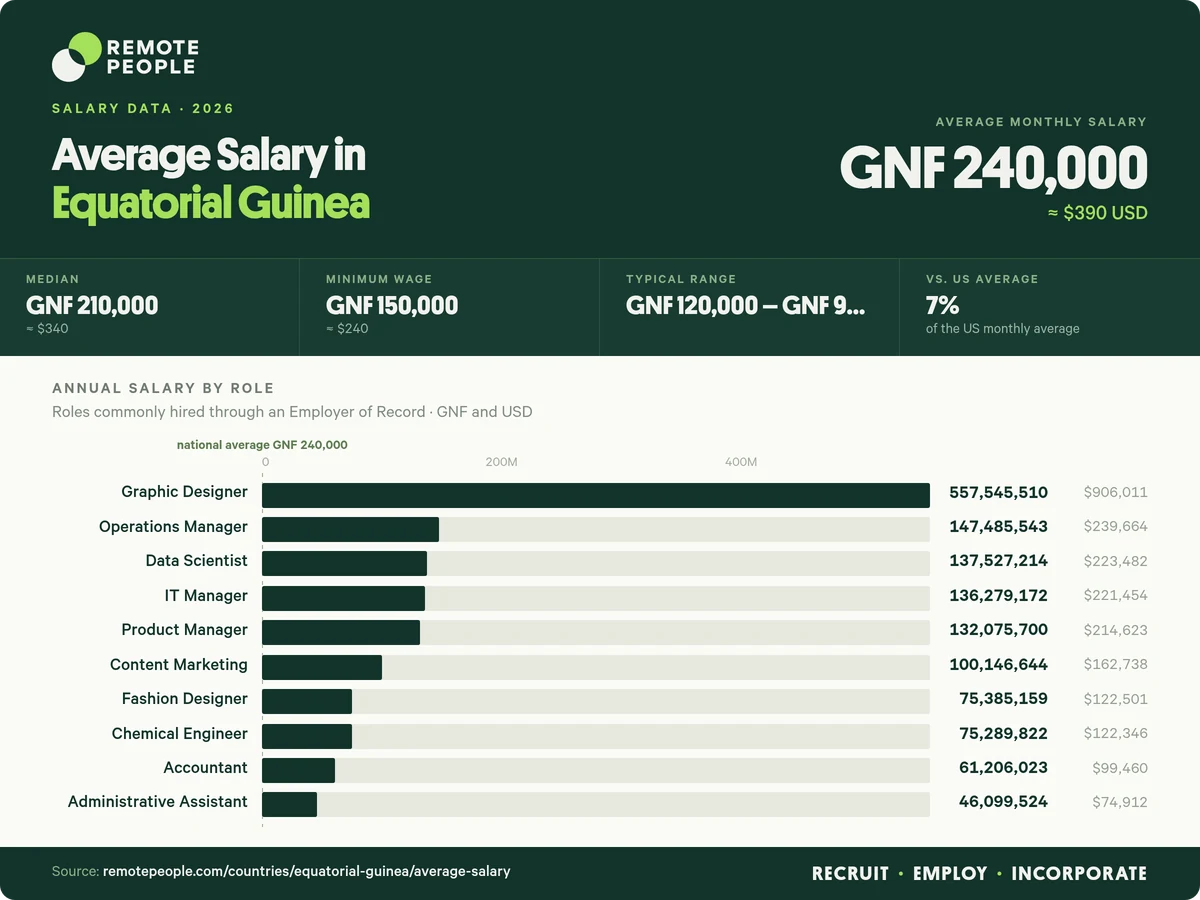
The average salary in Equatorial Guinea is 240,000 XAF, equivalent to approximately $390. Wages in the country are low due to economic mismanagement, corruption, and a focus on infrastructure over social development. The government is also heavily reliant on oil, making it vulnerable to fluctuations in industry pricing.
Median Income
Equatorial Guinea’s median monthly income is approximately 210,000 Central African CFA francs (XAF), or about $340. Half of the population earns higher salaries, while the other half earns less.
Salary Range
Salary range spans from the lowest to the highest wages in the country. In Equatorial Guinea, low earners make about 120,000 Central African CFA francs (XAF), about $195, while high earners make closer to 900,000 XAF, about $1,460.
Salary Comparisons in Equatorial Guinea
Salary by Position
This salary comparison chart reveals how wages vary by position.
Position | Average Annual Salary (GNF) |
|---|---|
Operations Manager | 147,485,543 |
Product Manager | 132,075,700 |
IT Manager | 136,279,172 |
Accountant | 61,206,023 |
Data Scientist | 137,527,214 |
Chemical Engineer | 75,289,822 |
Mechanical Engineer | 79,588,631 |
Fashion Designer | 75,385,159 |
Content Marketing | 100,146,644 |
Graphic Designer | 557,545,510 |
Administrative Assistant | 46,099,524 |
Dentist | 214,931,773 |
Average Wage in Equatorial Guinea Based on Education
Salary Comparison by Experience
Experience impacts salaries as experienced workers earn more than entry-level workers. However, industry plays a more significant role.
For example, wages in the country are based on a minimum wage. Although the minimum wage is the same for everyone, it is multiplied by a coefficient that determines how much you earn.
For accountants in the formal sector (oil and gas), the minimum wage is multiplied by 11. Meanwhile, an accountant working in the informal sector (such as industrial, banking, or insurance) is subject to a 4.4 coefficient.
Salary Comparison by Location
Location also plays a role in wage determination. Workers in urban areas, such as the capital and financial center of Malabo and Bata, the largest city in the country, earn more than those on remote islands like Annobon and Bioko, due to higher living costs and proximity to large companies offering more job opportunities. However, remote islands may provide unique job opportunities due to their distinct climatic dynamics.
How Much is Minimum Wage in Equatorial Guinea?
The minimum wage in Equatorial Guinea is 150,000 XAF, equivalent to approximately $240 per month. The new wage went into effect on Jan. 1, 2024. However, informal and formal sectors are subject to a coefficient that changes the minimum wages across industries.
Average Salary in Equatorial Guinea vs. the Rest of the World
Equatorial Guinea vs. Developed Countries
Country | Average Salary | Comparison to Average Equatorial Guinea Salary |
|---|---|---|
Japan | 340,000 JPY (approx. $2,300) | − 490% |
United Kingdom | £3,000 (approx. $4,100) | − 951% |
Norway | 50,000 NOK (approx. $4,700) | − 1,105% |
Germany | €4,300 (approx. $4,470) | − 1,046% |
Austria | €3,700 (approx. $4,050) | − 939% |
Equatorial Guinea vs. Developing Countries
Country | Average Salary | Comparison to Average Equatorial Guinea Salary |
|---|---|---|
Romania | 4,000 RON (approx. $835) | − 114% |
Russia | 73,700 RUB (approx. $700) | − 80% |
Albania | 83,330 ALL (approx. $860) | − 121% |
Kazakhstan | 342,000 KZT (approx. $645) | − 65% |
Ukraine | 18,000 UAH (approx. $500) | − 28% |
Equatorial Guinea vs. Undeveloped Countries
Country | Average Salary | Comparison to Average Equatorial Guinea Salary |
|---|---|---|
Afghanistan | 13,200 AFN (approx. $150) | 62% |
Philippines | 15,000 PHP (approx. $265) | 32% |
Cambodia | 1,150,000 KHR (approx. $280) | 28% |
Egypt | 3,900 EGP (approx. $125) | 68% |
Pakistan | 60,000 PKR (approx. $210) | 46% |
Equatorial Guinea is a developing country with an upper-middle-income economy. It is heavily reliant on oil and gas production, leading to a significant increase in its GDP per capita. However, it does not invest in social welfare, and many of its citizens live in poverty.
Despite internal conflicts, Equatorial Guinea shows promise as an outsourcing destination due to its low labor costs. It is actively trying to diversify into industries like agriculture and BPO to attract the private sector. The government is also working on a data protection law, understanding its importance in supporting outsourcing activities.
What are the Most Common Outsourced Industries in Equatorial Guinea?
Companies that outsource to Equatorial Guinea will see the most benefits when focusing on the following industries.
Oil and Gas
Equatorial Guinea is a significant oil producer in Africa, with the oil industry contributing a substantial portion of its GDP. It is heavily reliant on foreign investment and is a primary source of income for the country. Companies that outsource can leverage oil and gas exports and related services.
BPO
The country’s BPO industry is in its early stages, but it shows great potential for international companies. The government is implementing measures to improve the business environment, including the One-Stop Shop initiative for business registration. It also offers a low tax rate.
Agriculture
Equatorial Guinea boasts a thriving agricultural industry, which accounts for approximately 2% of its GDP. Although it is mainly reliant on subsistence farming, it also produces export crops such as cocoa, coffee, and coconuts. The government is working to modernize the industry and enhance food security.
Conclusion
The low average salaries in Equatorial Guinea make it a promising destination for outsourcing. Companies that form remote partnerships in the region can benefit from reduced expenses and access to high-quality products and services, while helping the country overcome poverty and achieve positive outcomes for all parties involved.