
 Recruit
Employer of Record (EOR) in Guernsey
-
 Drew Donnelly
- Published
- September 21, 2026
RemotePeople’s employer of record in Guernsey lets you hire employees in Guernsey with Channel Islands compliance. We handle 7% social insurance contributions, Your Island Pension scheme enrollment, and ETI income tax deductions.
Hire in Guernsey — book a free 30-minute demo
Tell us what you need. You'll get a tailored, transparent proposal within 24 hours, plus a free call to walk through it.
Tell us about your company
So we can match you with a specialist who knows your market — and unlock volume pricing tiers.
* All fields are required.
Where and when are you hiring?
Tell us the geography and timing and we'll quote each country line by line, with onboarding timelines.
* All fields are required.
Help us beat your current setup
We'll benchmark your current deal and send a line-by-line proposal in 24 hours — showing exactly where we cut cost, time, or risk. After you submit, you can book a call to walk through it together.
* All fields are required.
Thanks! Your proposal is on its way.
Expect a tailored, line-by-line proposal in your inbox within 24 hours. In the meantime…
Want to walk through it together?
Book a free 30-minute call with one of our specialists. We'll explain every line, answer your questions, and tailor the proposal further if you need.
No obligation. Pick a time that works for you.








- Hire in Guernsey — book a free 30-minute demo
- Tell us about your company
- Where and when are you hiring?
- Help us beat your current setup
- Thanks! Your proposal is on its way.
- How an Employer of Record Works in Guernsey
- Hire in Guernsey
- Employment Laws and Regulations in Guernsey
- Work Permits and Visas in Guernsey
- Payroll, Taxes, and Social Security in Guernsey
- Cost of Hiring Through an EOR in Guernsey
- Benefits of Using an EOR in Guernsey
- Termination and Offboarding in Guernsey
- EOR vs. Other Hiring Models in Guernsey
- Public Holidays in Guernsey
- How to Get Started with an EOR in Guernsey
- Frequently Asked Questions About EOR in Guernsey
- Related EOR Destinations

Start hiring in Guernsey
Let RemotePeople handle payroll, compliance, and HR admin worldwide so you can focus on building your team.

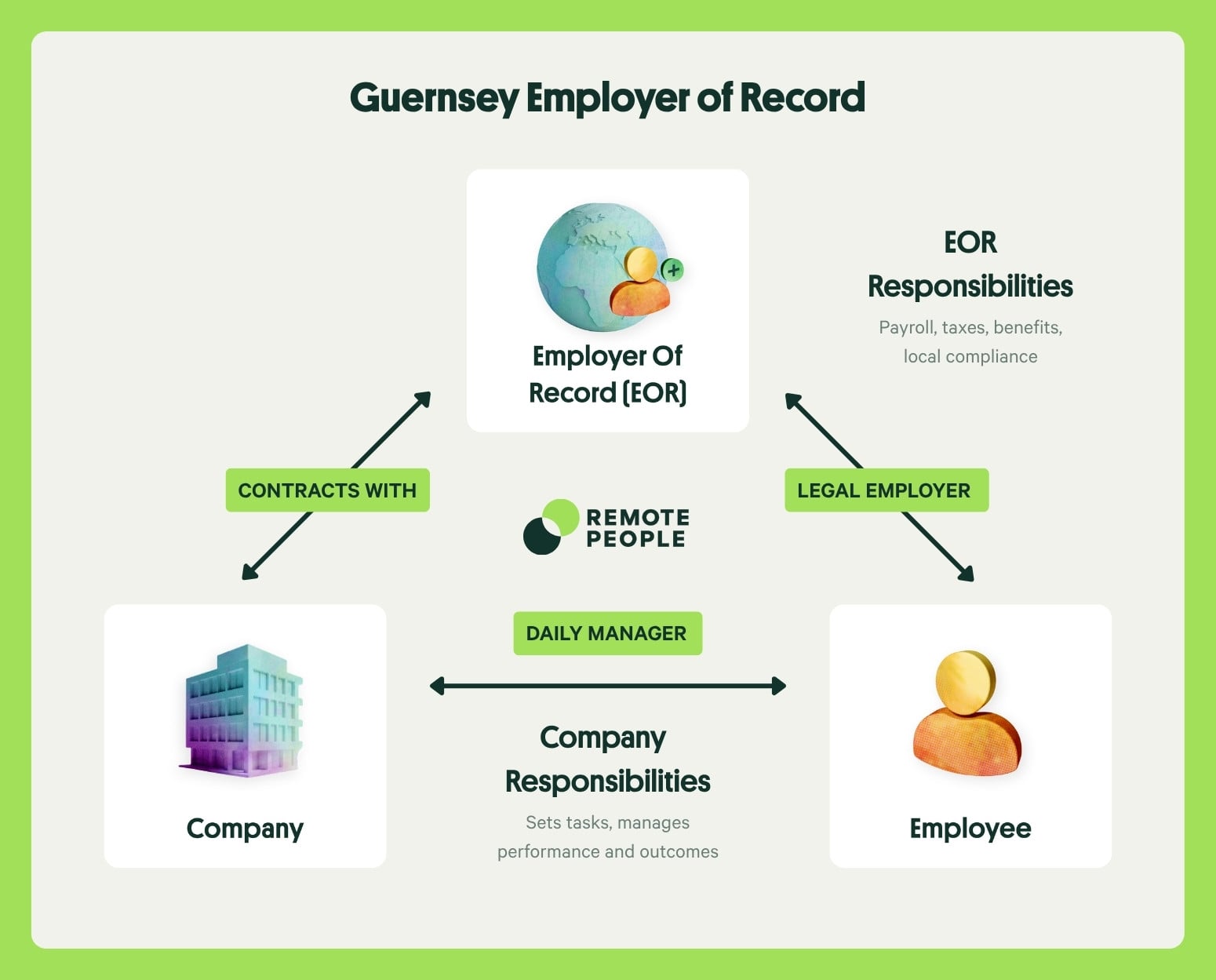
Guernsey offers an attractive business environment with competitive tax rates and stable employment regulations. For companies looking to hire employees in Guernsey, establishing a local legal entity creates administrative complexity and regulatory overhead. An employer of record in Guernsey serves as your legal employer while your team reports to you operationally, handling payroll, tax compliance, benefits administration, and employment law requirements without requiring you to form a subsidiary. This arrangement allows international businesses to access Guernsey’s skilled workforce while maintaining operational simplicity and reducing compliance risk.
How an Employer of Record Works in Guernsey
An employer of record (EOR) functions as the legal employer for your staff in Guernsey while you retain full operational control. The EOR assumes all employment-related liabilities, regulatory obligations, and administrative responsibilities, allowing you to focus on strategic business growth. This model has become standard practice for companies entering new markets without establishing subsidiary operations, whether in Guernsey or other Crown Dependencies like Jersey or Isle of Man.
If you’d like to learn more about how Employer of Record (EOR) services work, read our What Is an Employer of Record (EOR)? guide for a complete overview of the model, its benefits, and when to use it.
If you’re comparing providers, our Best Employer of Record (EOR) Providers guide reviews the leading platforms to help you choose the right solution for your business.
Who Uses an EOR in Guernsey?
A range of organizations use EOR services to hire in Guernsey, often to reduce the legal and compliance burden of expanding into a new market. These are the most common scenarios.
- Global Companies Entering Guernsey: Multinational organizations establishing their first operations in Guernsey without forming a local entity, using an EOR to manage employment compliance while maintaining central control.
- Rapid Hiring Scenarios: Companies needing to onboard teams quickly without the time investment of setting up subsidiary operations, regulatory registrations, or separate payroll infrastructure.
- Flexible Workforce Strategies: Organizations testing market viability, launching pilot projects, or maintaining a variable workforce size without commitment to a fixed local presence or administrative overhead.
- Companies Lacking Local Expertise: Businesses without the in-house knowledge to handle Guernsey employment law, tax regulations, social security requirements, and ongoing compliance obligations on their own.
Typical Onboarding Timeline
The process of hiring your first employee through an EOR in Guernsey typically follows a structured timeline. Each step builds on previous requirements to ensure full compliance and operational readiness.
- First: You provide employee information and contract details to your EOR provider, including position details, compensation structure, start date, and any special contractual terms. The EOR reviews your requirements against Guernsey employment law to identify any compliance adjustments needed.
- Second: The EOR drafts the employment contract based on Guernsey legal standards, incorporates your specific terms and conditions, and obtains your approval before presenting the offer to the candidate. This phase typically takes 3â5 business days once you provide complete information.
- Third: Once the candidate accepts and returns the signed contract, the EOR enrolls the employee in social security schemes, registers them for secondary pension contributions, and sets up payroll processing infrastructure. Work permit applications are initiated if the employee is a non-resident requiring authorization under Guernsey’s Population Management regime.
- Fourth: The EOR configures payroll systems, verifies all tax codes and deduction rates, collects final banking and personal details, and conducts any necessary compliance verifications before the official start date.
- Fifth: On the employee’s start date, all systems are active and payroll processing begins. The EOR maintains ongoing support including payroll administration, statutory reporting, benefits administration, and compliance monitoring throughout the employment relationship.
Hire in Guernsey
Let RemotePeople handle payroll, compliance, and HR in Guernsey so you can focus on growing your business.
Employment Laws and Regulations in Guernsey
Guernsey’s employment framework balances employer flexibility with employee protections through established legislation and regulatory oversight. The primary governing law is the Employment Protection (Guernsey) Law, 1998, which establishes baseline rights and obligations for all employment relationships. The Discrimination Ordinance 2023 extends protections across disability, race, carer status, sexual orientation, and religion. The Employment & Equal Opportunities Service (EEOS) is the primary regulatory authority, enforcing compliance and adjudicating disputes. Any employer operating in Guernsey, whether through a local subsidiary or an EOR, needs to know these rules.
Employment Contracts
Employment contracts in Guernsey must clearly specify terms and conditions, compensation, responsibilities, and any probationary arrangements. Contracts do not require written form to be enforceable, but written agreements provide essential clarity and evidence in dispute resolution. Under common law principles applied in Guernsey, contracts must contain all material terms to be considered complete and binding.
Contracts should explicitly state compensation structure (salary, allowances, benefits), job title and reporting relationships, working hours and schedule, probation period (if applicable), leave entitlements, confidentiality and intellectual property arrangements, and termination notice periods. Non-compete clauses are enforceable under English common law principles applied locally, provided they are reasonable in scope, duration, and geographic area. Any employment contract should be reviewed for compliance with the Employment Protection Law and should clearly distinguish between obligations under that law and contractual benefits exceeding statutory minimums.
Working Hours and Overtime
Guernsey employment law does not establish a statutory maximum working week, though 40 hours weekly is standard and 48 hours is a common ceiling. The law requires a minimum 30-minute meal break after 6 hours of continuous work. Overtime compensation is not statutorily mandated but is typically contractual, with rates commonly structured at 1.25 times regular pay for weekday overtime, 1.5 times for Saturday work, and 2.0 times for Sunday and public holiday work.
Guernsey overtime and premium pay rates · Per common contractual practice | |||
Hour Type | Rate Multiplier | Weekly/Daily Cap | Notes |
|---|---|---|---|
Weekday Overtime | 1.25x base pay | No statutory cap | Beyond contracted hours |
Saturday Hours | 1.5x base pay | No statutory cap | Weekend work premium |
Sunday Hours | 2.0x base pay | No statutory cap | Premium for statutory day off |
Public Holiday Hours | 2.0x base pay | No statutory cap | Working scheduled holidays |
Source: Employment Protection (Guernsey) Law, 1998 and market practice guidance from Guernsey Government | |||
Minimum Wage
Guernsey applies a tiered minimum wage structure as of October 2025. The adult minimum wage stands at £12.60 per hour for workers aged 21 and above, while youth minimum wage for workers aged 18â20 is £11.35 per hour. Apprentices and workers in their first 500 hours on the job may be paid a lower apprenticeship rate, though this is less common in Guernsey’s regulated market. Minimum wage rates are reviewed annually and adjusted based on earnings indices and cost-of-living assessments.
Probation Period
Guernsey employment law does not establish a statutory probation period. However, employment contracts commonly include probation terms ranging from 3 to 6 months. During probation, employees still enjoy the same statutory rights and protections, including annual leave entitlements and statutory minimum wage compliance. Termination of probationary employees follows the same notice requirements as permanent staff based on their length of service (see Notice Periods below).
The key distinction in Guernsey is that unfair dismissal protections only apply after 12 months of continuous service. This means probationary employees, whether their contract specifies probation or not, cannot claim unfair dismissal during their first year, even if terminated without cause. Contracts should clearly state any performance or capability requirements during probation to ensure enforceability.
Leave Entitlements
Guernsey employment law provides statutory leave protections covering annual leave, sick leave, maternity leave, paternity leave, and additional statutory leave for specific circumstances. These entitlements are considered minimum standards, and employers may offer more generous terms contractually. The following sections detail each leave category.
Annual Leave
Employees are entitled to 28 days of annual leave per year, which includes public bank holidays. This equates to 5.6 weeks of paid leave annually. Leave can be taken at times mutually agreed between employer and employee. Upon termination of employment, unused annual leave must be paid out based on the employee’s regular salary, calculated on a pro-rata basis if employment ended partway through the leave year. Employers may establish carry-over policies limiting how much unused leave can roll into the following year, provided the leave year and accrual rules are clearly specified in the employment contract.
Sick Leave
Guernsey has no statutory sick pay obligation on employers. Instead, employees receive statutory sick benefits through the Guernsey Social Security system after a 3-day waiting period for each sickness event. Many employers contractually provide occupational sick pay exceeding statutory minimums as a competitive practice. Medical certification is typically required for absences exceeding 3 consecutive days. Frequent or extended sick leave may trigger capability procedures under employment law, provided fair process is followed.
Maternity Leave
All employees are entitled to 12 weeks of basic maternity leave regardless of length of service, under the Employment Protection (Guernsey) Law, 1998. Basic maternity leave is unpaid by the employer, though employees may claim maternity allowance through the Guernsey Social Security system. A compulsory two-week period from the date of childbirth prohibits the employee from working.
Employees with 15 months of continuous service by the 11th week before the expected due date qualify for an additional 26 weeks of maternity leave, extending total entitlement to 38 weeks. The additional leave is also unpaid under statute, though some employers provide contractual maternity pay as a competitive benefit.
Paternity Leave
Employees are entitled to 2 weeks of paternity leave, available only where the employee has completed 15 months of continuous service and meets other eligibility criteria. Paternity leave is unpaid under statute, though employers may provide contractual pay. Paternity leave must be taken within a defined window following the child’s birth and cannot be deferred or carried over to future years. The employee must provide proper notice and evidence of the child’s birth to access this entitlement.
Other Statutory Leave
Guernsey recognizes 9 public holidays in 2026, which are typically included within the 28-day annual leave entitlement rather than provided as separate days. Public holidays include New Year’s Day, Good Friday, Easter Monday, May Day Bank Holiday, Spring Bank Holiday, Summer Bank Holiday, August Bank Holiday, Liberation Day (9 May), and Christmas Day. If an employee is required to work on a public holiday, the time should be paid at the contractual overtime rate or, alternatively, a substitute day off provided. Guernsey does not provide statutory carer’s leave or bereavement leave, though these may be granted at employer discretion.
Guernsey statutory leave entitlements · Per Employment Protection (Guernsey) Law, 1998 | ||
Leave Type | Entitlement | Paid or Unpaid |
|---|---|---|
Annual Leave | 28 days (5.6 weeks) | Paid; includes public holidays; pro-rata for part-time |
Maternity Leave (Basic) | 12 weeks | Unpaid by employer; all employees regardless of service; social security maternity allowance may apply |
Maternity Leave (Additional) | 26 weeks | Unpaid; requires 15 months continuous service by 11th week before due date |
Paternity Leave | 2 weeks | Unpaid; requires 15 months continuous service; must be taken around birth |
Sick Leave | No statutory employer obligation | Social security sickness benefit after 3-day waiting period; contractual sick pay common |
Public Holidays | 9 days (2026) | Paid; included within the 28-day annual leave entitlement |
Bereavement Leave | No statutory entitlement | Employer discretion; commonly 3â5 days for close family |
Statutory Employee Benefits
Guernsey mandates employer participation in social security schemes and secondary pension arrangements. Employers must register employees with Guernsey Social Security and contribute 7.1% of earnings (as of 2026) toward employee benefits including sickness benefits, maternity benefits, and old-age pensions. Additionally, employers must enroll employees in secondary pension schemes with minimum contributions of 1.0% employer match against 1.5% employee contribution (2026 rates). These contributions are mandatory and represent a non-negotiable component of employment costs.
Health and safety protections are embedded in employment law, requiring employers to maintain safe working conditions and provide appropriate training. Employees have the right to time off for public holidays, maternity, paternity, and statutory leave as outlined above. Employers must also keep full employment records (contracts, payroll documentation, and leave records) for a minimum of 6 years.
Recent Regulatory Updates (2026)
Guernsey’s employment rules continue to change with regular rate updates and policy adjustments. The minimum wage was last updated in October 2025 to £12.60 for adults and £11.35 for youth workers. Social security contribution rates for 2026 maintain the employer rate at 7.1% and the employee rate at 7.5%, with an upper earnings limit of £3,780 per week (£196,560 annually). Secondary pension contributions remain at 1.0% employer and 1.5% employee for 2026.
The Discrimination Ordinance 2023 continues to strengthen protections for employees across disability, race, carer status, sexual orientation, and religion. Employers should ensure that recruitment, promotion, pay, and termination decisions are transparent and free from unlawful discrimination. The EEOS publishes updated guidance regularly, and employers are advised to monitor official government announcements for any further changes to statutory rates, thresholds, or regulatory requirements affecting employment relationships.
Work Permits and Visas in Guernsey
Guernsey manages workforce entry through its Population Management regime, which controls the number of foreign workers and their length of stay. The system distinguishes between Guernsey residents (who may be citizens of other jurisdictions) and non-residents requiring work authorization. Employers hiring international talent need to know the permit categories, eligibility criteria, and processing requirements. The system prioritizes economic benefit to Guernsey while protecting local employment opportunities.
Work Permit Requirements
Who Needs a Work Permit
Non-resident workers require work authorization to legally employment in Guernsey. A worker is classified as non-resident if they do not meet the definition of a resident under Guernsey’s Population Management regime. Generally, residents include individuals with indefinite residence rights, those with historical family connections, and those who have established continuous residence. Non-resident workers, including those on short-term contracts or relocating specifically for employment, must obtain appropriate work permit authorization before commencing work.
EU and UK citizens have the same work permit requirements as other non-residents following Guernsey’s exit from the EU framework. Citizens of Commonwealth nations and other countries follow identical authorization processes. An employer cannot legally employ a non-resident without a valid work permit, and both the employer and employee face penalties for non-compliance, including fines and potential deportation.
Eligibility and Required Documents
Eligibility for work permits depends on the permit category sought (see Visa Types below) and the employment role. Generally, employers must demonstrate that the position cannot be readily filled by a resident worker, the salary meets or exceeds minimum thresholds, and the worker possesses relevant qualifications or experience. Required documentation typically includes a completed work permit application form, a detailed job description, the employment contract, proof of the employer’s business registration, evidence of financial capacity, the worker’s passport, educational and professional qualifications, and references from previous employers.
The Employment & Equal Opportunities Service reviews applications to ensure compliance with Population Management policy and employment law. Processing times vary by permit category but typically range from 2 to 8 weeks. Applications should be submitted well in advance of the intended start date to accommodate processing and any requests for additional information.
Processing Time and Validity
Work permits vary in duration depending on the permit category. Short-term Employment Permits (SEP) are valid for 9 months and are designed for temporary roles or trial periods. Standard Employment Permits (STEP) are valid for 1 year and serve as the typical authorization for ongoing employment relationships. Long-Term Employment Permits (LTEP) are valid for 8 years and suit established, long-term roles where the employer has demonstrated genuine need for the worker. Processing times for new applications typically range from 4 to 8 weeks from submission to approval, though cases with incomplete documentation may face delays.
Renewal Process
Work permits must be renewed before expiration to maintain legal employment authorization. Renewal applications should be submitted to the Population Management team at least 6 weeks before the permit expires. Renewal processing typically takes 4â6 weeks and follows a similar assessment process as initial applications. If a renewal application is submitted on time, the worker may continue employment during the processing period even if the original permit has expired. However, if the renewal is not submitted timely, the worker’s authorization to work in Guernsey terminates immediately, and employment must cease until a new permit is issued.
Common Visa Types for Foreign Workers
Guernsey offers several visa and permit categories depending on the nature and duration of the assignment. The following table summarises the main routes available to foreign nationals seeking employment on the island.
Guernsey work visa types for foreign workers · 2026 | ||||
Permit Type | Valid Duration | Typical Use Case | Salary Threshold | Renewal Requirement |
|---|---|---|---|---|
Short-Term Employment Permit (SEP) | 9 months | Temporary roles, project-based work, trial periods | Standard rates apply | May apply for STEP or LTEP |
Standard Employment Permit (STEP) | 1 year | Ongoing employment, regular staff positions | Role-dependent minimum rates | Annual renewal before expiry |
Long-Term Employment Permit (LTEP) | 8 years | Established long-term roles, senior positions, specialized expertise | Higher thresholds, evidence of organizational need | Renewal every 8 years |
Resident Visa (Family Route) | Indefinite (residence status) | Family members of Guernsey residents or citizens | N/A â residence-based not employment-based | N/A â permanent status |
Visitor Status | Up to 3 months | Training, conferences, short-term knowledge transfer (no employment) | N/A â no employment authorization | No renewal; new visitor entry required |
Source: Guernsey Population Management Scheme and Guernsey Government policy guidance | ||||
How an EOR Handles Work Permits
An EOR in Guernsey manages the entire work permit application and renewal process on your behalf, which takes most of the administrative burden off your plate. The EOR prepares and files all required documentation with the Population Management authority to meet current criteria and policy. This includes drafting job descriptions that justify hiring a non-resident, verifying salary structures meet thresholds, and gathering supporting evidence of the business need. The EOR also advises on the optimal permit category based on the role duration and your organizational requirements.
Throughout the permit validity period, the EOR tracks expiration dates and initiates renewal applications well in advance to prevent lapses in authorization. The EOR also manages any administrative changes, such as salary adjustments or job title modifications, that may require permit amendment. If your organization plans to establish ongoing operations in Guernsey, the EOR can counsel you on whether Long-Term Employment Permits or alternative immigration pathways might offer greater stability and efficiency. This is especially useful for companies hiring multiple international workers, since the EOR keeps all permit obligations in one place and reduces the risk of unauthorized employment.
Payroll, Taxes, and Social Security in Guernsey
Guernsey’s tax and payroll system pairs competitive rates with solid social security coverage. The jurisdiction applies a flat 20% income tax rate with a personal allowance of £15,200 (2026), so there are no progressive brackets to worry about. Employers must withhold income tax and manage both employer and employee social security contributions through their payroll systems. Social security contributions fund sickness support, maternity coverage, and pension accumulation, while secondary pension schemes provide additional retirement savings.
Employer Contributions
Employers in Guernsey are required to make social insurance and pension contributions on behalf of each employee. The rates below apply to the 2026 contribution year as set by the Guernsey Social Security Department.
Guernsey employer social security contributions · 2026 rates | ||
Contribution Type | Rate | Upper Earnings Limit |
|---|---|---|
Social Security (Primary) | 7.1% | £3,780/week (£196,560/year) |
Secondary Pension Contribution | 1.0% | No statutory upper limit |
Total Employer Cost | 8.1% of eligible wages | Varies by component |
Source: Guernsey Social Security and Guernsey Income Tax Office | ||
Employee Contributions
Employees in Guernsey also contribute to social insurance through payroll deductions. The employer withholds these amounts and remits them to Guernsey Social Security on the employee’s behalf.
Guernsey employee payroll deductions · 2026 monthly withholdings | ||
Contribution Type | Rate | Upper Earnings Limit |
|---|---|---|
Social Security (Primary) | 7.5% | £3,780/week (£196,560/year) |
Secondary Pension Contribution | 1.5% | No statutory upper limit |
Total Employee Deduction | 9.0% of eligible wages | Varies by component |
Source: Guernsey Social Security and Guernsey Income Tax Office | ||
Income Tax
Guernsey operates a flat-rate income tax system with a personal allowance. Residents receive a tax-free allowance, with all taxable income above that threshold subject to a single rate.
Guernsey income tax brackets · 2026 | |
Earnings Range | Tax Rate |
|---|---|
Up to £15,200 (personal allowance) | 0% (tax-free) |
Above £15,200 | Flat 20% |
Source: Guernsey Income Tax Office and Guernsey Revenue Service | |
Payroll Cycle
Guernsey employers typically operate monthly payroll cycles, processing salaries at calendar month-end or a defined pay date within the month. Payroll must be processed and employees paid by the agreed date stated in their employment contract. Income tax withholding and social security contributions are calculated and deducted from each paycheck based on the employee’s earnings and tax status. Employers must file monthly tax deduction returns with the Income Tax Office detailing all employees, wages, tax withheld, and social security contributions.
Annual payroll reporting includes providing employees with a year-end earnings statement showing gross salary, tax paid, social security contributions, pension contributions, and net pay. Employers must also file annual tax and employment records with the Income Tax Office by a specified deadline, typically within 60 days of the tax year end (31 December). Failure to meet payroll deadlines or file accurate returns results in penalties and potential compliance investigation by tax authorities.
13th Month Salary and Bonus Pay
Guernsey employment law does not mandate a 13th month salary or annual bonus payment. Any 13th month payment or variable bonus is purely contractual and must be explicitly stated in the employment agreement. If offered, 13th month salaries are typically paid in December and are subject to the same income tax withholding and social security contributions as regular monthly pay. Employers who wish to avoid 13th month obligations should ensure employment contracts are silent on this matter or explicitly exclude such payments. Conversely, if bonuses or 13th month amounts are contractually promised, they must be paid as agreed and are enforceable through employment disputes.
Bonus structures, when contractually provided, should clearly specify the calculation methodology, conditions for payment, and any performance metrics. Variable bonuses that depend on company performance or individual targets should include dispute resolution mechanisms and clear communication of bonus criteria to ensure transparency. Upon termination, accrued but unpaid 13th month salaries or earned bonuses must typically be paid out in final settlement, unless the contract explicitly allows forfeiture under specific circumstances (e.g., cause termination).
Cost of Hiring Through an EOR in Guernsey
The total cost of hiring an employee in Guernsey through an EOR comprises three main components: the gross salary, employer social security and pension contributions, and the EOR service fee. Understanding this breakdown helps organizations budget accurately and compare hiring models.
EOR Service Fees
EOR providers in Guernsey typically charge a flat monthly fee ranging from USD 300 to USD 600 per employee. This fee covers payroll processing, benefits administration, compliance management, and ongoing HR support. Fees may vary based on contract duration, employee count, and additional services such as relocation support or specialized benefits administration.
Total Employment Cost Breakdown
The example below illustrates the full cost of employing one person in Guernsey on a USD 5,000 monthly gross salary.
Guernsey employer cost example · USD 5,000 gross · 2026 | ||
Employer Cost | Amount (USD) | % of Gross |
|---|---|---|
Gross Salary | 5,000.00 | 100.0% |
Employer Social Security (7.1%) | 355.00 | 7.1% |
Employer Secondary Pension (1.0%) | 50.00 | 1.0% |
EOR Service Fee (est.) | 449.00 | 9.0% |
Total Monthly Cost | 5,854.00 | 117.1% |
Source: Guernsey Social Security and RemotePeople Pricing | ||
Figures converted at 1 GBP â 1.26 USD, April 2026.
Ready to hire in Guernsey? Get started with RemotePeople. We handle employment contracts, payroll, tax withholding, and full Guernsey compliance. No local entity needed. contact us for a quote.
Benefits of Using an EOR in Guernsey
Hiring through an EOR in Guernsey offers significant operational and financial advantages, particularly for international companies entering the market for the first time. An EOR manages all employment responsibilities while you focus on integrating and developing your team.
The most immediate benefit is speed to market: you can launch hiring in Guernsey within one to two weeks without setting up a legal entity, locking in local talent before competitors. An EOR also ensures full compliance with Guernsey employment law, social insurance requirements, and data protection regulations, reducing the risk of fines and disputes with the local tax authority.
From a cost perspective, you avoid the GBP 15,000 to 30,000 expense of company formation and the ongoing costs of local payroll infrastructure. The flat EOR fee is typically lower than maintaining these services independently. Your EOR provider brings deep local expertise in Guernsey business practices and regulatory changes.
EOR arrangements offer flexibility and scalability, letting you add or reduce headcount without long-term commitments. You retain full operational control over daily tasks and performance reviews while the EOR handles administrative and legal responsibilities. For multi-jurisdiction teams, a single EOR consolidates payroll and compliance across all locations into one platform.
EOR is an attractive model for companies prioritizing fast market entry and operational simplicity. RemotePeople also supports hiring in nearby jurisdictions, including EOR in the United Kingdom. how EOR works or get in touch.
Termination and Offboarding in Guernsey
Guernsey’s employment law sets out clear notice period requirements and limits on severance obligations. Getting these right matters, both for legal compliance and for maintaining good employee relations.
Notice Periods
Notice periods in Guernsey are determined by length of service and must be honored by both employer and employee. The notice requirements apply after the initial probation period ends.
Guernsey statutory notice periods by length of service · Per Employment Protection (Guernsey) Law, 1998 | |||
Length of Service | Notice Period | During Probation | Notes |
|---|---|---|---|
Less than 1 month | None | No notice required | Employer or employee may terminate without notice during probation |
1 month â 2 years | 1 week | No notice required | Must be written notice; either party may provide |
2 â 5 years | 2 weeks | No notice required | Written notice required; applies to both termination and resignation |
5+ years | 4 weeks | No notice required | Extended notice protects long-service employees; written notice mandatory |
Severance Pay
Guernsey has no statutory severance entitlement, meaning employers are not legally required to pay severance unless the employment contract specifies otherwise. However, contractual severance arrangements are common in professional roles and provide predictability for both parties.
Guernsey severance pay schedule by years of service · Per common contractual practice | |||
Years of Service | Severance Amount | Base Calculation | Notes |
|---|---|---|---|
0 â 2 years | None | N/A | No statutory or common contractual entitlement |
2 â 5 years | 1 week per year | Weekly gross salary à years of service | Common in private sector contracts; discretionary |
5+ years | 1.5 â 2 weeks per year | Weekly gross salary à 1.5â2 à years of service | States sector provides up to 5 weeks per year; private practice varies |
Calculation Method
Contractual severance in Guernsey is typically calculated by multiplying the employee’s weekly gross salary by the number of years of service and the agreed-upon multiplier (1, 1.5, or 2 weeks per year). For example, an employee earning GBP 1,000 per week with 4 years of service and a 1-week-per-year severance clause would receive GBP 4,000 (1,000 Ã 4). Severance is sometimes reduced if the employee finds new work during the notice period.
Caps and Exceptions
Guernsey law does not impose a statutory cap on severance, though contractual terms vary. Redundancy payments are contractual rather than statutory and are often negotiated individually. Misconduct or summary dismissal typically eliminates severance obligations entirely, even if the contract provides for it.
Grounds for Termination
Termination in Guernsey must be conducted fairly and must follow the notice period requirements specified in the employment contract. Valid grounds for termination include performance issues, misconduct, redundancy, incapacity due to illness, and breach of contract. An employee may also be dismissed summarily (without notice) for gross misconduct such as theft, violence, or serious insubordination, provided the employer has a fair disciplinary process.
Employers must document the reasons for termination and ensure the employee has a fair opportunity to respond before dismissal is finalized. Discrimination-based terminations (on grounds of age, gender, disability, or religion) are prohibited and may expose the employer to legal claims. An EOR provider will manage the dismissal process to ensure compliance with these requirements.
EOR vs. Other Hiring Models in Guernsey
Organizations entering Guernsey have three primary hiring options: Employer of Record, setting up a local legal entity, or engaging independent contractors. Each model has distinct cost, compliance, and operational implications.
EOR vs. Setting Up a Local Entity
The choice between EOR and establishing a local Guernsey company depends on scale, timeline, and strategic commitment to the market.
Guernsey EOR vs local entity comparison · Setup time, cost, risk and best-fit | ||
Factor | Employer of Record | Own Entity |
|---|---|---|
Setup time | 1â2 weeks | 3â6 months |
Upfront cost | $0 | $15,000â$30,000 |
Ongoing cost | $300â$600/employee/month | $5,000â$10,000/year maintenance |
Local partner required | No (EOR is the local entity) | No, but corporate service provider often engaged |
Social insurance registration | Handled by EOR | You manage it |
Payroll & tax filing | Handled by EOR | You manage it (or outsource) |
Best for team size | 1â15 employees | 15+ employees |
Scale down / exit | Easy, no entity to unwind | Costly: legal dissolution required |
Government contracts | Not eligible | Eligible (requires local entity) |
For companies hiring fewer than five employees or those uncertain about long-term market commitment, EOR is typically the most cost-effective and time-efficient option. The EOR model eliminates upfront capital expenditure and accounting overhead, allowing you to scale operations incrementally without the sunk cost of company establishment.
A local entity becomes more attractive once your Guernsey payroll reaches 10+ employees, as the monthly EOR fees begin to exceed the cost of a local accountant and registered company administration. Additionally, organizations seeking government contracts or planning operations beyond 3â5 years may find a local entity more efficient and better aligned with buyer expectations.
Many organizations adopt a hybrid approach: initially hire through EOR to test the market and build a team, then transition to a local entity once the business case justifies the investment. An experienced EOR provider can facilitate this transition smoothly.
EOR vs. Hiring Independent Contractors
Many companies consider hiring contractors to reduce administrative overhead. However, there are significant legal and operational differences between EOR employment and contractor relationships.
Guernsey EOR vs independent contractors · Compliance, cost, and risk | ||
Factor | EOR (Full-Time Employee) | Independent Contractor |
|---|---|---|
Legal relationship | Employee of the EOR | Self-employed, no employment relationship |
Compliance risk | Low: EOR ensures local labor law compliance | High: misclassification risk if relationship resembles employment |
Payroll & tax | EOR handles withholding, contributions, filings | Contractor invoices you; they handle their own taxes |
Benefits & leave | Statutory benefits, paid leave, social security | No entitlement to employee benefits |
IP protection | Stronger: employment contract assigns IP by default | Weaker: requires explicit IP assignment clause |
Termination | Subject to local notice periods and severance | Contract can be ended per agreement terms |
Best for | Long-term, core team roles | Short-term projects, specialized tasks |
Cost structure | Salary + employer contributions + EOR fee | Contractor fee (typically higher gross, lower total cost) |
A critical risk in the contractor model is misclassification. If a contractor is treated as an employee in fact â working set hours, using your systems and facilities, taking direction from your management â Guernsey tax authorities may reclassify the relationship, resulting in back-payment of social insurance, payroll taxes, and potential penalties. This risk is particularly acute if the contractor later claims unfair dismissal or breach of contract.
EOR employment provides legal clarity, reduces misclassification risk, and ensures compliance with statutory leave and benefits obligations. Contractors are appropriate for specialized roles, project work, or supplementary skills, but should not be used as a workaround to avoid employment formality with core team members.
RemotePeople offers both EOR for full-time employees and contractor hiring solutions, allowing you to optimize your workforce mix while maintaining legal compliance.
EOR vs. PEO
Professional Employer Organizations (PEOs) differ from EORs in structure and scope, though the terms are sometimes used interchangeably in international hiring. Understanding the distinction is important when evaluating hiring partners.
Guernsey EOR vs PEO comparison · Legal employer, liability, and setup | ||
Factor | Employer of Record (EOR) | PEO |
|---|---|---|
Legal employer | EOR is the legal employer | You remain the legal employer (co-employment) |
Local entity required | No (EOR is the local entity) | Yes, you must have your own entity in Guernsey |
Best for | Companies without a local entity | Companies that already have a local entity |
Compliance liability | EOR assumes compliance responsibility | Shared liability between you and the PEO |
Setup time | 1â2 weeks | Depends on your entity setup (weeks to months) |
Control over HR policies | EOR manages within local law framework | More direct control, PEO advises |
Typical use case | Market entry, small remote teams, testing new markets | Established local operations needing HR outsourcing |
Guernsey does not have a formal PEO regulatory framework, making true co-employment arrangements less practical in the jurisdiction. The EOR model is the standard and most straightforward approach for international companies seeking to hire Guernsey-based employees without establishing a local legal entity.
The key advantage of EOR over PEO arrangements is liability clarity. By becoming the sole legal employer, an EOR assumes all employment-related risks, including wrongful termination claims, benefits disputes, and regulatory fines. This is particularly valuable for international companies unfamiliar with Guernsey employment law.
When evaluating hiring partners, confirm that your provider is structured as a true EOR (the legal employer) rather than a PEO arrangement (which would share liability with you). RemotePeople operates as an EOR in Guernsey and assumes full legal and compliance responsibility for your employees.
Public Holidays in Guernsey
Guernsey observes nine public holidays in 2026, during which employees are entitled to a day off with pay. These dates are important for payroll planning, as employers must ensure adequate staffing and may need to offer compensatory time off or premium pay if critical operations continue.
Guernsey public holidays · 2026 calendar year | ||
Date | Holiday | Day of Week |
|---|---|---|
1 January | New Year’s Day | Thursday |
3 April | Good Friday | Friday |
6 April | Easter Monday | Monday |
4 May | May Bank Holiday | Monday |
9 May | Liberation Day | Saturday |
25 May | Spring Bank Holiday | Monday |
31 August | Summer Bank Holiday | Monday |
25 December | Christmas Day | Friday |
28 December | Boxing Day (in lieu) | Monday |
Source: States of Guernsey Public Holidays and timeanddate.com | ||
When a public holiday falls on a weekend, employers and employees may agree on a substitute day off. For example, Liberation Day in 2026 falls on a Saturday, so employers may offer Friday 8 May or Monday 11 May as a replacement day. This flexibility allows businesses to manage holiday schedules while respecting employees’ statutory entitlement to a full day off with pay.
Employees are entitled to receive their normal day’s pay on public holidays, even if they do not work. If an employee is required to work on a public holiday, the employer should offer compensatory time off or premium pay in addition to the regular wage. An EOR provider will ensure proper accounting for public holiday pay and manage compliance with these requirements.
How to Get Started with an EOR in Guernsey
Launching a hiring initiative in Guernsey through an EOR typically takes 1â2 weeks from initial inquiry to your first employee’s first day. The process is straightforward and requires minimal upfront investment from your organization.
- First, assess your hiring needs: Determine the number of roles you need to fill, the salary range, and the required start date. Clarify whether you need benefits such as private health insurance or additional leave above the statutory minimum. This information helps your EOR partner provide accurate pricing and a realistic timeline.
- Second, request a formal quote: Provide your EOR partner with job descriptions, compensation details, and any specific compliance or benefits requirements. The provider will submit a detailed cost breakdown, fee structure, and implementation timeline. Most EOR partners offer quotes within 24â48 hours.
- Third, finalize the service agreement: Review and sign the EOR service agreement, which outlines roles, liabilities, fees, and service levels. Your provider will also confirm whether your employment contracts comply with Guernsey law or will draft compliant contracts on your behalf. Expect this phase to take 3â5 business days.
- Fourth, collect candidate information: Once the service agreement is signed, submit candidate details (name, address, qualifications, start date, and compensation) to your EOR provider. The provider will conduct background checks, verify work eligibility, and register the employee with Guernsey social insurance. This typically takes 5â7 business days.
- Fifth, prepare for day one: Your EOR partner will issue offer letters, arrange IT provisioning (if needed), and confirm payroll setup. On the employee’s start date, the EOR will handle first-day administration, tax forms, and benefits enrollment. You can begin managing the employee immediately through your EOR’s self-service portal.
The entire process from initial inquiry to first payday typically takes 2â3 weeks. Ready to expand into Guernsey? Contact RemotePeople.
Frequently Asked Questions About EOR in Guernsey
An EOR in Guernsey charges a flat monthly fee ranging from USD 300 to USD 600 per employee, depending on contract duration and the level of support required. This fee covers payroll processing, benefits administration, statutory compliance, and HR support (RemotePeople Pricing). In addition to the EOR fee, you pay the employee’s gross salary and employer social insurance contributions (7.1%) and secondary pension (1.0%). For an employee earning USD 5,000 monthly, the total monthly cost (salary + contributions + EOR fee) is approximately USD 5,854.
From initial inquiry to your first employee’s first day takes 1–2 weeks. This includes EOR agreement execution (3–5 days), candidate information collection and background checks (5–7 days), and social insurance registration (concurrent with other steps). The process is significantly faster than setting up a local company, which typically takes 3–6 months (RemotePeople EOR).
Yes. An EOR provider in Guernsey is registered as a licensed employer and manages all compliance with employment law, social insurance requirements, payroll tax filing, and data protection regulations (States of Guernsey Employment). The EOR assumes legal liability for employment-related issues, protecting your organization from regulatory fines and wrongful termination claims. You should verify that your provider is authorized to operate as an employer by Guernsey tax and social insurance authorities.
Intellectual property created by the employee in the course of their employment belongs to the client company (you) by default under Guernsey common law (States of Guernsey IP). This applies to work product, code, designs, and inventions created during working hours using company resources. You should include intellectual property assignment clauses in the employment contract to ensure clarity. Your EOR provider will include these provisions in the standard contract template.
The employee experience is the same as working for a traditional employer. The EOR issues the employment contract, manages payroll in GBP, processes statutory leave (28 days annual leave including public holidays (States of Guernsey)), handles benefits enrollment, and provides HR support. Employees receive payslips from the EOR and have access to an employee portal for leave requests, benefits, and payroll information. The EOR is the registered employer on all official documents, though the employee works directly with you day-to-day.
Choose EOR employment for core team members, ongoing roles, and positions requiring stability and full integration. Use independent contractors for specialized, project-based work or temporary consulting. Be cautious of misclassification risk: if a contractor works set hours, uses your systems, and takes direction from your management, Guernsey tax authorities may reclassify the relationship as employment, resulting in back-payment of taxes and social insurance. RemotePeople offers both EOR employment solutions and contractor hiring services.
By law, all employees in Guernsey are entitled to statutory benefits: 28 days of annual leave per year (including public holidays), social insurance coverage (employer contributes 7.1%), secondary pension (employer contributes 1.0%), and sickness benefit through the Guernsey Social Security system (Social Security Department) (there is no statutory employer sick pay obligation). The EOR provider will administer these statutory benefits automatically. Additional benefits (private health insurance, life insurance, gym memberships) are optional and negotiable at hiring. Your EOR provider can facilitate additional benefits at additional cost.
Yes. EOR arrangements allow you to hire or terminate employees without long-term commitments, ongoing costs, or exit penalties. You simply pay the EOR service fee on a per-employee basis. If you need to reduce headcount, you provide notice according to statutory notice periods (1 week for employees with 1–2 years of service, 2 weeks for 2–5 years, 4 weeks for 5+ years), and the EOR manages the offboarding and final payroll. This flexibility makes EOR ideal for testing new markets or scaling in response to business fluctuations (RemotePeople EOR).
Employer of Record in
Employer of Record in
Employer of Record in
Employer of Record in
Employer of Record in
Employer of Record in
Employer of Record in
Employer of Record in