
 Recruit
Employer of Record (EOR) in the Isle of Man
-
 Drew Donnelly
- Published
- September 22, 2026
RemotePeople’s employer of record in Isle of Man lets you hire employees in Isle of Man with National Insurance compliance. We handle 13.8% National Insurance contributions, income tax withholding, and payroll compliance.
Hire in Isle of Man — book a free 30-minute demo
Tell us what you need. You'll get a tailored, transparent proposal within 24 hours, plus a free call to walk through it.
Tell us about your company
So we can match you with a specialist who knows your market — and unlock volume pricing tiers.
* All fields are required.
Where and when are you hiring?
Tell us the geography and timing and we'll quote each country line by line, with onboarding timelines.
* All fields are required.
Help us beat your current setup
We'll benchmark your current deal and send a line-by-line proposal in 24 hours — showing exactly where we cut cost, time, or risk. After you submit, you can book a call to walk through it together.
* All fields are required.
Thanks! Your proposal is on its way.
Expect a tailored, line-by-line proposal in your inbox within 24 hours. In the meantime…
Want to walk through it together?
Book a free 30-minute call with one of our specialists. We'll explain every line, answer your questions, and tailor the proposal further if you need.
No obligation. Pick a time that works for you.








- Hire in Isle of Man — book a free 30-minute demo
- Tell us about your company
- Where and when are you hiring?
- Help us beat your current setup
- Thanks! Your proposal is on its way.
- How to Hire Employees in the Isle of Man
- Isle of Man EOR vs Legal Entity in Isle of Man
- Using an Employer of Record in the Isle of Man
- How Much Does an Isle of Man EOR Cost?
- Employment and Labor Laws in the Isle of Man
- Payroll and Employment Taxes in the Isle of Man
- Employee Benefits in the Isle of Man
- Work Permits and Visas in the Isle of Man
- Hiring Contractors in the Isle of Man
- Time Off and Leave in the Isle of Man
- Terminations and Severance in the Isle of Man
- Isle of Man Salary Benchmarks and Cost of Living
- Expand into the Isle of Man Easily with RemotePeople’s EOR
- Frequently Asked Questions
- Related EOR Destinations

Start hiring in Isle of Man
Let RemotePeople handle payroll, compliance, and HR admin worldwide so you can focus on building your team.

How to Hire Employees in the Isle of Man
The business may hire workers through different pathways, including establishing a local entity or using an Employer of Record (EOR) service, all of which have different specifications. You must consider duration, whether it is for a long or short period of time, or how many workers or employees you are looking to hire in the Isle of Man. The following may also be influenced by future business goals and jurisdiction strategies.
The Isle of Man is a self-governing Crown Dependency with its own parliament, Tynwald, traditionally dating back to 979 AD and regarded as the world’s oldest continuous parliament. The island manages its own domestic affairs, including employment law, taxation, and social security systems. Although it governs itself internally, the United Kingdom is responsible for defence and international relations. Laws affecting the island are passed by Tynwald, and UK legislation does not automatically apply unless specifically extended through formal constitutional arrangements.
Employment in the Isle of Man follows its own laws and legislation that is separate from United Kingdom employment law. Although there are many similarities, employment on the island operates under British law, which has since become its own system. There have also been recent legislative changes, which came into effect in 2024.
Setting Up a Local Entity
By far the most traditional means of employing people is to set up a legal entity on the island, such as a private limited company. This would require the company to be registered with the Isle of Man Companies Registry, obtain a physical office address, open a local bank account, and register with the Isle of Man Treasury’s Income Tax Division.
Although incorporation of a local entity results in a permanent and official presence, it is a complex, time-consuming, and costly process. The business becomes fully accountable for all aspects of Manx employment law, from ensuring employment contracts are compliant to payroll, NICs, and tax reporting.
This approach is usually best suited to companies that are making a significant, long-term commitment to the Isle of Man market.
Working with an Employer of Record (EOR)
A much simpler solution is to work with an Isle of Man Employer of Record (EOR). An EOR service enables a business to recruit employees in the Isle of Man without having to set up an entity on the island. The EOR already has a registered entity there and will use it to legally employ the candidates selected by the client company.
The EOR takes care of all legal and administrative work, including creating a locally compliant employment contract, executing monthly payroll, withholding taxes and National Insurance, and processing employee benefits.
This is a much quicker time to market, and new employees can be onboarded in days, rather than months. The approach also shifts the compliance risk from the client to the EOR, whose core business is staying up to date with the changes in Manx labor law.
Hiring Independent Contractors
While independent contractors are a viable option, Isle of Man law requires specific standards to be met to be considered a contractor and not an employee. Failure to comply can result in penalties and an order that the parties retrospectively treat the relationship as employment.
The law states that genuine independent contractors must have their own business, have more than one client, be free to do the work as they see fit, and bear financial risk for their services.
If you’d like to learn more about how Employer of Record (EOR) services work, read our What Is an Employer of Record (EOR)? guide for a complete overview of the model, its benefits, and when to use it.
If you’re comparing providers, our Best Employer of Record (EOR) Providers guide reviews the leading platforms to help you choose the right solution for your business.
Isle of Man EOR vs Legal Entity in Isle of Man
Whether to use an Employer of Record or a legal entity is often a decision based on the company’s long-term objectives, budget, and risk tolerance.
A legal entity denotes a permanent establishment. The company may directly own assets, enter into local contracts, and have a physical presence on the island—the best option for companies with a high-volume, long-term vision for their Manx operations. However, incorporation can take months, and there are high legal and administrative costs to set the company up initially. Notably, there is a significant ongoing operational burden. Staff or local partners are required to manage HR, payroll, and corporate affairs to stay compliant with Isle of Man law.
In contrast, an EOR provides a much more flexible and cost-effective solution. The key benefit is speed. The company can have an employee on board and working on the Isle of Man within days. The up-front cost is a fraction of the company formation, and the ongoing fee is known and fixed.
With an EOR, the company does not need to know or understand the Employment Act 2006, the tax system, or the pension scheme, as this knowledge is built into the service. Using an EOR service is particularly useful where the company is trialing the Manx market, taking on a handful of remote employees, or needs someone in post quickly without the administrative overhead and delays associated with entity setup. It provides an economical and compliant point of entry to the market, with a far lower risk profile and up-front investment.
Hire in Isle of Man
A self-governing Crown Dependency with its own National Insurance system, employment tribunals, and Manx employment law.
We handle employment contracts, payroll, social contributions, and full Isle of Man compliance.
No local entity needed. Your team can start in days.
Using an Employer of Record in the Isle of Man
When it comes to setting up an Employer of Record (EOR) solution, the first step would be to onboard an EOR with extensive local labor law knowledge and experience. This will also include defining the scope of the services that the EOR will provide, the legal terms of employment of the employees, and processes for managing and monitoring their activity.
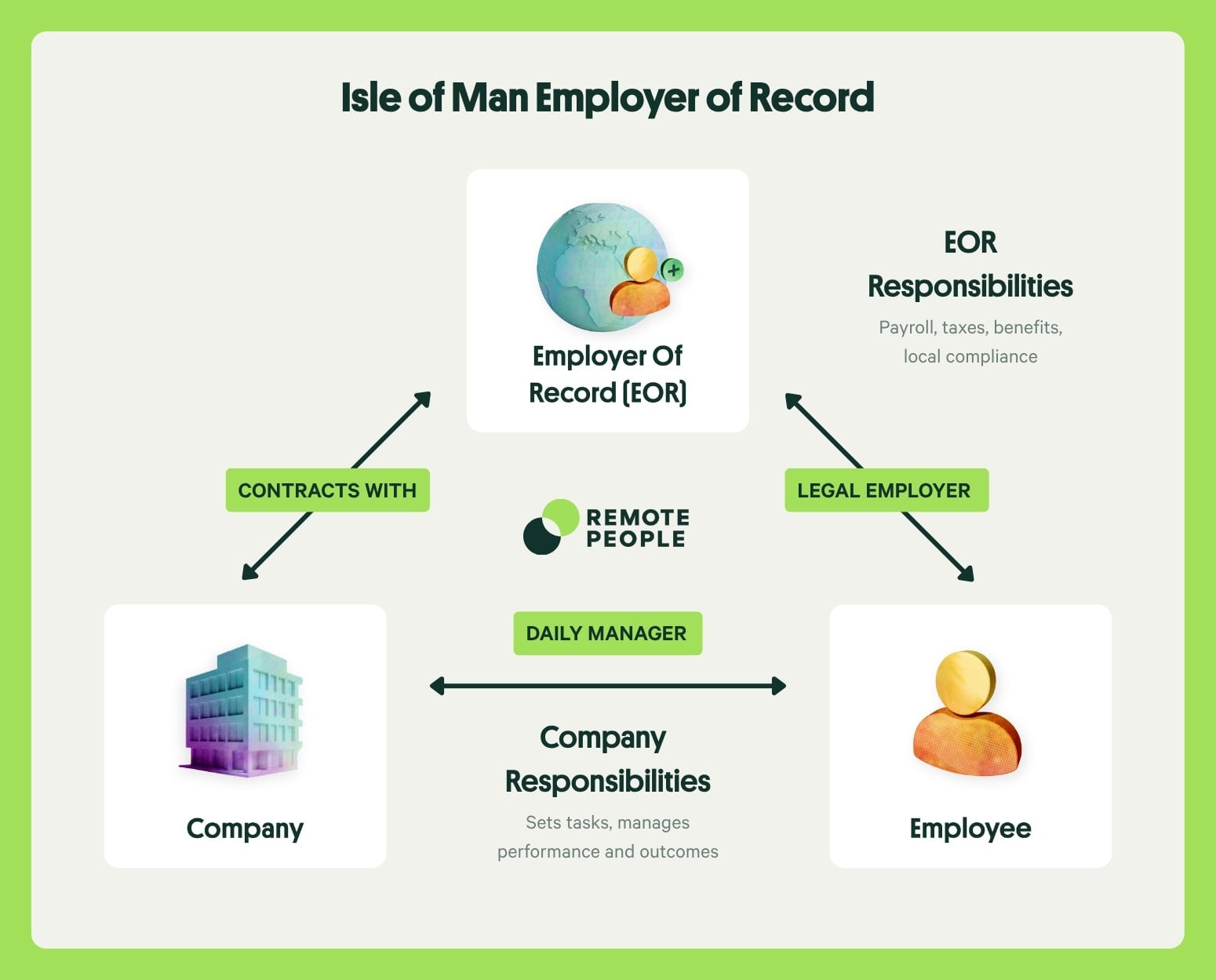
The EOR will then work on creating an employment agreement with terms that comply with Isle of Man employment law requirements, as well as are relevant to the needs of the hiring company.
In terms of ongoing management services, the EOR would take care of the payroll for all of the company’s employees, as well as calculating and remitting taxes and duties, benefits administration and ensuring compliance and providing regular reports to the client company.
How Much Does an Isle of Man EOR Cost?
EOR fees on the Isle of Man vary depending on the number of employees, salary, and the range of services required. Fees are typically calculated as either a percentage of gross salary (8–15%) or a fixed monthly fee per employee (about £200–£800).
Compared to the fees and expenses of setting up and maintaining a local presence, EORs can be a lower-cost solution, especially for small groups or for short-term projects.
RemotePeople’s EOR provides a simple, cost-effective solution to scaling up your global workforce. Our services start at $199 per employee and require no complicated local entity set-up.
Employment and Labor Laws in the Isle of Man
Employment in the Isle of Man is governed by the Employment Act 2006 and amendments to that Act. The Act sets out the minimum rights and obligations of employers and employees. Any business on the island should understand and apply the legislation.
Employment Contract Requirements
Employment contracts in the Isle of Man must include certain mandatory information. As of April 2024, all workers have additional rights to key employment information and more detailed pay statements, broadening what must be covered. Contracts must state the names of both employer and employee, the start date, job title or a brief description of the work, rate of pay and how it is calculated, pay interval, working hours, holiday entitlement and pay, sickness and sick pay terms, pension details, notice periods for termination by either party, and the place of work.
Standard Working Hours
Working time is generally limited to an average of 48 hours per week, calculated over a 17-week reference period, unless the employee agrees to opt out. Workers are entitled to at least 11 consecutive hours of rest in each 24-hour period, and 24 hours of uninterrupted rest each week (or 48 hours within a 14-day period).
Employees working more than six hours are entitled to a rest break of at least 20 minutes. Night workers are subject to additional protections, including limits on night-working hours and access to health assessments.
Social Security Contributions
The Isle of Man operates its own social security system, separate from the UK. Benefits include unemployment, sickness, disability support, and pensions, all subject to contribution history and qualifying conditions. There is no statutory employer-paid sick pay or maternity pay. Instead, support is provided through Manx Social Security Provisions, with eligible individuals receiving Incapacity Benefit for sickness and Maternity Allowance for pregnancy and childbirth. Entitlement is based on National Insurance contributions, employment status, and other qualifying criteria.
Overtime
In the Isle of Man, formal overtime rules apply primarily to civil servants with set conditioned hours. Overtime should only be worked during exceptionally busy periods and, where possible, scheduled within the working week rather than at weekends. It is generally voluntary; where compulsory, staff must receive at least 48 hours’ notice. Overtime rates vary by pay span as follows:
| Pay Span | Overtime Rate |
|---|---|
| Pay spans 1–4 | Time and a half |
| Pay spans 5–6 | Plain-time rate |
| Pay spans 7–9 | No entitlement |
For private sector employees, overtime arrangements are generally governed by the individual employment contract or applicable collective agreement rather than statute.
Probation Periods
Probationary periods are common on the Isle of Man as a method of assessing a new employee’s suitability for a role. There is no statutory maximum period for a probation period. However, it should be a reasonable period given the circumstances.
Probationary periods can be up to three to six months. The notice period on termination during the probationary period is often shorter.
Pension System
There is a state pension in the Isle of Man, which is funded from National Insurance contributions. From 2020, legislation will also require employers to give eligible employees access to a pension scheme to provide a vehicle for them to save for retirement, although this does not necessarily have to be a scheme where the employer also provides a contribution. However, many employers provide an enhanced pension scheme with employer contributions as a benefit to their employees to attract and retain them.
Payroll and Employment Taxes in the Isle of Man
Employers are required to run a payroll through which income tax and National Insurance contributions are deducted from their employees’ wages. The deductions, along with the employer’s own NI contributions, are paid to the Isle of Man Treasury through the ITIP system.
Payroll Cycles
In the Isle of Man, the standard payroll cycle is monthly. Employees are paid monthly at the end of each calendar month for the work carried out during that month.
Employers must issue employees a detailed payslip with each payment. The payslip must show the gross salary, the breakdown of all deductions (including tax, National Insurance, and pension), and the net amount paid.
Minimum Wage
Tynwald determined the minimum wage in the Isle of Man and reviewed it on a regular basis. The following rates have been approved for 1 April 2025: £12.25 per hour for workers aged 18 and over, and £9.55 per hour for workers over compulsory school age and under 18. The accommodation offset has not changed.
These rates followed an earlier increase that was approved in May 2024 and which applied from 1 July 2024, when the minimum wage for adult workers was £11.45 and £8.75 for younger workers. The separate “development worker” rate was also abolished in April 2023.
Income Tax
The Isle of Man operates its own income tax system, separate from the UK, with rates significantly lower than most comparable jurisdictions.
For 2025/26, the standard rate is 10% on the first £6,500 of taxable income, with a higher rate of 21% on income above that threshold. The personal allowance is £14,750, rising to £17,000 from 2026/27. Income tax is collected through the ITIP system and withheld at source by the employer each pay period.
Employer Payroll Contributions
Employers pay Class 1 NICs at 12.8% on all employee earnings above the secondary threshold of £168 per week (2025/26). Employee contributions are 11% on earnings between the primary threshold (£168/week) and the Upper Earnings Limit (£1,032/week), and 1% on earnings above that. Both employer and employee contributions are remitted monthly and fund the Isle of Man’s social security system, covering benefits including the state pension, incapacity benefit, and maternity allowance.
For self-employed individuals, Class 2 contributions are £6.45 per week (2025/26), and Class 4 contributions are 8% on profits between £8,736 and £53,664 per year, and 1% above that.
Employee Payroll Contributions
Employees in the Isle of Man contribute to National Insurance alongside their income tax obligations. NIC deductions are made directly from earnings by the employer and remitted monthly to the Isle of Man’s social security system. The amount deducted depends on the employee’s weekly earnings relative to the thresholds below.
Employee Class 1 NIC rates for 2025/26 are as follows:
| Earnings | Rate |
|---|---|
| Below £168/week (primary threshold) | No contribution |
| £168 to £1,032/week (between primary threshold and UEL) | 11% |
| Above £1,032/week (above UEL) | 1% |
Bonus Payments
The Isle of Man has no statutory requirements for 13th-month pay or similar additional salary payments, unless as part of a contractual agreement. Additional payments may be made by some employers, as part of their remuneration packages.
- Winter Bonus for vulnerable people to support them with home-heating costs
- The TT Hospitality and Retail Staffing Incentive is a bonus payment that gives staff additional pay for working extra hours during the TT period.
- The Employment Incentives Scheme, which offers grants to employers to take on skilled staff
Tax Compliance and Payroll Reporting
Employers must report all payroll details to the Income Tax Division. This means providing end-of-year returns showing the total pay and deductions for each employee. There are fines for not reporting on time or for not making the proper payments.
Employee Benefits in the Isle of Man
Whilst there is a minimum set of benefits that are provided by law, many employers in the Isle of Man provide additional benefits in order to be an attractive employer in a competitive job market.
Typical examples are private medical insurance (enabling quicker access to medical care), enhanced pension plans (allowing generous employer contributions), life insurance or death in service benefits, and long-term disability or income protection insurance.
Work Permits and Visas in the Isle of Man
The Isle of Man operates its own work permit system, separate from the UK. Any worker not classified as an Isle of Man worker must obtain a valid permit from the Department for Enterprise before starting employment, unless they qualify for an exemption.
Exemptions cover a range of occupations including registered medical practitioners, dentists, nurses and midwives, secondary school teachers, social workers, ministers of religion, and certain ICT roles. Workers holding an Immigration Employment Document, and EEA nationals with settled status, also do not require a permit.
Spouses, civil partners, and cohabiting partners of permit holders are entitled to apply for an automatic work permit, granted annually and renewable. The employer is responsible for applying and paying the £60 permit fee, which cannot be recovered from the worker. Most applications are processed within 1 to 3 working days, but work cannot legally begin until the permit is granted.
Critical Skills Employment Permit
The Isle of Man does not have a separate “Critical Skills Employment Permit” scheme as found in some other jurisdictions. Generally speaking, the Isle of Man requires anyone who is not already an “Isle of Man worker” in the employment of the Chief Minister to hold a general work permit (unless the post is specifically exempt).
Although the government has taken action to streamline the process in recent years (including temporarily replacing work permits with a registration system and extending exemptions for certain positions in certain fields, such as ICT/ ICT/e-business), it has not established “critical skills” as a criterion.
However, it does offer the Employment Incentives Scheme for employers hiring skilled employees, under which businesses are offered a grant to employ and retain skilled staff.
General Employment Permit
General Employment Permits are for ‘normal’ employment situations where the employer can establish that there is a genuine requirement for them to employ from outside the local labour network. The job must be advertised locally, and the employer must show that there are no suitable local applicants.
Intra-Company Transfer Permit
Intra-Company Transfer Permits are designed to enable the movement of employees within multi-national companies to the Isle of Man operations. The application must show a genuine intra-company relationship and that the employee has specialist knowledge that will be of benefit to the Isle of Man operation.
Hiring Contractors in the Isle of Man
Independent contractors offer a flexible and cost-effective option for businesses looking to engage specialist skills without the obligations of a permanent employment relationship. However, contractor engagements on the Isle of Man carry real misclassification risks, and getting the classification wrong can result in significant liability for unpaid tax, National Insurance contributions, and employment entitlements backdated to the start of the relationship.
The key distinction between an employee and a contractor lies in the nature of the working arrangement rather than the label applied to it. The Isle of Man’s tax and employment authorities will look at factors such as control over how work is carried out, financial risk, exclusivity, and the degree of integration into the business when determining status. A contractor who works exclusively for one client, follows set hours, and uses the client’s equipment may be reclassified as an employee regardless of what the contract says.
A well-drafted contractor agreement is essential. It should clearly document the independent nature of the relationship, the scope of work, payment terms, and the contractor’s responsibility for their own tax and National Insurance obligations. Contractors operating in the Isle of Man are generally responsible for registering with the Isle of Man Income Tax Division, filing their own returns, and paying Class 2 and Class 4 NIC where applicable.
For businesses engaging multiple contractors or those working on long-term projects, it is worth conducting a periodic review of each arrangement to ensure the working relationship still reflects the terms of the contract and does not inadvertently create an employment relationship over time.
Time Off and Leave in the Isle of Man
Employee leave entitlements in the Isle of Man are regulated by law to ensure workers have adequate time for rest, holidays, and personal circumstances.
Mandatory Leave Entitlement
Every employee on the Isle of Man is entitled to take four weeks paid annual leave per year. This includes agency staff and trainees. Annual leave entitlement begins on the first day of employment. It is accrued monthly during the first year of employment at the rate of one twelfth of the total amount of leave due.
Entitlement is calculated based on the employee’s normal working pattern. For example:
- An employee working five days a week is entitled to 20 days’ leave per year.
- An employee working three hours a week is entitled to 12 hours of leave per year.
At the end of employment, payment must be made for any accrued but untaken leave. Paid public holidays taken in the year can be included by the employer in the statutory four-week entitlement.
Public Holidays
The Isle of Man has some public holidays, including:
- New Year’s Day
- Good Friday
- Easter Monday
- Early May Bank Holiday
- TT Bank Holiday (which falls during the TT motorcycle races)
- Tynwald Day (Isle of Man National Day)
- Senior Race Day
- Late Summer Bank Holiday
- Christmas Day
- Boxing Day
Sick Leave
The Isle of Man has no statutory employer-paid sick pay. Entitlements are set by the individual employment contract, and many employers offer discretionary contractual sick pay schemes.
Financial support during illness is provided through the Isle of Man’s social security system via Manx Statutory Sick Pay (MSSP) and Incapacity Benefit. MSSP becomes payable after 3 qualifying waiting days, for a maximum of 28 weeks, provided the employee has been incapacitated for at least 4 consecutive days and has sufficient National Insurance contributions. For longer-term illness, Incapacity Benefit applies, with a short-term rate for up to 52 weeks a
Parental Leave
Maternity and paternity rights are protected by statute in the Isle of Man. In addition, maternity and paternity allowances are paid by the Treasury.
- Maternity Leave: Pregnant women can claim ordinary leave of up to 26 weeks. A further 26 weeks can be added for women who have worked continuously for at least 26 weeks by the 14th week before the expected week of childbirth. This allows a maximum of 52 weeks’ leave.
Employees are also entitled to paid time off for antenatal care, and to have a risk assessment of their work in relation to the pregnancy. Employees who are not able to be offered alternative work that the evaluation proves to be safe will be suspended on full pay. Employers are not obliged to pay maternity leave, but most women will be eligible to claim Maternity Allowance from the Treasury provided eligibility requirements are met.
- Paternity leave: Fathers and partners are entitled to one or two weeks’ paternity leave within 56 days of birth or adoption. Employers are not obliged to pay, but many employees will be entitled to a Paternity Allowance.
- Adoption Leave: Adoption leave is similar to maternity leave. There is no requirement to pay, but there may be allowances.
Other Leave
Many law also provides for other types of leave, such as the right to reasonable time off to deal with an emergency involving a dependent.
Terminations and Severance in the Isle of Man
Many law also provides for other types of leave, such as the right to reasonable time off to deal with an emergency involving a dependent.
Termination
Employment contracts end by resignation, dismissal, redundancy, or mutual agreement. Dismissal should follow a fair investigation, an opportunity for the employee to respond, and consideration of alternatives.
Notice Periods
In the Isle of Man, employers and employees must, by law, give a minimum notice period if they wish to end employment. The length of notice is dependent on the amount of continuous service an employee has undertaken.
| Length of Service | Notice by Employer | Notice by Employee |
|---|---|---|
| Less than 1 month | — | — |
| 1 month to less than 2 years | 2 weeks | 1 week |
| 2 years to less than 4 years | 1 week per year of service | 1 week per year of service |
| 4 years to less than 12 years | 1 week per year of service | 4 weeks |
| 12 years or more | 12 weeks minimum | 4 weeks |
Severance Pay
Employees terminated without a valid cause may be eligible for payment. Redundancy situations may involve severance pay on top of the standard notice period.
Isle of Man Salary Benchmarks and Cost of Living
Salary levels in the Isle of Man vary significantly by industry, experience, and sector. According to the Isle of Man Government Earnings Survey, median weekly earnings for full-time employees were approximately £732–£765 per week, equivalent to around £38,000–£40,000 per year depending on the year and dataset.
Based on these median earnings and typical labour-market patterns, salary ranges commonly observed across sectors such as finance, information technology, hospitality, and the public sector are broadly estimated as:
| Salary Category | Estimated Annual Salary (GBP) |
|---|---|
| Entry-Level Positions | £20,000 – £30,000 |
| Mid-Career Positions | £40,000 – £65,000 |
| Senior / Specialist Positions | £85,000+ |
Government data shows that housing is a major component of living costs in the Isle of Man. Public-sector housing rents for a two-bedroom property typically range from about £101–£115 per week. In contrast, private market rentals are significantly higher, with two-bedroom properties commonly estimated at £1,200–£2,000 per month, depending on location and property quality.
Because the Isle of Man is located in the Irish Sea, it relies heavily on ferry and air transport for goods and travel. This can increase supply chain costs, shipping times for imported goods, and travel expenses to the UK, contributing to higher overall costs for both residents and businesses.
The island has increasingly attracted remote workers and professionals relocating from the UK, particularly in finance, technology, and digital services. Salaries for remote or hybrid roles may reflect a balance between UK mainland salary benchmarks and local labour market conditions. Employers sometimes offer compensation packages that account for the island’s cost of living, professional skill shortages, and the limited size of the local labour market.
Expand into the Isle of Man Easily with RemotePeople’s EOR
Employment law, payroll, and benefits regulations can be challenging on the Isle of Man. An experienced EOR provider like RemotePeople makes it easy to hire quickly and compliantly without setting up a local entity.
We manage all contracts, payroll, tax, and compliance, so companies can focus on growth and easily test the market, build remote teams, or hire for strategic positions with confidence.
Frequently Asked Questions
The timeline depends on the role and immigration status of the employee. For workers who require a work permit, the Isle of Man Government states that many correctly completed permit applications are processed within around three working days, although processing times may vary depending on the case.
Yes. Businesses expanding into the Isle of Man may later establish their own local entity and transfer employees from the EOR arrangement to the new company. In such cases, employment contracts may be updated and, if applicable, new work permits may be required if the employer of record changes, because permits are issued for a specific employer and role.
An EOR can generally employ workers in most job categories, including full-time employees, part-time employees, or remote workers. However, if the individual is not classified as an “Isle of Man worker,” a work permit may be required before they can legally work in the island.
Yes. Companies can hire multiple employees through a single EOR provider, which then acts as the legal employer for each individual. Each employee must still have their own employment contract and payroll record, and any required work permits must be issued for the specific employee and job role.
If a contractor is determined to be working under conditions that resemble employment, authorities may reclassify the worker as an employee, which can lead to liability for unpaid taxes, National Insurance contributions, and employment rights.
International companies often use EOR services to test the market, hire remote workers, or quickly expand operations without the administrative complexity of forming a local entity.
Employer of Record in
Employer of Record in
Employer of Record in
Employer of Record in
Employer of Record in
Employer of Record in
Employer of Record in
Employer of Record in