
 Recruit
Average Salary in Italy
-
 Drew Donnelly
- Published
- September 21, 2026
- 5 ★ on G2








Let RemotePeople handle payroll, compliance, and HR admin worldwide so you can focus on building your team.
Italy’s highly skilled workforce and strategic location within the European market make it an excellent outsourcing destination. Employers who wish to hire in the area may wonder, what is the average salary in Italy? This information will help them create attractive job offers.
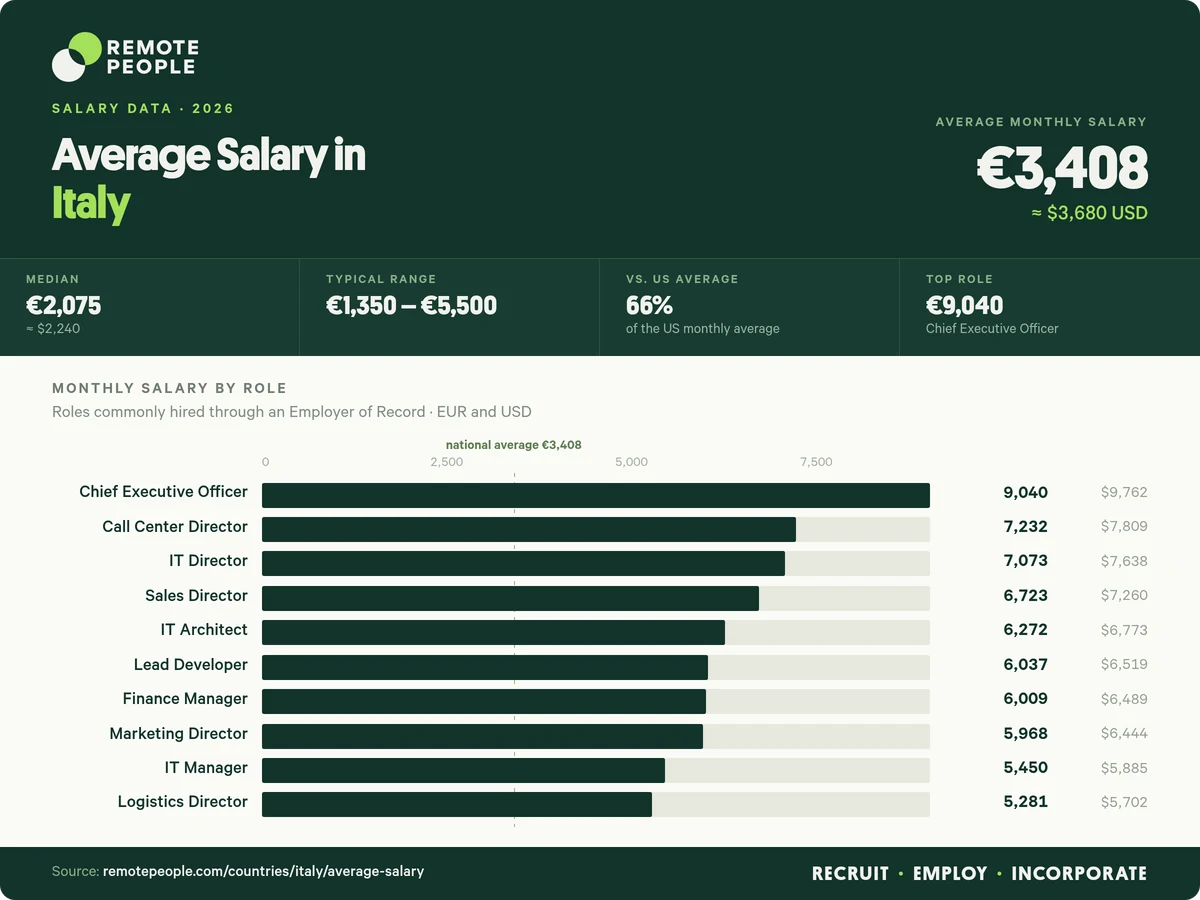
The average monthly salary in Italy is €3,408, approximately USD 3,680. However, salaries vary by education, experience, location, position, and industry. You must also consider median wages and salary ranges.
This article will explore all aspects of salaries in Italy to provide comprehensive insight.
What is the Average Salary in Italy?
The average salary in Italy is €3,408 or $3,680. While wages aren’t as low as those in popular outsourcing destinations, they are competitive with those in America and many European regions. Employers seeking remote partnerships in Italy can benefit from quality and some cost savings.
Median Income
The median salary can also be considered the ‘middle salary’. Italy’s median monthly income is approximately €2,075 (about $2,240). Half the country earns higher wages while the other half earns lower salaries.
Salary Range
The salary range spans the lowest to highest in the country. Low earners in Italy make about €1,350 (around $1,460) monthly, while high earners can make closer to €5,500 (about $5,940) depending on industry, seniority, and specialization.
Salary Comparison by Profession
This salary comparison chart lists various wages by profession, providing a more comprehensive view.
Profession | Average Monthly Salary (EUR) |
|---|---|
Chief Executive Officer | 9040 |
Call Center Director | 7232 |
IT Director | 7073 |
Sales Director | 6723 |
IT Architect | 6272 |
Lead Developer | 6037 |
Finance Manager | 6009 |
Marketing Director | 5968 |
IT Manager | 5450 |
Logistics Director | 5281 |
Machine Operator | 1503 |
Fabric Cutter | 1479 |
Medical Orderly | 1458 |
Kinetotherapist | 1451 |
Seamstress | 1375 |
Tailor | 1364 |
Porter | 1330 |
Medical Records Clerk | 1327 |
Social Counselor | 1307 |
Average Wage in Italy by Education
Education is a factor in earnings among Italian workers, but it is less significant than in other countries. For example, 25-to 34-year-olds with a vocational upper secondary or post-secondary degree earn only 4% more than their peers with only a primary education.
However, the earnings advantage increases to 40% for workers aged 45-54. The increase may be due to the popularity of VET (Vocational Education and Training) programs among workers with secondary degrees.
Salary Comparison by Experience
Experience is a significant factor in earnings. Entry-level workers are paid less than experienced workers. Employees also earn more as they become eligible for raises.
The following table explores salaries in various industries based on experience to provide additional insight.
Job Role | Beginner Annual Salary (€) | Mid-Level Annual Salary (€) | Senior-Level Annual Salary (€) |
|---|---|---|---|
Engineering Production Manager | €43,000 | €58,000 | €80,000 |
Accounting Office Manager | €37,000 | €39,000 | €41,000 |
Energy Electrical Engineer | €35,000 | €48,000 | €63,000 |
Banking Credit Analyst | €30,000 | €40,000 | €50,000 |
Insurance Claims Adjuster | €28,000 | €35,000 | €45,000 |
Salary Comparison by Location
Italy’s income is characterized by a “North and South” divide. As the Northern region is more developed, workers tend to earn more than workers in the Southern region. The Northern region is also home to major cities like Milan, Venice, Turin, and Genoa.
However, statistics show that other factors, such as education and experience, are more critical in determining salaries. Hence, there are many wealthy families in the Southern region. They often reside in major cities like Naples, Bari, and Taranto.
How Much is Minimum Wage in Italy?
Italy does not have a minimum wage. Instead, minimum wages are set through sector-specific collective bargaining agreements (CCNL). Minimum hourly rates vary by industry and role, with many collective agreements setting entry-level wages between €7 and €9 per hour, depending on the sector.
Average Salary in Italy vs. the Rest of the World
The following charts provide more perspective on salaries in Italy, providing a wages comparison to developed, developing, and undeveloped countries worldwide.
Italy vs. Developed Countries
Country | Average Salary | Comparison to Average Italy Salary |
|---|---|---|
United Kingdom | £3,000 (approx. $4,100) | − 11% |
United States | $5,220 | − 42% |
Norway | 50,000 NOK (approx. $4,700) | − 28% |
Germany | €4,300 (approx. $4,470) | − 22% |
Austria | €3,700 (approx. $4,050) | − 10% |
Italy vs. Developing Countries
Country | Average Salary | Comparison to Average Italy Salary |
|---|---|---|
Romania | 4,000 RON (approx. $835) | 77% |
Russia | 73,700 RUB (approx. $700) | 81% |
Albania | 83,330 ALL (approx. $860) | 77% |
Kazakhstan | 342,000 KZT (approx. $645) | 83% |
Ukraine | 18,000 UAH (approx. $500) | 86% |
Italy vs. Undeveloped Countries
Country | Average Salary | Comparison to Average Italy Salary |
|---|---|---|
Thailand | 15,000 Baht (approx. $420) | 89% |
Philippines | 15,000 PHP (approx. $265) | 93% |
Vietnam | 7.5 million Dong (approx. $300) | 92% |
Egypt | 14,317 EGP (approx. $284) | 92% |
Pakistan | 60,000 PKR (approx. $210) | 94% |
Italy is one of the EU’s leading economies with a high GDP per capita. Its work economy is dominated by the service sector, including industries like tourism, retail, and hospitality. It is also known for its high quality, luxury manufacturing.
The country is a good outsourcing destination due to its skilled workforce, design innovation, and European market access. It is often utilized for its strong IT sector. While not the most cost-effective option, reasonable salaries can reduce expenses for some companies.
What are the Most Common Outsourced Industries in Italy?
Employers considering outsourcing to Italy may benefit most when concentrating on the following sectors:
IT Services
Italy’s IT industry has grown significantly over the past few years. The country boasts a highly skilled workforce focusing on AI, cloud computing, cybersecurity, data analytics, and IoT. Major tech hubs include Milan, Rome, and Turin.
Fashion and Design
Italy has long been known for its luxury fashion focus, birthing iconic brands like Armani, Gucci, and Versace. The country stands out for its design influence, high level of craftsmanship and industry expertise. The fashion industry plays a significant role in its economy, contributing to exports and employment.
Automotive Manufacturing
The country also stands out for its luxury automotive brands, including Alfa Romeo, Lamborghini, and Maserati. It is widely recognized for its superior designs and renowned styling. Although Italy does not produce the highest volume of cars, it makes specialized vehicles that stand out for their performance and exceptional looks.
Conclusion
Italy’s skilled workforce, convenient European location, and sense of innovation make it an ideal outsourcing location. While not the most cost-effective option, its reasonable salaries can reduce expenses for some companies. Businesses can also benefit from exceptional quality products and services that establish them as leaders in their industry.