
 Recruit
Average Salary in Laos
-
 Drew Donnelly
- Published
- September 21, 2026
Curious about salaries in Laos? This guide breaks down the average wages, compares professions, highlights minimum wage figures, and explores how Laos’ earnings measure up internationally. Partnering with an Employer of Record (EOR) in Laos lets you employ staff there without establishing a legal entity of your own.
- 5 ★ on G2








Let RemotePeople handle payroll, compliance, and HR admin worldwide so you can focus on building your team.
Laos’ low labor cost and strategic advantage make it a potentially ideal outsourcing destination. Employers looking to hire in the area may wonder, what is the average salary in Laos? This information will help them prepare a competitive job offer. Employers may also run background checks in Laos for certain roles, so it is worth knowing what is permitted before you hire.
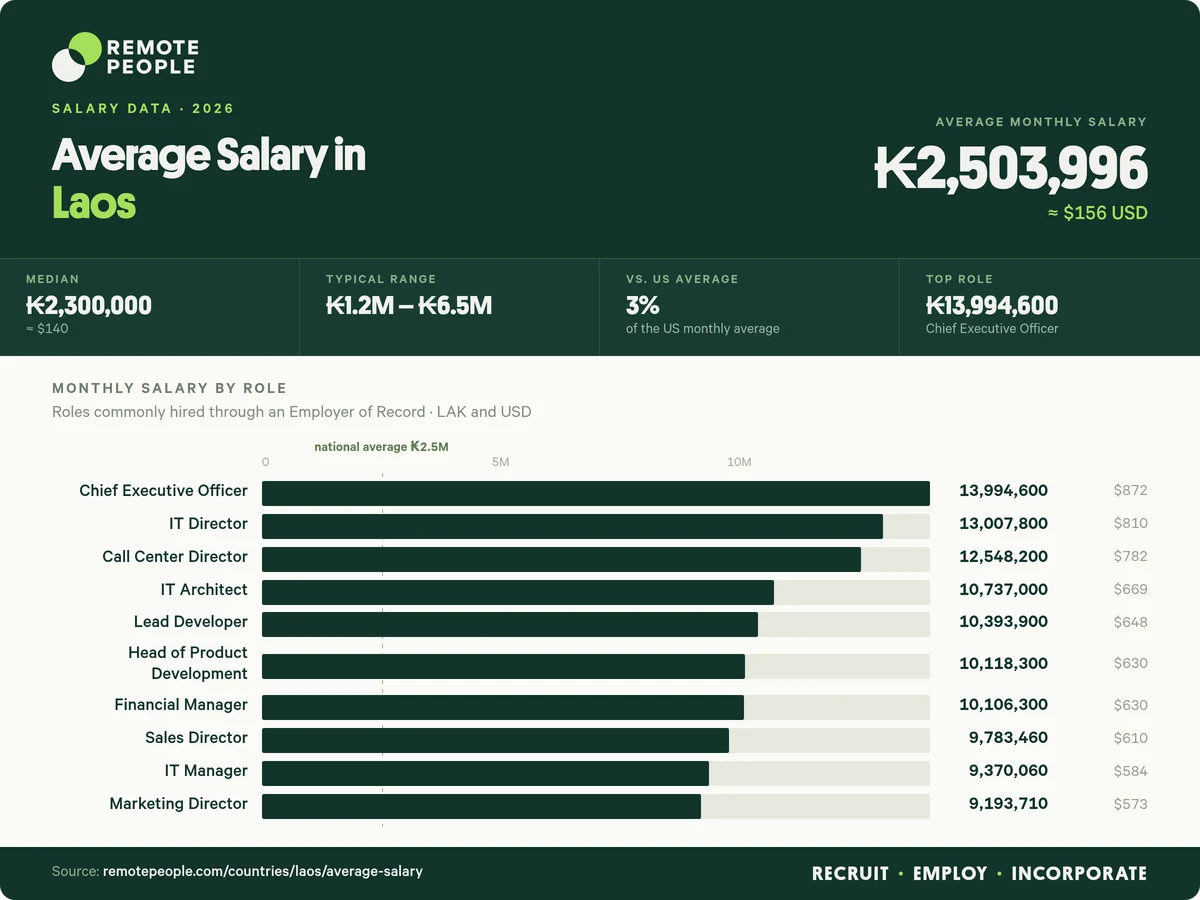
The average monthly salary in Laos is 2,503,996 Laotian kips (LAK) or USD 156. However, salaries vary by experience, education, location, position, and industry. Comparing wages in the country to earnings worldwide will also provide more insight.
This guide will explore all aspects of Laotian salaries to prepare you to outsource in the country.
What is the Average Salary in Laos?
The average salary Laos is 2,503,996 LAK, which translates to about $156. However, wages in the country are low due to economic instability and inflation. The Lao kip has also been depreciating, meaning wages are worth less in real terms.
Median Income
The median monthly income in Laos is about $140, or around 2,300,000 LAK. Half the country’s workers earn higher wages, and the other half earn lower salaries.
Salary Range
The salary range spans the lowest to highest salaries in the country. Low earners in Laos make about 1,200,000 LAK monthly (about $75) while high earners make closer to 6,500,000 LAK monthly (about $406).
Salary Comparison by Profession
Average salary information provides wages comparison insight, but you must consider how salaries vary depending on education, experience, location, position, and industry. The following sections will explore these factors and how they impact wages.
Position | Average Monthly Salary (LAK) |
|---|---|
Chief Executive Officer | 13,994,600 |
IT Director | 13,007,800 |
Call Center Director | 12,548,200 |
IT Architect | 10,737,000 |
Lead Developer | 10,393,900 |
Head of Product Development | 10,118,300 |
Financial Manager | 10,106,300 |
Sales Director | 9,783,460 |
IT Manager | 9,370,060 |
Marketing Director | 9,193,710 |
Banking Cashier | 2,571,020 |
Fabric Cutter | 2,566,300 |
Clothing Technologist | 2,555,120 |
General Laborer | 2,539,700 |
Packer | 2,502,600 |
Seamstress | 2,389,370 |
Porter | 2,308,430 |
Medical Records Clerk | 2,301,680 |
Tailor | 2,283,850 |
Average Wage in Laos by Education
Education is a factor in wage determination and employment status. A 2023 study reveals that:
Education Level | Employment Rate |
|---|---|
Bachelor’s Degree | 51% |
Upper Secondary Degree | 18% |
High Vocational Degree | 12% |
Primary/Lower Secondary or No Formal Education | 3% |
Workers with high education levels also tend to earn more. Those with an upper secondary degree earn 18% more than those with lower upper secondary attainment. Those with tertiary degrees earn almost double the income of those with lower upper secondary education.
Salary Comparison by Experience
Experience is another factor to consider in wage determination. Workers with experience tend to earn more than entry-level workers. Employees also become eligible for raises with tenure in their industries.
While we couldn’t find exact numbers on how much more you earn based on experience, statistics show how wages vary by age, indicating that experience is a factor. Here are some numbers to consider.
Age Group | Median Salary (LAK) |
|---|---|
Under 24 | 3,200,000 |
25–34 | 4,200,000 |
35–44 | 4,500,000 |
45–54 | 4,200,000 |
55 and over | 4,000,000 |
Salary Comparison by Location
Laotian workers who live close to the capital city of Vientiane tend to earn higher salaries due to the higher cost of living, more developed infrastructure, and proximity to more prominent companies, which offer higher-paying positions. However, most workers are employed in the agricultural industries, work in rural areas, and earn low pay.
How Much is Minimum Wage in Laos?
As of January 2026, the national minimum wage in Laos is LAK 2,500,000 per month (about USD 113), a level set in October 2024 that remains unchanged into 2026. Under the current rules, employers must provide a subsistence allowance of up to LAK 900,000 to unskilled workers without formal education or training so that their total monthly pay meets the minimum wage. These policies were introduced to help workers cope with rising inflation and living costs.
Average Salary in Laos vs. the Rest of the World
The following charts provide more insight into salaries in Laos by comparing them to earnings in developed, developing, and undeveloped countries.
Laos vs. Developed Countries
Country | Average Salary | Comparison to Average Laos Salary |
|---|---|---|
United Kingdom | £3,000 (approx. $4,100) | − 2529% |
United States | $5,220 | − 3246% |
Norway | 50,000 NOK (approx. $4,700) | − 2913% |
Germany | €4,300 (approx. $4,470) | − 2765% |
Austria | €3,700 (approx. $4,050) | − 2496% |
Laos vs. Developing Countries
Country | Average Salary | Comparison to Average Laos Salary |
|---|---|---|
Romania | 4,000 RON (approx. $835) | − 435% |
Russia | 73,700 RUB (approx. $700) | − 349% |
Albania | 83,330 ALL (approx. $860) | − 451% |
Kazakhstan | 342,000 KZT (approx. $645) | − 313% |
Ukraine | 18,000 UAH (approx. $500) | − 221% |
Laos vs. Undeveloped Countries
Country | Average Salary | Comparison to Average Laos Salary |
|---|---|---|
Thailand | 15,000 Baht (approx. $420) | − 169% |
Philippines | 15,000 PHP (approx. $265) | − 70% |
Vietnam | 7.5 million Dong (approx. $300) | − 92% |
Egypt | 14,317 EGP (approx. $284) | − 82% |
Pakistan | 60,000 PKR (approx. $210) | − 35% |
Laos is classified as a least developed country with a lower middle income. However, its economy is growing and aims to graduate from that status in 2026. The government prioritizes diversifying the economy to provide more job opportunities.
The country shows promise as a viable outsourcing destination due to its cost-effective labor and growing IT sector. It also offers political and financial stability. However, it is still outpaced by surrounding countries like India and the Philippines.
What are the Most Common Outsourced Industries in Laos?
Companies wishing to outsource to Laos will most benefit from exploring opportunities in the following industries.
Mining
The minerals and mining sectors have been a significant source of growth in Laos, and silver, gold, copper, bauxite, and potash are recognized as substantial resources. The country has attracted several foreign investors from China and Australia. Its Sepon mine is one of the largest gold mines in the world with reserves estimated at 7.65 million oz.
Agriculture
Data indicates that about 4% of Laos’ total area (3474 square miles) is used for agriculture. It is a significant source of rice, coffee, opium, and corn. The people also keep cattle, goats, and pigs as livestock. The government supports the country’s agricultural industry with veterinary services and irrigation initiatives.
Textile
Tens of thousands of Laotian citizens work in the textile industry, which plays a significant role in the country’s economy. Most textile products are exported to the European Union. Japan and Thailand are some countries that have made considerable investments in the Laotian textiles.
Conclusion
Laos’ low labor costs, stable political and financial environment, and strategic location make it an ideal outsourcing destination. Employers that partner with workers in the area can benefit from cost savings while accessing quality products and services. They also help workers overcome poverty, creating a win-win situation for all involved parties.