
 Recruit
Employer of Record (EOR) in Laos
-
 Drew Donnelly
- Published
- September 22, 2026
An Employer of Record (EOR) in Laos is a locally registered company that hires employees on your behalf, handling National Social Security Fund (NSSF) contributions, personal income tax withholding, work permits, and Lao Labour Law compliance. A Laos EOR lets you onboard local or expat staff in 2–3 weeks without registering an enterprise with the Ministry of Industry and Commerce.
Hire in Laos — book a free 30-minute demo
Tell us what you need. You'll get a tailored, transparent proposal within 24 hours, plus a free call to walk through it.
Tell us about your company
So we can match you with a specialist who knows your market — and unlock volume pricing tiers.
* All fields are required.
Where and when are you hiring?
Tell us the geography and timing and we'll quote each country line by line, with onboarding timelines.
* All fields are required.
Help us beat your current setup
We'll benchmark your current deal and send a line-by-line proposal in 24 hours — showing exactly where we cut cost, time, or risk. After you submit, you can book a call to walk through it together.
* All fields are required.
Thanks! Your proposal is on its way.
Expect a tailored, line-by-line proposal in your inbox within 24 hours. In the meantime…
Want to walk through it together?
Book a free 30-minute call with one of our specialists. We'll explain every line, answer your questions, and tailor the proposal further if you need.
No obligation. Pick a time that works for you.








- Hire in Laos — book a free 30-minute demo
- Tell us about your company
- Where and when are you hiring?
- Help us beat your current setup
- Thanks! Your proposal is on its way.
- How an Employer of Record Works in Laos
- Employment Laws and Regulations in Laos
- Work Permits and Visas in Laos
- Payroll, Taxes, and Social Security in Laos
- Cost of Hiring Through an EOR in Laos
- Benefits of Using an EOR in Laos
- Termination and Offboarding in Laos
- EOR vs Other Hiring Models in Laos
- Public Holidays in Laos
- How to Get Started with an EOR in Laos
- Frequently Asked Questions
- Related EOR Destinations

Start hiring in Laos
Let RemotePeople handle payroll, compliance, and HR admin worldwide so you can focus on building your team.

Laos offers emerging market opportunities with a growing workforce and favorable business incentives. For companies looking to hire employees in Laos, navigating complex labor laws, work permits, and social security compliance is difficult. An employer of record in Laos solves these problems by becoming your legal employer on government records, handling all compliance obligations, and enabling fast market entry without establishing a local entity. This guide explains how an employer of record works, outlines Laos employment law, details payroll and tax requirements, and walks you through hiring your first employee through an EOR model.
How an Employer of Record Works in Laos
An employer of record (EOR) is the most efficient way to hire in Laos without establishing a local legal entity. Here’s how this hiring model works and why companies choose it.
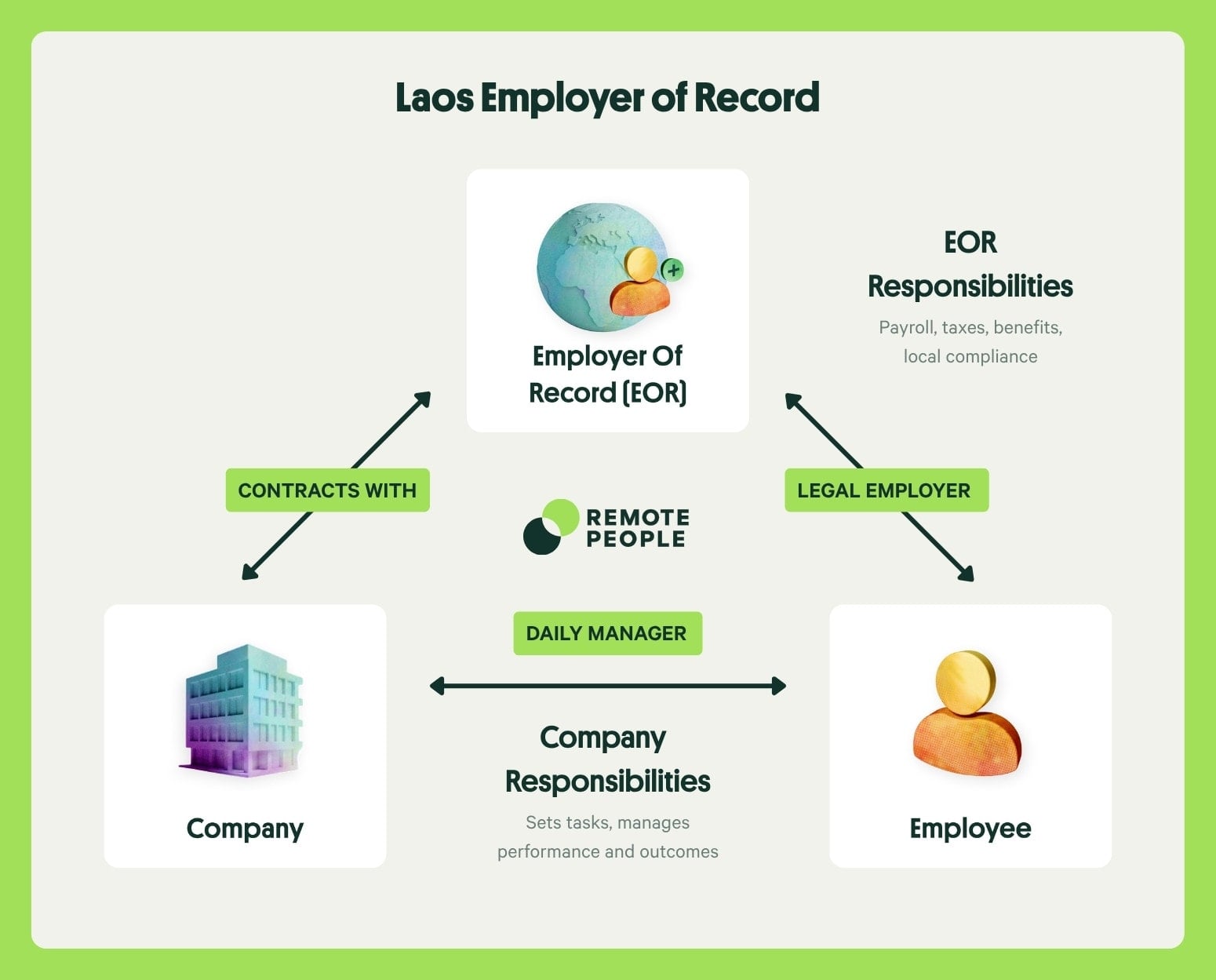
If you’d like to learn more about how Employer of Record (EOR) services work, read our What Is an Employer of Record (EOR)? guide for a complete overview of the model, its benefits, and when to use it.
If you’re comparing providers, our Best Employer of Record (EOR) Providers guide reviews the leading platforms to help you choose the right solution for your business.
Who Uses an EOR in Laos?
Companies across multiple scenarios benefit from an EOR model in Laos:
- Startups and scale-ups entering Laos for the first time without a local entity
- Global teams wanting to hire remote workers in Laos while maintaining control from abroad
- Temporary or seasonal operations that do not warrant the cost of entity setup and maintenance
- Companies testing market demand before committing to a full local subsidiary
Typical Onboarding Timeline
Onboarding a new employee through an EOR in Laos typically follows this timeline. The work permit application takes 4–8 weeks from submission to approval, while payroll setup happens in parallel. Most employees can begin work within 2–3 weeks, though full work permit clearance may take longer. The EOR coordinates with the Ministry of Labour and Immigration authorities to ensure all documentation is complete and submitted correctly.
Hire in Laos
Low employer social security costs (6% of gross), a growing talent pool, ASEAN-aligned labour standards, and competitive salaries make Laos one of Southeast Asia’s most cost-effective hiring markets.
We handle employment contracts, payroll, tax withholding, and full Laos compliance.
No local entity needed. Your team can start in days.
Employment Laws and Regulations in Laos
Compliance with Laos labor law is essential when you hire employees in Laos, whether directly or through an employer of record. An employer of record ensures that all employment practices meet or exceed local legal requirements.
Employment Contracts
All employment relationships in Laos must be documented with a written contract that specifies job duties, compensation, leave entitlements, and termination conditions. The Labour Law No. 43/NA requires contracts to be signed in at least two copies, with one retained by the employee and one by the employer.
Verbal agreements are not enforceable in Laos labour courts. Contracts must clearly state whether the position is full-time, part-time, fixed-term, or indefinite. An employer of record ensures all contract language complies with local law and includes mandatory clauses covering probation, notice periods, and grounds for termination.
Any changes to core contract terms must be made in writing and signed by both parties.
Working Hours and Overtime
Standard working hours in Laos are 8 hours per day, 48 hours per week across 6 days, as specified in Article 51 of the Labour Law. For work in hazardous conditions, the maximum is 6 hours per day and 36 hours per week. Night work (between 10 p.m. and 6 a.m.) receives an automatic 15% wage bonus on the hourly rate, regardless of whether it qualifies as overtime. An EOR ensures working hours comply with these rules.
Overtime is strictly regulated and compensated at premium rates depending on when it is worked. The table below outlines the overtime multipliers and caps that apply under Laos law.
Laos overtime and premium pay rates · Per Labour Law No. 43/NA | ||
Overtime Type | Pay Rate | Monthly Cap |
|---|---|---|
Weekday overtime | 150–200% of hourly rate | 45 hours per month |
Weekend overtime | 250–300% of hourly rate | 45 hours per month |
Public holiday work | 350% of hourly rate | 45 hours per month |
Night work bonus (10 p.m.–6 a.m.) | +15% of hourly rate | No separate cap |
Overtime is capped at 3 hours per day, and no more than 4 consecutive days of overtime are allowed. Employees must get at least one full rest day per week. The EOR tracks and calculates all overtime compensation to ensure compliance.
Minimum Wage
The statutory minimum wage in Laos is LAK 2,500,000 per month. This applies to all employees regardless of sector, though specialized roles and senior positions may negotiate higher pay. The minimum wage covers basic salary only, not overtime, bonuses, or allowances. It is reviewed periodically, and employers must update salaries to match the current rate. An EOR ensures your payroll meets this floor while managing all contributions.
Probation Period
The Labour Law permits a probation period during which either party can terminate employment with reduced notice. For general and non-skilled roles, probation lasts up to 30 days with 5 days’ notice to terminate.
Technical and specialized positions may have a longer probation of up to 60 days, requiring 3 days’ notice to end the probation. During probation, an employee must receive at least 90% of the agreed monthly wage.
The probation term must be stated in the employment contract; if not explicitly documented, the employee is considered permanent from the first day of employment. After probation ends, full notice periods and severance provisions apply. An employer of record documents probation terms clearly in each contract to avoid disputes.
Leave Entitlements
Laos labour law requires statutory leave for employee health, family welfare, and religious observance. Below are the main types.
Annual Leave
Employees get 15 days of paid annual leave per year after 1 year of service. Hazardous work (mining, chemical exposure, heavy construction) provides 18 days annually. Annual leave accrues during employment and pays at the employee’s regular daily rate. Unused leave cannot be lost and may carry over to the next year or be paid out on termination.
Sick Leave
Employees can take up to 30 days of paid sick leave per year. A medical certificate is required after three consecutive days. The employer funds sick leave, and it does not reduce other leave entitlements.
Maternity Leave
Female employees get 105 days of paid maternity leave, or 120 days for multiple births. At least 45 days must be taken after birth. The NSSF pays 80% of average earnings from the prior 6 months. Employers cannot terminate an employee during maternity leave or up to 30 days after return.
Paternity Leave
Paternity leave is not explicitly defined in the Labour Law as a separate entitlement. However, male employees may be granted 3 days of personal paid leave per event (such as the birth of a child) under personal/bereavement leave provisions, at the employer’s discretion or as defined in the employment contract.
Other Paid Leave
Employees get 3 days of paid personal leave per event for major life events like marriage, death in the family, or divorce. Additional leave may apply for religious observance or cultural celebrations. The table below summarizes all statutory leave entitlements.
Laos statutory leave entitlements · Per Labour Law No. 43/NA | ||
Leave Type | Duration | Conditions |
|---|---|---|
Annual leave | 15 days per year | After 1 year service; 18 days for hazardous work |
Sick leave | 30 days per year | Medical certificate required after 3 days |
Maternity leave | 105 days (120 for multiple births) | Minimum 45 days post-birth; 80% pay via NSSF |
Paternity leave | 3 days per event | Personal leave for birth or family event |
Personal/bereavement leave | 3 days per event | Marriage, death, divorce or similar |
Source: Labour Law No. 43/NA and SSA.gov Laos Social Security | ||
Statutory Employee Benefits
When you hire through an employer of record, all statutory benefits are handled automatically. Laos law requires several employee benefits. All employees are enrolled in the National Social Security Fund (NSSF), which covers old age, disability, survivors’ benefits, sickness, maternity, work injury, and unemployment. Employer and employee contributions are detailed in the tax section below. The NSSF also provides medical coverage, work injury insurance, and unemployment insurance.
Recent Regulatory Updates (2026)
The Lao government is aligning labour standards with ASEAN protocols and ILO conventions. Recent amendments have strengthened protections for migrant workers and clarified remote work arrangements. The Ministry of Labour and Social Welfare may adjust rates and thresholds periodically. An EOR monitors regulatory changes and updates employers and employees to ensure hiring practices remain compliant.
Work Permits and Visas in Laos
Work permits and visa sponsorship are essential for hiring in Laos. An employer of record handles this process entirely, ensuring foreign employees gain legal authorization without administrative burden on your company.
Work Permit Requirements
Who Needs a Work Permit
All foreign nationals working in Laos must obtain a work permit and corresponding visa, regardless of employment duration or position level. Laos citizens employed by foreign-owned companies do not require a work permit but must have a valid employment contract and appropriate visa status. The work permit process involves coordination with the Ministry of Labour and Social Welfare, the Ministry of Foreign Affairs, and the Department of Immigration.
Eligibility Criteria
To qualify for a work permit in Laos, a foreign employee must: hold a valid passport with at least 6 months remaining, have a signed employment contract, show relevant professional qualifications, pass a medical exam (tuberculosis and HIV screening), and provide a certificate of good conduct or police clearance. Sensitive sectors (government, defence, banking) may require additional vetting. The employer or EOR submits the application on behalf of the employee.
Processing Timeline and Documents
Processing a work permit and visa typically takes 4–8 weeks from submission of a complete application. Required documents include a valid passport, completed application forms, employment contract, medical exam results, criminal background check, employer sponsorship letter, and proof of qualifications. Applications may be prioritized for critical skills or strategic investment positions. The EOR handles document compilation and submission with government authorities.
Renewal and Validity
Work permits are issued for 3, 6, or 12 months depending on the employment contract and visa type. Renewal must start at least 2 weeks before expiration to avoid gaps. The process typically requires updated medical clearance, confirmation of continued employment, and any salary or position changes. The EOR handles renewals and tracks expiration dates. The table below outlines work permit and visa categories available to foreign workers in Laos.
Laos work visa types for foreign workers · 2026 | |||
Visa Type | Visa Code | Duration | Best For |
|---|---|---|---|
Labour visa | LA-B2 | 3, 6, or 12 months | Employees, technicians, managers |
Expert visa | E-B2 | 3, 6, or 12 months | International experts, NGO workers, consultants |
Investor visa | NI-B2 | Up to 12 months, renewable | Foreign investors, business owners, company managers |
Source: Lao PDR Immigration Website and Labour Law No. 43/NA | |||
Common Visa Types for Foreign Workers
The LA-B2 (Labour Visa) is the most commonly used visa for foreign employees working under employment contracts. It requires a work permit issued by the Ministry of Labour and can be granted for 3, 6, or 12 months.
The E-B2 (Expert Visa) is used for international consultants, NGO staff, and specialized professionals who are not classified as traditional employees. The NI-B2 (Investor Visa) serves foreign nationals investing in or managing businesses in Laos.
All visa categories require a stay permit (TM.30 registration) for the employment duration. The stay permit must be filed with Immigration within 24 hours of entry to Laos. Multiple-entry visas are available for roles requiring frequent travel outside Laos.
How an EOR Handles Work Permits
An EOR manages the entire work permit and visa process for the employer and employee. It prepares all documentation, coordinates with Ministry of Labour officials, submits applications, tracks progress, and communicates updates. The EOR ensures compliance with immigration regulations and maintains copies of all permits for audits. It also handles visa extensions, renewals, and employment status changes that affect visa validity. This removes administrative burden and ensures foreign staff remain legally authorized to work.
Payroll, Taxes, and Social Security in Laos
Understanding payroll tax in Laos is essential for compliance. An employer of record handles all payroll calculations, tax withholding, and social security contributions, ensuring accuracy every month. Employers and employees contribute to the National Social Security Fund (NSSF), and progressive income tax applies to all employment income.
Employer Contributions
Employers in Laos are required to contribute to the National Social Security Fund (NSSF) on behalf of all employees. The total employer contribution is 6% of gross monthly salary, capped at LAK 4,500,000 per month. The 6% is allocated across five benefit programs as shown in the table below.
Laos employer social security contributions · 2026 rates | ||
Benefit Program | Contribution Rate | Coverage |
|---|---|---|
Old Age, Disability & Survivors | 2.5% | Retirement, disability, death benefits |
Sickness & Maternity (cash benefits) | 1.25% | Sick leave payments, maternity allowance |
Sickness & Maternity (medical benefits) | 0.75% | Medical treatment, health facility access |
Work Injury | 0.5% | Workplace injury compensation, rehabilitation |
Unemployment | 1.0% | Unemployment insurance, job transition support |
Employee Contributions
Employees also contribute to the NSSF at a combined rate of 5.5% of gross salary, subject to the same LAK 4,500,000 monthly cap. The employee contribution is deducted from the employee’s salary and remitted by the employer to the NSSF. Unlike the employer contribution, employees do not pay into the Work Injury program (0%), but they do contribute to all other programs.
Laos employee payroll deductions · 2026 monthly withholdings | ||
Benefit Program | Deduction Rate | Coverage |
|---|---|---|
Old Age, Disability & Survivors | 2.5% | Retirement, disability, death benefits |
Sickness & Maternity (cash benefits) | 1.25% | Sick leave payments, maternity benefits |
Sickness & Maternity (medical benefits) | 0.75% | Medical treatment, health facility access |
Work Injury | 0% (employer-funded only) | N/A for employee contributions |
Unemployment | 1.0% | Unemployment insurance, job transition support |
Income Tax
Laos levies personal income tax on residents and non-residents based on their annual gross income. The tax is progressive, with rates increasing at higher income brackets. Employers are responsible for withholding income tax from employee salaries and remitting it monthly to the Lao Internal Revenue Department. Non-residents working temporarily in Laos may have different tax treatment depending on their visa status and period of residence.
The income tax brackets for 2026 are structured as follows, with rates applied to annual gross income in LAK.
Laos income tax brackets · 2026 | ||
Annual Income (LAK) | Tax Rate | Effective For |
|---|---|---|
0 – 15,600,000 | 0% | Below LAK 1.3 million/month |
15,600,001 – 60,000,000 | 5% | LAK 1.3–5 million/month |
60,000,001 – 180,000,000 | 10% | LAK 5–15 million/month |
180,000,001 – 300,000,000 | 15% | LAK 15–25 million/month |
300,000,001 – 780,000,000 | 20% | LAK 25–65 million/month |
780,000,001+ | 25% | LAK 65 million+/month |
Source: PwC Lao PDR Individual Tax and PwC Lao PDR Other Taxes | ||
An employee earning LAK 2,500,000 per month pays no income tax under the 0% bracket. As income rises, progressive brackets apply only to income above each threshold. The EOR calculates withholding accurately and files monthly tax returns.
Payroll Cycle
Most employers in Laos process payroll monthly, with salary disbursement on or before the last business day. Organizations with international operations may use fortnightly or weekly payroll if the monthly total matches the employment contract. An EOR calculates gross salary, deducts NSSF contributions (5.5%) and income tax, and remits payments to government agencies. Payroll records must be kept for at least 3 years and are subject to audit. The EOR provides detailed payroll reports showing gross salary, deductions, net pay, and contributions for transparency.
13th Month Salary and Bonus Pay
A 13th month salary is not required by law. However, many employers voluntarily offer one, typically equal to one month’s salary, as a year-end or festive season bonus. This is common during Lao New Year (Songkran, mid-April) or year-end. Any bonus must be stated in the employment contract or bonus policy to avoid disputes. Bonuses and performance incentives are taxable and subject to income tax and NSSF contributions. The EOR includes them in annual income calculations for tax purposes.
Cost of Hiring Through an EOR in Laos
EOR Service Fees
EOR service fees in Laos typically range from USD 300 to USD 600 per employee per month, depending on role complexity and scope of services. A standard flat fee of around USD 499 per month covers contract management, payroll processing, tax compliance, social security administration, and leave tracking. Additional services like benefits administration or termination may incur extra fees. The structure is transparent and includes all statutory compliance costs. Unlike a local HR team, the EOR fee combines all employment administration into one monthly cost that scales with headcount.
Total Employment Cost Breakdown
The following table illustrates the total monthly cost of hiring a single employee in Laos through an EOR. The example uses a USD 2,500 monthly salary (above the average salary in Laos), which translates to approximately LAK 55 million at current exchange rates.
Laos employer cost example · USD 2,500 gross · 2026 | ||
Cost Component | Monthly Amount (USD) | Notes |
|---|---|---|
Employee gross salary | $2,500.00 | Base compensation agreed with employee |
Employer NSSF contribution (6%) | $150.00 | Old age, sickness, work injury, unemployment |
EOR service fee (flat) | $499.00 | All compliance, payroll, tax, HR administration |
Total employer cost | $3,149.00 | Full monthly cost to hire one employee |
Cost above gross salary | $649.00 (25.96%) | Employer contributions + EOR fees combined |
Source: PwC Lao PDR Individual Tax and RemotePeople EOR Solutions | ||
This is much cheaper than establishing a local subsidiary, which requires entity registration, annual filings, HR staff, and audits. For companies hiring 1 to 15 employees, an EOR model provides immediate access to compliant payroll without the overhead of a permanent office or management.
Ready to hire in Laos? Get started with RemotePeople. We handle employment contracts, payroll, tax withholding, and full Laos compliance. No local entity needed.
Benefits of Using an EOR in Laos
An employer of record offers multiple advantages for hiring in Laos:
- Fast market entry without legal setup, reducing time from 3–6 months to 1–2 weeks
- Full compliance with Labour Law No. 43/NA, including all statutory leave, overtime, severance, and benefits
- Work permit and visa management by experienced professionals, reducing delays and rejection risk
- Transparent, flat-fee pricing that scales with headcount, with no hidden costs
- Payroll processing in LAK with automatic tax withholding, NSSF contributions, and monthly tax filing
- Flexibility to scale up or down and exit the market with no legal dissolution or prolonged offboarding
- The EOR assumes legal employment liability, reducing your company’s exposure to disputes and fines
Termination and Offboarding in Laos
Termination in Laos follows strict legal requirements that an employer of record helps you navigate. An EOR ensures you comply with notice periods, severance calculations, and offboarding obligations.
Notice Periods
Termination in Laos is regulated by the Labour Law and requires strict notice periods. For physical labour roles (construction, manufacturing, agriculture), the minimum notice is 30 days. For office work (administration, professional services), the minimum is 45 days. During the notice period, the employer must continue paying full salary and benefits. Termination without notice or with short notice creates legal liability and potential fines.
Laos statutory notice periods by position level · Per Labour Law No. 43/NA | ||
Employment Type | Minimum Notice | Salary Continuation |
|---|---|---|
Physical labour (construction, manufacturing) | 30 days | Full salary + benefits paid during notice |
Mental/office work (professional, administrative) | 45 days | Full salary + benefits paid during notice |
During probation (general roles) | 5 days | Final salary, no severance required |
During probation (technical/specialized) | 3 days | Final salary, no severance required |
Severance Pay
Severance is a statutory right for employees terminated without cause. The amount is based on the employee’s last monthly salary and length of employment. Employers must pay severance unless terminated for legally valid reasons like misconduct, serious breach, or voluntary resignation.
Calculation Method
Severance equals a percentage of the employee’s last monthly salary multiplied by months worked. For employer-initiated termination without cause, the rate is 10% of last monthly salary per month of service. If the termination is unjustified (lacking proper process or documentation), the rate is 15% of last monthly salary per month of service. For example, an employee earning LAK 5,000,000 per month with 24 months of service receives LAK 12,000,000 for justified termination or LAK 18,000,000 for unjustified.
Caps and Exceptions
Severance is not payable if the employee resigns voluntarily, is terminated during probation, or is dismissed for gross misconduct (theft, violence, willful damage). The employer must provide written justification and follow proper process per the employment contract and labour law. Disputed severance claims may be escalated to the Ministry of Labour or labour courts.
The table below provides severance calculation scenarios and rates for various termination circumstances.
Laos severance pay schedule by years of service · Per Labour Law No. 43/NA | ||
Termination Scenario | Severance Rate | When Payable |
|---|---|---|
Employer-initiated (no cause) | 10% of last monthly salary × months worked | At final paycheck after notice period ends |
Unjustified termination | 15% of last monthly salary × months worked | Plus any unpaid wages and benefits owed |
Voluntary resignation | 0% (no severance) | Employee forfeits severance entitlement |
Termination during probation | 0% (no severance) | Probation period exempt from severance pay |
Gross misconduct (theft, violence) | 0% (no severance) | Misconduct documented in writing |
Source: Labour Law No. 43/NA and SSA.gov Laos Social Security | ||
Grounds for Termination
The Labour Law permits termination only for valid reasons: serious breach, willful misconduct, repeated violations, unauthorized absence exceeding 15 days, or illness incapacity. The employer must document reasons and provide written notice, allowing the employee to respond or fix the issue. Termination is prohibited during protected periods like maternity leave (up to 30 days post-return), sick leave, or approved leave. Termination for discriminatory reasons (gender, age, religion, political affiliation) is illegal and creates civil and criminal liability. An EOR ensures all terminations follow proper legal procedure and documentation.
EOR vs Other Hiring Models in Laos
When evaluating hiring strategies in Laos, it helps to compare an EOR with alternatives: establishing a local entity, using a Professional Employer Organization (PEO), or engaging contractors. An EOR is often the best choice for companies entering Laos. The comparisons below help you choose the right approach for your situation.
EOR vs Local Entity
An EOR offers a compelling alternative to establishing a local legal entity. A local entity (subsidiary or representative office) provides more control and eligibility for government contracts, but requires higher setup costs and ongoing overhead. The table below contrasts an EOR with a local entity.
Laos EOR vs local entity comparison · Setup time, cost, risk and best-fit | ||
Factor | EOR | Local Legal Entity |
|---|---|---|
Setup time | 1–2 weeks | 3–6 months |
Upfront cost | $0 | $5,000–$15,000 |
Ongoing cost | $300–$600/employee/month | $8,000–$15,000/year maintenance |
Local partner required | No | Sometimes (sector-dependent) |
Social insurance registration | Handled by EOR | You manage or outsource |
Payroll & tax filing | Handled by EOR | You manage or outsource |
Best for team size | 1–15 employees | 15+ employees |
Scale down / exit | Easy, no entity to unwind | Costly, legal dissolution required |
Government contracts | Not eligible | Eligible |
Source: RemotePeople EOR Solutions and Lao PDR Immigration | ||
EOR vs Contractors
Many companies explore independent contractor arrangements instead of employment. However, misclassifying employees as contractors creates legal risk in Laos. An EOR eliminates this risk by managing full employment relationships. The table below clarifies the differences between EOR employment and independent contractors.
Laos EOR vs independent contractors · Compliance, cost, and risk | ||
Factor | EOR (Full-Time Employee) | Independent Contractor |
|---|---|---|
Legal relationship | Employee of the EOR | Self-employed, no employment relationship |
Compliance risk | Low, EOR ensures local labour law compliance | High, misclassification risk if relationship resembles employment |
Payroll & tax | EOR handles withholding, contributions, filings | Contractor invoices you; they handle their own taxes |
Benefits & leave | Statutory benefits, paid leave, social security | No entitlement to employee benefits |
IP protection | Stronger, employment contract assigns IP by default | Weaker, requires explicit IP assignment clause |
Termination | Subject to local notice periods and severance | Contract can be ended per agreement terms |
Best for | Long-term, core team roles | Short-term projects, specialized tasks |
Cost structure | Salary + employer contributions + EOR fee | Contractor fee (typically higher gross, lower total cost) |
EOR vs PEO
A Professional Employer Organization (PEO) and an EOR are often confused but operate differently. A PEO maintains a co-employment relationship where you remain the legal employer while the PEO handles HR. An EOR becomes the sole legal employer, eliminating your employment liability entirely.
Laos EOR vs PEO comparison · Legal employer, liability, and setup | ||
Factor | EOR | PEO |
|---|---|---|
Legal employer | EOR is the legal employer | You remain the legal employer (co-employment) |
Local entity required | No, the EOR is the local entity | Yes, you must have your own entity in Laos |
Best for | Companies without a local entity | Companies that already have a local entity |
Compliance liability | EOR assumes compliance responsibility | Shared liability between you and the PEO |
Setup time | 1–2 weeks | Depends on your entity setup (weeks to months) |
Control over HR policies | EOR manages within local law framework | More direct control, PEO advises |
Typical use case | Market entry, small remote teams, testing new markets | Established local operations needing HR outsourcing |
Source: RemotePeople EOR Solutions and Labour Law No. 43/NA | ||
Public Holidays in Laos
Laos observes 10 public holidays per year when most offices close. Employees get paid time off on these days, and work performed is compensated at 350% of the hourly rate. The table below lists all public holidays in 2026.
Laos public holidays · 2026 calendar year | ||
Holiday Name | Date | Observance |
|---|---|---|
International New Year Day | January 1 (Thursday) | Paid holiday, all sectors |
International Women’s Day | March 9 (Monday) | Observed on next working day if Sunday |
Lao New Year Day | April 14 (Tuesday) | Songkran Festival, 3-day holiday |
Lao New Year Holiday | April 15 (Wednesday) | Continuation of Songkran |
Lao New Year Holiday | April 16 (Thursday) | Final day of Songkran |
International Labour Day | May 1 (Friday) | Paid holiday, all sectors |
Lao Women Union’s Day | July 20 (Monday) | Paid holiday, women may receive special recognition |
End of Buddhist Lent Day | October 26 (Monday) | Buddhist observance, widely celebrated |
Thatluang Festival Day | November 24 (Tuesday) | Religious festival, paid holiday |
Lao National Day | December 2 (Wednesday) | Independence Day, major national celebration |
Organizations typically schedule closures around multi-day holidays like Songkran (April 14–16) and confirm leave schedules with employees in advance. Many businesses stay open on other holidays with reduced staff and pay statutory overtime rates for work on those days.
How to Get Started with an EOR in Laos
Getting started with an EOR in Laos is straightforward and does not require you to establish a legal entity or navigate complex government registration. An EOR streamlines hiring from start to finish. Follow these five steps to hire your first employee through an EOR.
First, contact an EOR provider and provide basic company information, including your company name, industry, intended team size, and hiring timeline. The provider will confirm whether they operate in Laos and explain their service scope, fee structure, and support model.
Second, confirm your hiring needs: job title, description, required qualifications, desired salary, and start date. The EOR advises whether the role is feasible under Laos labour law and which work visa applies.
Third, draft and finalize the employment contract. The EOR provides a Labour Law No. 43/NA-compliant template and incorporates company-specific terms like confidentiality or IP assignments. Both employer and employee must sign before employment starts.
Fourth, initiate the work permit and visa process. You and the employee provide documents (passport, medical exam, criminal check, qualifications), and the EOR submits to the Ministry of Labour and Immigration. Processing takes 4–8 weeks.
Fifth, onboard the employee to payroll once the work permit is approved. The EOR registers with the NSSF, configures salary and tax, and processes the first paycheck. You receive detailed payroll reports and tax documentation.
Ready to expand your team in Laos without the overhead of a local entity? Contact RemotePeople today to discuss your hiring needs and get started with an employer of record.
Frequently Asked Questions
An EOR becomes the legal employer on government records and assumes all employment liability, which is ideal if you don't have a local entity. A PEO is a co-employment model where you remain the legal employer but the PEO handles HR administration; it requires you to already have a local legal entity in Laos. For companies entering Laos, an EOR is the faster and simpler choice. See RemotePeople's EOR solutions for details.
Yes, many EOR providers facilitate contractor engagements. Contractors invoice you directly and handle their own taxes but receive no statutory benefits or leave. Contractors work best for short-term, specialized projects. Long-term staff should be employees to avoid misclassification risks and receive the protections Laos law affords employees. RemotePeople's contractor management solution handles compliant contractor onboarding and payments in Laos.
EOR onboarding takes 1–2 weeks for contract signing and payroll setup. The work permit and visa process adds 4–8 weeks for government approval. Most employees can start working within 2–3 weeks, with full legal authorization once the Ministry of Labour issues the work permit.
The statutory minimum wage in Laos is LAK 2,500,000 per month, applicable to all employees regardless of sector or industry. Specialized or senior roles typically negotiate higher salaries above the minimum floor. The rate is reviewed periodically by the Ministry of Labour and Social Welfare, and employers must update payroll to comply with any changes.
A 13th month salary is not mandated by Labour Law No. 43/NA but is offered voluntarily by many employers, typically around Songkran (April) or year-end. Any bonus must be stated in the employment contract or bonus policy to avoid disputes. Bonuses are taxable and subject to income tax and NSSF contributions.
EOR service fees typically range from USD 300 to USD 600 per employee per month, with a common flat fee of USD 499. This covers payroll processing, tax compliance, social security administration, and leave management. Add the employer's statutory NSSF contribution (6% of gross salary) and employee salary. For a USD 2,500 monthly salary, total monthly cost is approximately USD 3,149. See RemotePeople EOR pricing for current rates.
Termination requires notice periods of 30–45 days depending on the type of work under Labour Law No. 43/NA, and the employer must continue paying salary during notice. If not for cause, the employee is entitled to severance equal to 10% of the last monthly salary multiplied by months worked. Severance increases to 15% if unjustified. An EOR handles all calculations and ensures legal compliance.
Yes, the EOR manages the entire work permit and visa process, including document preparation, government submission to the Ministry of Labour and Immigration, status tracking, and renewals. This eliminates the complexity of navigating Laos immigration and labour ministry requirements on your own.
Employer of Record in
Employer of Record in
Employer of Record in
Employer of Record in
Employer of Record in
Employer of Record in
Employer of Record in
Employer of Record in




