
 Recruit
Average Salary in Mauritius
-
 Drew Donnelly
- Published
- September 21, 2026
- 5 ★ on G2








Let RemotePeople handle payroll, compliance, and HR admin worldwide so you can focus on building your team.
Mauritius’s skilled workforce, reliable infrastructure, and cost-effective labor make it an excellent outsourcing destination. Employers seeking to hire in the country may wonder, What is the average salary in Mauritius? If you want to hire in Mauritius without setting up your own legal entity, an employer of record (EOR) in Mauritius is a practical solution. An EOR becomes your official local employer, handling employment compliance, payroll, taxes, and all regulatory requirements.
This information will help them prepare a fair offer.
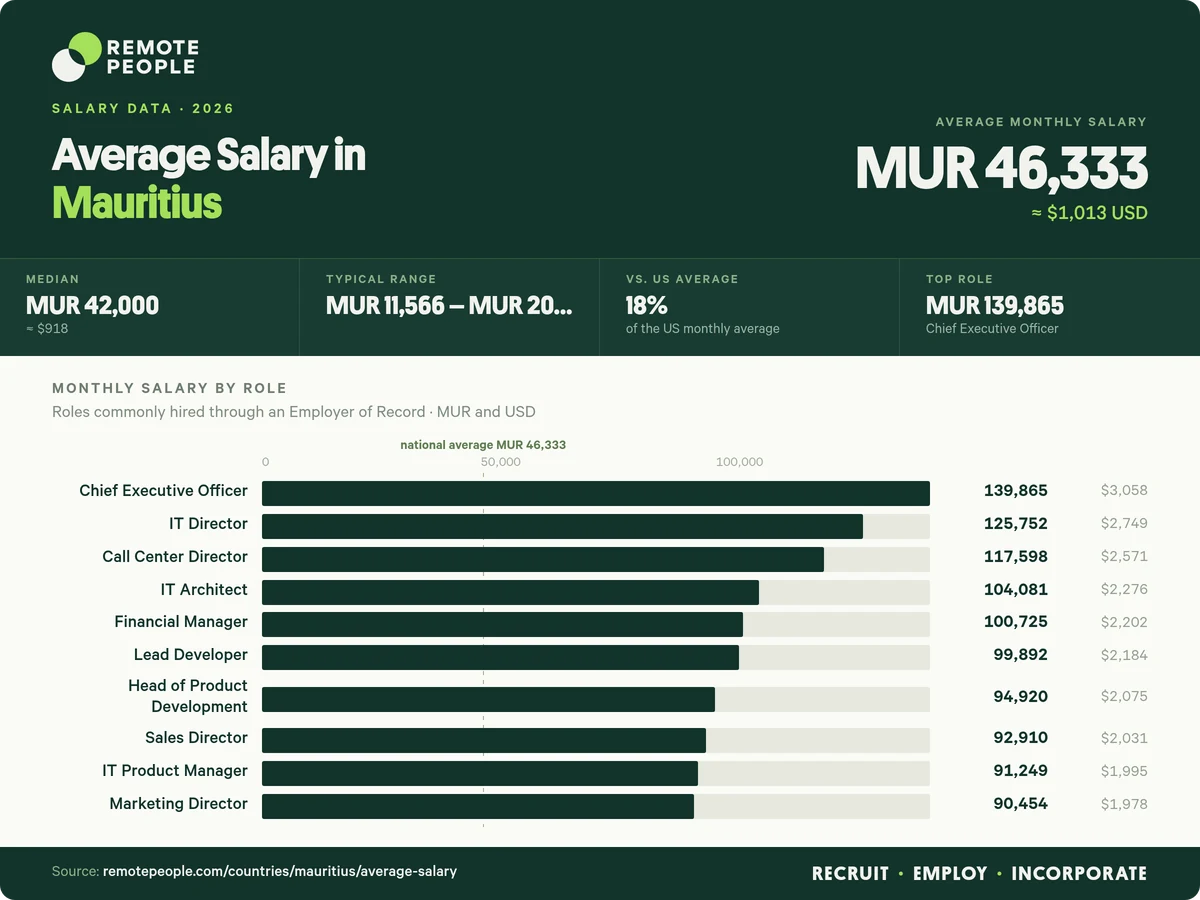
The average monthly salary in Mauritius is 46,333 Mauritian Rupees (MUR), about USD 1013. However, salaries vary depending on experience, education, position, industry, and location. You must also consider factors like median monthly income and salary range.
This guide will discuss all aspects of Mauritius’ salaries to provide a comprehensive overview.
What is the Average Salary in Mauritius?
The average salary Mauritius is 46,333 MUR or about $1013 a month. Wages in the country are relatively low due to low living costs and a focus on low-paying industries like tourism and manufacturing. Additionally, although the government has invested in education, workers’ skills don’t always meet the demands of higher-paying jobs.
Median Income
The median salary can also be considered the middle salary. Mauritius’ median monthly income is 42,000 MUR, about $918. Half the population earns higher wages; the other half earns lower salaries.
Salary Range
The salary range spans from the lowest to the highest in the country. Low earners in Mauritius make about 11,566 MUR (about $253), while high earners make closer to 207,150 MUR, about $4531.
Salary Comparison by Profession
Average salaries tell part of the story, but you must also consider how wages vary by education, experience, location, position, and industry. In the following sections, we will explore how those factors impact salaries.
Position | Average Monthly Salary (MUR) |
|---|---|
Chief Executive Officer | 139,865 |
IT Director | 125,752 |
Call Center Director | 117,598 |
IT Architect | 104,081 |
Financial Manager | 100,725 |
Lead Developer | 99,892 |
Head of Product Development | 94,920 |
Sales Director | 92,910 |
IT Product Manager | 91,249 |
Marketing Director | 90,454 |
General Laborer | 23,557 |
Packer | 23,477 |
Shop Assistant | 22,792 |
Seamstress | 22,392 |
Porter | 21,655 |
Medical Records Clerk | 21,621 |
Tailor | 21,425 |
Social Counselor | 20,964 |
Nursery School Teacher Assistant | 18,889 |
Average Wage in Mauritius by Education
In many countries, education directly impacts salaries, with workers with higher education earning more than those with minimal education. However, Mauritius faces an education and wage mismatch, likely due to access to free education and a lack of high-paying jobs. Overeducated workers typically deal with a wage penalty of 10.9%.
Salary Comparison by Experience
Experience typically affects salaries, with workers earning more as they gain industry experience. This situation holds in Mauritius, which is evident in the following statistics.
Experience Level | Estimated Annual Salary (MUR) |
|---|---|
Entry-Level (1–3 years) | 300,000 – 450,000 |
Mid-Tier (4–7 years) | 500,000 – 800,000 |
Experienced (8+ years) | 1,000,000+ |
However, this isn’t true at every company. Due to budgeting, skills are not always aligned with experience.
Salary Comparison by Location
Location also impacts salaries in Mauritius. Workers living in or close to Port Louis, the country’s capital, largest city, and economic and administrative center, earn the highest wages due to a higher cost of living and proximity to large companies offering high-paying job opportunities.
Other significant hubs include Mahebourg, Grand Baie, Curepipe, Vacoas-Phoenix, and Quatre Bornes. However, as tourist attractions, they provide service-oriented positions that may not be as high-paying. Workers in rural areas earn the lowest salaries.
How Much is Minimum Wage in Mauritius?
As of January 2026, the total minimum payout in Mauritius is Rs 17,745 per month (about $384 USD). This includes the base wage of Rs 17,110 plus a mandatory Rs 635 monthly compensation for employees earning up to Rs 50,000. The increase of 3.7% over 2025 continues the government’s policy of keeping wages ahead of inflation.
Average Salary in Mauritius vs. the Rest of the World
The following charts provide a better perspective on salaries in Mauritius, comparing them to wages in developed, developing, and undeveloped countries.
Mauritius vs. Developed Countries
Country | Average Salary | Comparison to Average Mauritius Salary |
|---|---|---|
United Kingdom | €3,000 (approx. $3,116) | – 210% |
United States | $5,677 | – 470% |
Norway | 50,790 NOK (approx. $4,700) | – 370% |
Germany | €4,300 (approx. $4,467) | – 350% |
Austria | €3,500 (approx. $3,636) | – 260% |
Mauritius vs. Developing Countries
Country | Average Salary | Comparison to Average Mauritius Salary |
|---|---|---|
Romania | 4,000 RON (approx. $835) | 19% |
Russia | 73,709 RUB (approx. $700) | 42% |
Albania | €1,500 (approx. $1,550) | – 55% |
Kazakhstan | 342,082 KZT (approx. $645) | 53% |
Ukraine | 18,000 UAH (approx. $500) | 100% |
Mauritius vs. Undeveloped Countries
Country | Average Salary | Comparison to Average Mauritius Salary |
|---|---|---|
Thailand | 97,500 Baht (approx. $2,772) | – 180% |
Philippines | 18,423 PHP (approx. $875) | 42% |
Vietnam | 8.5 million VND (approx. $360) | 177% |
Egypt | 13,244 EGP (approx. $263) | 284% |
Pakistan | 45,000 PKR (approx. $150) | 566% |
Mauritius may not be a traditionally developed country like Western Europe and North America. However, it offers an upper-middle-income economy with a diversified work sector that has moved beyond a reliance on sugar cultivation into tourism, textiles, IT, and finance. Despite economic challenges, the country has shown resilience in financial turbulence.
The country is a good outsourcing destination due to its skilled workforce, stable economic, political, and social environment, and favorable economic policies. It offers low taxes, no capital gains, dividend, or interest withholding taxes, supporting optimal profitability. Its advanced IT infrastructure and strong legal framework are other benefits.
What are the Most Common Outsourced Industries in Mauritius?
Companies seeking to partner with Mauritius on outsourcing projects will see the most benefits in the following industries:
IT Services
Mauritius has a booming IT industry supported by government initiatives and talent development. The sector focuses on AI, cybersecurity, and fintech, and a thriving startup ecosystem is emerging in the country. An IT worker in the country earns around 91,249 MUR, around $1996, while American workers earn closer to $5000, leading to significant cost savings for employers.
Financial Services
Mauritius is recognized as a regional financial hub for cross-border investment and finance. The sector is a primary driver of the country’s GDP and economy. Key services include fund administration, corporate banking, global business services, private banking, wealth management, insurance, investment banking, and international headquarters administration.
A financial manager in Mauritius earns around 100,725 MUR monthly, about $2203, while their American counterparts earn closer to $13,008. Employers who outsource financial services to the country will see a considerable reduction in human resource expenses.
Manufacturing
Mauritius’ manufacturing industry has been a key driver of the country’s economic growth. Textiles and apparel are among the most critical sectors. However, it has diversified with an increased production of jewelry, optical goods, furniture, and electric components.
Companies that outsource manufacturing to the country can benefit from low-cost labor and quality products.
Conclusion
Mauritius’s skilled workforce, low-cost labor, and stable business environment make it an ideal outsourcing destination. Remote partnerships can be beneficial, as companies can gain cost savings and quality goods and services, while helping the country overcome wage mismatch issues. There are positive aspects for all involved parties.




