
 Recruit
Employer of Record (EOR) in Mauritius
-
 Drew Donnelly
- Published
- September 22, 2026
An Employer of Record (EOR) in Mauritius is a locally licensed entity that hires employees on your behalf, managing Mauritius Revenue Authority (MRA) payroll taxes, National Pension Fund (NPF) and CSG contributions, work permits, and Employment Rights Act compliance. A Mauritius EOR lets you hire local staff in under two weeks—no local company required.
Hire in Mauritius — book a free 30-minute demo
Tell us what you need. You'll get a tailored, transparent proposal within 24 hours, plus a free call to walk through it.
Tell us about your company
So we can match you with a specialist who knows your market — and unlock volume pricing tiers.
* All fields are required.
Where and when are you hiring?
Tell us the geography and timing and we'll quote each country line by line, with onboarding timelines.
* All fields are required.
Help us beat your current setup
We'll benchmark your current deal and send a line-by-line proposal in 24 hours — showing exactly where we cut cost, time, or risk. After you submit, you can book a call to walk through it together.
* All fields are required.
Thanks! Your proposal is on its way.
Expect a tailored, line-by-line proposal in your inbox within 24 hours. In the meantime…
Want to walk through it together?
Book a free 30-minute call with one of our specialists. We'll explain every line, answer your questions, and tailor the proposal further if you need.
No obligation. Pick a time that works for you.








- Hire in Mauritius — book a free 30-minute demo
- Tell us about your company
- Where and when are you hiring?
- Help us beat your current setup
- Thanks! Your proposal is on its way.
- How an Employer of Record Works in Mauritius
- Employment Laws and Regulations in Mauritius
- Work Permits and Visas in Mauritius
- Payroll, Taxes, and Social Security in Mauritius
- Cost of Hiring Through an EOR in Mauritius
- Benefits of Using an EOR in Mauritius
- Termination and Offboarding in Mauritius
- EOR vs. Other Hiring Models in Mauritius
- Public Holidays in Mauritius
- How to Get Started with an EOR in Mauritius
- Frequently Asked Questions
- Related EOR Destinations

Start hiring in Mauritius
Let RemotePeople handle payroll, compliance, and HR admin worldwide so you can focus on building your team.

Mauritius offers a stable business environment, a bilingual English and French workforce, and one of Africa’s most liberal labour regimes, with the Workers’ Rights Act 2019 providing a clear statutory framework for employment. For companies looking to hire employees in Mauritius, the challenge is navigating local payroll registrations with the Mauritius Revenue Authority, the 10-year Occupation Permit process for foreign hires, and the mandatory Portable Retirement Gratuity Fund contributions that replaced the old severance system. An employer of record in Mauritius solves these problems by acting as the legal employer of record on your behalf, handling every statutory registration, monthly PAYE and social contribution filing, and ensuring full compliance with the Workers’ Rights Act 2019 while you retain day-to-day direction of the employee.
This guide explains how an employer of record in Mauritius works, the cost of hiring, payroll and tax obligations, work permit routes, and the current statutory entitlements your employees will receive under Mauritian law in 2026. Every rate and legal reference below is drawn from the Mauritius Revenue Authority, the Ministry of Labour, the Economic Development Board, and primary government gazettes.
How an Employer of Record Works in Mauritius
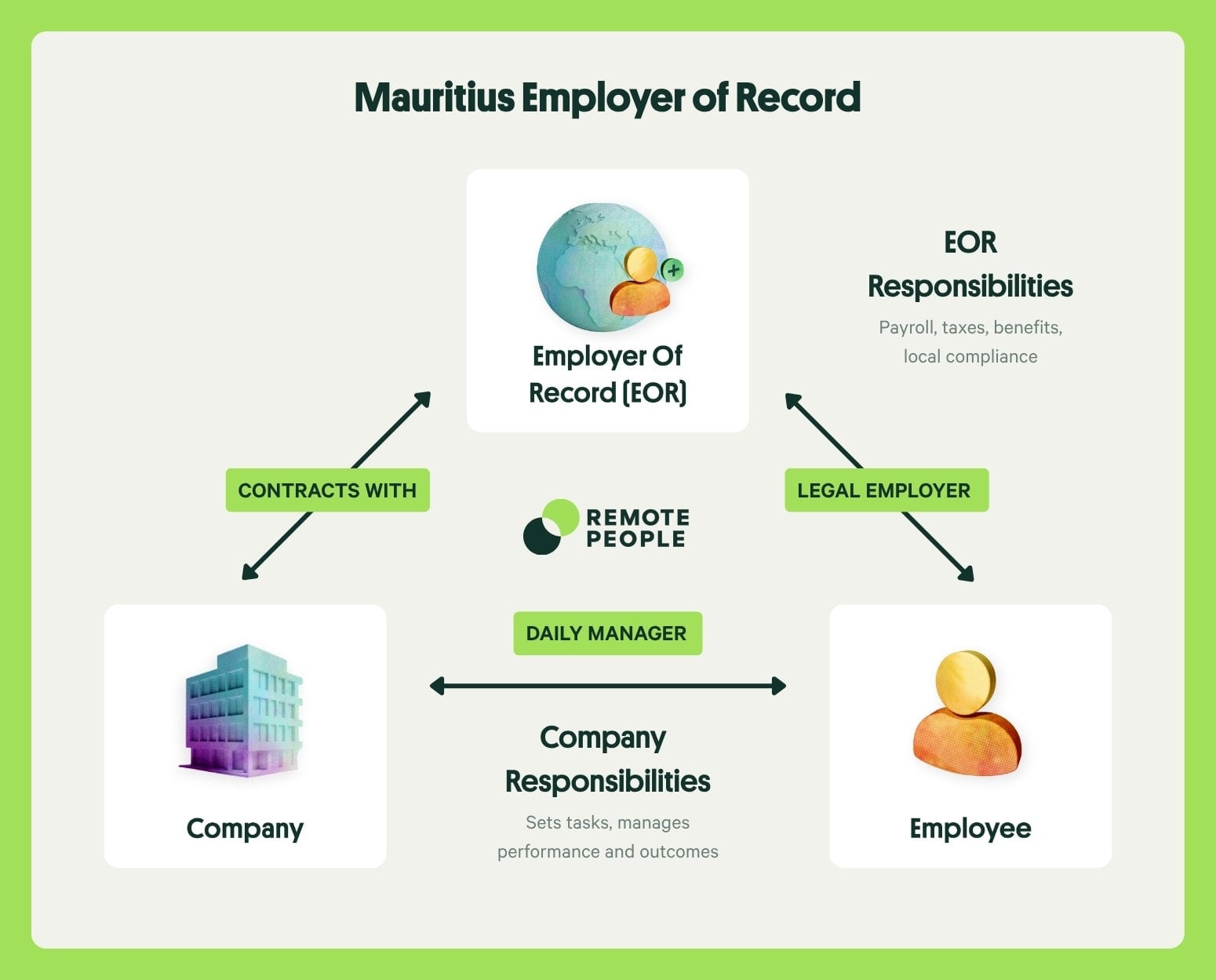
If you’d like to learn more about how Employer of Record (EOR) services work, read our What Is an Employer of Record (EOR)? guide for a complete overview of the model, its benefits, and when to use it.
If you’re comparing providers, our Best Employer of Record (EOR) Providers guide reviews the leading platforms to help you choose the right solution for your business.
Who Uses an EOR in Mauritius?
An EOR is the most efficient entry point for companies that want a presence in Mauritius without the lead time and cost of setting up a Global Business Licence company or a domestic limited company through the Corporate and Business Registration Department.
- Companies testing the Mauritian market: A business that wants to validate demand before committing to a full entity setup can hire one or two employees through an EOR and scale up or exit within weeks rather than months.
- Companies hiring small remote teams: Organisations with fewer than 15 Mauritian employees rarely see a return on the cost of running their own local entity, so an EOR consolidates all payroll and compliance overhead into a single monthly fee.
- Companies that need to onboard quickly: Where a candidate must start in two to three weeks, the EOR route compresses registration steps that would otherwise take two to three months.
- Companies hiring foreign nationals: Non-Mauritians need an Occupation Permit or Young Professional Occupation Permit sponsored by a local employer, and the EOR can act as that sponsor when the client has no Mauritian entity.
An EOR is also a pragmatic choice for companies winding down operations, preserving an employment relationship during restructuring, or onboarding returning Mauritian expatriates who want to be paid locally in rupees.
Typical Onboarding Timeline
Most EOR providers can onboard a Mauritian employee within one to two weeks. The sequence below shows the key milestones and the factors that can extend the timeline.
- EOR agreement and employee details: 1–2 days to sign the master services agreement and collect the employee’s national identity card, tax account number, and bank details.
- Employment contract drafting and review: 2–3 days to issue a Workers’ Rights Act 2019-compliant contract in English or bilingual French for the employee’s signature.
- Social security and tax registration: 3–5 days for the EOR to register the new hire under its existing MRA employer file and activate CSG, NSF, and PRGF records.
- Payroll setup and benefits enrolment: 2–3 days to configure the first payroll run and register any voluntary benefits.
- Employee onboarding and first day: 1 day to issue the welcome pack, company equipment, and local orientation.
Foreign hires add two to four additional weeks because the Economic Development Board processes Occupation Permit applications in two to four weeks once the file is complete, and the employee cannot begin work before the permit is issued.
Hire in Mauritius
Africa’s business gateway with NPF/NSF contributions, Mauritian Workers’ Rights Act 2019, and a stable regulatory environment.
We handle employment contracts, payroll, social contributions, and full Mauritian compliance.
No local entity needed. Your team can start in days.
Employment Laws and Regulations in Mauritius
Employment Contracts
The Workers’ Rights Act 2019 (Act 20 of 2019) is the principal employment statute in Mauritius, replacing the Employment Rights Act 2008 and the Employment Relations Act 2008 as the main source of individual employment law. It is administered by the Ministry of Labour, Human Resource Development and Training, which also operates the Industrial Court for employment disputes. A consolidated version updated to 9 August 2025 is published by the Ministry (Ministry of Labour consolidated text).
Every employment relationship must be documented in a written contract signed before the employee starts work. Required terms include the start date, job description, remuneration, hours of work, place of work, probation period if any, leave entitlements, and notice period. English is the working language of contracts; bilingual English and French is common and accepted by the Ministry of Labour. Fixed-term contracts are permitted only where the nature of the work is genuinely temporary; otherwise, contracts are presumed to be of indefinite duration under the Act.
Working Hours and Overtime
The statutory normal working week is 45 hours, typically spread over five or six days with a daily maximum of 10 hours including breaks. Every worker is entitled to a continuous weekly rest period of at least 24 hours, usually taken on Sunday. Managerial and supervisory staff earning above MUR 600,000 per annum are excluded from daily and weekly hour limits but retain all other protections under the Workers’ Rights Act 2019. Overtime is voluntary, except in emergencies, and must be compensated either in cash or in equivalent time off at the multiplier shown below (Ministry of Labour).
Mauritius overtime and premium pay rates · Per Workers’ Rights Act 2019 | |||
Hour Type | Rate Multiplier | Cap / Basis | Notes |
|---|---|---|---|
Standard weekday overtime (beyond 45 hrs/week) | 1.5× | Per hour worked | Payable in cash or as time off in lieu at the same multiplier. |
Weekly rest day work (usually Sunday) | 1.5× | Per hour worked | Worker is also entitled to a substitute rest day within the following week. |
Public holiday work (within normal hours) | 2× | In addition to the holiday pay already due | Combined effect is triple pay for the day when holiday pay is included. |
Public holiday work (beyond normal hours) | 3× | Per hour beyond the normal daily limit | Applied on top of the holiday-day multiplier. |
Night work (regular shift pattern) | 1.15× | Applied to basic rate | Applies where work begins or ends between 6 p.m. and 6 a.m. |
Overtime is capped at 10 hours per week in most sectors, and the employer must keep a daily record of overtime hours available for Ministry of Labour inspection. Overtime pay forms part of the reckonable remuneration for 13th-month bonus and for the severance allowance calculation, which makes accurate timesheet records important for termination costing.
Minimum Wage
The national minimum wage is MUR 17,110 per month as of 1 January 2025, set by the National Minimum Wage (Amendment) Regulations and applicable across all sectors (Mauritius Revenue Authority). A statutory salary compensation of MUR 635 per month is payable in 2026 to every employee earning up to MUR 50,000, bringing the effective floor for a full-time worker to MUR 17,745 per month. The compensation is added to the basic wage and attracts the same income tax and social contributions as salary.
Probation Period
The Workers’ Rights Act 2019 does not fix a statutory maximum probation period, leaving the duration to the employment contract. Market practice is one to three months for non-managerial roles and up to six months for professional or supervisory positions, with senior executive roles occasionally running to twelve months. Probationary employees accrue annual leave from day one and are entitled to the statutory 30-day notice period, or payment in lieu, unless the contract validly provides for a shorter notice during the probation window.
Leave Entitlements
Mauritian statutory leave is set by the Workers’ Rights Act 2019 and supplemented by sector-specific Remuneration Orders. The Act distinguishes paid leave funded by the employer (annual, sick, maternity, paternity) from unpaid statutory leave such as casual absences beyond the annual entitlement. The five leave types below apply to nearly every private-sector worker in Mauritius.
Annual Leave
Every worker with at least 12 consecutive months of continuous service is entitled to 22 working days of paid annual leave per calendar year, composed of 20 days of ordinary annual leave and two additional days. Leave accrues from the first day of service, is pro-rated for service of less than a full year, and up to ten days of unused leave may be carried forward or encashed at the employee’s option. Annual leave accrues during probation.
Sick Leave
Workers are entitled to 15 days of paid sick leave per calendar year at full salary, funded entirely by the employer. Unused sick leave accumulates up to 90 days as a “sick bank” that may be drawn upon after the 15-day annual allowance is exhausted. A medical certificate from a registered practitioner is required for any absence of three consecutive days or longer, and the employer may request a certificate for shorter absences where abuse is suspected.
Maternity Leave
Mauritius expanded maternity leave from 14 to 16 weeks with effect from 7 June 2024 under amendments to the Workers’ Rights Act 2019 (Lockton Global Insights). Leave is paid in full by the employer, requires at least 12 months’ continuous service, and must include at least eight weeks taken after the birth. Multiple or premature births attract an additional two weeks, bringing the total to 18 weeks. Employees also receive a maternity allowance of MUR 3,000 payable by the employer on presentation of the birth certificate, and job protection applies throughout the protected period.
Paternity Leave
Paternity leave was extended in 2024 from five working days to four consecutive calendar weeks of fully paid leave, taken within one year of the birth. The father must have at least 12 months of continuous service with the same employer at the date of the child’s birth, and the leave is funded in full by the employer.
Other Statutory Leave
- Bereavement leave: Three days of paid leave on the death of a spouse, child, parent, sibling, grandparent, or grandchild.
- Marriage leave: Three days of paid leave on the first marriage of the worker or the marriage of one of the worker’s children.
- Adoption leave: Twelve weeks of paid leave where a child under three is legally adopted, paid in the same way as maternity leave.
- Union and jury duty leave: Paid time off for recognised trade union representation duties and for attending court as a juror or witness.
The table below summarises every statutory leave entitlement under the Workers’ Rights Act 2019 and should be read together with the individual H4 sections above. One practical point to notice is that both annual leave and sick leave accrue from day one of service – not after probation – so leave liability begins building immediately on the first payroll run.
Mauritius statutory leave entitlements · Per Workers’ Rights Act 2019 | ||
Leave Type | Duration | Eligibility & Notes |
|---|---|---|
Annual leave | 22 days (20 + 2) | After 12 months’ service; pro-rated earlier. Up to 10 days may be encashed or carried over. |
Sick leave | 15 days / year | Fully paid by employer; unused days accumulate up to 90 days. Certificate required after 3 consecutive days. |
Maternity leave | 16 weeks (18 for multiple births) | Full pay by employer after 12 months’ service. At least 8 weeks post-birth. MUR 3,000 maternity allowance. |
Paternity leave | 4 weeks | Full pay by employer after 12 months’ service; extended from 5 working days in 2024. |
Adoption leave | 12 weeks | Where a child under three is legally adopted; paid on the same basis as maternity leave. |
Bereavement leave | 3 days | Paid; on death of spouse, child, parent, sibling, grandparent, or grandchild. |
Marriage leave | 3 days | Paid; on first marriage of worker or marriage of the worker’s child. |
Statutory Employee Benefits
Beyond leave and paid time off, Mauritian employers are required to enrol staff in a number of contributory schemes administered by the Mauritius Revenue Authority and the Ministry of Social Integration. The rates themselves appear in the contribution tables in the Payroll, Taxes, and Social Security section; this section explains what each scheme covers.
- Contribution Sociale Généralisée (CSG): Employer-and-employee contribution introduced in September 2020 to replace the National Pensions Fund. Funds the Basic Retirement Pension and a range of solidarity benefits administered by the Ministry of Social Integration.
- National Savings Fund (NSF): Employee-only savings scheme that pays a lump sum on retirement or death. Contributions are capped at MUR 608 per month.
- Human Resource Development Council levy (HRDC): Employer-funded training levy of 1.5% of basic wages, which funds national training grants accessible through the HRDC refund scheme.
- Portable Retirement Gratuity Fund (PRGF): Employer-funded scheme under the Workers’ Rights Act 2019 that replaces the pre-2019 severance allowance for most workers; contributions vest with the employee and are portable between employers.
- Private health insurance and pension: Not statutorily mandated for employees below the managerial threshold but provided by most large employers as a market benefit. An EOR can administer employer-sponsored medical and pension plans on the client’s behalf.
Statutory contributions are deducted by the employer each month and paid to the MRA through a single combined return with the monthly PAYE filing.
Recent Regulatory Updates 2026
Mauritius has pushed through an unusually active legislative period between 2024 and 2026. The 2025–26 national budget simplified personal income tax by collapsing the eleven-bracket progressive structure into three rates of 0%, 10% and 20% with effect from 1 July 2025, and introduced a “Fair Share Contribution” of 15% on annual chargeable income above MUR 12 million (Government of Mauritius budget statement).
On the labour side, maternity leave was extended from 14 to 16 weeks and paternity leave from five working days to four calendar weeks, both taking effect on 7 June 2024 under amendments to the Workers’ Rights Act 2019. The minimum wage was revised upward to MUR 17,110 per month from 1 January 2025, and the 2026 salary compensation of MUR 635 per month was gazetted for all workers earning up to MUR 50,000. Finally, the Economic Development Board introduced the ProPass and Expert Pass Occupation Permit categories in 2025, with minimum monthly salary thresholds of MUR 30,000 and MUR 250,000 respectively, alongside a ten-year validity period.
Work Permits and Visas in Mauritius
Work Permit Requirements
Who Needs a Work Permit
Every non-Mauritian national who takes up paid employment in Mauritius must hold either an Occupation Permit or a separate Work Permit issued by the Ministry of Labour. The Economic Development Board (EDB) is the one-stop shop for Occupation Permits and acts as the sponsor-side gateway for most foreign hires. Citizens of Mauritius, permanent residents, and holders of the Permanent Residence Permit have automatic right to work and do not require any additional authorisation.
Eligibility and Required Documents
The standard supporting file for an Occupation Permit application includes a valid passport (minimum six months remaining validity), a signed employment contract, degree certificates and CV, a clean criminal record certificate, a medical certificate, the employer’s sponsor letter, and proof that the minimum salary threshold is met. The EDB application is submitted online through its e-Immigration portal, with all documents scanned and the Mauritian-side sponsor paying the application fee.
Processing Time and Validity
Standard Occupation Permits, including the new ProPass and Expert Pass categories, are issued for a ten-year period and are typically processed within two to four weeks once the file is complete (Economic Development Board). The Young Professional Occupation Permit is issued for three years, the Premium Visa for one year (renewable), and the Self-Employed Occupation Permit for an initial period of up to ten years subject to revenue milestones. Delays generally relate to criminal background checks from jurisdictions that require consular attestation.
Renewal Process
Renewal is initiated at least two months before expiry and follows the same documentary format as the initial application, with additional evidence of the employee’s tax compliance, social security contributions, and continued salary at or above the category threshold. Employees may continue working during the renewal window provided the renewal application was filed before expiry. Failure to renew on time triggers an immediate loss of work rights and a potential overstay penalty.
Common Visa Types for Foreign Workers
The Economic Development Board, together with the Passport and Immigration Office, operates a tiered Occupation Permit framework designed to match Mauritius’s priorities for skilled migration, entrepreneurship, and high-net-worth residency. The table below summarises the principal categories an EOR typically sponsors.
Mauritius work visa types for foreign workers · 2026 | ||||
Visa Type | Duration | Best For | Leads to PR? | Processing |
|---|---|---|---|---|
Occupation Permit – ProPass | 10 years | Professionals with monthly salary ≥ MUR 30,000 | Yes (after 3 years of continuous permit) | 2–4 weeks |
Occupation Permit – Expert Pass | 10 years | Senior or specialised roles ≥ MUR 250,000/month | Yes (fast-track) | 2–4 weeks |
Young Professional Occupation Permit | 3 years | Foreign graduates of Mauritian institutions earning ≥ MUR 25,000 | Yes (convertible to standard OP) | 2–3 weeks |
Self-Employed Occupation Permit | 10 years | Entrepreneurs investing at least USD 50,000 | Yes (linked to turnover) | 4–8 weeks |
Premium Visa | 1 year, renewable | Remote workers, retirees, long-stay visitors | No | 1–2 weeks |
Family Occupation Permit (Investor) | Long-term | Investor families contributing USD 250,000 | Yes | 4–8 weeks |
- Tourist visa: 60-day entry permit; does not authorise paid employment.
- Student visa: Permits enrolment in a Mauritian institution; limited part-time work rights only.
- Business visit visa: Short-stay category for meetings, conferences, and market visits; does not authorise local employment.
How an EOR Handles Work Permits
An EOR with a registered Mauritian entity is able to act as the sponsoring employer for Occupation Permit applications, which means a foreign hire can be onboarded without the client setting up a local company. The EOR prepares and submits the EDB file, pays the application fee, and manages the medical and police certificate requests. The employee supplies the personal documents – passport, degree certificates, criminal record – and books any local appointments.
Work permit sponsorship adds two to four weeks to the onboarding timeline referenced earlier. Some categories, such as Expert Pass, require specific credential verification that can push the file closer to four weeks. Once the permit is issued, the employee may begin work immediately, and the EOR handles all ongoing renewal, dependant applications, and exit formalities.
Payroll, Taxes, and Social Security in Mauritius
Employer Contributions
Employer-side contributions comprise CSG at the employer rate, the HRDC training levy, and the Portable Retirement Gratuity Fund. Rates depend on whether the employee earns above or below MUR 50,000 per month. The MRA collects all employer contributions through a single monthly return alongside PAYE withholding.
Mauritius employer social security contributions · 2026 rates | ||
Component | Rate | Notes |
|---|---|---|
CSG – salary up to MUR 50,000 | 3% | Applied to monthly basic wage; no ceiling on pensionable earnings. |
CSG – salary above MUR 50,000 | 6% | Higher rate applies to the whole salary once the MUR 50,000 threshold is crossed. |
HRDC training levy | 1.5% | Applied to basic wage; refundable through HRDC-approved training programmes. |
Portable Retirement Gratuity Fund | 4.5% | Employer contribution under Workers’ Rights Act 2019 replacing legacy severance. |
Total employer cost (salary ≤ MUR 50,000) | 9.0% | CSG 3% + HRDC 1.5% + PRGF 4.5%. |
Employee Contributions
Employees pay CSG at the reduced employee rate and the fixed 2.5% NSF contribution, which is capped at MUR 608 per month. All employee deductions are withheld by the employer and remitted to the MRA monthly, which means the worker sees only the net figure on the pay slip.
Mauritius employee payroll deductions · 2026 monthly withholdings | ||
Withholding | Rate | Notes |
|---|---|---|
CSG – salary up to MUR 50,000 | 1.5% | Deducted at source; funds Basic Retirement Pension and solidarity benefits. |
CSG – salary above MUR 50,000 | 3% | Higher rate applies to the whole salary once the threshold is crossed. |
National Savings Fund (NSF) | 2.5% | Capped at MUR 608 per month; paid into a personal savings account. |
PAYE income tax | 0% / 10% / 20% | Applied per tax bracket below; monthly exempt threshold MUR 38,462. |
Total employee deductions (salary ≤ MUR 50,000 excl. PAYE) | 1.5% + NSF cap | CSG 1.5% + NSF 2.5% (capped at MUR 608). |
Income Tax
Mauritius reformed its personal income tax structure with effect from 1 July 2025, simplifying the prior eleven-bracket progressive system into three rates. The monthly exempt threshold rose to MUR 38,462 for a single earner, with higher exemption bands for taxpayers with dependants (PwC Mauritius Worldwide Tax Summaries).
Mauritius income tax brackets · 2026 | |
Annual Chargeable Income (MUR) | Tax Calculation |
|---|---|
0 – 500,000 | 0% (exempt band) |
500,001 – 1,000,000 | 10% on the portion above MUR 500,000 |
Above 1,000,000 | MUR 50,000 + 20% on the portion above MUR 1,000,000 |
Above 12,000,000 (Fair Share Contribution) | Additional 15% on the portion above MUR 12 million |
Payroll Cycle
Payroll is run on a monthly cycle, with salaries paid by bank transfer in Mauritian rupees no later than the last working day of the month. Pay slips must be issued showing gross pay, each deduction line, and net pay, and must be kept for at least five years. The combined PAYE, CSG, NSF, HRDC, and PRGF return is filed electronically through the MRA e-services portal by the end of the month following the pay period, with payment due on the same date. Annual statements of emoluments are issued to each employee by 15 August of the following fiscal year.
13th Month Salary and Bonus Pay
A statutory end-of-year bonus is mandatory in Mauritius under the Workers’ Rights Act 2019 and the End of Year Gratuity Act 2001. Any worker who has been in continuous service for the full calendar year is entitled to a bonus equivalent to one-twelfth of their annual earnings, pro-rated for shorter service. At least 75% of the bonus must be paid five clear working days before 25 December, with the balance due on the last working day of the year. The bonus is calculated on basic salary plus regular allowances and is subject to PAYE and CSG in the same way as normal pay (DLA Piper Africa Mauritius guide). There is no statutory 14th-month bonus, and any additional performance bonuses remain contractual.
Cost of Hiring Through an EOR in Mauritius
EOR Service Fees
EOR providers in Mauritius typically charge a flat monthly fee between USD 300 and USD 600 per employee, depending on the complexity of the payroll, the need for Occupation Permit sponsorship, and whether private medical and pension top-ups are bundled. The fee includes contract drafting, payroll processing, monthly MRA filings, employee support, and reporting to the client. Initial set-up is usually included within the first month’s fee.
Total Employment Cost Breakdown
The cost model below illustrates the fully loaded monthly cost of employing a professional on a gross salary of USD 3,000 (approximately MUR 135,000 at the April 2026 rate). Figures are rounded to the nearest dollar and reflect the employer-side contributions set out in the tables above for the upper CSG band.
Mauritius employer cost example · USD 3,000 gross · 2026 | ||
Line Item | Amount (USD) | % of Gross |
|---|---|---|
Gross monthly salary | $3,000 | 100.0% |
Employer CSG (6% – above MUR 50,000 band) | $180 | 6.0% |
HRDC training levy (1.5%) | $45 | 1.5% |
PRGF contribution (4.5%) | $135 | 4.5% |
Accrued 13th-month bonus (1/12 of annual) | $250 | 8.3% |
EOR service fee (flat) | $499 | 16.6% |
Total monthly cost | $4,109 | 137.0% |
Figures converted at USD 1 ≈ MUR 45, April 2026.
Ready to hire in Mauritius? Get started with RemotePeople – we handle employment contracts, payroll, tax withholding, and full Mauritius compliance. No local entity needed. Reach out through our contact page to scope your first hire.
Benefits of Using an EOR in Mauritius
Hiring through an employer of record in Mauritius compresses the administrative burden of a Workers’ Rights Act 2019-compliant employment relationship into a single service line. For most businesses, the benefits below deliver a faster market entry and a materially lower compliance risk than running a domestic entity for a small team.
- Speed to market: An EOR can have a Mauritian employee working within one to two weeks, compared with the two to three months typically required to form a domestic company and register it with the MRA, Business Registry, and social security bodies.
- Compliance assurance: The EOR assumes direct responsibility for every Workers’ Rights Act 2019 obligation, monthly MRA return, and Industrial Court exposure, which protects the client from penalties and back-pay orders.
- Cost efficiency vs local entity: The fully loaded cost of an EOR hire is usually lower than the legal, accounting, and compliance fees required to maintain a Mauritian company with fewer than 15 employees.
- Local expertise: A Mauritius EOR already knows how to navigate the PRGF, the 13th-month payment calendar, and the EDB Occupation Permit system, which are the three areas where foreign-owned companies most often make mistakes.
- Flexibility to scale up or down: Adding or removing employees through an EOR is a contractual adjustment, not a corporate restructuring, so companies can pilot a team of two or three before scaling to a larger local operation.
- Risk mitigation: Misclassification, incorrect PAYE calculation, late CSG payment, and failure to accrue end-of-year bonus are all transferred to the EOR, which carries professional indemnity cover for these risks.
- Employee experience: Workers are paid on time in rupees, receive a statutory 13th-month bonus and PRGF accrual, and have a single point of contact for leave, tax, and social security questions.
For many companies, the decision comes down to focus: the EOR handles every Mauritian formality so the client can focus on product, sales, and the employee relationship itself.
Termination and Offboarding in Mauritius
Notice Periods
The Workers’ Rights Act 2019 sets a single statutory notice period of 30 calendar days, applicable to both employer and employee and payable in lieu if either party prefers a clean break. Longer periods may be agreed in the employment contract, particularly for senior roles, but cannot be reduced below the statutory floor except during probation (CMS Expert Guide to Dismissals – Mauritius). Notice runs on calendar days, so weekends and public holidays count toward the 30-day period.
Mauritius statutory notice periods by position level · Per Workers’ Rights Act 2019 | |||
Position / Tenure | Notice Period | During Probation | Notes |
|---|---|---|---|
Less than 6 months’ service | 30 calendar days | Per contract; often 7–14 days | Statutory minimum still applies outside probation. |
6 months – 2 years’ service | 30 calendar days | Not applicable | Same statutory floor; longer may be agreed contractually. |
2 – 5 years’ service | 30 calendar days | Not applicable | Market practice often lifts to 60 days for professional roles. |
5+ years’ service | 30 calendar days | Not applicable | Senior and managerial contracts commonly specify 60–90 days. |
Collective redundancy (Reduction of Workforce) | 30 days + 30-day Redundancy Board review | Not applicable | Employer must notify the Redundancy Board at least 30 days before planned termination. |
The statutory notice does not apply where the worker is summarily dismissed for serious misconduct such as fraud, theft, or insubordination, or where both parties sign a mutual separation agreement. Fixed-term contracts end automatically on the agreed date without notice, unless the contract provides otherwise.
Severance Pay
Severance in Mauritius has been transformed by the Workers’ Rights Act 2019. The pre-2019 severance allowance of six months’ salary per year of service was replaced by the Portable Retirement Gratuity Fund (PRGF), into which the employer contributes 4.5% of monthly basic salary throughout the employment relationship. On termination, the employee receives the accumulated PRGF balance, which is portable between employers. A residual statutory severance allowance remains available in specific cases – unjustified dismissal, reduction of workforce, or long tenure accrued before January 2020 – at three months’ remuneration per year of service.
Mauritius severance pay schedule by years of service · Per Workers’ Rights Act 2019 | |||
Years of Service | Severance Amount | Base Salary | Notes |
|---|---|---|---|
1 year | 3 months’ remuneration | Average of last 12 months | Applies to unjustified dismissal; PRGF benefit paid separately. |
3 years | 9 months’ remuneration | Average of last 12 months | PRGF contributions of 4.5% also accumulate over the period. |
5 years | 15 months’ remuneration | Average of last 12 months | Employer may deduct gratuities already paid from own retirement scheme. |
10 years | 30 months’ remuneration | Average of last 12 months | Pre-2020 service tiers may differ; check legacy entitlement. |
Reduction of workforce | 3 months per year of service | Average of last 12 months | Requires Redundancy Board approval; payable within 7 days of termination. |
Calculation Method
The statutory severance formula is three months of reckonable remuneration for every 12 months of continuous service, with pro-rata adjustment for partial years. Reckonable remuneration is the average of the last 12 months of basic salary plus any regular allowances that form part of contractual pay, excluding discretionary bonuses and one-off payments. Worked figures for 1, 3, 5 and 10 years of service appear in the table above so the total cost can be read directly rather than recalculated in prose.
Caps and Exceptions
There is no absolute monetary cap on severance. Exceptions include summary dismissal for serious misconduct, where no severance is payable; termination during a properly-framed probationary period, which attracts only the notice obligation; and expiry of a fixed-term contract, where no severance is due. Employers may deduct any gratuity already paid from their own occupational retirement scheme, and PRGF payments are not deducted from the severance due in cases of unjustified dismissal.
Grounds for Termination
The Workers’ Rights Act 2019 distinguishes termination for cause, termination on economic or operational grounds (“reduction of workforce”), and mutual separation. For-cause termination requires the employer to follow a disciplinary procedure – written warning, right to be heard, and a decision letter citing specific misconduct – and any deviation exposes the employer to an unjustified dismissal claim at the Industrial Court. Reduction of workforce requires a written notification to the Redundancy Board at least 30 days in advance, which will examine the commercial rationale. Protected categories include pregnant workers, workers on sick leave with certificate, and trade union representatives, all of whom benefit from a higher threshold before dismissal can be upheld.
EOR vs. Other Hiring Models in Mauritius
EOR vs. Setting Up a Local Entity
Mauritius EOR vs local entity comparison · Setup time, cost, risk and best-fit | ||
Factor | Employer of Record | Own Entity (Domestic Company) |
|---|---|---|
Setup time | 1–2 weeks | 2–3 months (CBRD, MRA, CSG registrations) |
Upfront cost | $0 | $3,000–$10,000 incorporation and registration fees |
Ongoing cost | $300–$600/employee/month | $8,000–$25,000/year legal, accounting, MRA e-filing |
Local partner required | No (EOR is the local entity) | No (Mauritius allows 100% foreign ownership) |
Social insurance registration | Handled by EOR | You manage it (MRA, NSF, PRGF) |
Payroll and tax filing | Handled by EOR | You manage it or outsource monthly |
Best for team size | 1–15 employees | 15+ employees or regulated activity |
Scale down / exit | Easy – no entity to unwind | Costly – voluntary winding-up under Companies Act |
Government contracts | Not eligible | Eligible (requires local entity) |
For companies with more than 15 Mauritian employees, a domestic entity typically becomes cheaper on a per-employee basis and opens the door to tenders, Global Business Licence structuring, and a long-term Mauritian tax residency position. Below that threshold, the EOR model is almost always the faster and lower-risk route, particularly for organisations that do not have corporate services expertise on the ground. Many clients begin with an EOR and transition to a local entity once headcount and revenue justify the overhead.
EOR vs. Hiring Independent Contractors
Mauritius EOR vs independent contractors · Compliance, cost, and risk | ||
Factor | EOR (Full-Time Employee) | Independent Contractor |
|---|---|---|
Legal relationship | Employee of the EOR | Self-employed, no employment relationship |
Compliance risk | Low – EOR ensures Workers’ Rights Act compliance | High – misclassification attracts MRA back-tax and Industrial Court claims |
Payroll and tax | EOR withholds PAYE, CSG, NSF, PRGF | Contractor invoices you; they pay their own income tax and CSG |
Benefits and leave | Statutory leave, bonus, PRGF | No entitlement to employee benefits |
IP protection | Stronger – employment contract assigns IP by default | Weaker – requires explicit IP assignment clause |
Termination | Subject to 30-day notice and Industrial Court rules | Contract can be ended per agreement terms |
Best for | Long-term, core team roles | Short-term projects, specialised tasks |
Cost structure | Salary + employer contributions + EOR fee | Contractor fee (typically higher gross, lower total cost) |
The Mauritius Revenue Authority applies a multi-factor test to distinguish genuine self-employment from disguised employment, looking at control, economic dependence, provision of tools, exclusivity, and integration into the business. Where a contractor is reclassified as an employee, the company becomes liable for back-PAYE, CSG, NSF, PRGF and penalties, plus any statutory leave and bonus that should have been accrued. Using an EOR eliminates this misclassification risk while still giving the client day-to-day direction of the worker’s activities.
EOR vs. PEO (Professional Employer Organization)
Mauritius EOR vs PEO comparison · Legal employer, liability, and setup | ||
Factor | Employer of Record (EOR) | PEO |
|---|---|---|
Legal employer | EOR is the legal employer | You remain the legal employer (co-employment) |
Local entity required | No – the EOR is the local entity | Yes – you must have your own entity in Mauritius |
Best for | Companies without a local entity | Companies that already have a local entity |
Compliance liability | EOR assumes compliance responsibility | Shared liability between you and the PEO |
Setup time | 1–2 weeks | Depends on your entity setup (weeks to months) |
Control over HR policies | EOR manages within local law framework | More direct control, PEO advises |
Typical use case | Market entry, small remote teams, testing new markets | Established local operations needing HR outsourcing |
Mauritius does not have a dedicated statutory PEO framework in the way the United States does. Companies seeking a co-employment arrangement typically structure it as a services agreement between their Mauritian subsidiary and an HR outsourcing firm, which is closer to payroll outsourcing than to a true co-employment relationship. For organisations without a Mauritian entity, an EOR is the correct structure. For those that already have one, payroll outsourcing to a local HR consultancy may deliver the administrative benefit of a PEO without creating new legal exposure.
Public Holidays in Mauritius
Mauritius observes a mix of secular, Christian, Hindu, Muslim, and Chinese holidays reflecting the island’s multi-ethnic population. The dates for 2026 were gazetted in General Notice 1195 of 2025 issued by the Prime Minister’s Office. Some holidays move each year based on religious calendars; Eid-ul-Fitr in particular is subject to the lunar sighting and the gazetted date may be confirmed closer to the day.
Mauritius public holidays · 2026 calendar year | ||
Date | Holiday | Type |
|---|---|---|
1 January | New Year’s Day | Secular |
2 January | New Year holiday | Secular |
1 February | Abolition of Slavery | National |
1 February | Thaipoosam Cavadee | Hindu (Tamil) |
15 February | Maha Shivaratree | Hindu |
17 February | Chinese Spring Festival | Cultural |
12 March | National Day | National |
19 March | Ugaadi | Hindu (Telugu) |
21 March | Eid-ul-Fitr (subject to lunar sighting) | Islamic |
1 May | Labour Day | Secular |
15 August | Assumption of the Blessed Virgin Mary | Christian |
16 September | Ganesh Chaturthi | Hindu |
2 November | Arrival of Indentured Labourers | National |
8 November | Diwali | Hindu |
25 December | Christmas Day | Christian |
Payroll teams should pay particular attention to the dual holidays on 1 February 2026, which create a single day off but two separate overtime-trigger records, and to the Eid-ul-Fitr date, which may shift by one day depending on the final lunar sighting in late March.
How to Get Started with an EOR in Mauritius
- Step 1 – Scope the hire: Agree the job description, salary, benefits, and start date with the candidate. Confirm whether they are a Mauritian resident or will need an Occupation Permit, since this determines the onboarding timeline.
- Step 2 – Sign the EOR services agreement: Execute a master services agreement with the provider covering fees, scope, and confidentiality. The EOR then issues a Workers’ Rights Act 2019-compliant employment contract for the employee’s signature.
- Step 3 – Register the employee: The EOR adds the new hire to its existing MRA employer file, configures CSG, NSF, PRGF, and HRDC records, and opens any private medical or pension plan the client has agreed to provide.
- Step 4 – Run the first payroll: The EOR processes the first monthly payroll, delivers a net-pay instruction, and issues a compliant pay slip. The client reimburses the EOR for the gross cost plus the monthly fee.
- Step 5 – Ongoing management: The EOR handles monthly filings, leave tracking, end-of-year bonus, annual statements of emoluments, and any changes to salary, role, or termination.
If you are ready to scope a Mauritian hire, contact RemotePeople for a quotation. Our team will walk you through the paperwork, estimate the fully loaded cost, and onboard your first employee within two weeks.
Frequently Asked Questions
Budget for roughly 137% of the gross salary. Employer contributions add about 12% (CSG, HRDC, and PRGF) and you should accrue 8.3% for the mandatory 13th-month bonus, plus a flat EOR fee of USD 300–600 per employee per month. For a USD 3,000 gross salary, the fully loaded monthly cost works out to around USD 4,100.
Mauritian nationals can usually start within one to two weeks. Foreign hires add two to four weeks for the Economic Development Board to process the Occupation Permit, so plan for a four-to-six-week window end to end.
Yes. Under the Workers' Rights Act 2019 and the End of Year Gratuity Act 2001, every worker who completes a full calendar year of continuous service is entitled to a bonus equivalent to one-twelfth of their annual earnings, with at least 75% paid five working days before 25 December and the balance on the last working day of the year.
Yes. An EOR registered with the Economic Development Board can sponsor Occupation Permits (including the 2025 ProPass and Expert Pass categories), Young Professional Occupation Permits, and Self-Employed Occupation Permits on behalf of the client, which removes the need to set up a Mauritian entity just to hire one foreign worker.
The Workers' Rights Act 2019 introduced the Portable Retirement Gratuity Fund (PRGF). Employers contribute 4.5% of basic salary monthly, and the balance is paid to the employee on termination and is portable between employers. The statutory severance allowance of three months per year of service still applies in specific cases such as unjustified dismissal or reduction of workforce.
Yes. The national minimum wage is MUR 17,110 per month from 1 January 2025, plus a MUR 635 monthly salary compensation in 2026 for workers earning up to MUR 50,000, giving an effective floor of MUR 17,745 per month for a full-time worker.
The Mauritius Revenue Authority looks at control, economic dependence, integration into the business, and provision of tools to decide whether a worker is genuinely self-employed. If a contractor relationship is reclassified as employment, the company is liable for back PAYE, CSG, NSF, PRGF, and the 13th-month bonus, plus penalties. Using an EOR removes this misclassification risk.
From 1 July 2025, Mauritius uses a three-rate personal income tax structure: 0% on annual income up to MUR 500,000, 10% between MUR 500,001 and MUR 1 million, and 20% above MUR 1 million. A Fair Share Contribution of 15% applies to income above MUR 12 million per year.
Employer of Record in
Employer of Record in
Employer of Record in
Employer of Record in
Employer of Record in
Employer of Record in
Employer of Record in
Employer of Record in




