
 Recruit
Average Salary in Mozambique
-
 Drew Donnelly
- Published
- September 6, 2026
- 5 ★ on G2








Let RemotePeople handle payroll, compliance, and HR admin worldwide so you can focus on building your team.
Mozambique’s cost-effective labor and strategic location make it a promising destination for outsourcing. Employers considering hiring in the region may wonder, What is the average salary in Mozambique? This information will help them develop fair job offers.
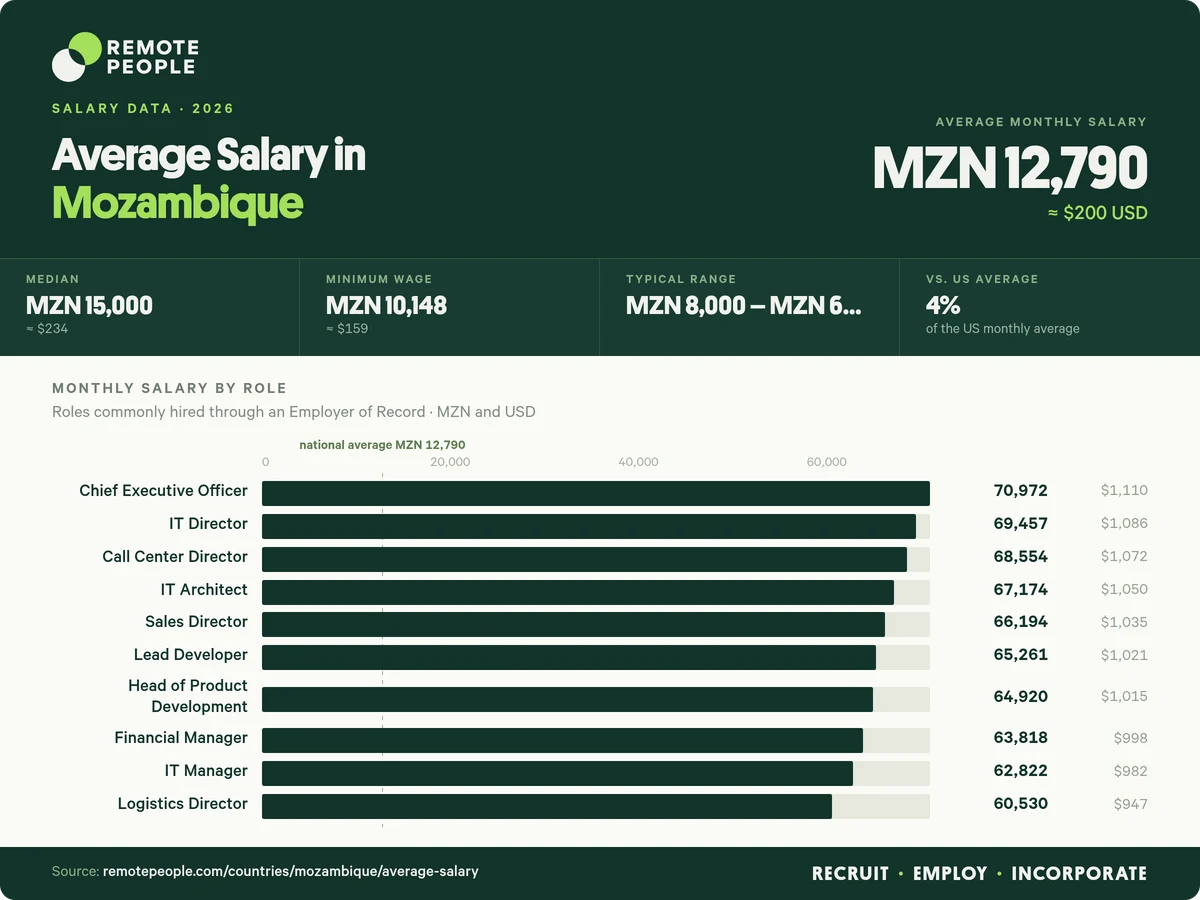
The average salary in Mozambique is 12,790 Mozambican meticals (MZN), approximately USD 200. However, you must consider how wages vary by education, experience, location, position, and industry. Comparing salaries in the country to earnings worldwide provides additional insight.
This article will review all aspects of Mozambique salaries, preparing you for your hiring journey.
What is the Average Salary in Mozambique?
The average salary in Mozambique is 12,790 MZN, equivalent to approximately $200. Wages in the country are low due to the presence of a large informal sector with an unregulated workforce. Mozambique is also highly reliant on agriculture, but productivity in the industry is low.
Median Income
The median salary in Mozambique is approximately $234, or 15,000 MZN. Half the people in the country earn higher wages, and the other half earn less.
Salary Range
Salary range spans from the lowest to the highest salaries in the country. In Mozambique, low earners make about 8,000 MZN, approximately $125. High earners can make as much as 64,995 MZN, about $1,106.
Salary Comparisons in Mozambique
The average salary provides some insight, but wages vary depending on factors such as experience, education, location, position, and industry. The following sections explore how these factors impact earnings.
Salary by Position
The following salary comparison chart reveals how wages vary by position.
Position | Average Monthly Salary (MZN) |
|---|---|
Chief Executive Officer | 70,972 |
IT Director | 69,457 |
Call Center Director | 68,554 |
IT Architect | 67,174 |
Sales Director | 66,194 |
Lead Developer | 65,261 |
Head of Product Development | 64,920 |
Financial Manager | 63,818 |
IT Manager | 62,822 |
Logistics Director | 60,530 |
Banking Cashier | 15,832 |
Fabric Cutter | 14,492 |
Clothing Technologist | 13,697 |
General Laborer | 12,566 |
Packer | 11,251 |
Seamstress | 10,289 |
Porter | 10,118 |
Medical Records Clerk | 9,957 |
Tailor | 9,882 |
Average Wage in Mozambique Based on Education
Education impacts wages in Mozambique, with Bachelor’s degrees earning workers a 7% premium on immediate earnings. Although this accounts for something, the percentage is not as high as that of other countries. Moreover, there is a skills gap in the nation, and many graduates are unable to secure the skilled jobs for which they are qualified.
Salary Comparison by Experience
Salary also plays a role in wage determination, as experienced workers typically earn more than entry-level workers, and employees often qualify for raises with tenure in their positions. This situation applies in Mozambique. However, workers in the informal sector may struggle to negotiate higher wages with employers.
Salary Comparison by Location
Location affects earnings, as workers in urban areas, such as the capital city of Maputo, earn more than those in rural areas due to higher living costs and proximity to large companies offering high-paying job opportunities.
Generally, the southern region benefits from a diversified economy, while the northern and central areas rely heavily on subsistence farming. 2019-2020 statistics reveal that consumption in rural areas accounts for only 46.3% of what it is in urban areas.
How Much is Minimum Wage in Mozambique?
The minimum wage in Mozambique varies by sector and company size. Here are some wages to consider.
Sector | Minimum Wage |
|---|---|
Industrial/Manufacturing | 10,147.50 MZN ($159) |
Large Companies (Electricity/Water) | 12,275.00 MZN ($192) |
Non-Financial Services | 10,310.00 MZN ($161) |
Hotels and Tourism | 9,700.00 MZN ($152) |
Banking and Insurance | 19,043.61 MZN ($298) |
Average Salary in Mozambique vs. the Rest of the World
The following charts compare Mozambique salaries to those in developed, developing, and undeveloped countries, providing more insight.
Mozambique vs. Developed Countries
Country | Average Salary | Comparison to Mozambique Average Salary |
|---|---|---|
Japan | 379,434 Yen (approx. $2,635) | – 1,200% |
United Kingdom | 3,000 Euros (approx. $3,116) | – 1,450% |
Norway | 50,790 Kroner (approx. $4,700) | – 2,250% |
Germany | 4,300 Euros (approx. $4,467) | – 2,150% |
Austria | 3,500 Euros (approx. $3,636) | – 1,700% |
Mozambique vs. Developing Countries
Country | Average Salary | Comparison to Mozambique Average Salary |
|---|---|---|
Romania | 4,000 RON (approx. $835) | – 320% |
Russia | 73,709 Rubles (approx. $700) | – 250% |
Albania | 1,500 Euros (approx. $1,550) | – 675% |
Kazakhstan | 342,082 Tenge (approx. $645) | – 225% |
Ukraine | 18,000 Hryvnia (approx. $500) | – 150% |
Mozambique vs. Undeveloped Countries
Country | Average Salary | Comparison to Mozambique Average Salary |
|---|---|---|
Afghanistan | 30,000 Afghanis (approx. $419) | – 110% |
Philippines | 18,423 PHP (approx. $875) | – 340% |
Cambodia | 1,000,027 KHR (approx. $250) | – 25% |
Egypt | 13,244 EGP (approx. $263) | – 30% |
Pakistan | 45,000 PKR (approx. $150) | – 25% |
Mozambique is a least developed country with a low-income economy. Although it has experienced periods of strong economic growth, this growth has not been translated into widespread development or poverty reduction. The economy heavily relies on natural gas and agriculture, both of which are vulnerable to climate change and market fluctuations.
Although the country has internal issues, it has the potential to grow through outsourcing opportunities. It offers a strategic location and rich natural resources. However, it is limited by its infrastructure and complex business environment.
What are the Most Common Outsourced Industries in Mozambique?
Employers looking to outsource in Mozambique will benefit most when focusing on the following sectors.
Petroleum & Coal Products
Mozambique is rich in natural gas and coal deposits, offering investment opportunities in the processing and extraction of these resources. Its coal products are primarily exported with a focus on coking coal for steelmaking and thermal coal for power generation. The petroleum industry is also making strides, positioning Mozambique as a major exporter, potentially the third largest in Africa.
Chemicals
The country’s processing of natural resources and agricultural activities makes it a significant global source for chemical products, including fertilizers, soaps, and paints. It is currently investing in a National Petrochemical City in the Inhambane province to boost domestic production. However, the industry has faced obstacles in terms of environmental regulations and safety practices.
Transportation Equipment
Companies in Mozambique seek partnerships focused on the manufacturing and assembly of transportation-related equipment. Its strengths in aluminum smelting and cement production support the transportation infrastructure. Although manufacturing is limited, several companies engage in assembling imported components.
Conclusion
Mozambique’s low average salary and strategic location make it a promising destination for outsourcing. Companies that form remote partnerships in the area can benefit from reduced expenses and access to exceptional products and services, while helping workers in the country overcome poverty, leading to positive outcomes for all parties involved.




