
 Recruit
Employer of Record in Nicaragua
-
 Drew Donnelly
- Published
- September 22, 2026
RemotePeople’s employer of record in Nicaragua lets you hire employees in Nicaragua without complex INSS navigation. We handle INSS registrations, employer contributions of 18.5-22.5% depending on company size, plus 2% National Technological Institute (INATEC) contributions.
Hire in Nicaragua — book a free 30-minute demo
Tell us what you need. You'll get a tailored, transparent proposal within 24 hours, plus a free call to walk through it.
Tell us about your company
So we can match you with a specialist who knows your market — and unlock volume pricing tiers.
* All fields are required.
Where and when are you hiring?
Tell us the geography and timing and we'll quote each country line by line, with onboarding timelines.
* All fields are required.
Help us beat your current setup
We'll benchmark your current deal and send a line-by-line proposal in 24 hours — showing exactly where we cut cost, time, or risk. After you submit, you can book a call to walk through it together.
* All fields are required.
Thanks! Your proposal is on its way.
Expect a tailored, line-by-line proposal in your inbox within 24 hours. In the meantime…
Want to walk through it together?
Book a free 30-minute call with one of our specialists. We'll explain every line, answer your questions, and tailor the proposal further if you need.
No obligation. Pick a time that works for you.








- Hire in Nicaragua — book a free 30-minute demo
- Tell us about your company
- Where and when are you hiring?
- Help us beat your current setup
- Thanks! Your proposal is on its way.
- How an Employer of Record Works in Nicaragua
- Employment Laws and Regulations in Nicaragua
- Work Permits and Visas in Nicaragua
- Payroll, Taxes, and Social Security in Nicaragua
- Cost of Hiring Through an EOR in Nicaragua
- Benefits of Using an EOR in Nicaragua
- Termination and Offboarding in Nicaragua
- EOR vs. Other Hiring Models in Nicaragua
- Public Holidays in Nicaragua
- How to Get Started with an EOR in Nicaragua
- Frequently Asked Questions
- Related EOR Destinations

Start hiring in Nicaragua
Let RemotePeople handle payroll, compliance, and HR admin worldwide so you can focus on building your team.

An employer of record in Nicaragua lets your company hire, pay and onboard employees in Managua, León, Granada or anywhere else in the country without registering a local entity, with EOR services typically priced at USD 300–600 per employee per month on top of gross salary and the 23.5–24.5% combined INSS plus INATEC employer contributions.
Nicaragua offers access to a young, Spanish-speaking workforce, competitive labour costs and proximity to North American time zones, with bilateral trade agreements such as DR-CAFTA easing cross-border business. Nicaragua’s employment framework can be complex: the Código del Trabajo (Ley 185), Nicaraguan Social Security Institute (INSS) registration, monthly IR income tax withholdings, and a 2026 labour calendar that now includes 14 mandatory paid public holidays following Law 1272.
Setting up a local entity to manage these obligations typically takes three to six months and ties up significant capital. An employer of record in Nicaragua acts as the legal employer on your behalf, handling compliant contracts, INSS and INATEC contributions, payroll, IR withholding, and termination procedures so you can hire and pay staff in Managua, León, Granada or anywhere else in the country within one to two weeks.
How an Employer of Record Works in Nicaragua
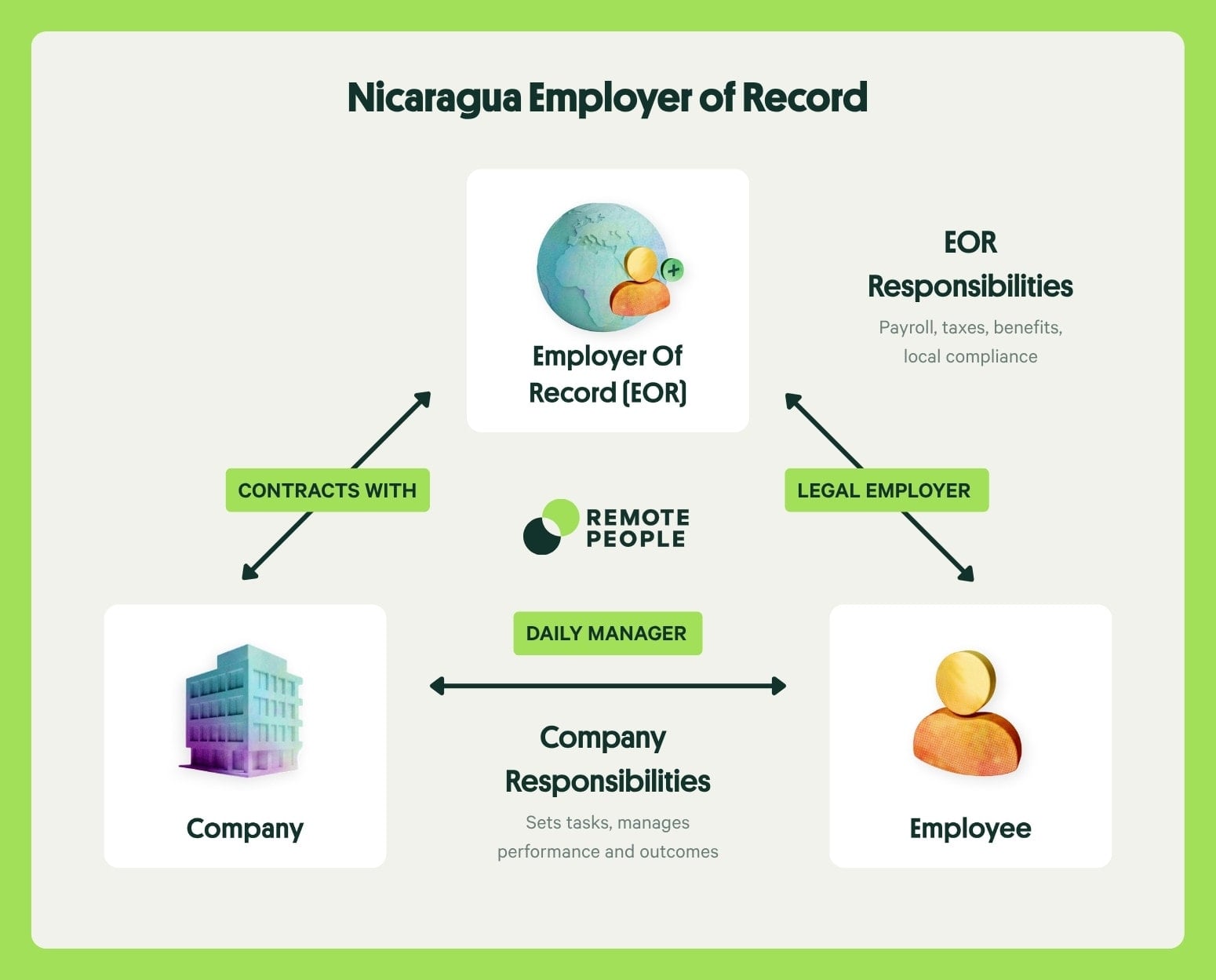
If you’d like to learn more about how Employer of Record (EOR) services work, read our What Is an Employer of Record (EOR)? guide for a complete overview of the model, its benefits, and when to use it.
If you’re comparing providers, our Best Employer of Record (EOR) Providers guide reviews the leading platforms to help you choose the right solution for your business.
Who Uses an EOR in Nicaragua?
An EOR works for any business that wants to put one or more people on the payroll in Nicaragua without registering a local company. Typical scenarios include:
- Testing the Nicaraguan market before committing: A company can hire two or three people in Managua to validate demand or build a pilot operation, then either scale up or wind down without legal dissolution costs.
- Hiring small teams without entity overhead: Operating a Sociedad Anónima requires a registered legal address, statutory auditor, monthly DGI filings and annual municipal patente. An EOR avoids all of this for teams of one to fifteen workers.
- Rapid onboarding for time-sensitive roles: Where entity setup typically runs three to six months, an EOR can issue a compliant contract and complete INSS affiliation within seven to ten business days.
- Hiring foreign nationals who need work permits: The EOR sponsors the Permiso de Trabajo and supports the residencia temporal application with DGME, which a non-resident employer cannot do directly.
- Converting existing contractors to employees: Companies that have engaged Nicaraguan freelancers and now face misclassification risk can transition them to compliant employment with statutory benefits, aguinaldo and INSS coverage.
For organisations expanding into Central America, an EOR in Nicaragua often serves as the entry point before deciding whether long-term operations justify a full subsidiary.
Typical Onboarding Timeline
The end-to-end timeline from contract sign-off to first day on payroll usually fits inside two weeks for Nicaraguan nationals.
- EOR agreement and employee details: 1–2 days to confirm role, salary, benefits and start date.
- Contract drafting and review: 2–3 days to prepare the bilingual or Spanish-language contrato de trabajo and obtain employee sign-off.
- INSS and DGI registration: 3–5 days to affiliate the employee with social security and confirm RUC tax registration where applicable.
- Payroll setup and benefits enrolment: 2–3 days to activate banking, payroll codes and the INSS digital file.
- Employee onboarding and first day: 1 day for orientation, equipment and access provisioning.
Most EOR providers can onboard a Nicaraguan employee within 1–2 weeks. Foreign nationals requiring a Permiso de Trabajo and residencia temporal usually add four to eight weeks because the consulted-visa procedure introduced in 2026 adds a layer of pre-approval before the employee can travel.
Hire in Nicaragua
Low employer payroll costs, an aguinaldo (13th month) requirement codified in Articles 93–96, INSS contributions of 21.5–22.5%, and a Spanish-speaking workforce in DR–CAFTA proximity make Nicaragua an attractive nearshore base.
We handle employment contracts, payroll, IR tax withholding, INSS and INATEC contributions, and full Nicaraguan compliance.
No local entity needed. Your team can start in days.
Employment Laws and Regulations in Nicaragua
Employment Contracts
Nicaraguan employment is governed by the Código del Trabajo (Ley 185), enforced by the Ministerio del Trabajo (MITRAB). Articles 19 and 20 require every employment relationship to be documented in a written contract drafted in Spanish, signed in duplicate, and containing the parties’ identification, job description, salary, working hours, contract duration, work location and any probation period. Contracts can be indefinite (the default) or fixed-term, but fixed-term contracts may only be used for genuinely temporary work and convert automatically to indefinite if renewed beyond the original term. Verbal contracts are recognised but unenforceable evidence of agreed terms, so a written contract always favours the employer in disputes before MITRAB. Collective bargaining agreements (convenios colectivos) may add to but not reduce the statutory floor.
Working Hours and Overtime
The standard workweek in Nicaragua is 48 hours, distributed across six days under Article 51 of the Código del Trabajo. The daily limit is eight hours for daytime work, seven hours for night work (between 7:00 p.m. and 6:00 a.m.) and seven and a half hours for mixed shifts. Workers are entitled to one 30-minute meal break and one 24-hour rest day per week, normally Sunday. Managerial staff and confidential employees are excluded from the overtime ceilings. All overtime hours are paid at a premium calculated on the ordinary hourly wage, and the maximum legal overtime is three hours per day and nine hours per week per Article 58.
Nicaragua overtime and premium pay rates · Per Código del Trabajo (Ley 185) | |||
Hour Type | Rate Multiplier | Weekly / Daily Cap | Notes |
|---|---|---|---|
Daytime overtime (after 8 hrs/day) | 200% of ordinary hourly rate | 3 hrs/day · 9 hrs/week | Article 62 of the Código del Trabajo; double pay applies to all overtime hours. |
Night overtime (7 p.m. – 6 a.m.) | 200% of ordinary hourly rate | 3 hrs/day · 9 hrs/week | Night shift is 7 hours; any work beyond is overtime at the same 100% premium. |
Weekly rest day (séptimo día) | 200% of ordinary daily rate | Voluntary; compensatory rest day required | Article 64. Workers cannot be forced to work the weekly rest day except in essential services. |
Public holiday work | 200% of ordinary daily rate | Voluntary; paid on top of holiday wage | Article 67. Applies to all 14 mandatory holidays in 2026. |
Sunday work (where Sunday is the rest day) | 200% of ordinary daily rate | Voluntary unless industry exception | Treated identically to séptimo día when Sunday is the assigned rest day. |
Overtime cannot exceed three hours per day or nine hours per week, and any work beyond this ceiling is unenforceable against the employee but still payable. Overtime pay is excluded from the calculation base for aguinaldo unless it is regular and habitual, in which case MITRAB jurisprudence treats it as ordinary salary. Managers, executives and trusted confidential staff (empleados de confianza) are exempt from overtime premiums under Article 60 because their schedules are not clocked.
Minimum Wage
Nicaragua sets sectoral minimum wages through the Comisión Nacional de Salario Mínimo, with rates published twice yearly. Effective 1 March 2026, all sectors except free-trade zones received a 4% increase, while free-trade zones increased by 6.7%. Wages are set per month and apply to a 48-hour workweek.
- Construction, financial services and insurance: NIO 13,848.23/month
- Commerce, hotels and transport: NIO 11,350.08/month
- Mining and quarrying: NIO 11,113.46/month
- Manufacturing (general): NIO 8,486.05/month
- Free-trade zones (zonas francas): NIO 9,986.54/month
- Central and municipal government: NIO 7,558.40/month
- Micro and small enterprises (MIPYME): NIO 7,107.92/month
- Agriculture and fishing: NIO 6,188.02/month
Employers in any sector may pay above the floor, and most professional roles in Managua exceed it by a wide margin. The next adjustment is scheduled for September 2026.
Probation Period
Article 28 of the Código del Trabajo caps the probation period (período de prueba) at 30 calendar days for indefinite contracts. During this window either party may terminate the relationship without cause and without severance. Notice is not required during probation, but salary, INSS and INATEC contributions are owed for every day worked. Probation cannot be extended or restarted, even by mutual agreement, and any clause attempting to do so is void. Annual leave accrues from day one and is paid out if the employee leaves during probation.
Leave Entitlements
Nicaragua offers a comprehensive statutory leave package built around annual vacation, INSS-funded sickness and maternity, and a growing list of paid public holidays. Leave is governed by Articles 76 to 145 of the Código del Trabajo, with maternity and sickness benefits administered by INSS under Decree 974.
Annual Leave
Article 76 grants every worker 30 calendar days of paid annual leave for each year of continuous service, accruing at 2.5 calendar days per month. Leave must be taken in two periods of 15 days, normally six months apart, and cannot be replaced with cash payment except at termination. Accrued but unused vacation is paid out as part of the finiquito on exit. Leave accrues during probation, sick leave and maternity leave. The vacation pay equals the average ordinary salary of the six months preceding the rest period.
Sick Leave
Sick leave (subsidio por enfermedad) is funded by INSS once the worker has at least eight contributions in the prior 26 weeks. The employer pays 100% of salary for the first three days; from day four onwards, INSS pays a subsidy equal to 60% of the average insured weekly wage for up to 26 weeks, extendable to 52 weeks for the same condition. A medical certificate from an INSS-affiliated doctor is required, and employers may verify it through the INSS clinic network. The job is protected throughout the subsidy period.
Maternity Leave
Article 141 of the Código del Trabajo grants 12 weeks of paid maternity leave: 4 weeks before and 8 weeks after birth, extended by an additional 10 days for multiple births or complications. INSS pays 60% of the average insured wage for workers with the required contributions, and the employer tops up the remaining 40% so the worker receives full salary. The job is protected during pregnancy and for one year after birth, and termination during this period requires prior MITRAB authorisation. Nursing mothers receive two 30-minute breastfeeding breaks per day for six months after returning to work.
Paternity Leave
Paternity leave is five working days, fully paid by the employer, taken within the first 15 days after birth. The benefit was added by Ley 779 (Ley Integral contra la Violencia hacia las Mujeres) and applies to fathers in formal employment regardless of marital status. INSS does not subsidise paternity leave; it is an employer-borne cost.
Other Statutory Leave
Beyond the core entitlements, Nicaraguan workers receive additional protected absences:
- Bereavement leave: Three working days of paid leave for the death of a spouse, parent, child or sibling under Article 73.
- Marriage leave: Five working days of paid leave for the worker’s own marriage.
- Voting leave: Time off to vote on national election days, with no salary deduction.
- Civic and trade-union duties: Paid time off to act as a juror, witness or elected union representative under Article 73.
- Study leave: Paid release of up to 10 hours per week for workers pursuing approved professional or technical studies, under collective agreement or Ministry of Labour authorisation.
Under the Código del Trabajo (Ley 185), the table below summarises every statutory leave entitlement available to workers in Nicaragua. The single most important takeaway is that paid annual leave begins accruing from day one, including during the 30-day probation period, with no qualifying service requirement.
Nicaragua statutory leave entitlements · Per Código del Trabajo (Ley 185) | ||
Leave Type | Duration | Eligibility & Notes |
|---|---|---|
Annual leave (vacaciones) | 30 calendar days/year (2.5 days/month) | Article 76. Accrues from day one. Paid at average salary of prior 6 months. Cash settlement only at termination. |
Public holidays | 14 paid days in 2026 | Article 66 (amended by Ley 1272). Work on a holiday paid at 200% premium. |
Sick leave | Up to 26 weeks (extendable to 52) | Days 1–3 paid 100% by employer; from day 4 INSS pays 60% subsidy. Requires 8 contributions in prior 26 weeks. |
Maternity leave | 12 weeks (4 pre + 8 post) | Article 141. INSS pays 60%, employer tops up 40%. Job protected during pregnancy + 1 year post-birth. |
Paternity leave | 5 working days | Ley 779. Employer-paid in full. Taken within 15 days of birth. |
Bereavement leave | 3 working days | Article 73. Paid by employer. Spouse, parent, child, sibling. |
Marriage leave | 5 working days | Paid by employer. Once per marriage. |
Civic / union duties | As required by law | Article 73. Voting, jury duty, MITRAB hearings, elected union office. |
Breastfeeding break | 2 × 30 min/day for 6 months | Article 143. Paid as ordinary working time after return from maternity leave. |
Statutory Employee Benefits
Beyond paid leave, Nicaraguan employers must provide a defined package of statutory benefits funded through INSS contributions and direct payments. Most are fully employer-funded; INSS coverage is shared.
- Health and maternity coverage: Affiliation with INSS gives the worker and their dependants access to Régimen Integral medical care, prescription drugs, hospitalisation and maternity services. The employer funds the bulk of this through the 6% Salud y Maternidad contribution.
- Pension and disability insurance: The IVM (Invalidez, Vejez y Muerte) branch of INSS funds old-age pensions, disability and survivors’ benefits. Employer pays 12.5–13.5% (rate depends on company size); employee pays 4.0%.
- Occupational risk insurance (Riesgos Profesionales): A 1.5% employer-only contribution covering work-related injuries, occupational disease and rehabilitation.
- War-victim contribution (Víctimas de Guerra): A 1.5% employer-only contribution funding pensions for veterans and victims of the 1980s conflict.
- INATEC training levy: A 2% employer-only contribution to the Instituto Nacional Tecnológico, used to subsidise vocational training programmes for the workforce.
- Aguinaldo (13th-month pay): One month’s salary paid every December under Articles 93–96 of the Código del Trabajo.
- Severance pay (indemnización por antigüedad): Statutory under Article 45 when the employer terminates without cause.
Exact contribution rates appear in the contribution tables in §H2 4 below. Most employers also offer voluntary benefits such as private health insurance, life insurance and meal vouchers (vales de canasta) to attract and retain mid- and senior-level talent in Managua.
Recent Regulatory Updates (2026)
Nicaragua’s employment framework saw substantial changes in early 2026. On 20 January 2026, Law 1272 entered into force, amending Article 66 of the Código del Trabajo to add four new mandatory paid public holidays: 18 January (Rubén Darío Day), 2 February (National Reconciliation and Peace Day in honour of Cardinal Obando y Bravo), 21 February (Death of General Augusto C. Sandino) and 8 November (Death of Carlos Fonseca Amador). Workers nationwide are now entitled to up to 14 paid holidays, or to 200% premium pay if they work them. Employers must update payroll calendars and HR policies to reflect the new dates from January 2026 onward.
Effective 1 March 2026, the Comisión Nacional de Salario Mínimo approved a 4% increase across all general sectors and a 6.7% rise for free-trade zones (zonas francas). The construction and financial services minimum reached NIO 13,848.23, while agriculture remained the lowest at NIO 6,188.02 per month. The next bi-annual review is scheduled for September 2026.
On the immigration side, Nicaragua moved to a “consulted visa” (visa consultada) regime in 2026. Foreign nationals who previously entered visa-free or with a tourist card now require advance approval from DGME before booking travel, depending on nationality. The Permiso de Trabajo and Residencia Temporal frameworks remain in place, but processing times have lengthened by two to four weeks while the new system stabilises. Employers planning to relocate foreign hires should add the consulted-visa step to onboarding timelines.
Work Permits and Visas in Nicaragua
Work Permit Requirements
Who Needs a Work Permit
All non-Nicaraguan nationals require a Permiso de Trabajo issued by MITRAB plus a corresponding immigration status from DGME before starting paid work. Citizens of Central American Integration System (SICA) countries, including Guatemala, El Salvador, Honduras, Costa Rica and Panama, can travel under the CA-4 free-movement agreement for tourism, but still need a work permit and residency status to take up employment. Nationals of Argentina, Brazil, Chile, Mexico, Spain and most EU member states historically benefited from visa-free entry; under the 2026 consulted-visa rules, several of these now require pre-clearance from DGME before travel.
Eligibility and Required Documents
To obtain a Permiso de Trabajo, the foreign hire generally needs an apostilled or legalised passport copy, an apostilled birth certificate, an apostilled criminal-record certificate from their country of origin, a medical certificate from an authorised Nicaraguan clinic, the signed employment contract and the employer’s RUC certificate. The employer must demonstrate that no equally qualified Nicaraguan is available for the role, in line with the 90% local-workforce rule under Article 14 of the Código del Trabajo (the law caps foreign workers at 10% of total headcount, with exceptions for technical and managerial roles).
Processing Time and Validity
Standard processing for the work permit takes four to six weeks once a complete file is submitted to MITRAB. The accompanying Residencia Temporal application at DGME runs in parallel and adds two to four more weeks. Both documents are typically issued for one year initially, renewable for the duration of the employment contract up to a five-year cumulative cap before the worker is eligible to apply for permanent residency. The 2026 consulted-visa step, where applicable, must be completed before the employee enters Nicaragua.
Renewal Process
Renewals must be filed at least 30 days before expiry. The renewal package is lighter than the initial application and usually requires an updated medical certificate, a solvencia migratoria from DGME, the previous permit, and a current employment letter from the EOR. Employees may continue working while a complete renewal is in process, but employers should obtain written confirmation from MITRAB that the file is “en trámite” to avoid penalties at routine inspections.
Common Visa Types for Foreign Workers
DGME and MITRAB issue several categories of work-related residence under the Ley 761 General de Migración y Extranjería. The EOR can sponsor each of the categories below for employees joining the Nicaraguan payroll. Tourist or student visas do not authorise paid work and cannot be converted in-country without leaving and re-applying.
Nicaragua work visa types for foreign workers · 2026 | ||||
Visa Type | Duration | Best For | Leads to PR? | Processing |
|---|---|---|---|---|
Permiso de Trabajo + Residencia Temporal | 1 year, renewable up to 5 | Standard EOR-sponsored employment | Yes – after 5 cumulative years | 6–10 weeks |
Intra-company Transfer | Up to 2 years, renewable | Multinationals moving managers or specialists | Yes – counts toward 5-year residency | 5–8 weeks |
Investor Visa (Residente Inversionista) | 2 years, renewable | Foreign investors of USD 30,000+ | Yes – fast-tracked | 8–12 weeks |
Free-trade Zone Worker Permit | Tied to zona franca contract | Manufacturing roles in CNZF zones | Yes – same as standard permit | 4–6 weeks (CNZF expedited) |
Pensionado / Rentista Visa | 5 years, renewable | Retirees with pension of USD 600+/month or rentiers | Yes | 8–12 weeks |
Visas that do not authorise paid employment in Nicaragua include:
- Tourist card / tourist visa: 30–90 days, no work authorisation, cannot be converted in-country.
- Student visa: Tied to enrolment, no general work rights.
- Transit visa: Maximum 72 hours, no work rights.
How an EOR Handles Work Permits
The EOR acts as the local sponsoring employer for both the Permiso de Trabajo at MITRAB and the Residencia Temporal at DGME. It compiles and apostilles the supporting documents, files the application, attends inspections, and provides the formal employment letter that satisfies the labour-quota rule. The employee remains responsible for personal documentation such as the apostilled birth certificate, criminal-record check from their home country, and the in-country medical exam. As noted in the onboarding timeline above, work-permit cases generally extend the 1–2 week onboarding window by four to eight weeks. EORs operating in Nicaragua can sponsor every category in Table 11 because the EOR itself is the registered local entity; companies without a Nicaraguan presence cannot sponsor work permits directly and must use either an EOR or a local subsidiary.
Payroll, Taxes, and Social Security in Nicaragua
Employer Contributions
Employer-side payroll contributions in Nicaragua go to two institutions: INSS, which manages social security across pensions, healthcare, occupational risks and the war-victims fund, and INATEC, which receives a 2% training levy. The total employer cost depends on company size: businesses with 50 or more workers pay 22.5%, while smaller companies pay 21.5%, plus the universal 2% INATEC contribution. Rates apply to the worker’s gross monthly salary up to a 2026 contribution ceiling of NIO 121,209.32 published by INSS.
Nicaragua employer social security contributions · 2026 rates | ||
Component | Rate | Notes |
|---|---|---|
INSS Invalidez, Vejez y Muerte (IVM) – pension | 13.5% (50+ workers) / 12.5% (<50) | Funds old-age, disability and survivor pensions. |
INSS Salud y Maternidad – health & maternity | 6.0% | Covers worker and dependants under Régimen Integral. |
INSS Riesgos Profesionales – occupational risk | 1.5% | Work-injury and occupational-disease coverage. |
INSS Víctimas de Guerra – war victims | 1.5% | Funds pensions for 1980s conflict veterans and victims. |
INATEC training levy | 2.0% | Funds Instituto Nacional Tecnológico vocational programmes. |
Total employer contributions (50+ workers) | 24.5% | 22.5% INSS + 2% INATEC. Cap: NIO 121,209.32/month for 2026. |
Total employer contributions (under 50 workers) | 23.5% | 21.5% INSS + 2% INATEC. |
Employee Contributions
Employees contribute a flat 7.0% of monthly gross salary to INSS, withheld at source by the employer and remitted alongside the employer share. The contribution is split between IVM (pension), Salud y Maternidad (health) and Régimen Integral (supplementary), and applies up to the same NIO 121,209.32 monthly ceiling. Employees do not contribute to INATEC.
Nicaragua employee payroll deductions · 2026 monthly withholdings | ||
Withholding | Rate | Notes |
|---|---|---|
INSS IVM (pension) | 4.0% | Funds employee’s old-age and disability rights. |
INSS Salud y Maternidad | 2.25% | Covers worker and dependants for INSS health services. |
INSS Subsidios y otros | 0.75% | Funds short-term sickness and other subsidies. |
IR – Impuesto sobre la Renta | 0–30% progressive | See Table 3 for bracket detail. Withheld monthly under Article 23 LCT. |
Total INSS employee withholding | 7.0% | Capped at NIO 121,209.32/month for 2026. IR is additional and progressive. |
Income Tax
Personal income tax (Impuesto sobre la Renta, IR) on employment income is governed by Article 23 of the Ley de Concertación Tributaria (Ley 822). Brackets are progressive from 0% to 30% on annual taxable income, withheld monthly by the employer. The first NIO 100,000 of annual income is exempt, providing relief for minimum-wage and lower-paid workers. INSS contributions are deductible from the IR base.
Nicaragua income tax brackets · 2026 | |
Annual Taxable Income (NIO) | Tax Calculation |
|---|---|
0.01 – 100,000.00 | Exempt – 0% on the bracket; no base tax |
100,000.01 – 200,000.00 | 15% on the excess over NIO 100,000; no base tax |
200,000.01 – 350,000.00 | NIO 15,000 base + 20% on the excess over NIO 200,000 |
350,000.01 – 500,000.00 | NIO 45,000 base + 25% on the excess over NIO 350,000 |
500,000.01 and above | NIO 82,500 base + 30% on the excess over NIO 500,000 |
Payroll Cycle
Most Nicaraguan employers run monthly payroll, paid by the 30th of the same month or within five days of month-end. Bi-weekly cycles are common in manufacturing and free-trade-zone operations. Salaries must be paid in Nicaraguan córdobas; payment in foreign currency is permitted only for foreign nationals or by mutual written agreement. Payslips (recibo de pago) must itemise gross pay, INSS withholding, IR withholding, and any voluntary deductions, and must be issued in writing or electronically. Monthly INSS contributions are due by the 17th of the following month via the SIE platform; IR retentions are due by the 15th via the DGI’s Ventanilla Electrónica Tributaria; and the annual IR reconciliation is filed by 28 February each year.
13th Month Salary and Bonus Pay
The 13th-month salary, called the aguinaldo in Nicaragua, is mandatory under Articles 93 to 96 of the Código del Trabajo. It equals one month’s ordinary salary for every full year of continuous service, calculated proportionally for workers with less than 12 months of service (one-twelfth per month worked). The reference salary is the highest ordinary monthly wage in the previous year of service. Employers must pay the aguinaldo within the first 10 days of December; late payment carries a penalty of one day of salary for every day of delay. The aguinaldo is exempt from IR up to the equivalent of one month’s salary and exempt from INSS contributions. There is no statutory 14th-month pay, but voluntary year-end bonuses, profit-sharing schemes and performance incentives are common in the financial services and BPO sectors.
Cost of Hiring Through an EOR in Nicaragua
EOR Service Fees
EOR service fees in Nicaragua typically range from USD 300 to USD 600 per employee per month. The fee covers the legal employer service, contract drafting, monthly payroll, IR and INSS filings, INATEC remittance, statutory benefits administration, leave tracking, and ongoing compliance support. Some providers price as a flat fee; others charge a percentage of gross salary. Fees do not include the employer’s statutory contributions (which are paid through to INSS and INATEC) or one-off costs such as work permit applications.
Total Employment Cost Breakdown
The example below shows the fully loaded monthly cost of hiring a mid-level professional in Nicaragua at a USD 1,500 gross monthly salary, using the higher 22.5% INSS rate that applies to companies with 50 or more workers, plus the 2% INATEC levy. Figures converted at 1 USD ≈ 36.6 NIO, April 2026.
Nicaragua employer cost example · USD 1,500 gross · 2026 | ||
Line Item | Amount (USD) | % of Gross |
|---|---|---|
Gross monthly salary | $1,500.00 | 100.0% |
INSS employer contribution (22.5%) | $337.50 | 22.5% |
INATEC training levy (2.0%) | $30.00 | 2.0% |
Aguinaldo accrual (1/12 of salary) | $125.00 | 8.33% |
Vacation accrual (30 days/year) | $125.00 | 8.33% |
EOR service fee (mid-range) | $450.00 | 30.0% |
Total monthly cost | $2,567.50 | 171.2% |
Ready to hire in Nicaragua? Get started with RemotePeople’s global payroll service. We handle employment contracts, INSS and INATEC remittance, IR withholding and full Código del Trabajo compliance, with no local entity needed. Contact our team to receive a tailored quote.
Benefits of Using an EOR in Nicaragua
Hiring through an EOR in Nicaragua removes most of the operational and legal friction of building a team without a local entity. Companies gain immediate compliance with the Código del Trabajo, INSS and DGI rules, while keeping full operational control of the workforce.
- Speed to market: Onboard an employee in Managua, León or Granada within 7–10 business days, versus the three to six months typically needed to register a Sociedad Anónima, secure a RUC and complete INSS affiliation.
- Compliance assurance: The EOR keeps every payroll cycle aligned with the latest INSS rates, IR brackets, aguinaldo deadlines and the new 14-holiday calendar under Ley 1272, removing the risk of MITRAB inspections, late-filing penalties and back-pay claims.
- Cost efficiency vs local entity: No incorporation fees, no auditor retainer, no minimum capital, and no statutory accounting infrastructure. EOR fees of USD 300–600/employee/month are predictable and scale with headcount rather than fixed entity costs.
- Local expertise: EORs in Nicaragua maintain ongoing relationships with INSS, MITRAB, DGME and DGI, which speeds up registrations, work-permit renewals and exit clearances that would otherwise require a dedicated in-country HR specialist.
- Flexibility to scale up or down: Add or release headcount month-by-month without entity restructuring, board resolutions or formal liquidation procedures, which is especially valuable when testing demand or piloting new operations.
- Risk mitigation on termination: Severance under Article 45 of the Código del Trabajo is calculated, documented and paid by the EOR, including the finiquito and INSS exit notification, reducing wrongful-dismissal exposure and MITRAB conciliation risk.
- Improved employee experience: Workers receive locally compliant payslips in córdobas, INSS coverage from day one, full statutory benefits and aguinaldo paid on time, all of which support retention in Nicaragua’s competitive talent market.
For most companies entering Nicaragua, the EOR pays for itself within the first three months by avoiding entity-setup costs, accelerating revenue capture and removing compliance overhead.
Termination and Offboarding in Nicaragua
Notice Periods
Employer-initiated termination without just cause does not require advance notice under Nicaraguan law. Article 45 of the Código del Trabajo instead provides for monetary indemnity (severance) calculated on years of service. Employees who resign from an indefinite contract must give 15 days’ written notice under Article 44, although in practice this is frequently waived by mutual agreement. Notice can be paid in lieu in either direction, and any contractual notice period above the statutory floor is enforceable so long as it is not abusive. Probation-period terminations require no notice from either side.
Nicaragua statutory notice periods by position level · Per Código del Trabajo (Ley 185) | |||
Scenario | Notice Period | During Probation | Notes |
|---|---|---|---|
Employer dismissal without cause (any tenure) | No notice required; severance owed instead | No notice; no severance | Article 45 – severance replaces notice as the statutory remedy. |
Employee resignation (indefinite contract) | 15 calendar days written notice | No notice during probation | Article 44. May be paid in lieu by mutual agreement. |
Employee resignation (fixed-term contract) | Until contract expiry | N/A | Early termination by employee can trigger damages equal to remaining contract value. |
Mutual agreement | As agreed in writing | No restriction | Article 41(b). Both parties sign the renuncia mutua before MITRAB. |
Just-cause dismissal (employer) | Immediate; no notice | Immediate | Article 48. Employer must file justification with MITRAB within 24 hours. |
Exceptions to the standard rules apply for protected categories. Pregnant employees and workers on maternity leave (one year post-birth), union representatives, and workers on INSS-funded sick leave can only be dismissed with prior MITRAB authorisation, even where just cause exists. Fixed-term contracts end automatically on the expiry date with no severance unless terminated early without cause.
Severance Pay
Severance pay (indemnización por antigüedad) is mandatory under Article 45 of the Código del Trabajo whenever an employer dismisses a worker on an indefinite contract without just cause. The benefit accrues from the first year of service, applies to all sectors, and is capped at five months of salary irrespective of tenure. Just-cause dismissals under Article 48 (theft, repeated insubordination, gross misconduct) eliminate the severance obligation, but the employer must prove the cause before MITRAB or the labour courts.
Nicaragua severance pay schedule by years of service · Per Código del Trabajo (Ley 185) | |||
Years of Service | Severance Amount | Base Salary | Notes |
|---|---|---|---|
1 year | 1 month’s salary | Last ordinary monthly salary | Years 1–3: 1 month per year of service. |
3 years | 3 months’ salary | Last ordinary monthly salary | Maximum at the year-3 tier under the 1-month rule. |
5 years | 3 months + (2 × 20 days) = ~4.33 months | Last ordinary monthly salary | From year 4 onwards: 20 days per year of service. |
10 years | 5 months’ salary (statutory cap) | Last ordinary monthly salary | Article 45 caps severance at 5 months regardless of tenure. |
Calculation Method
Severance follows two formulas under Article 45. For the first three years of service, the worker receives one month’s salary per year. From year four onwards, the rate drops to 20 days per year of service. The base salary is the last ordinary monthly salary, excluding overtime, aguinaldo and discretionary bonuses unless they were habitual and contractual. The worked examples in Table 13 above illustrate how the formula compounds: a worker with five years’ tenure receives three months (years 1–3) plus 40 days (years 4–5), or roughly 4.33 months in total, while anyone with seven and a half or more years hits the five-month statutory cap.
Caps and Exceptions
The five-month cap in Article 45 applies regardless of how long the worker has been employed; an employee with 20 years of service receives the same five months as one with seven and a half years. Exceptions include just-cause dismissal under Article 48 (no severance owed), fixed-term contracts that expire naturally (no severance, only pro-rated aguinaldo and vacation), mutual termination (severance optional, set by agreement) and resignation by the employee (no severance owed). Severance is paid alongside the finiquito (final settlement) within five days of the termination date, and any delay accrues interest at the legal rate.
Grounds for Termination
Nicaraguan law distinguishes between dismissal with just cause (despido con justa causa) under Article 48 and without just cause (despido sin causa) under Article 45. Just causes include serious misconduct, repeated unjustified absences, theft, breach of confidentiality, drug or alcohol use at work and acts of violence. Employers must document the cause and notify MITRAB within 24 hours; failure to do so converts the dismissal to without-cause and triggers severance. Protected workers (pregnant women, union officers, INSS-subsidised sick employees) require prior MITRAB authorisation even when just cause exists. Collective dismissals affecting 10% or more of the workforce trigger additional consultation requirements with MITRAB. Probation-period terminations require no cause, no notice and no severance under Article 28.
EOR vs. Other Hiring Models in Nicaragua
EOR vs. Setting Up a Local Entity
Nicaragua EOR vs local entity comparison · Setup time, cost, risk and best-fit | ||
Factor | Employer of Record | Own Entity (Sociedad Anónima) |
|---|---|---|
Setup time | 1–2 weeks | 3–6 months |
Upfront cost | $0 | $3,000–$8,000 (incorporation, RUC, notary, capital) |
Ongoing cost | $300–$600/employee/month | $15,000–$30,000/year (audit, accounting, municipal patente, statutory filings) |
Local partner required | No (EOR is the local entity) | No, but local director / domicile required |
INSS / DGI registration | Handled by EOR | You manage RUC, INSS patronal, INATEC enrolment |
Payroll & tax filing | Handled by EOR | You manage it (or outsource locally) |
Best for team size | 1–15 employees | 15+ employees |
Scale down / exit | Easy – no entity to unwind | Costly – formal liquidation through registry and DGI |
Government contracts | Not eligible | Eligible (requires Nicaraguan legal entity) |
For most companies hiring fewer than 15 workers in Nicaragua, the EOR route delivers faster time-to-hire and lower total cost of ownership over the first two to three years. A Sociedad Anónima only becomes more economical once headcount or revenue justify the fixed costs of incorporation, statutory audit and ongoing DGI filings. Companies bidding for Nicaraguan government contracts or operating in the regulated free-trade-zone regime do, however, need a local entity to qualify, and an EOR cannot replace that requirement.
A common hybrid pattern is to start with an EOR while testing the market, then incorporate once the team passes 15 to 20 employees and predictable revenue justifies the entity overhead. The EOR’s exit process simply hands employees over to the new local entity, preserving continuity of service for severance and aguinaldo purposes.
EOR vs. Hiring Independent Contractors
Nicaragua EOR vs independent contractors · Compliance, cost, and risk | ||
Factor | EOR (Full-Time Employee) | Independent Contractor |
|---|---|---|
Legal relationship | Employee of the EOR | Self-employed; no employment relationship |
Compliance risk | Low – EOR ensures Código del Trabajo compliance | High – MITRAB applies the primacy-of-reality test (Article 19) and can reclassify as employment |
Payroll & tax | EOR withholds IR, INSS and INATEC | Contractor invoices and self-files IR; subject to 10% withholding for services |
Benefits & leave | Statutory benefits, vacation, INSS coverage, aguinaldo | No entitlement to employee benefits |
IP protection | Stronger – employment contract assigns IP by default | Weaker – requires explicit IP assignment clause |
Termination | Subject to Article 45 severance and notice rules | Per service agreement; no statutory severance |
Best for | Long-term, core team roles | Short-term projects, specialised tasks |
Cost structure | Salary + employer contributions + EOR fee | Contractor fee (typically higher gross, lower total cost) |
Misclassification is a real and rising risk in Nicaragua. Article 19 of the Código del Trabajo establishes the principle of primacy of reality (primacía de la realidad), under which MITRAB looks at the substance of the working relationship rather than the contract’s label. Indicators of disguised employment include exclusivity, fixed working hours, use of company equipment, integration into the organisational chart and a salary-like payment pattern.
If MITRAB or the labour courts reclassify a contractor as an employee, the company becomes liable for retroactive INSS contributions (typically two to four years), unpaid aguinaldo, vacation pay, IR withholdings, INATEC contributions and severance under Article 45. Contractor of record services or moving the worker to EOR employment eliminate this exposure when the role looks like ongoing employment.
EOR vs. PEO (Professional Employer Organization)
Nicaragua EOR vs PEO comparison · Legal employer, liability, and setup | ||
Factor | Employer of Record (EOR) | PEO |
|---|---|---|
Legal employer | EOR is the legal employer | You remain the legal employer (co-employment) |
Local entity required | No – the EOR is the local entity | Yes – you must have your own Sociedad Anónima in Nicaragua |
Best for | Companies without a Nicaraguan entity | Companies that already have a Nicaraguan entity |
Compliance liability | EOR assumes compliance responsibility | Shared liability between you and the PEO |
Setup time | 1–2 weeks | Depends on your entity setup (weeks to months) |
Control over HR policies | EOR manages within Código del Trabajo framework | More direct control; PEO advises |
Typical use case | Market entry, small remote teams, testing the Nicaraguan market | Established Nicaraguan operations needing HR outsourcing |
Nicaragua does not have a formal PEO regulatory framework, and the term is rarely used in local HR practice. What functions in other markets as a PEO is closer to a local payroll-administration outsourcing service: the client retains the legal employer role through its own Sociedad Anónima, and the third party manages payroll calculations, INSS filings and HR administration on its behalf. The key distinction with an EOR remains whether the foreign company already has a Nicaraguan entity. If it does, a payroll-outsourcing arrangement may be enough; if not, only an EOR can act as the legal employer for the workforce.
Companies considering both models in Central America often compare Nicaragua with neighbouring options such as the EOR in El Salvador or the EOR in Honduras to align market entry across the region with consistent compliance support.
Public Holidays in Nicaragua
Nicaragua observes 14 mandatory paid public holidays in 2026, following the entry into force of Ley 1272 on 20 January 2026. Workers receive their ordinary salary for each holiday and, if required to work, an additional 100% premium under Article 67 of the Código del Trabajo. Movable holidays such as Maundy Thursday and Good Friday shift each year with the Easter calendar.
Nicaragua public holidays · 2026 calendar year | ||
Date | Holiday | Type |
|---|---|---|
Thursday, 1 January | Año Nuevo (New Year’s Day) | National public holiday |
Sunday, 18 January | Natalicio de Rubén Darío | National (added 2026 by Ley 1272) |
Monday, 2 February | Día Nacional de la Reconciliación y la Paz | National (added 2026 by Ley 1272) |
Saturday, 21 February | Tránsito a la Inmortalidad del General Sandino | National (added 2026 by Ley 1272) |
Thursday, 2 April | Jueves Santo (Maundy Thursday) | National public holiday |
Friday, 3 April | Viernes Santo (Good Friday) | National public holiday |
Friday, 1 May | Día del Trabajador (Labour Day) | National public holiday |
Saturday, 30 May | Día de las Madres (Mother’s Day) | National public holiday |
Sunday, 19 July | Día de la Revolución Sandinista | National public holiday |
Monday, 14 September | Batalla de San Jacinto | National public holiday |
Tuesday, 15 September | Día de la Independencia | National public holiday |
Sunday, 8 November | Tránsito a la Inmortalidad de Carlos Fonseca | National (added 2026 by Ley 1272) |
Tuesday, 8 December | La Purísima (Immaculate Conception) | National public holiday |
Friday, 25 December | Navidad (Christmas Day) | National public holiday |
Local and municipal patron-saint feast days (such as Managua’s Santo Domingo on 1–10 August and Granada’s Asunción de María on 15 August) are observed regionally but are not nationally mandatory. Employers should confirm regional observances when scheduling payroll cycles, project deadlines or store opening hours, and bear in mind that the September holiday cluster (14–15 September) and Christmas–New Year window typically result in extended employee time off.
How to Get Started with an EOR in Nicaragua
- 1. Define the role and budget: Confirm job title, work location (Managua, León, Granada or remote), gross monthly salary in USD or NIO, start date and any benefits beyond the statutory floor. Map the all-in cost using the cost example in §H2 5 to ensure you have approved budget for INSS, INATEC, aguinaldo and the EOR fee.
- 2. Choose your EOR provider: Compare providers on Nicaragua coverage, transparency of pricing, payroll-cycle reliability and support for work-permit cases. Look for confirmation that the provider holds INSS patronal status and has a local team familiar with MITRAB inspections.
- 3. Sign the EOR service agreement: Execute the Master Service Agreement that governs the relationship between your company and the EOR, including indemnity, data protection and IP assignment terms. Provide the candidate’s offer letter for the EOR to convert into a compliant Spanish-language contrato de trabajo.
- 4. Onboard the employee: The EOR collects identification documents, opens the INSS file, registers with DGI where applicable, sets up the local payroll record and runs orientation. For foreign hires, the EOR initiates the Permiso de Trabajo with MITRAB and the residencia temporal application with DGME in parallel.
- 5. Run monthly payroll and reporting: The EOR processes payroll, withholds IR and INSS, files the SIE social-security declaration, remits INATEC, and shares monthly cost and compliance reports. You receive a single invoice and approve any salary changes, bonuses or terminations directly through the EOR portal.
Ready to put your first employee on the Nicaraguan payroll? Contact RemotePeople for a no-obligation quote and a tailored onboarding plan covering INSS registration, IR withholding, aguinaldo accrual and the new 2026 holiday calendar.
Frequently Asked Questions
Most EOR providers charge USD 300–600 per employee per month, on top of the gross salary and the 23.5–24.5% combined INSS plus INATEC employer contributions. Aguinaldo (one month per year) and accrued vacation (30 days per year) add roughly 16.7% in deferred costs. For a USD 1,500 gross salary, total monthly cost lands around USD 2,500–2,700, including the EOR fee.
For Nicaraguan nationals, onboarding usually takes 7–10 business days from contract sign-off to the first pay cycle. Foreign nationals require a Permiso de Trabajo from MITRAB and Residencia Temporal from DGME, which adds four to eight weeks. The 2026 consulted-visa procedure can extend this further depending on nationality.
Yes. Nicaraguan law recognises a third-party legal employer model under the Código del Trabajo (Ley 185) provided the EOR is a registered Nicaraguan entity, holds INSS patronal status, and signs the formal contrato de trabajo with each worker. The EOR carries all employer-side obligations, including IR withholding, INSS and INATEC contributions, aguinaldo and severance.
The aguinaldo is mandatory under Articles 93–96 of the Código del Trabajo. It equals one month's ordinary salary per year of continuous service, prorated for partial years. Employers must pay it within the first 10 days of December each year. Late payment incurs a penalty of one day of salary per day of delay.
Employers contribute 22.5% to INSS for businesses with 50 or more workers, or 21.5% for smaller companies, plus a flat 2% INATEC training levy. Combined employer cost is therefore 23.5% or 24.5% of gross salary, capped at NIO 121,209.32 per month for 2026. Employees contribute an additional 7% to INSS, withheld by the employer.
Under Article 45 of the Código del Trabajo, employees dismissed without just cause receive one month's salary per year of service for the first three years, then 20 days per year from year four onwards, capped at five months total. Just-cause dismissals under Article 48 carry no severance, but the employer must justify the cause to MITRAB within 24 hours.
Yes. The EOR acts as the local sponsoring employer for both the MITRAB Permiso de Trabajo and the DGME Residencia Temporal. Standard processing runs six to ten weeks for a complete file. The 10% local-workforce rule under Article 14 of the Código del Trabajo applies, with exceptions for technical and managerial roles.
An EOR makes the worker a full-time employee with statutory benefits, INSS coverage, aguinaldo, paid vacation and severance. A contractor invoices for services and is responsible for their own taxes, but if MITRAB applies the primacy-of-reality test (Article 19) and reclassifies the relationship as employment, the company becomes liable for retroactive INSS contributions, aguinaldo, vacation and severance going back several years.
A PEO and an employer of record cover similar ground in Nicaragua, but only a full EOR becomes the legal employer on record with INSS, DGI and MITRAB. A PEO in Nicaragua typically shares responsibility under a co-employment model that still requires you to have a Nicaraguan legal entity, while a global EOR Nicaragua provider takes on 100% of employer liability for contracts, INSS contributions, INATEC levies and aguinaldo. For most foreign companies without a registered Sociedad Anónima, an EOR is the correct route; a PEO is usually only workable if you already operate a local subsidiary.
No — you do not need a local entity to hire employees in Nicaragua if you work with an employer of record provider. The EOR is the registered Nicaraguan entity on the INSS patronal roll and signs the contrato de trabajo under the Código del Trabajo (Ley 185), while you direct the employee's day-to-day work. This removes the 3–6 month Sociedad Anónima setup, annual municipal patente, statutory auditor requirement and monthly DGI filings that a direct-hire structure demands.
Employer of Record in
Employer of Record in
Employer of Record in
Employer of Record in
Employer of Record in
Employer of Record in
Employer of Record in
Employer of Record in