
 Recruit
Average Salary in Peru
-
 Drew Donnelly
- Published
- September 21, 2026
Curious about salaries in Peru? This guide breaks down the average wages, compares professions, highlights minimum wage figures, and explores how Peru’s earnings measure up internationally. Partnering with an Employer of Record (EOR) in Peru lets you employ staff there without establishing a legal entity of your own.
- 5 ★ on G2








Let RemotePeople handle payroll, compliance, and HR admin worldwide so you can focus on building your team.
Peru’s skilled workforce and cost-effective labor make it an ideal outsourcing destination. Employers considering hiring in the region may wonder, “What is the average salary in Peru?” This information will help them prepare competitive job offers. Employers may also run background checks in Peru for certain roles, so it is worth knowing what is permitted before you hire.
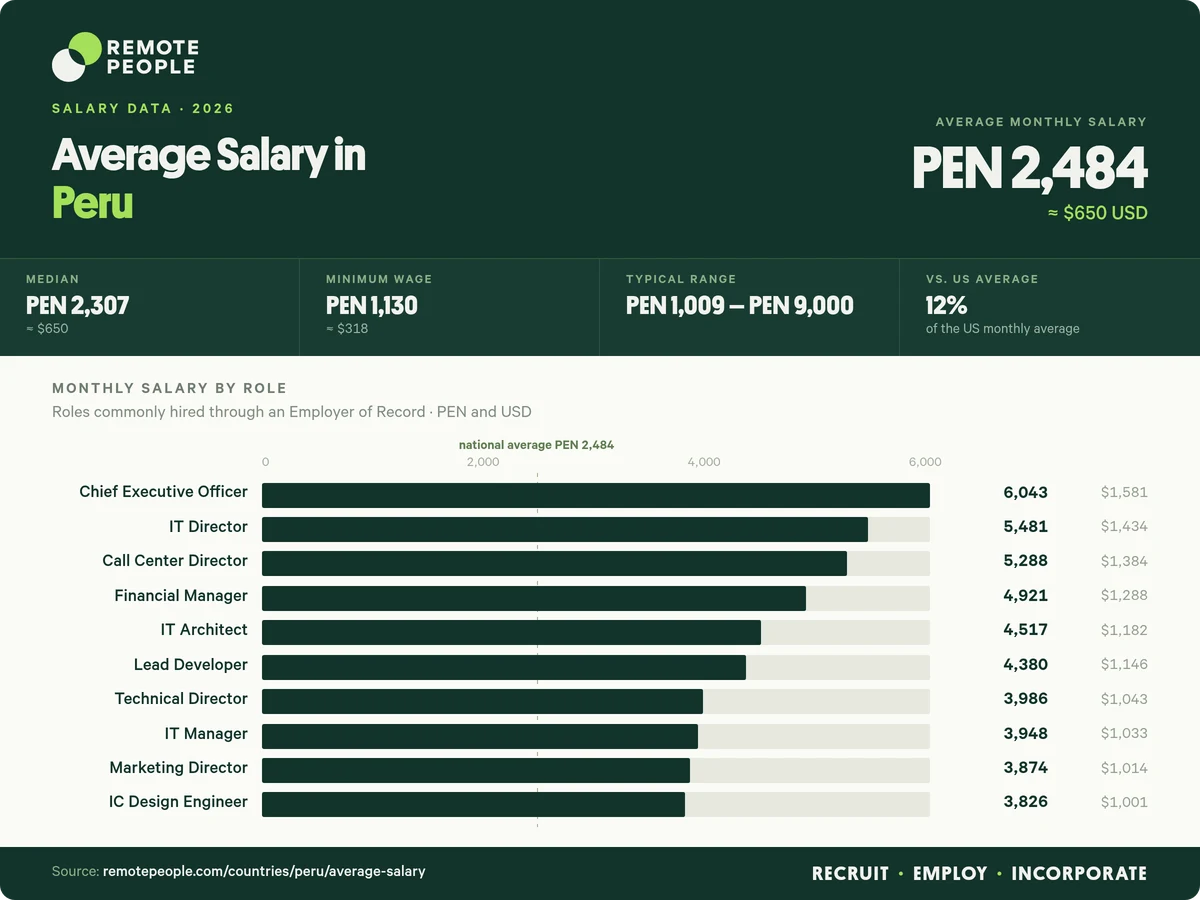
The average salary in Peru is 2,484 Peruvian Soles (PEN), about USD 650. However, wages vary by experience, education, position, industry, and location. Comparing salaries in the nation to earnings worldwide provides additional insight.
This guide reviews those factors and provides the information you need to know.
What is the Average Salary in Peru?
The average salary in Peru is 2,484 PEN, about $700. Wages are low in the country due to its large informal economy and considerable concentration of employment in low-paying industries.
Median Income
Peru’s median monthly salary is 2,307 PEN, about $650. Half the country earns lower wages, the other half makes more.
Salary Range
The salary range in Peru spans from the lowest to the highest. Low earners make about 1,009 PEN, about $284, while high earners make closer to 9,000 PEN, about $2535.
Salary Comparisons in Peru
Average salary provides insight, but you must consider how wages vary by location, education, experience, position, and industry. The following sections will explore how these factors impact earnings.
Salary by Position
The following salary comparison chart reveals how wages vary by position.
Position | Average Monthly Salary (PEN) |
|---|---|
Chief Executive Officer | 6,043 |
IT Director | 5,481 |
Call Center Director | 5,288 |
Financial Manager | 4,921 |
IT Architect | 4,517 |
Lead Developer | 4,380 |
Technical Director | 3,986 |
IT Manager | 3,948 |
Marketing Director | 3,874 |
IC Design Engineer | 3,826 |
Banking Cashier | 1,083 |
Fabric Cutter | 1,081 |
Clothing Technologist | 1,076 |
General Laborer | 1,070 |
Packer | 1,054 |
Seamstress | 1,006 |
Porter | 972 |
Medical Records Clerk | 970 |
Tailor | 962 |
Average Wage in Peru Based on Education
Education directly affects salaries in Peru. One study reveals that it helps to close the gender gap, showing that educated women are likely to increase their wages by 2.35%.
Unfortunately, however, education does not always have positive outcomes. For example, another study revealed that workers aged 18-29 with secondary degrees struggle to find employment. Those who do find work often encounter poor working conditions.
The government is aware of difficult working conditions in the country and aims to improve the situation by making education more accessible.
Salary Comparison by Experience
Experience also impacts salaries as workers with more experience earn more than entry-level employees. This situation especially rings true in skilled sectors that offer more upward mobility.
Salary Comparison by Location
Workers in Lima, Peru’s capital city, tend to earn more than rural workers due to higher living costs and proximity to large companies offering higher-paying job opportunities.
How Much is Minimum Wage in Peru?
The minimum wage in Peru is 1,130 PEN per month, about $318. The current wage went into effect on Jan. 1, 2025, and applies to all industries and sectors. The previous minimum wage was 1,025 PEN.
Average Salary in Peru vs. the Rest of the World
The following charts provide additional insight by comparing salaries in Peru to those in developed, developing, and least developed countries.
Peru vs. Developed Countries
Country | Average Salary | Comparison to Average Peru Salary |
|---|---|---|
Japan | 379,434 Yen (approx. $2,635) | – 271% |
United Kingdom | 3,000 Euros (approx. $3,116) | – 342% |
Norway | 50,790 Kroner (approx. $4,700) | – 571% |
Germany | 4,300 Euros (approx. $4,467) | – 552% |
Austria | 3,500 Euros (approx. $3,636) | – 414% |
Peru vs. Developing Countries
Country | Average Salary | Comparison to Average Peru Salary |
|---|---|---|
Romania | 4,000 RON (approx. $835) | – 20% |
Russia | 73,709 Rubles (approx. $700) | 0% |
Albania | 1,500 Euros (approx. $1,550) | – 121% |
Kazakhstan | 342,082 Tenge (approx. $645) | 8% |
Ukraine | 18,000 Hryvnia (approx. $500) | 40% |
Peru vs. Undeveloped Countries
Country | Average Salary | Comparison to Average Peru Salary |
|---|---|---|
Afghanistan | 30,000 Afghanis (approx. $419) | 66% |
Philippines | 18,423 PHP (approx. $875) | – 25% |
Cambodia | 1,000,027 Riel (approx. $250) | 180% |
Egypt | 13,244 EGP (approx. $263) | 169% |
Pakistan | 45,000 PKR (approx. $150) | 366% |
Peru is a developing country with an upper-middle income economy. Although it has experienced significant economic growth over the past few years, it still faces challenges such as income inequality, political instability, and a lack of environmental sustainability. A large informal sector and a heavy reliance on natural resources like mining and agriculture characterize the work economy.
Although Peru faces internal challenges, it has the potential to grow through outsourcing opportunities. It offers a skilled workforce and cost-effective labor. The government supports foreign investments through various initiatives.
What are the Most Common Outsourced Industries in Peru?
Employers seeking remote partnerships in Peru will benefit most when focusing on the following industries.
IT Services
Peru’s IT industry has boomed in the past few years, with a focus on AI, cybersecurity, blockchain, and cloud computing. Lima is a tech hub offering a robust startup ecosystem. The government actively supports the industry with initiatives like Startup Peru, which has funded over 3,400 entrepreneurial projects.
An IT manager in Peru earns about 3,948 PEN, roughly $1,112 per month, compared to American salaries, which are closer to $8300 monthly. This leads to significant cost savings for employers who outsource.
BPO
The country’s BPO industry shows great potential, offering nearshoring advantages and lower prices than its competitors. It also stands out for its business-friendly environment, which attracts investors through tax advantages. Key sectors include IT and call centers.
BPO is a diverse industry, making cost comparisons difficult. However, employers who partner with the region for BPO services can considerably reduce expenses.
Mining
Peru is a global leader in lead, copper, gold, and zinc production. Its mineral resources account for about 50% of the country’s exports. It is rich in gold mines and reserves.
Several countries partner with Peru for mining exports and related services.
Conclusion
Peru’s low average salary and skilled workforce make it a promising outsourcing destination. Employers who invest in the region’s labor can benefit from cost savings and exceptional products and services while helping the country reach its development goals, leading to positive outcomes for all involved parties.




