
 Recruit
Average Salary in Qatar
-
 Drew Donnelly
- Published
- September 21, 2026
Curious about salaries in Qatar? This guide covers average wages, salary by profession, minimum wage figures, and how Qatar’s earnings measure up internationally. Companies hiring in the country commonly use an Employer of Record (EOR) in Qatar to manage contracts, payroll, and local employment law.
- 5 ★ on G2








Let RemotePeople handle payroll, compliance, and HR admin worldwide so you can focus on building your team.
Qatar’s skilled workforce and robust infrastructure make it an excellent outsourcing destination. Employers seeking to hire in the area may wonder, “What is the average salary in Qatar?” If you want to hire in Qatar without setting up your own legal entity, an employer of record (EOR) in Qatar is a practical solution. An EOR becomes your official local employer, handling employment compliance, payroll, taxes, and all regulatory requirements.
This information will help them prepare competitive job offers.
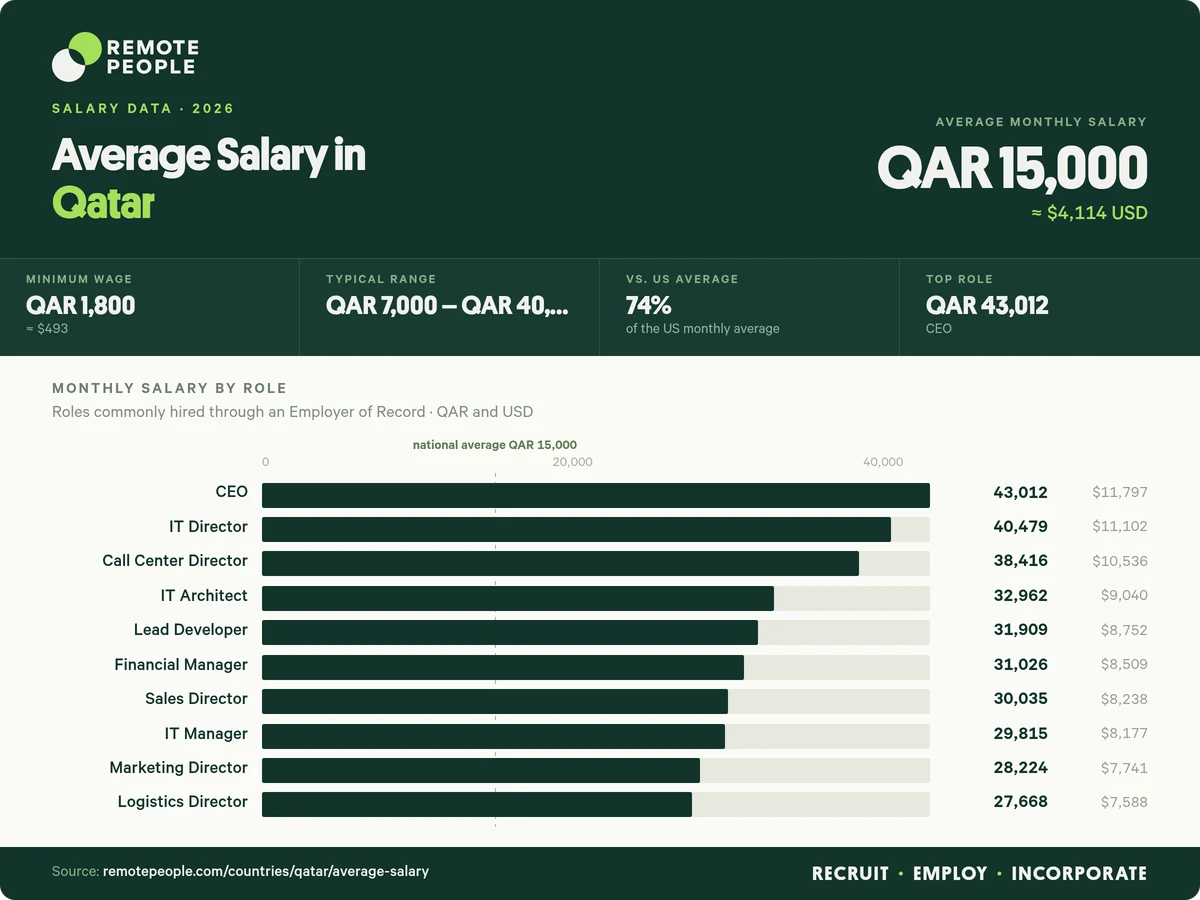
The average salary in Qatar is QAR 15,000, or about USD 4114. However, salaries vary based on education, experience, profession, industry, and location. Comparing wages in the country to earnings worldwide provides additional insight.
This guide will discuss all aspects of salaries in Qatar to provide a comprehensive overview.
What is the Average Salary in Qatar?
The average salary in Qatar is 15,000 QAR, about $4114. Wages are high in the country due to a work industry dominated by gas and oil, and a demand for skilled labor to support ambitious projects. Qatar also has a high cost of living.
Median Income
Qatar’s median monthly income is $14,380, or about $3944. Half the country earns higher wages, and the other half earns lower salaries.
Salary Range
Salary range spans the lowest to the highest earnings in the country. Low earners make around 7,000 QAR (about $1920), while high earners make closer to 40,000 QAR (about $10,973).
Salary Comparisons in Qatar
Salaries in Qatar vary by education, experience, profession, location, and industry. The following sections will examine how these factors impact earnings.
Salary by Profession
This salary comparison chart reveals how wages vary by profession.
Profession | Average Monthly Wages (QAR) |
|---|---|
CEO | 43,012 |
IT Director | 40,479 |
Call Center Director | 38,416 |
IT Architect | 32,962 |
Lead Developer | 31,909 |
Financial Manager | 31,026 |
Sales Director | 30,035 |
IT Manager | 29,815 |
Marketing Director | 28,224 |
Logistics Director | 27,668 |
Clothing Technologist | 7,844 |
Banking Cashier | 7,822 |
General Laborer | 7,796 |
Packer | 7,683 |
Seamstress | 7,335 |
Porter | 7,086 |
Medical Records Clerk | 7,066 |
Social Counselor | 6,860 |
Tailor | 6,660 |
Average Wage in Qatar by Education
Education plays a role in wage determination, as workers with high levels of education generally earn higher wages. This rings true in Qatar, where there is a focus on educating citizens to prepare them for highly skilled roles prevalent throughout the country.
Qatar is also a member of PISA, an OECD component. OECD statistics show that workers with high levels of education generally earn 18% more than those with basic education.
Salary Comparison by Experience
Experience is another factor that impacts salaries as follows:
Experience Level | Average Monthly Salary (QAR) |
|---|---|
Entry-level | 12,000 |
Mid-level | 20,000 |
Senior-level | 35,000 |
Salary Comparison by Location
Location impacts salaries as workers in urban areas tend to earn more than rural workers due to a high cost of living and proximity to large companies offering high salaries. For example, workers in the capital city of Doha tend to see high earnings. However, industries like agriculture and oil production may offer competitive salaries in rural areas to attract skilled workers to remote locations.
How Much is Minimum Wage in Qatar?
The minimum wage in Qatar is 1800 QAR per month, about $493, which went into effect on Jan. 1, 2025. The previous minimum wage of 1000 QAR (about $274) had been in effect since 2020.
Average Salary in Qatar vs. the Rest of the World
The following charts reveal how wages in Qatar compare to those in developed, developing, and least developed countries.
Qatar vs. Developed Countries
Country | Average Salary | Comparison to Average Qatar Salary |
|---|---|---|
United Kingdom | €3,000 (approx. $3,116) | 32% |
United States | $5,677 | – 39% |
Norway | 50,790 NOK (approx. $4,700) | – 14% |
Germany | €4,300 (approx. $4,467) | – 6% |
Austria | €3,500 (approx. $3,636) | 13% |
Qatar vs. Developing Countries
Country | Average Salary | Comparison to Average Qatar Salary |
|---|---|---|
Romania | 4,000 RON (approx. $835) | 388% |
Russia | 73,709 Rubles (approx. $700) | 485% |
Albania | €1,500 (approx. $1,550) | 146% |
Kazakhstan | 342,082 Tenge (approx. $645) | 530% |
Ukraine | 18,000 Hryvnia (approx. $500) | 720% |
Qatar vs. Undeveloped Countries
Country | Average Salary | Comparison to Average Qatar Salary |
|---|---|---|
Thailand | 97,500 Baht (approx. $2,772) | 46% |
Philippines | 18,423 PHP (approx. $875) | 365% |
Vietnam | 8.5 million VND (approx. $360) | 1,039% |
Egypt | 13,244 EGP (approx. $263) | 1,476% |
Pakistan | 45,000 PKR (approx. $150) | 2,633% |
Qatar is a developed country with a high-income economy and a high Human Development Index (HDI). Although the economy relies heavily on gas, it actively diversifies, growing in areas like tourism, manufacturing, and construction. The economy focuses on foreign investment, offering a business-friendly environment.
The country is an excellent outsourcing destination due to its skilled workforce, political stability, and economic growth. It offers flexible and adaptable policies suited to various employer needs. Although high salaries may not make it the most attractive option for some companies, it is still a cost-effective option for many Western employers.
What are the Most Common Outsourced Industries in Qatar?
Employers who outsource to Qatar will benefit most by focusing on the following industries:
Energy and Natural Resources
Qatar is a world leader in liquefied natural gas (LNG) exports. Although gas and oil are crucial, the industry diversifies into renewable energy projects. In addition to being a prime export destination, many countries outsource specific functions like energy management and environmental compliance.
Construction
The country’s construction industry is seeing significant growth, fueled by developments in healthcare, municipalities, and environmental projects. Qatar focuses on residential and commercial projects as well as infrastructure development. Employers worldwide utilize workers in the country to handle specific tasks and services within a project, and to provide infrastructure for their operations.
IT Services
The tech industry is another area with significant growth in the country as the government focuses on digital transformation. Initiatives like the Qatar Digital Agenda 2030 and the TASMU are driving innovation. The country also offers a robust digital infrastructure fueled by fiber optics, high-speed internet, and 5G networks.
Conclusion
Qatar’s highly skilled workforce and unique resources make it a popular outsourcing destination. While the average salary in Qatar is high, it can be a cost-effective option for some employers. Companies that utilize services in the country can benefit from exceptional output that establishes them as leaders in their field.