
 Recruit
Average Salary in Romania
-
 Drew Donnelly
- Published
- September 21, 2026
Wondering what people earn in Romania? Below you will find average wages by profession, current minimum wage figures, and how Romania’s pay compares with other markets. Employers hiring locally often work with an Employer of Record (EOR) in Romania to handle payroll and stay compliant without registering a business.
- 5 ★ on G2








Let RemotePeople handle payroll, compliance, and HR admin worldwide so you can focus on building your team.
Romania’s cost-effective labor, skilled workforce, and well-developed infrastructure make it an ideal outsourcing destination. Employers considering hiring in the area may wonder, “What is the average salary in Romania?” If you want to hire in Romania without setting up your own legal entity, an employer of record (EOR) in Romania is a practical solution. An EOR becomes your official local employer, handling employment compliance, payroll, taxes, and all regulatory requirements.
This information will help them prepare a fair offer. Employers may also run background checks in Romania for certain roles, so it is worth knowing what is permitted before you hire.
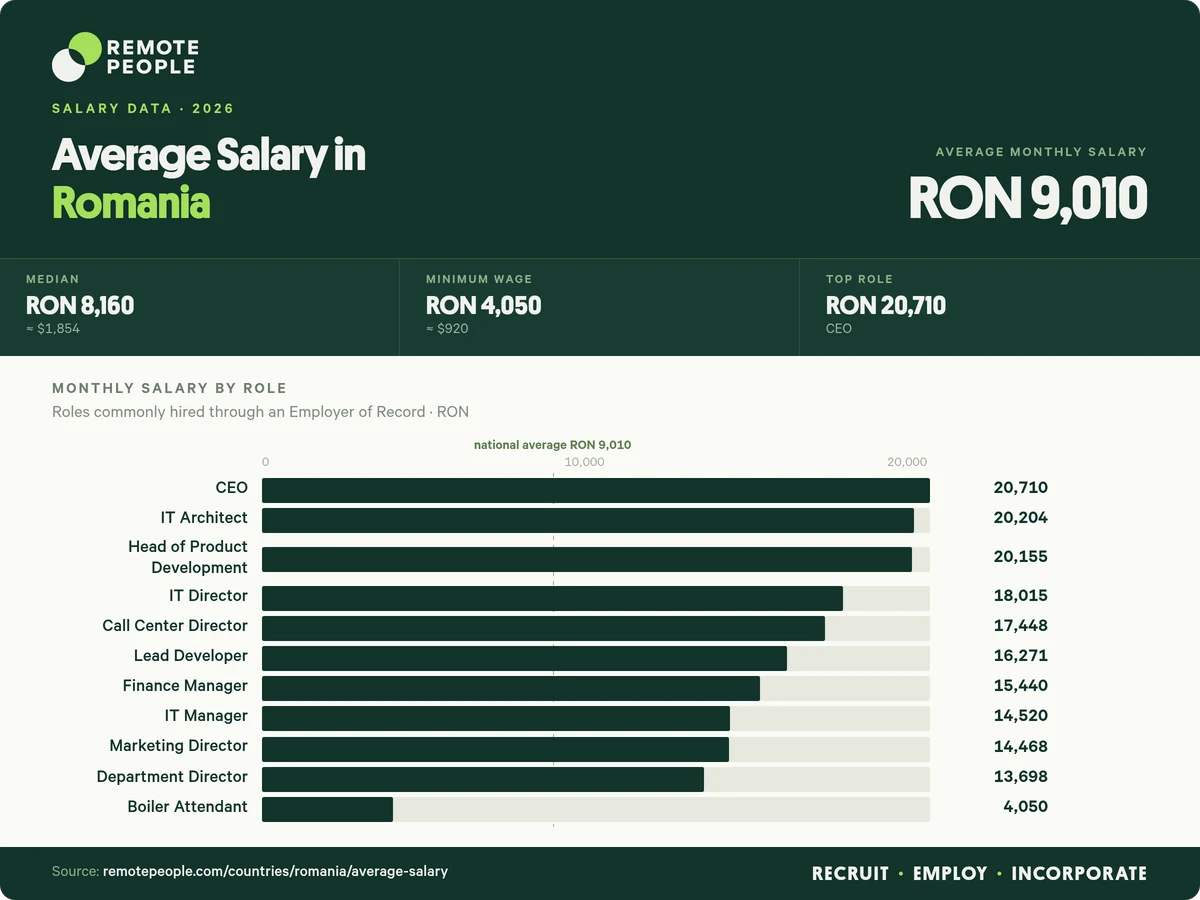
The average monthly salary in Romania is ROL 9010, about USD 2048; however, salaries change based on experience, education, location, position, and industry. You must also consider how wages in the country compare to earnings worldwide.
This guide will explore all aspects of Romanian salaries to provide a deeper understanding.
What is the Average Salary in Romania?
The average salary in Romania is 9010 ROL, about $2048. Although wages in the country are high compared to those in least developed nations, they are lower than in most European nations due to a history of economic turmoil that led to uneven wealth distribution.
Median Income
The median salary in Romania is 8160 RON, about $1854. Half the country’s population earns lower salaries, and the other half earns higher wages. When comparing average vs. median salaries, average salaries are considerably higher due to wage inequality in the country.
Salary Range
The salary range spans from the lowest to the highest in the country. In Romania, low-earners make about 3000 RON monthly (about $681), while high-earners make closer to 15,000 RON (about $3409).
Salary Comparisons in Romania
Average salary provides some insight, but you must consider how wages vary depending on experience, education, location, position, and industry. The following sections explore how these factors impact earnings.
Salary by Profession
The following salary comparison chart reveals how salaries vary based on profession.
Profession | Average Monthly Salary (RON) |
|---|---|
CEO | 20,710 |
IT Architect | 20,204 |
Head of Product Development | 20,155 |
IT Director | 18,015 |
Call Center Director | 17,448 |
Lead Developer | 16,271 |
Finance Manager | 15,440 |
IT Manager | 14,520 |
Marketing Director | 14,468 |
Department Director | 13,698 |
Cleaner | 4,050 |
Assistant Cook | 4,050 |
Boiler Attendant | 4,050 |
Proofreader | 4,050 |
Radio Presenter | 4,050 |
Fast Food Worker | 4,050 |
Packer | 4,050 |
Medical Orderly | 4,050 |
General Laborer | 4,050 |
Average Wage in Romania by Education
Education is a key factor in Romanian wage determination and employment rates. Statistics show that 48% of workers aged 25-34 without an upper secondary education are employed compared to 78% of workers with an upper secondary, post-secondary, and non-tertiary qualification in the same age group.
Other research reveals that 50% of workers in the country with low education earn below-average salaries. In comparison, just 30% of workers with medium-level education and 10% of highly educated workers earn below-average wages.
Salary Comparison by Experience
Experience plays a significant role in Romanian salaries. Here are some statistics to consider.
Experience Level | Monthly Salary Range (RON) |
|---|---|
Entry-level | 3,000 – 4,500 |
Mid-level | 6,000 – 9,000 |
Senior-level | 10,000 – 15,000 |
Salary by Location
Workers in urban areas tend to earn more than workers in rural areas due to a higher cost of living and proximity to large companies offering competitive wages. In Romania, workers in Bucharest, Cluj-Napoca, and Timisoara tend to make the highest salaries.
How Much is Minimum Wage in Romania?
The minimum wage in Romania is 4050 RON, or about $920 monthly. The new salary, which went into effect on Jan. 1, 2025, is an increase from the previous 3700 RON.
Average Salary in Romania vs. the Rest of the World
The following charts reveal how salaries in Romania compare to wages in developed, developing, and least developed countries.
Romania vs. Developed Countries
Country | Average Salary | Comparison to Average Romania Salary |
|---|---|---|
United Kingdom | €3,000 (approx. $3,116) | – 51% |
United States | $5,677 | – 178% |
Norway | 50,790 NOK (approx. $4,700) | – 129% |
Germany | €4,300 (approx. $4,467) | – 119% |
Austria | €3,500 (approx. $3,636) | – 75% |
Romania vs. Developing Countries
|
Country |
Average Salary |
Comparison to Average Romania Salary |
|---|---|---|
|
Romania |
4,000 RON (approx. $835) |
— |
|
Russia |
73,709 Rubles (approx. $700) |
192% |
|
Albania |
€1,500 (approx. $1,550) |
32% |
|
Kazakhstan |
342,082 Tenge (approx. $645) |
215% |
|
Ukraine |
18,000 Hryvnia (approx. $500) |
310% |
Romania vs. Undeveloped Countries
Country | Average Salary | Comparison to Average Romania Salary |
|---|---|---|
Thailand | 97,500 Baht (approx. $2,772) | – 36% |
Philippines | 18,423 PHP (approx. $875) | 133% |
Vietnam | 8.5 million VND (approx. $360) | 469% |
Egypt | 13,244 EGP (approx. $263) | 688% |
Pakistan | 45,000 PKR (approx. $150) | 1,266% |
Romania is a developing country with an upper-middle-income economy. The primary industries include automotive, technology, manufacturing, energy, agriculture, and services. The government is seeing significant growth in construction and IT.
The country is an excellent outsourcing destination due to its skilled workforce and competitive costs. It offers a strong business environment and a stable economy, and its strategic location in Eastern Europe helps businesses access European markets.
What are the Most Common Outsourced Industries in Romania?
Employers will see the most benefits when outsourcing for the following services.
IT Services
Romania has a thriving technology industry, with strengths in software development and digital services. It also has a large, skilled workforce and a vibrant startup ecosystem. Several international companies have set up operations in the country.
BPO
The country is also a significant source for business process operations such as customer service and back office operations. It offers a nearshoring advantage to other European countries, and the multilingual workforce is an added benefit.
KPO
Knowledge Process Outsourcing refers to knowledge-based tasks like research, analysis, and innovation. The country excels in this field due to its large pool of skilled professionals. Other advantages, like low-cost labor and proximity to other European nations, make it a preferred outsourcing destination.
Conclusion
Romania’s cost-effective labor, skilled workforce, and strategic location make it a prime outsourcing destination. Companies that develop remote partnerships in the area can benefit from cost savings and quality products and services while helping the country achieve developed status, resulting in favorable outcomes for everyone involved.