
 Recruit
Average Salary in South Korea
-
 Drew Donnelly
- Published
- September 21, 2026
Curious about salaries in South Korea? This guide breaks down the average wages, compares professions, highlights minimum wage figures, and explores how South Korea’s earnings measure up internationally.
- 5 ★ on G2








Let RemotePeople handle payroll, compliance, and HR admin worldwide so you can focus on building your team.
South Korea’s skilled workforce and advanced technological infrastructure make it an ideal destination for outsourcing. Employers seeking workers in the area may wonder, What is the average salary in South Korea? This information will help them prepare a competitive job offer.
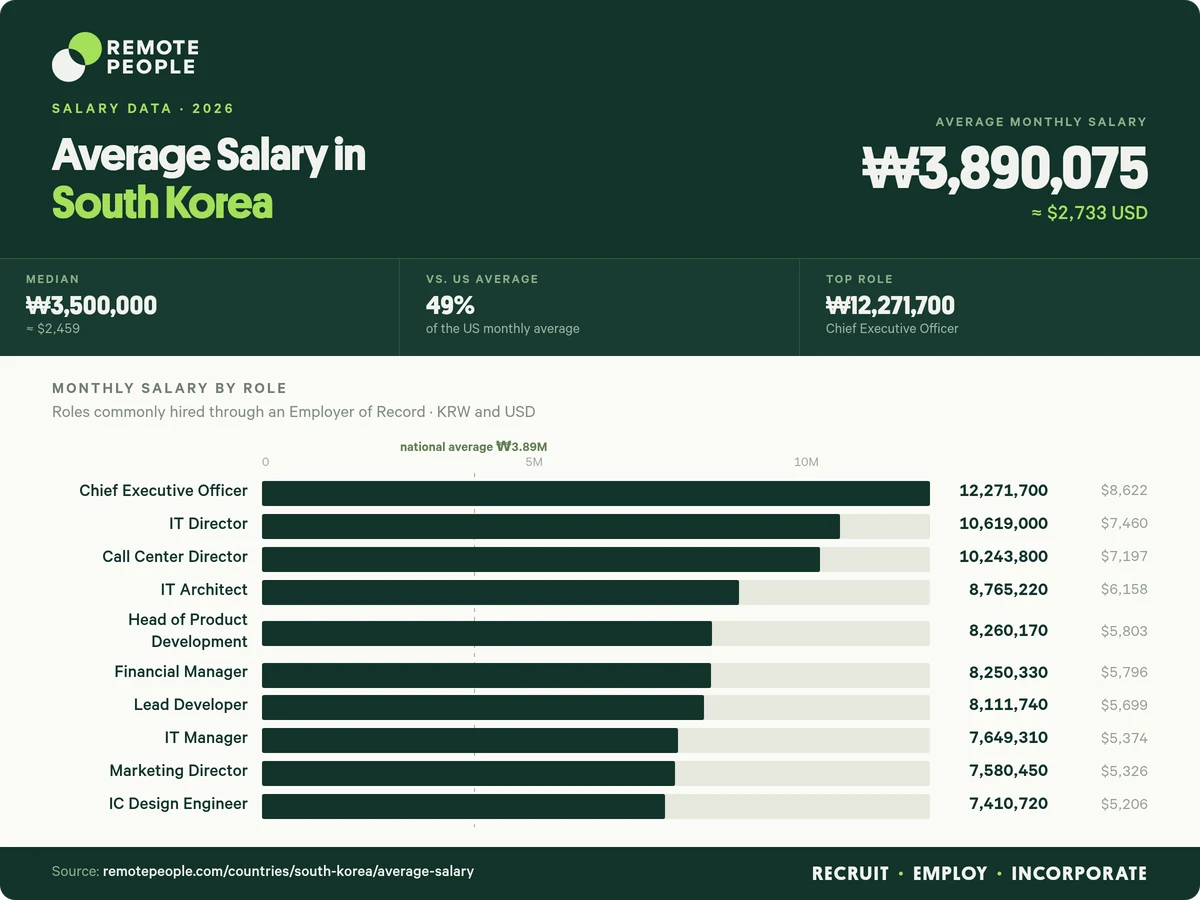
The average monthly salary in South Korea is SKW 3,890,075, approximately USD 2,733. However, you must also consider how wages vary by profession, industry, education, experience, and location. Comparing salaries in South Korea to earnings worldwide provides additional insight.
This guide will cover all aspects of South Korean salaries, preparing you for your hiring journey.
What is the Average Salary in South Korea?
The average salary in South Korea is approximately 3,890,075 won, equivalent to roughly $2,733. Wages are low compared to those in other developed countries, mainly due to the slow growth in the workforce. Although new jobs are created, they are typically awarded to entry-level workers who make low salaries.
Median Income
The median salary in South Korea is approximately SKW 3,500,000, equivalent to about $2,459. Half of the country earns higher salaries, while the other half earns lower wages.
Salary Range
Salary range spans from the lowest to the highest salaries in the country. Low earners in South Korea earn around SKW 982,950, approximately $690, while high earners earn about SKW $1.74 million, equivalent to around $12,226.
Salary Comparisons in South Korea
The average salary provides some insight, but you must also consider how wages vary based on factors such as education, experience, location, position, and industry. The following sections will explore how they impact earnings.
Salary by Profession
The following salary comparison chart examines how wages vary by position.
Position | Average Monthly Salary (KRW) |
|---|---|
Chief Executive Officer | 12,271,700 |
IT Director | 10,619,000 |
Call Center Director | 10,243,800 |
IT Architect | 8,765,220 |
Head of Product Development | 8,260,170 |
Financial Manager | 8,250,330 |
Lead Developer | 8,111,740 |
IT Manager | 7,649,310 |
Marketing Director | 7,580,450 |
IC Design Engineer | 7,410,720 |
Banking Cashier | 2,098,870 |
Fabric Cutter | 2,095,020 |
Clothing Technologist | 2,085,890 |
General Laborer | 2,053,550 |
Packer | 2,043,020 |
Seamstress | 1,950,580 |
Tailor | 1,884,700 |
Porter | 1,884,500 |
Medical Records Clerk | 1,878,990 |
Average Salary Based on Education
Education plays a significant role in wage determination, as college graduates earn approximately 14.8% more than workers with only a high school diploma. However, beyond that, the type of degree you earn is not as relevant. For example, workers with two and 4-year college degrees have similar wages, as 2-year degrees generally directly prepare you for employment, while 4-year degrees are not as vocationally focused.
Salary Comparison by Experience
Experience also impacts salaries as experienced workers in South Korea earn more than entry-level workers. Employees also become eligible for raises with tenure in their field. Here are some salary comparisons to consider:
Worker Level | Average Annual Salary (SKW) |
|---|---|
Junior-level | 42,500,000 |
Mid-level | 52,400,000 |
Senior-level | 75,300,000 |
Top management | 110,200,000 |
Salary Comparison by Location
Salaries vary by location as workers in urban areas tend to earn more than those in rural areas due to higher living costs and proximity to large companies offering high-paying job opportunities. The following chart provides pay rates in various regions of the country.
Region | Average Annual Salary (KRW) |
|---|---|
Bucheon | 43,198,900 |
Busan | 51,479,800 |
Daegu | 49,561,800 |
Daejeon | 48,721,100 |
Goyang | 45,119,800 |
Gwangju | 47,578,300 |
Ulsan | 46,080,100 |
Suwon | 46,921,300 |
Seoul | 52,319,400 |
Seongnam | 44,040,700 |
Incheon | 50,519,600 |
What is the Minimum Wage in South Korea?
As of January 1, 2026, the minimum wage in South Korea is KRW 10,320 per hour, approximately $7.51 South Korea minimum wage per hour in USD, marking a 2.9% increase from the previous KRW 10,030 per hour, which translates to a monthly salary of about KRW 2,156,880 for a worker working 209 hours per month.
Average Salary in South Korea vs. the Rest of the World
The following charts compare South Korean salaries to those in developed, developing, and underdeveloped countries, providing more insight.
South Korea vs. Developed Countries
Country | Average Salary | Comparison to Average South Korea Salary |
|---|---|---|
United Kingdom | 3,000 euros (approx. $3,116) | 14% |
United States | $5,677 | 111% |
Norway | 50,790 kroner (approx. $4,700) | 74% |
Germany | 4,300 euros (approx. $4,467) | 66% |
Austria | 3,500 euros (approx. $3,636) | 33% |
South Korea vs. Developing Countries
Country | Average Salary | Comparison to Average South Korea Salary |
|---|---|---|
Romania | 4,000 RON (approx. $835) | 222% |
Russia | 73,709 Rubles (approx. $700) | 285% |
Albania | 1,500 Euros (approx. $1,550) | 74% |
Kazakhstan | 342,082 Tenge (approx. $645) | 315% |
Ukraine | 18,000 Hryvnia (approx. $500) | 440% |
South Korea vs. Undeveloped Countries
Country | Average Salary | Comparison to Average South Korea Salary |
|---|---|---|
Thailand | 97,500 Baht (approx. $2,772) | – 3% |
Philippines | 18,423 PHP (approx. $875) | 206% |
Vietnam | 8.5 million dong (approx. $360) | 650% |
Egypt | 13,244 EGP (approx. $263) | 938% |
Pakistan | 45,000 PKR (approx. $150) | 1700% |
South Korea is a developed country with a high-income industrial economy. Its remarkable transformation from a developing country has earned it the nickname “Miracle on the Han River.” It has a strong position in global trade, diplomacy, and cultural exchange.
The country boasts a competitive and dynamic labor force, with a strong emphasis on manufacturing and technology. Its highly skilled workforce can bring exceptional products and services to the table for companies looking to outsource. The moderate average salary in Korea can lead to cost savings for some organizations.
What are the Most Common Outsourced Industries in South Korea?
Companies will see the most benefits when outsourcing for the following industries:
IT Services
South Korea is a global leader in IT services, thanks to its focus on research and development (R&D) and digital transformation. Essential sectors include AI, blockchain, software engineering, and cloud computing, and it is a key player in the semiconductor market. The industry is backed by government initiatives that fuel its growth.
An IT specialist in South Korea earns around $ 3,642 monthly, while American workers earn closer to $ 5,000, resulting in significant cost savings for some employers.
BPO Services
The country’s BPO industry has seen steady growth, reaching $9.20 billion in 2024. There is a high demand for healthcare-related BPO services, while contact centers, finance, logistics, and IT sectors are also thriving. The government actively promotes the BPO sector through tax incentives, subsidies, and other initiatives.
With such varied positions in the BPO sector, it’s impossible to say how much companies can save, but they can benefit through outsourcing opportunities.
Manufacturing
The country is a global manufacturing hub with leading industries including electronics, motor parts, industrial machinery, chemicals, textiles, shipbuilding, and steel. It boasts large deposits of minerals, providing a range of natural resources for the manufacturing sector. South Korea’s focus on technology supports automation, leading to highly efficient systems.
Conclusion
South Korea’s highly skilled labor force makes it an ideal destination for outsourcing. Although average salaries in South Korea are moderate, they can lead to cost savings for some companies. The quality products and services can make some organizations leaders in their field.




