
 Recruit
Average Salary in the United Arab Emirates
-
 Drew Donnelly
- Published
- September 21, 2026
Curious about salaries in the United Arab Emirates? This guide breaks down the average wages, compares professions, highlights minimum wage figures, and explores how United Arab Emirates’ earnings measure up.
- 5 ★ on G2








Let RemotePeople handle payroll, compliance, and HR admin worldwide so you can focus on building your team.
The United Arab Emirates’ skilled and diverse workforce and strong economy make it an excellent outsourcing destination. Employers looking to hire in the area may wonder, What is the average salary in the United Arab Emirates? This information will help them prepare a competitive job offer.
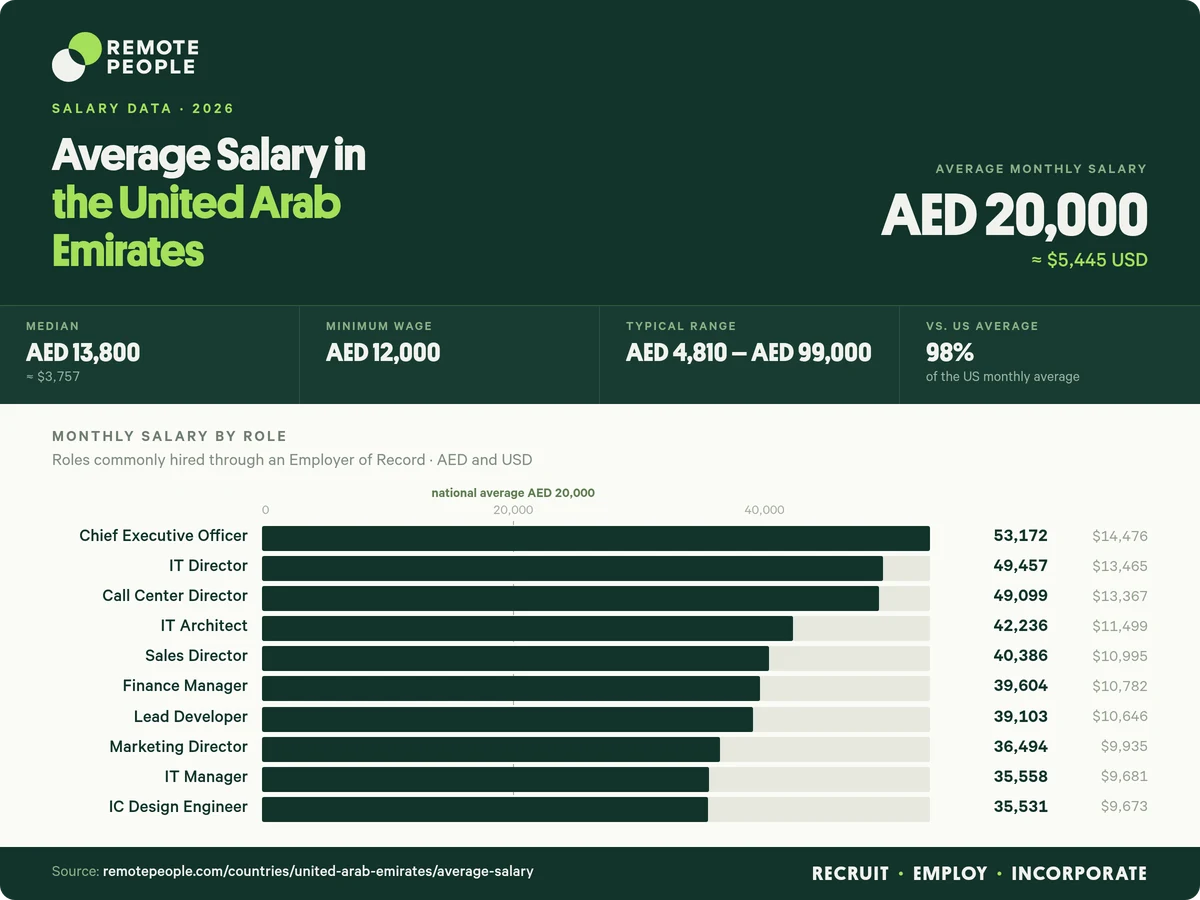
The average monthly salary in the United Arab Emirates is 20,000 United Arab Emirates Dir (AED), about USD 5445. However, salaries vary depending on experience, education, location, industry, and position. You must also consider how wages in the country compare to earnings worldwide.
This guide will deeply dive into UAE salaries to provide more insight.
What is the Average Salary in the United Arab Emirates?
The average salary in the UAE is 20,000 AED, about $5445. The country’s high wages are due to its flourishing economy and tax-free environment. Its diverse workforce also leads to generous compensation packages.
Median Income
The median monthly income in the UAE is 13,800 AED, about $3757. Half the country earns higher salaries, and the other half earn less. When comparing average vs. median salary, the average salary is significantly higher due to wage inequality in the country, which exists mainly between expatriates and nationals but also, to some extent, between men and women.
Salary Range
The salary range spans from the country’s lowest to the highest earnings. In the UAE, low earners make around 4810 AED (about $1309) while high earners make closer to 99,000 AED, about $26,953 monthly.
Salary Comparisons in the UAE
Average salary provides insight, but you must consider how wages vary by experience, education, location, industry, and position. The following sections reveal how these factors impact earnings.
Industry Salary Comparison
The following salary comparison chart shows how wages vary by profession.
Position | Average Monthly Salary (AED) |
|---|---|
Chief Executive Officer | 53,172 |
IT Director | 49,457 |
Call Center Director | 49,099 |
IT Architect | 42,236 |
Sales Director | 40,386 |
Finance Manager | 39,604 |
Lead Developer | 39,103 |
Marketing Director | 36,494 |
IT Manager | 35,558 |
IC Design Engineer | 35,531 |
Fabric Cutter | 10,041 |
Clothing Technologist | 9,997 |
Banking Cashier | 9,939 |
General Laborer | 9,937 |
Packer | 9,792 |
Seamstress | 9,349 |
Porter | 9,032 |
Medical Records Clerk | 9,006 |
Tailor | 8,936 |
Average Salary in the UAE Based on Education
Education impacts earnings, as workers with higher degrees earn more than those with basic schooling. 2008 statistics show UAE workers with a university degree earn around 120,000 UAE annually, while those with a secondary education earn closer to 48,000 UAE. Furthermore, those with a secondary degree earn about 57.17% more than those with an undergraduate degree.
Salary Comparison by Experience
Experience also plays a role in wage determination. Research reveals that UAE workers with 2-5 years of experience earn about 35% more than entry-level workers. Those with 10 years of experience typically see a salary increment of about 20%.
Workers also receive performance bonuses, housing allowances, and stock options with seniority in their field.
Salary Comparison by Location
Location impacts salaries as workers in urban areas tend to earn more than rural workers due to higher living costs and proximity to large companies offering high-paying job opportunities. In the UAE, employees in economic hubs like Dubai and Abu Dhabi generally earn more than those in emirates like Ras Al Khaimah. However, as remote work becomes more prevalent, we may see less differentiation among regions.
What is the Minimum Wage in the UAE?
There is no mandatory minimum wage in the UAE. However, employers must compensate employees fairly, offering generous salaries to cover their basic needs. Furthermore, the UAE Ministry of Human Resources and Emiratisation (MoHRE) provides guidelines for minimum wages for specific employee categories as follows:
Occupation | Minimum Salary (AED/month) |
|---|---|
University Graduation | 12,000 |
Skilled Laborers | 5,000 |
Skilled Technicians | 7,000 |
Average Salary in the UAE vs. the Rest of the World
The following charts will compare salaries in the UAE to those in other countries to provide more insight.
UAE vs. Developed Countries
Country | Average Salary | Comparison to Average UAE Salary |
|---|---|---|
United Kingdom | 3000 euros (approx. $3116) | 43% |
United States | $5677 | – 3% |
Norway | 50,790 kroner (approx. $4700) | 17% |
Germany | 4300 euros (approx. $4467) | 22% |
Austria | 3500 euros (approx. $3636) | 52% |
UAE vs. Developing Countries
Country | Average Salary | Comparison to Average UAE Salary |
|---|---|---|
Romania | 4000 RON (approx. $835) | 554% |
Russia | 73,709 Rubles (approx. $700) | 685% |
Albania | 1500 Euros (approx. $1550) | 254% |
Kazakhstan | 342,082 Tenge (approx. $645) | 746% |
Ukraine | 18,000 Hryvnia (approx. $500) | 1000% |
UAE vs. Undeveloped Countries
Country | Average Salary | Comparison to Average UAE Salary |
|---|---|---|
Afghanistan | 30,000 Afghanis (approx. $419) | 12% |
Philippines | 18,423 PHP (approx. $875) | 525% |
Vietnam | 8.5 million dong (approx. $360) | 1433% |
Egypt | 13,244 EGP (approx. $263) | 2015% |
Pakistan | 45,000 PKR (approx. $150) | 3566% |
The UAE is a developed country with a high Human Development Index and a strong economy. The work sector is growing rapidly with advanced diversification. Key sectors include oil, gas, construction, tourism, finance, healthcare, and technology. It is also a global logistics, trade, and real estate hub.
The country’s strategic location, skilled workforce, and advanced infrastructure make it an ideal outsourcing destination. Its pro-business environment, which focuses on incentives, streamlined regulations, and a stable legal framework, promotes growth. It is a leader in digital transformation and innovation.
What are the Most Common Outsourced Industries in the UAE?
Employers who outsource to the UAE will benefit most when focusing on the following industries.
IT Services
The UAE’s IT industry is seeing significant growth due to digital innovation and the adoption of new technologies. The sector focuses on AI, blockchain, and cloud computing. Its supportive environment, robust infrastructure, and favorable business relations make it a popular source for remote partnerships.
BPO
The country’s BPO industry is growing rapidly, with the market expected to reach 2,600.9 million by 2030. It is known for its back office and call center services in the hospitality, construction, and education sectors. Its bilingual citizens and growing tech services make it an efficient outsourcing choice.
Gas and Oil
Gas and oil are major drivers of the UAE economy. It is among the world’s largest oil and gas producers and exporters, playing a key role in OPEC+. The country is also focusing on diversifying into the natural energy sector.
Conclusion
The UAE’s highly skilled workforce, business-friendly environment, and robust digital infrastructure make it an attractive outsourcing destination. Although the average salary in the UAE is high, its exceptional products and services could make some companies industry leaders, benefiting all involved parties.