
 Recruit
Average Salary in Uruguay
-
 Drew Donnelly
- Published
- September 21, 2026
Curious about salaries in Uruguay? This guide breaks down the average wages, compares professions, highlights minimum wage figures, and explores how Uruguay’s earnings measure up internationally. If you plan to hire there without opening a local entity, an Employer of Record (EOR) in Uruguay can run payroll, contracts, and compliance on your behalf.
- 5 ★ on G2








Let RemotePeople handle payroll, compliance, and HR admin worldwide so you can focus on building your team.
Uruguay’s skilled workforce, cost-effective labor, and favorable business climate make it an excellent outsourcing destination. Employers seeking remote partnerships may wonder, “What is the average salary in Uruguay?” If you want to hire in Uruguay without setting up your own legal entity, an employer of record (EOR) in Uruguay is a practical solution. An EOR becomes your official local employer, handling employment compliance, payroll, taxes, and all regulatory requirements.
This information will help them prepare a fair hiring offer. Employers may also run background checks in Uruguay for certain roles, so it is worth knowing what is permitted before you hire.
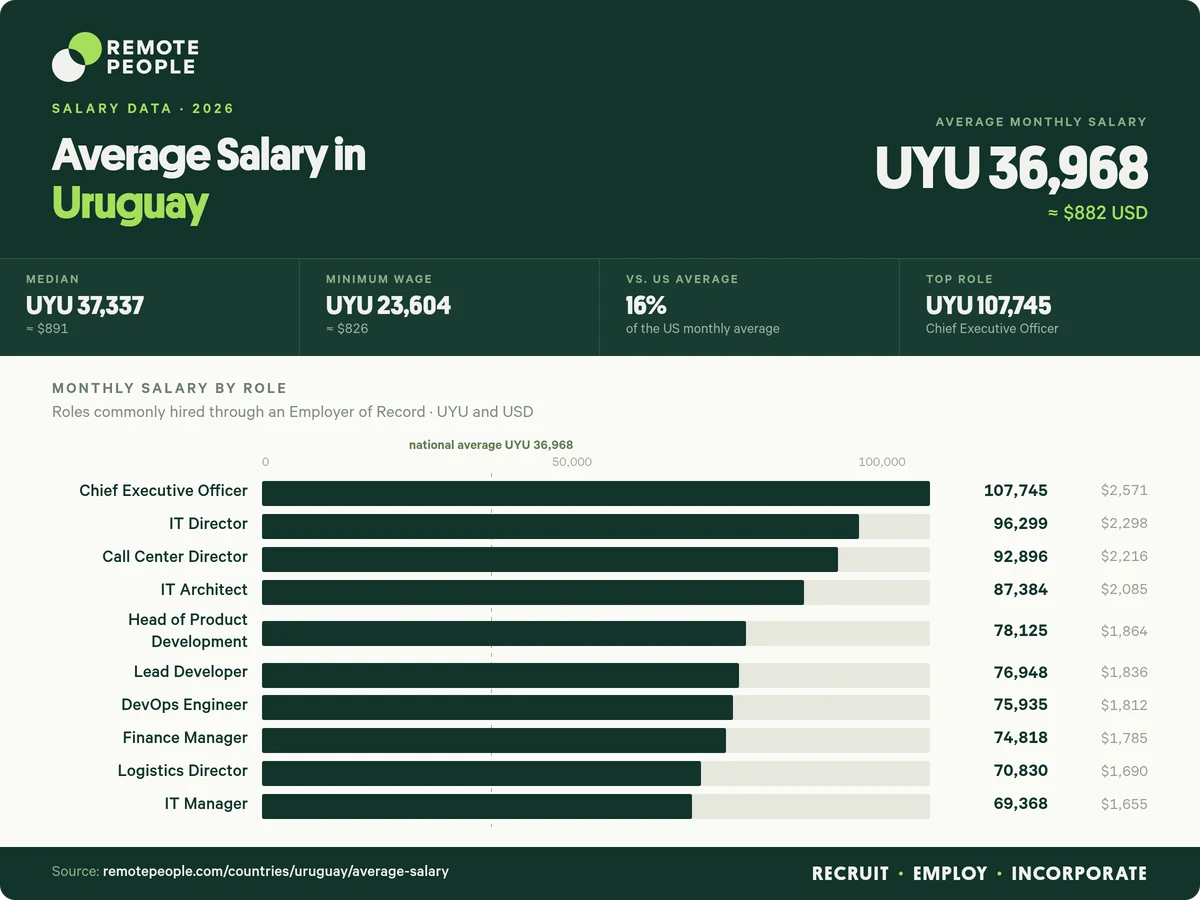
The average monthly salary in Uruguay is 36,968 Uruguayan Pesos (UYU), about USD 882. However, wages vary based on experience, education, location, profession, and industry. You must also consider how earnings differ worldwide.
This guide will look at all aspects of Uruguayan salaries to provide deep insights.
What is the Average Salary in Uruguay?
The average salary in Uruguay is 36,968 UYU, about $882. Wages in the country are low due to a low GDP per capita and cost of living. Although the minimum wage is designed to reduce poverty and meet basic needs, it does not adequately cover most people’s living costs.
Median Income
Uruguay’s median monthly income is 37,337 UYU, about $891. Half the country’s population earns lower wages, and the other half earns more.
Salary Range
The salary range spans from the lowest to the highest wages in the country. In Uruguay, low earners make around 18,124 UYU (about $18,124), while high earners make closer to 56,969 UYU (about $1360).
Salary Comparisons in Uruguay
The average salary in Uruguay provides some insight, but you must consider how wages vary based on education, experience, position, industry, and location. The following sections will explore how these factors impact earnings.
Industry Salary Comparison
The following salary comparison chart reveals how wages in Uruguay vary by position.
Position | Average Monthly Salary (UYU) |
|---|---|
Chief Executive Officer | 107,745 |
IT Director | 96,299 |
Call Center Director | 92,896 |
IT Architect | 87,384 |
Head of Product Development | 78,125 |
Lead Developer | 76,948 |
DevOps Engineer | 75,935 |
Finance Manager | 74,818 |
Logistics Director | 70,830 |
IT Manager | 69,368 |
Banking Cashier | 19,033 |
Fabric Cutter | 18,998 |
Clothing Technologist | 18,916 |
General Laborer | 18,801 |
Packer | 18,527 |
Seamstress | 17,869 |
Porter | 17,089 |
Medical Records Clerk | 17,039 |
Tailor | 16,907 |
Average Wage in Uruguay by Education
Typically, education directly correlates with wages, as highly educated workers earn more than those with lower degrees. However, Uruguay is an exception.
Although Uruguay has shown improvements in education with more average years of education in young adults, the gap between people in the highest and lowest quintiles remains the same, around 60%. These statistics suggest a lack of focus on skills development.
Salary Comparison by Experience
Experience is another wage-determining factor that is not as prevalent in Uruguayan society. Although workers make more with experience, returns diminish over the years. For example, a skilled worker may see high rate increases in their early years with their company, but they will receive fewer raises with tenure in their field.
Salary Comparison by Location
Location impacts salaries, with workers in urban areas earning more than rural workers due to higher living costs and proximity to large companies offering more job opportunities. In Uruguay, workers in the capital city of Montevideo earn more than those in the country’s towns and villages.
How Much is Minimum Wage in Uruguay?
The minimum wage in Uruguay is 23,604 UYU monthly, about $826 Uruguay minimum wage USD. The wage increased on January 1, 2025, from the previous rate of 21,106 UYU, based on a 44-hour work week.
Average Salary in Uruguay vs. the Rest of the World
To provide more insight, the following charts compare salaries in Uruguay to those in developed, developing, and undeveloped countries.
Uruguay vs. Developed Countries
Country | Average Salary | Comparison to Average Uruguay Salary |
|---|---|---|
Japan | 379,434 Yen (approx. $2,635) | – 188% |
United States | $5,677 | – 533% |
Norway | 50,790 kroner (approx. $4,700) | – 422% |
Germany | 4,300 euros (approx. $4,467) | – 400% |
Austria | 3,500 euros (approx. $3,636) | – 300% |
Uruguay vs. Developing Countries
Country | Average Salary | Comparison to Average Uruguay Salary |
|---|---|---|
Romania | 4,000 RON (approx. $835) | 71% |
Russia | 73,709 Rubles (approx. $700) | 28% |
Albania | 1,500 Euros (approx. $1,550) | – 72% |
Kazakhstan | 342,082 Tenge (approx. $645) | 38% |
Ukraine | 18,000 Hryvnia (approx. $500) | 80% |
Uruguay vs. Undeveloped Countries
Country | Average Salary | Comparison to Average Uruguay Salary |
|---|---|---|
Afghanistan | 30,000 Afghanis (approx. $419) | 114% |
Philippines | 18,423 PHP (approx. $875) | 0% |
Vietnam | 8.5 million dong (approx. $360) | 150% |
Egypt | 13,244 EGP (approx. $263) | 246% |
Pakistan | 45,000 PKR (approx. $150) | 500% |
Uruguay is a developed country with a high Human Development Index. Although its GDP is low compared to many Western nations, it has one of the highest GDPs in South America. It boasts a stable and resilient economy.
The country is a popular outsourcing destination due to its skilled workforce and cost-effective labor. Its advanced infrastructure supports a growing tech sector, and Uruguay’s innovative culture leads to effective outsourcing relationships.
What are the Most Common Outsourced Industries in Uruguay?
Employers outsourcing to Uruguay will see the most advantages when concentrating on the following sectors.
IT Services
Uruguay offers a thriving IT market with considerable strength in software development, fintech, cloud computing, and cybersecurity. It boasts a robust digital infrastructure with nearly universal high-speed internet and ongoing investments in 5G technology. The country is gaining recognition as the Silicon Valley of South America.
IT technicians in Uruguay earn about 96,297 UYU, about $2300 monthly. Although these wages are much higher than the national average, they are considerably lower than what Western IT technicians make, which is closer to $5000 monthly.
BPO
Uruguay’s BPO sector is growing rapidly. While IT service and software development are seeing significant growth, the country is also a popular source for call center services, back office services like HR and finance, cybersecurity, data analytics, and cloud consulting. Its nearshoring advantage to North America and Europe leads to cost savings and reduced time zone differences.
Agriculture
The country stands out for its high-quality agricultural products, particularly beef, soybeans, and rice. Its farming sector contributes significantly to its GDP, ranging between 7% and 25%. Much of its land is suitable for agriculture, and there’s great potential for further development.
Conclusion
Uruguay’s low average salaries and skilled labor make it a popular outsourcing destination. Companies that forge remote partnerships in the country can benefit from quality products and services and money savings while helping workers overcome poverty, resulting in a beneficial situation for all involved parties.