
 Recruit
Employer of Record in Uruguay
Uruguay’s labor law includes BPS social security, aguinaldo, and mandatory vacation bonuses, and a Uruguayan EOR handles payroll and full compliance with no local entity needed.
Hire in Uruguay — book a free 30-minute demo
Tell us what you need. You'll get a tailored, transparent proposal within 24 hours, plus a free call to walk through it.
Tell us about your company
So we can match you with a specialist who knows your market — and unlock volume pricing tiers.
* All fields are required.
Where and when are you hiring?
Tell us the geography and timing and we'll quote each country line by line, with onboarding timelines.
* All fields are required.
Help us beat your current setup
We'll benchmark your current deal and send a line-by-line proposal in 24 hours — showing exactly where we cut cost, time, or risk. After you submit, you can book a call to walk through it together.
* All fields are required.
Thanks! Your proposal is on its way.
Expect a tailored, line-by-line proposal in your inbox within 24 hours. In the meantime…
Want to walk through it together?
Book a free 30-minute call with one of our specialists. We'll explain every line, answer your questions, and tailor the proposal further if you need.
No obligation. Pick a time that works for you.








- Hire in Uruguay — book a free 30-minute demo
- Tell us about your company
- Where and when are you hiring?
- Help us beat your current setup
- Thanks! Your proposal is on its way.
- How an Employer of Record Works in Uruguay
- Employment Laws and Regulations in Uruguay
- Work Permits and Visas for Foreign Employees
- Payroll and Taxes in Uruguay
- Cost of Hiring an Employee in Uruguay
- Employee Benefits in Uruguay
- Termination and Severance in Uruguay
- EOR vs Other Hiring Models in Uruguay
- Public Holidays in Uruguay
- How to Get Started with an EOR in Uruguay
- Frequently Asked Questions
- Related EOR Destinations

Start hiring in Uruguay
Let RemotePeople handle payroll, compliance, and HR admin worldwide so you can focus on building your team.

An employer of record in Uruguay lets you hire and pay employees in Uruguay without registering a local SRL or SA, typically at a service fee of USD 500–800 per employee per month plus statutory employer on-cost of approximately 12.625% before workers’ compensation. The EOR becomes the legal employer on the ground, registers staff with BPS, withholds the 10–36% IRPF and any IASS pension-income tax, manages the mandatory Aguinaldo 13th-month payment in two installments (June and December), and sponsors residence permits — so you can build a Uruguayan team without opening a peso-denominated bank account.
Uruguay itself offers one of the most stable and mature payroll jurisdictions in South America: a dollarised economy in practice, a 1.3-million-strong formal workforce concentrated around Montevideo and the Canelones tech corridor, a Spanish-language talent pool that includes the region’s highest English proficiency, and a rule-of-law record that ranks first in Latin America on the World Justice Project Index. Employment runs under Law 16.074 and a dense framework of individual statutes (Law 10.489 on severance, Law 12.590 on paid annual leave, Law 18.345 on special leave, Law 17.292 on paternity), with social security collected through the Banco de Previsión Social (BPS), IRPF withheld through the Dirección General Impositiva (DGI), and residence permits issued through the Dirección Nacional de Migración (DNM).
How an Employer of Record Works in Uruguay
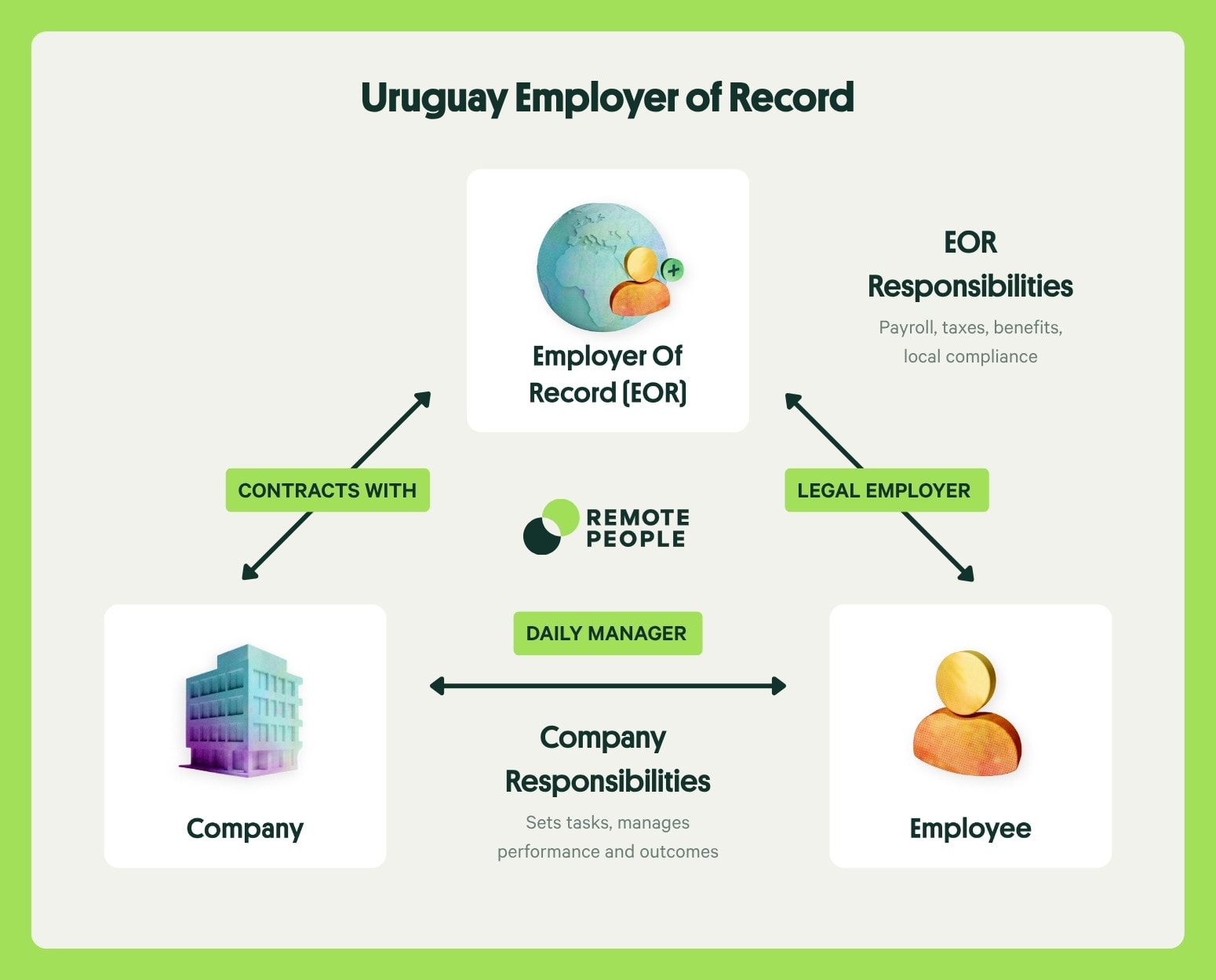
If you’d like to learn more about how Employer of Record (EOR) services work, read our What Is an Employer of Record (EOR)? guide for a complete overview of the model, its benefits, and when to use it.
If you’re comparing providers, our Best Employer of Record (EOR) Providers guide reviews the leading platforms to help you choose the right solution for your business.
Who Uses an EOR in Uruguay?
Because Uruguay’s employment framework requires direct engagement with BPS, DGI, DNM, and in some cases MTSS, EOR demand comes from companies that want one Uruguayan legal entity handling every filing. Common situations include:
- Testing the Uruguayan market: A company expanding into the Southern Cone that wants a small team in Montevideo, Zonamerica, or the World Trade Center free zone for six to twelve months before committing to a Uruguayan SA or SRL.
- Small remote teams: Businesses hiring one to five employees in Uruguay for software engineering, financial services, bilingual customer support, or regional shared services, where the cost of incorporating and maintaining a local entity outweighs the administrative burden.
- Fast onboarding of Uruguayan nationals: Companies that need a Uruguayan engineer, designer, or bilingual analyst on payroll quickly with proper BPS enrolment and IRPF withholding from day one, rather than treating them as an unipersonal contractor.
- Relocating foreign specialists: Employers bringing in an Argentine, Brazilian, European, or U.S. specialist and sponsoring a Temporary Residence permit or MERCOSUR Residence, without first standing up a Uruguayan corporation authorised to hire foreign nationals.
- Free-zone and regional LatAm hubs: Organisations that operate regional shared service centres for Latin America or maintain a free-zone presence at Zonamerica, Aguada Park, or Parque de las Ciencias and need Uruguay-resident staff on compliant employment terms while the parent bills into the group from abroad.
In each case, the EOR absorbs the registration, filing, and advisory burden that would otherwise require the client to staff a full in-country HR, payroll, and tax function.
Typical Onboarding Timeline
Most EOR providers can onboard a Uruguay-resident employee within one to two weeks, assuming the candidate is already in Uruguay and authorised to work. The steps below are sequential but several overlap in practice:
- EOR agreement and employee details: One to two business days to sign the client-EOR service agreement and collect the new hire’s cédula de identidad, BPS number (if already registered from prior employment), bank details, and signed offer letter.
- Employment contract drafting and review: Two to three days to issue the Uruguay-compliant employment contract in Spanish, localise it for the employee’s work location, and incorporate the client’s specific benefits and IP-assignment clauses.
- BPS and DGI registration: Three to five days for BPS to confirm or issue the employee’s affiliation, for the EOR to add the employee to the nómina filed monthly, and for DGI to activate the IRPF withholding profile.
- Payroll and benefits setup: Two to three days to load the employee into the payroll system, set up UYU direct deposit (or USD where contracted), and enrol them in any supplemental health or pension plan the client offers on top of FONASA.
- First day of work: One day to deliver the signed contract, equipment, and client orientation.
When a foreign national is involved, the timeline extends by four to eight weeks for residence processing: the Dirección Nacional de Migración typically needs one to two months from a complete file to issue a Temporary Residence card with work authorisation, plus apostilled police clearances and a medical certificate from the Ministerio de Salud Pública.
Hire in Uruguay
A stable regulatory environment, free-trade zone incentives, and strong Spanish-English bilingual talent make Uruguay one of Latin America’s most EOR-friendly jurisdictions.
We handle employment contracts, UYU payroll, BPS and IRPF withholding, and full Uruguay compliance under the Consejos de Salarios framework.
No local entity needed. Your team can start in days.
Employment Laws and Regulations in Uruguay
Employment Contracts
Uruguay does not have a single consolidated labour code; instead, the employment relationship is governed by a layered framework of individual statutes, collective bargaining agreements negotiated through the Consejos de Salarios, and the 1967 Constitution. Key statutes include Law 10.489 on severance, Law 12.590 on paid annual leave and the Salario Vacacional, Law 12.840 on the Aguinaldo, Law 16.074 on mandatory workers’ compensation insurance through the Banco de Seguros del Estado (BSE), Law 17.292 on paternity leave, Law 18.345 on special leave categories, and Law 18.083 establishing the IRPF system. Written contracts are not legally required for indefinite-term employment, but every EOR issues a Spanish-language written contract in practice to evidence salary, working time, and probation terms. Both indefinido (indefinite-term) and plazo (fixed-term) contracts are permitted, though Uruguayan courts will recharacterise successive fixed-term renewals as indefinite where the underlying role is permanent, under the principio de primacía de la realidad. Contracts must identify the parties, the position, the base salary, the workplace, the start date, and the working-time schedule, and must reference the applicable Consejo de Salarios group where a collective agreement binds the employer.
Working Hours and Overtime
Uruguay sets a maximum working week of forty-eight hours for industrial and rural workers and forty-four hours for commerce and services, under Law 5.350 (1915) as amended and Decree-Law 14.320. Daily hours are capped at eight for day shifts. Overtime is governed by Law 15.996, which pays weekday overtime at a 100% premium (2.0 times the base hourly rate) and work on public holidays or the weekly rest day at a 150% premium (2.5 times). The total overtime cap is eight hours per week, and overtime must be authorised by the MTSS Inspección General del Trabajo where it exceeds the statutory cap. Managerial and senior technical roles may be excluded from the weekly working-time cap by collective agreement, though they remain entitled to holiday and rest-day premiums.
Uruguay overtime and premium pay rates · Per Law 15.996 and Law 5.350 | |||
Hour Type | Rate Multiplier | Daily / Weekly Cap | Notes |
|---|---|---|---|
Day overtime (Mon–Sat, weekday) | 2.0x base hourly rate | Max 8 hrs/week | Statutory minimum under Law 15.996. Must be paid no later than the next regular pay cycle. |
Weekly rest-day work | 2.5x base hourly rate | Compensatory rest required | Must grant a paid compensatory rest day during the following week where worked on the weekly day of rest. |
Public holiday work (non-working holidays) | 2.5x base hourly rate | Per holiday worked | Applies to the five feriados no laborables: 1 Jan, 1 May, 18 Jul, 25 Aug, and 25 Dec. |
Night premium | +20% over day rate | Applies 10 p.m.–6 a.m. | Night work itself carries a 20% premium over the ordinary hourly wage where agreed by collective bargaining. |
Managerial / senior technical | May be exempted by collective agreement | n/a | Senior managers with autonomy may fall outside the 44/48-hour cap, but holiday and rest-day premiums still apply. |
Overtime pay forms part of the BPS contribution base and is treated as ordinary Category II income for IRPF withholding. Employers must log overtime in the planilla de control de trabajo filed monthly with the MTSS; Inspección General del Trabajo inspectors treat missing overtime records as prima facie evidence of underpayment and can impose fines of up to 150 Unidades Reajustables per worker per month.
Minimum Wage
Uruguay’s Salario Mínimo Nacional is set annually by executive decree on the recommendation of the Consejo Superior Tripartito, and revised in line with inflation. For 2026 the minimum wage is UYU 24,572 per month as of 1 January 2026, rising to UYU 25,383 per month from 1 July 2026 under the mid-year adjustment announced in December 2025. The equivalent daily rate is UYU 982.88 and the hourly rate is UYU 122.86. Sector-specific minimum wages negotiated through the Consejos de Salarios typically sit well above the national floor – the tech and services groups in Group 19 set minimums two to four times higher – and an EOR will apply the sectoral scale that matches the employee’s role. For a detailed breakdown of sectoral minimums and the BPS wage-base treatment, see our Uruguay minimum wage guide.
Probation Period
The default probation period in Uruguay is three months under general practice, though there is no single statutory provision and the length is typically set by collective bargaining or the written contract. During probation either party may terminate the employment without the notice period that would otherwise apply, though BPS contributions, annual-leave accrual, and the Aguinaldo proportion continue from day one. An EOR will ordinarily align the probation clause with the client’s internal policy while keeping it within the three-month norm. Severance may still be payable during probation if the employee has completed at least one hundred calendar days of continuous service, per Article 4 of Law 10.489 as interpreted by the Supreme Court.
Leave Entitlements
Uruguay’s statutory leave regime is set in Law 12.590 (annual leave and Salario Vacacional), Law 17.215 and Law 19.161 (maternity), Law 17.292 as amended (paternity), and Law 18.345 (special leave categories). The framework ties annual-leave entitlement to tenure, gives maternity and paternity their own statutory minimums, and channels sick leave through the BPS subsidy system. EOR contracts should reference each entitlement explicitly to avoid disputes at termination, when unused annual leave must be paid out.
Annual Leave
Annual paid leave under Law 12.590 is twenty calendar days after one completed year of service, rising by one additional day for every four years of continuous service thereafter. Accrual begins on the first day of employment, but the employee must complete twelve months of service before the first period can be taken. On top of the leave days, Uruguay grants a statutory Salario Vacacional (vacation bonus) equal to 100% of the net liquid pay for the leave period, payable before the employee begins leave, funded entirely by the employer. Leave must be scheduled by mutual agreement, usually during the November-to-April low-activity season, and cannot be replaced by a cash payment except at termination.
Sick Leave
Uruguayan employers pay no statutory sick leave directly. Instead, BPS-enrolled employees who have contributed for at least three of the twelve months before illness qualify for a subsidio por enfermedad (sick-leave subsidy) of 70% of average wages, payable from the fourth day of certified illness up to one year per episode, extendable in exceptional cases. A certificado médico from a BPS-registered physician is required, and the first three days are unpaid under the statute (though many employers and EOR contracts close that gap as a discretionary benefit). For long-term incapacity, BPS pays disability benefits through the pension system.
Maternity Leave
Uruguay’s maternity regime is set in Law 17.215 and Law 19.161, which give pregnant employees fourteen weeks of fully paid maternity leave – typically six weeks before the expected date of birth and eight weeks after. Pay is funded entirely by BPS-FONASA at 100% of average wages (capped at a statutory ceiling), with the employer topping up where salary exceeds the cap by contract. Pregnant employees are protected from dismissal from the date pregnancy is notified to the employer through six months after return to work. After maternity leave, Law 19.161 provides a reduced working-day benefit of up to six months, during which the mother works half-time while BPS covers the difference.
Paternity Leave
Paternity leave was expanded effective 1 January 2026 from thirteen days to twenty days of fully paid leave, taken at the birth of a child or on legal adoption. The first three days are funded by the employer and the remaining days are funded by BPS. A thirty-day post-leave dismissal protection (fuero paternal) applies to the employee from the date of return. Same-sex partners are covered on equal terms under the Law 19.075 marriage-equality regime. The EOR monitors the annual MTSS decree list to confirm the applicable BPS ceiling for each calendar year.
Other Statutory Leave
Law 18.345 and subsequent amendments provide several additional categories of statutory leave that apply alongside the headline categories above:
- Marriage leave: Three working days paid under Law 18.345.
- Bereavement leave: Three working days paid on the death of a spouse, child, or parent under Law 18.345.
- Study leave: Up to nine days paid per year for university or equivalent examinations, rising to twelve days for employees in tertiary technical programmes.
- Adoption leave: Six weeks paid leave to the adoptive parent under Law 17.292 where the adopted child is under age nine.
- Voting and civic duty leave: Paid time off on national election days and for jury-style civic duties.
The table below summarises the statutory leave framework applied by every EOR in Uruguay. The headline point for buyers is that annual leave is twenty calendar days from year one with a full Salario Vacacional on top, maternity is fourteen weeks fully paid by BPS, and paternity rose to twenty days in 2026 – one of the more generous frameworks in Latin America.
Uruguay statutory leave entitlements · Per Law 12.590, Law 19.161, and Law 17.292 | ||
Leave Type | Duration | Eligibility & Notes |
|---|---|---|
Annual leave (1–4 yrs) | 20 calendar days/year | After 1 completed year. Accrual from day one; first period taken after 12 months. Plus 100% Salario Vacacional bonus. |
Annual leave (5–9 yrs) | 21 calendar days/year | Adds 1 day from the fifth completed year of service with the same employer. |
Annual leave (10+ yrs) | +1 day every 4 years thereafter | 22 days at 9 yrs, 23 at 13 yrs, and so on. Unused days paid out at termination with proportional Salario Vacacional. |
Sick leave | Up to 1 year per episode | BPS subsidy at 70% of wages from day 4. First 3 days unpaid unless employer offers top-up. |
Maternity leave | 14 weeks paid | 6 weeks pre-birth, 8 weeks post-birth. Funded by BPS at 100% of average wages. Dismissal protection until 6 months post-return. |
Paternity leave (from Jan 2026) | 20 days paid | First 3 days funded by employer, remaining 17 by BPS. 30-day post-return fuero paternal. |
Adoption leave | 6 weeks paid | Applies to adoptive parent under Law 17.292 where the child is under age 9. |
Marriage & bereavement | 3 working days each | Under Law 18.345. Paid by employer. |
Study leave | Up to 9 days/year | For certified university examinations. 12 days for tertiary technical programmes. |
Source: Law 19.161 (Maternity) and Banco de Previsión Social | ||
Statutory Benefits Beyond Leave
Beyond the leave categories above, every Uruguayan employee is entitled to the mandatory 13th-month Aguinaldo, the Salario Vacacional vacation bonus, BPS pension enrolment, FONASA health-system enrolment, and mandatory accident-and-occupational-disease insurance through the Banco de Seguros del Estado under Law 16.074. BSE premiums sit outside the BPS contribution schedule and are paid directly by the employer at a rate that varies by industry-risk category (typically 0.3% for low-risk office roles, rising to 6% or higher for construction and heavy industry). EOR contracts list every benefit explicitly so that the client sees the true all-in cost before salary negotiation.
Recent Updates
Uruguay enacted two material employment-adjacent reforms that take effect during 2026. First, paternity leave rose from thirteen to twenty days of fully paid leave effective 1 January 2026, with the BPS cost-share framework unchanged. Second, Law 20.446 came into force on 1 January 2026, substantially broadening the scope of taxable foreign-source income for Uruguayan tax residents by treating most foreign capital income as Uruguayan-source for IRPF purposes. The change matters for expatriate employees on EOR-sponsored residence permits: Uruguay’s historical territorial tax exemption no longer protects most foreign dividend, interest, rental, or royalty income after the five-year “tax holiday” window elapses. EOR providers should flag the change to incoming foreign hires during onboarding and coordinate with a DGI-registered tax adviser to plan for the new regime.
Work Permits and Visas for Foreign Employees
Uruguay does not issue a standalone work permit in the way many jurisdictions do. Instead, the right to work is conferred by a residence permit issued by the Dirección Nacional de Migración (DNM) within the Ministerio del Interior. Any foreign national who holds Temporary Residence, Permanent Residence, or MERCOSUR Residence may legally work in Uruguay; the EOR’s role is to sponsor the application, supply the employment contract, and coordinate with BPS and DGI registration. Short-term business visitors under a ninety-day tourist entry may not legally earn Uruguayan-source employment income, though the digital nomad residence under Decree 238/022 opens a narrow channel for remote workers serving non-Uruguayan clients.
Temporary Residence Permit
The Temporary Residence (Residencia Temporaria) permit is the standard route for foreign employees sponsored by an EOR. Issued under Law 18.250 and Decree 394/009, it is granted for a renewable one-to-two-year term and confers the right to work in any job for any employer. The DNM requires an apostilled police-clearance certificate from every country in which the applicant has lived in the prior five years, a medical certificate from the Ministerio de Salud Pública, proof of sufficient income (typically evidenced by the EOR employment contract), and a clean DGI/BPS record for the sponsoring employer. Processing takes four to eight weeks from filing a complete file, and the cédula de identidad para extranjeros is issued on approval. After two renewals, the holder becomes eligible for Permanent Residence.
MERCOSUR Residence
Nationals of the MERCOSUR bloc and its associated states (Argentina, Brazil, Paraguay, Bolivia, Chile, Colombia, Ecuador, and Peru) qualify for an accelerated residence route under the bloc’s Residence Agreement, transposed into Uruguayan law. MERCOSUR Residence is issued for an initial two-year term, renewable once for a further two years, and converts to Permanent Residence at the end of the four-year window. The documentary burden is lighter than the general Temporary Residence: a single country-of-origin police clearance, passport, and proof of identity are typically sufficient, and processing completes in three to six weeks. Because Uruguay has roughly 28,000 Argentine and 12,000 Brazilian residents under this route, the EOR pipeline is well-developed and predictable.
Digital Nomad Residence
Uruguay’s Digital Nomad Residence, introduced by Decree 238/022 in 2022, permits remote workers whose employers or clients are located outside Uruguay to live in the country for an initial six-month term, renewable once for a further six months. The route does not authorise employment by a Uruguayan employer (including an EOR), so it is not applicable where the client wants to hire through a Uruguayan entity; it is relevant only for remote workers maintaining a non-Uruguayan employment relationship. For a buyer using an EOR to hire a Uruguayan team, the standard Temporary or MERCOSUR Residence routes apply.
Permanent Residence
Permanent Residence (Residencia Permanente) confers indefinite right of residence and work in Uruguay under Law 18.250. It is granted to applicants who have held Temporary or MERCOSUR Residence for the statutory qualifying period (typically three-to-five years), and directly to spouses or civil partners of Uruguayan citizens, parents of Uruguayan-born children, and retirees with a stable pension income exceeding the statutory threshold. Permanent Residence does not confer Uruguayan citizenship; naturalisation is a separate process requiring three-to-five years of residence and a language, civics, and integration assessment.
Uruguay residence permits for foreign workers · 2026 | |||
Permit Type | Eligibility | Validity | Processing Time |
|---|---|---|---|
Temporary Residence (general) | Foreign nationals with EOR employment contract | 1–2 years, renewable | 4–8 weeks |
MERCOSUR Residence | Nationals of Argentina, Brazil, Paraguay, Bolivia, Chile, Colombia, Ecuador, Peru | 2 years, renewable once | 3–6 weeks |
Digital Nomad Residence | Remote workers for foreign employers/clients (Decree 238/022) | 6 months + 6-month renewal | 2–4 weeks |
Permanent Residence | Prior Temporary holders, spouses of UY citizens, parents of UY-born children, qualifying retirees | Indefinite | 8–16 weeks |
MERCOSUR → Permanent conversion | After 2 + 2 years on MERCOSUR Residence | Indefinite | 4–8 weeks |
Source: Dirección Nacional de Migración and Migration Law 18.250 | |||
The EOR handles every step of the residence sponsorship: the employment contract that proves income, the BPS affiliation letter that evidences lawful payroll enrolment, the clean DGI tax record, and the appearance before the DNM office in Misiones 1513, Montevideo. For MERCOSUR nationals the EOR will often file under both the MERCOSUR and general Temporary Residence tracks to secure whichever issues first. For a typical U.S. or EU foreign hire, budget six to eight weeks between signed EOR agreement and first legal day of work in Uruguay.
Payroll and Taxes in Uruguay
Uruguayan payroll runs on a dual-filing calendar: BPS contributions and the monthly nómina are filed by the end of the following month, and IRPF withholding is remitted to DGI on the same cycle. The headline numbers for 2026 are a 12.625% base employer contribution before workers’ compensation, an 18.1% base employee contribution (rising to 23.1% for employees with dependent spouses), and a progressive IRPF schedule from 10% to 36% indexed to the 2026 BPC of UYU 6,864. The figures below reflect BPS Resolution Board notices in force at 1 January 2026.
Employer Social Security Contributions
Employer BPS contributions cover the Jubilación (pension), the FONASA health system, and the Fondo de Reconversión Laboral (FRL). A separate workers’ compensation premium under Law 16.074 is paid to the Banco de Seguros del Estado at a rate that varies by industry risk (0.3% to 6%+ of payroll). The BPS base contribution of 12.625% applies to gross wages with no cap on the first UYU 283,000 per month (approximately 41 BPC); higher earnings are capped at the ceiling for the aporte jubilatorio portion. EOR clients should budget 15-20% total employer on-cost inclusive of BSE premium for typical office roles.
Uruguay employer social security contributions · 2026 | ||
Contribution | Rate | Cap / Notes |
|---|---|---|
BPS pension (Jubilación) | 7.5% | Capped at the pension ceiling (~UYU 283,000 per month for 2026). |
FONASA (National Health) | 5.0% | No ceiling on the employer portion. Funds the SNIS. |
FRL (Labour Reconversion Fund) | 0.10% | Funds unemployment training programmes. |
Guarantee Fund (FGCL) | 0.025% | Small payroll-insolvency backstop under Law 18.407. |
Subtotal BPS employer | 12.625% | Applied on gross wages to statutory ceilings. |
BSE workers’ compensation (Law 16.074) | 0.3% – 6.0%+ | Industry-risk-weighted premium to Banco de Seguros del Estado. |
Total employer on-cost (office roles) | ~12.9% – 14.0% | Excludes discretionary benefits and EOR service fee. |
Employee Social Security Contributions
Employee BPS contributions are withheld at source by the EOR and remitted monthly. The base rate is 18.125%, composed of the 15% pension contribution, the 3% FONASA health contribution (the employee’s own coverage), and the 0.125% FRL. The FONASA rate rises to 5% where the employee covers a spouse or civil partner without their own health coverage, and by a further 1.5% where dependent children are covered – bringing the total employee contribution to as much as 23.125% in a full-dependent household. An additional surcharge on pension contributions applies to employees whose earnings exceed 10 BPC per month, under Article 181 of Law 16.713 as amended.
Uruguay employee social security contributions · 2026 | ||
Contribution | Rate | Cap / Notes |
|---|---|---|
BPS pension (Jubilación) | 15.0% | Capped at the pension ceiling (~UYU 283,000/month for 2026). |
FONASA – single employee | 3.0% | Applied on gross wages. Employee’s own FONASA coverage. |
FONASA – with spouse/partner | 5.0% | Where the spouse or civil partner has no own FONASA cover. |
FONASA – with dependent children | +1.5% | Adds on top of the 3% or 5% base where dependent children covered. |
FRL (Labour Reconversion Fund) | 0.125% | Applied on gross wages to same cap as pension. |
Base employee contribution (single) | 18.125% | Applied on gross wages before IRPF withholding. |
Maximum (full dependents) | Up to 23.125% | Where spouse and children are both covered through the employee’s FONASA. |
Income Tax (IRPF)
Uruguay taxes employment income under Category II of the Impuesto a la Renta de las Personas Físicas (IRPF), established by Law 18.083 and reformed periodically. The eight-bracket progressive schedule ranges from 0% to 36% and is indexed to the Base de Prestaciones y Contribuciones (BPC). For 2026 the BPC stands at UYU 6,864 (effective 1 January 2026), which places the non-taxable threshold at the first 7 BPC of monthly income (UYU 48,048). Employees may claim personal deductions for dependents, mortgage payments, private pension contributions, and FONASA contributions already withheld, subject to a deduction cap that itself is stepped according to total income. The EOR calculates IRPF on a monthly basis, withholds the net amount, and files the annual reconciliation by 31 May of the year following the tax year.
Uruguay IRPF Category II monthly tax brackets · 2026 (BPC = UYU 6,864) | ||
Monthly Income (UYU) | BPC Range | Rate |
|---|---|---|
Up to 48,048 | 0 – 7 BPC | 0% |
48,049 – 68,640 | 7 – 10 BPC | 10% |
68,641 – 102,960 | 10 – 15 BPC | 15% |
102,961 – 205,920 | 15 – 30 BPC | 24% |
205,921 – 343,200 | 30 – 50 BPC | 25% |
343,201 – 514,800 | 50 – 75 BPC | 27% |
514,801 – 789,360 | 75 – 115 BPC | 31% |
Above 789,360 | 115+ BPC | 36% |
Source: Dirección General Impositiva and Law 18.083 (Tax Reform) | ||
The IRPF brackets apply in stepped fashion: each rate is charged only on the portion of income within the bracket, and all-inclusive calculations require the EOR to apply the statutory deductions schedule against the gross before computing withholding. A worked example helps. An employee earning UYU 200,000 gross per month (approximately 29 BPC) will fall into the fourth bracket at the top of their earnings, with a marginal rate of 24% on the top peso and an effective rate of roughly 14–16% before deductions, falling to around 9–11% after standard deductions, depending on dependents and mortgage interest.
Payroll Cycle and Filings
Uruguay runs a monthly payroll cycle with pay day falling at the end of the month or by the fifth business day of the following month under standard practice. The EOR files the nómina BPS (BPS roster) by the end of the following month, remits employer and employee social security contributions on the same cycle, and remits IRPF withholding to DGI under Form 2181. Annual filings include the IRPF reconciliation (Form 1103) by 31 May and the DGI annual affidavit. Pay slips (recibos de sueldo) must itemise gross wages, each statutory deduction with its BPS or DGI line reference, any voluntary deductions, and the net pay, and must be signed by the employee and archived for five years per the Inspección General del Trabajo recordkeeping rules.
13th Month (Aguinaldo)
The mandatory 13th-month payment (Aguinaldo or Sueldo Anual Complementario) is set by Law 12.840 (1960) and is paid in two installments: the first by 30 June, covering the period 1 December to 31 May, and the second by 20 December, covering the period 1 June to 30 November. The Aguinaldo equals one-twelfth of total earnings accrued during the relevant period (including base salary, overtime, bonuses, and commissions), so the annual total equals approximately one month’s pay. The EOR calculates each installment against the relevant six-month earnings record, remits BPS contributions on the Aguinaldo payment, withholds IRPF where applicable, and issues a separate recibo de sueldo. Partial-year employees receive a proportional Aguinaldo on termination or on the statutory payment date.
Cost of Hiring an Employee in Uruguay
The true cost of a Uruguayan employee is more than gross salary. On top of the base wage, the employer pays the 12.625% BPS contribution, the BSE workers’ compensation premium (0.3% for office roles), one month of Aguinaldo spread across the year (8.33%), and the Salario Vacacional vacation bonus (roughly 5.5% of annual gross depending on leave days taken). A typical all-in on-cost lands between 28% and 32% of gross salary before any EOR fee, and the EOR service fee on top is a flat monthly charge that does not scale with salary.
EOR Service Fees
Uruguay EOR service fees run between USD 500 and USD 800 per employee per month, depending on the provider, the complexity of the employee’s compensation package, and whether foreign-national residence sponsorship is included. RemotePeople charges a flat monthly fee inclusive of Uruguay-compliant contract drafting, monthly UYU payroll, BPS pension and FONASA contributions, FRL levy, BSE workers’ compensation premium pass-through, IRPF withholding, Aguinaldo calculation and both installment payments, Salario Vacacional accrual, benefits administration, and HR advisory. Temporary Residence or MERCOSUR Residence sponsorship for foreign nationals is billed as a separate one-time setup fee.
Cost Breakdown Example
The table below breaks down the employer cost for a USD 60,000 per year Uruguayan employee through an EOR, in USD for buyer budgeting. Conversions assume an April 2026 reference rate of approximately UYU 40 = USD 1; the employee sees the full gross paid in UYU and statutory deductions calculated in UYU per the tables above. Figures are indicative and any quoted EOR fee will be given in writing in the service agreement.
Uruguay EOR cost example · USD 60,000 annual gross salary (approx. UYU 2,400,000) | ||
Cost Component | Annual Amount (USD) | Notes |
|---|---|---|
Gross annual salary | $60,000 | Paid in 12 monthly installments in UYU. |
BPS employer contribution (12.625%) | $7,575 | Pension 7.5% + FONASA 5% + FRL 0.1% + FGCL 0.025%. |
BSE workers’ comp (Law 16.074, ~0.5%) | $300 | Premium to Banco de Seguros del Estado for office-class risk. |
Aguinaldo (13th month) | $5,000 | 1/12th of annual earnings, paid in June and December installments. |
BPS employer on Aguinaldo | $631 | Same 12.625% rate applied to the 13th-month payment. |
Salario Vacacional | $3,287 | 100% of net liquid leave pay on 20 calendar days’ annual leave. |
EOR service fee (~$650/mo flat) | $7,800 | Flat monthly fee does not scale with salary. |
Total employer cost (first year) | ~$84,593 | Approx. 41% mark-up over gross salary before discretionary benefits. |
Source: BPS and Banco de Seguros del Estado. USD figures illustrative at UYU 40 = USD 1. | ||
The illustrative mark-up of approximately 41% is at the high end for a Latin American EOR engagement because Uruguay couples a moderate BPS employer rate with a full Aguinaldo and Salario Vacacional on top. Compared with neighbouring jurisdictions, Uruguay’s total on-cost sits between Paraguay (lower, around 25-27%) and Brazil (substantially higher, around 55-70% with FGTS and 13th month) and is comparable with Chile and Argentina’s formal-sector mark-ups. Where the gross salary is close to the BPS pension ceiling (UYU 283,000 per month, approximately USD 84,750 annually), the employer on-cost ratio falls further because contributions above the ceiling are exempt.
Employee Benefits in Uruguay
Uruguayan employees receive a broad package of statutory benefits funded partly by the employer and partly by BPS-FONASA. On top of the statutory floor, most EOR clients layer supplementary benefits – private health insurance, additional life cover, and variable pay – to match market expectations for professional roles in Montevideo. Standard EOR benefit components include:
- BPS pension enrolment: Contributions build the employee’s pension record under the mixed public-private pension system (BPS base plus AFAP individual accounts for earnings above the threshold).
- FONASA national health coverage: Employees and (with additional contribution) dependents access the SNIS integrated health system through a registered prestador. Waiting-time rules apply to new enrolments.
- Mandatory accident-and-occupational-disease cover: Law 16.074 cover through BSE pays medical costs, rehabilitation, and wage-loss compensation on workplace injuries.
- Family allowance (Asignaciones Familiares): BPS-funded cash transfers to employees with dependent children, under Law 15.084 and subsequent reforms, typically paid direct to the employee’s BPS account.
- Unemployment insurance: BPS-funded seguro de desempleo at 50% of average wages for up to 6 months after involuntary termination with at least 180 days of BPS contributions.
- Private health top-up: EOR clients commonly add a supplemental private health plan (for example, through Hospital Británico, Clínica Asociación Española, or Medicauruguaya) for professional roles.
- Meal and transport allowances: Tax-advantaged vouchers under the ticket alimentación and canasta de alimentos regimes, up to statutory caps free of IRPF and BPS contributions.
On top of the statutory mandatory set, EOR clients may add performance bonuses, stock or phantom-stock programmes, and learning-and-development stipends. The EOR administers all components through the monthly recibo de sueldo so the employee sees a single consolidated statement.
Termination and Severance in Uruguay
Uruguayan employment relationships can be terminated by mutual agreement, resignation, expiration of a fixed-term contract, dismissal for cause (notoria mala conducta), or dismissal without cause (despido común). The severance rules are among the oldest in Latin America – Law 10.489 dates from 1944 – and are well-settled in case law. Notice (preaviso) is not strictly mandated by statute for indefinite contracts, but common practice and collective agreements require the timeline shown below. The EOR handles every step: calculation, final liquidación, BPS deregistration, and DGI final withholding.
Notice Periods
There is no general statutory notice period for indefinite contracts under Uruguayan law; the Labour Code framework relies on severance rather than preaviso. However, tenure-based notice has emerged through collective agreements and customary practice as set out below, and fixed-term contracts require notice where the contract is terminated before the agreed end date. Common practice is summarised in the table below.
Uruguay notice periods by tenure · Customary and collective practice | ||
Length of Service | Common Notice Period | Notes |
|---|---|---|
Less than 1 year | 1 month | Generally zero statutory requirement; 1 month set by customary practice and most Consejos de Salarios agreements. |
1 to 5 years | 2 months | Set by sectoral collective bargaining in most groups. Pay-in-lieu is acceptable. |
More than 5 years | 3 months | Longer notice typical for technical and management roles. |
Fixed-term contracts | Per contract | Early termination triggers damages equivalent to remaining term. |
Probation | None required | Either party may terminate. Severance may be payable after 100 days (Law 10.489 case law). |
Severance Pay
Severance for dismissal without just cause is governed by Law 10.489 of 1944. For monthly-paid workers, Article 4 sets severance at one month of wages per year of service or fraction thereof, with a statutory cap of six months’ wages. The calculation base is the average of the employee’s earnings over the last six months before dismissal, inclusive of base salary, commissions, Aguinaldo proportion, and other regular remuneration components, so a typical calculation base sits above the stated monthly salary. Daily-paid workers follow the parallel Article 2 schedule of 25 days’ wages per year of service, capped at 150 days. No severance is payable where dismissal is for notoria mala conducta (gross misconduct) under Law 12.597, but the burden of proof sits with the employer, and any challenged dismissal defaults to full severance if the employer cannot substantiate the misconduct in court.
Uruguay severance payable on dismissal without cause · Law 10.489 Article 4 | ||
Length of Service | Severance (Monthly-Paid) | Notes |
|---|---|---|
Less than 100 days | None | Statutory exclusion for very short tenure (probation period). |
100 days – 1 year | 1 month’s wages | Minimum severance once employment passes the 100-day threshold. |
2 years | 2 months’ wages | 1 month per year of service, including the fraction over. |
3 years | 3 months’ wages | 1 month per year of service. |
5 years | 5 months’ wages | 1 month per year of service. |
6+ years | 6 months’ wages (cap) | Statutory cap. Further tenure does not increase severance. |
Daily-paid workers | 25 days/year, cap 150 days | Article 2 schedule for jornaleros. |
Gross misconduct | None | Law 12.597 exclusion. Employer bears burden of proof in court. |
Source: Law 10.489 (Severance) and Law 12.597 | ||
Termination Procedure
The EOR handles terminations on a strict procedural track. A written termination letter identifies the cause of termination (dismissal without cause, dismissal for gross misconduct, or mutual agreement), sets the last day of work, and reserves any pay-in-lieu of notice. Within ten days of the termination date, the EOR issues the final liquidación, which covers: (i) accrued and unpaid salary, (ii) proportional Aguinaldo, (iii) accrued but unused annual leave plus proportional Salario Vacacional, (iv) statutory severance where applicable, and (v) any other amounts under the employment contract. Final payment is made by bank transfer in UYU; any USD-denominated severance must be converted at the Banco Central del Uruguay reference rate on the payment date. The EOR also submits the BPS baja (exit) filing and the DGI final withholding adjustment, which closes the employee’s tax and social security record for the employment.
EOR vs Other Hiring Models in Uruguay
Foreign buyers hiring in Uruguay can theoretically choose between four models: hire through an EOR, incorporate a Uruguayan subsidiary (SA or SRL), engage the worker as an independent contractor (unipersonal), or set up a co-employment arrangement with a local PEO. The right choice depends on headcount, engagement length, capital commitment, and control requirements. The comparisons below distinguish the operational and compliance trade-offs.
EOR vs. Establishing Your Own Uruguayan Entity
Incorporating a Uruguayan SA or SRL takes eight to twelve weeks from first application to operational payroll, requires a local registered address, a resident director, paid-in capital (substantially higher for SA than SRL), BPS patronal registration, DGI registration, and opening of a Uruguayan peso bank account. Ongoing compliance includes quarterly or annual DGI tax filings, annual audited financial statements where the SA exceeds statutory thresholds, and the general corporate-secretarial burden. The EOR removes all of those friction points for a fixed monthly fee.
Uruguay EOR vs local entity incorporation · Time, cost, and risk comparison | ||
Factor | EOR | Own Entity (SA or SRL) |
|---|---|---|
Setup time | 1–2 weeks to first hire | 8–12 weeks to operational payroll |
Local entity required | No | Yes: SA or SRL registered with RUT |
Resident director | Not required of the client | Required for SA |
Payroll burden | Managed by EOR | Client runs BPS, DGI, BSE, MTSS filings |
Break-even headcount | Up to ~15 employees | Generally above 15 long-term hires |
Scale down / exit | Easy: notice-period transition | Costly: 6–12 month disolución y liquidación required |
Government contracts / free zone | Not eligible | Eligible (registered local RUT required) |
Source: DGI and Auditoría Interna de la Nación | ||
The decisive factor for most buyers is the combination of setup time and exit cost. Eight to twelve weeks before a new hire can be paid is rarely acceptable, and a Uruguayan dissolution typically runs six to twelve months under the Civil Code procedures. The EOR model eliminates both friction points and is the right choice for engagements expected to last less than three years or involve fewer than fifteen hires. Buyers contemplating a free-zone operation at Zonamerica, Aguada Park, or Parque de las Ciencias will eventually outgrow the EOR; for everything else, the EOR is the better structure.
EOR vs. Hiring Independent Contractors
Hiring a Uruguayan worker as an unipersonal or monotributista (independent contractor) is appropriate for genuinely project-scoped work where the contractor sets their own hours, uses their own tools, and serves multiple clients. For full-time, ongoing, exclusive relationships, MTSS labour inspectors and DGI tax auditors can (and regularly do) recharacterise the contractor arrangement as employment under the principio de primacía de la realidad, which prioritises the substance of the relationship over its form. Recharacterisation exposes the client to back BPS contributions, back IRPF, MTSS fines, and potential severance claims for the entire historical period.
Uruguay EOR vs independent contractors · Compliance, cost, and risk | ||
Comparison | EOR (Full-Time Employee) | Independent Contractor |
|---|---|---|
Legal relationship | Employee of the EOR | Unipersonal or Monotributo; no employment |
Compliance risk | Low: EOR ensures statutory compliance | High: MTSS and DGI recharacterisation risk under primacía de la realidad |
Payroll and tax | EOR handles BPS, IRPF, BSE filings | Contractor invoices via RUT; they handle their own taxes |
Benefits and leave | Statutory leave, BPS pension, FONASA, Aguinaldo | No statutory benefits |
IP protection | Strong: employment law assigns work product to employer by default | Weaker: requires explicit IP-assignment clause in the service agreement |
Termination | Notice + Law 10.489 severance | Ends per the service agreement; no statutory severance |
Best for | Long-term, core team roles | Short-term, clearly project-scoped engagements |
Cost structure | Salary + BPS 12.625% + BSE + Aguinaldo + Salario Vacacional + EOR fee | Contractor fee (often higher gross but lower on-cost) |
Source: Law 10.489 and DGI | ||
Uruguay’s misclassification risk is real and well-established in case law: the Supreme Court has repeatedly applied the primacía de la realidad doctrine to recharacterise long-running contractor engagements as employment. For any role where the worker is exclusive to the client, follows the client’s schedule, uses the client’s tools, or is integrated into the client’s hierarchy, the EOR model is the appropriate structure. RemotePeople’s Uruguay contractor-of-record service is the right option for clearly project-scoped, non-exclusive engagements where the risk profile supports that structure.
EOR vs. PEO (Professional Employer Organization)
The Professional Employer Organization (PEO) model is well-established in the United States and depends on the client already operating its own entity in the relevant country. Uruguay has no formal PEO regulatory framework, but some domestic HR firms offer co-employment-style administration to foreign-parent groups that already have a Uruguayan SA or SRL. The practical distinction is simple: an EOR is the legal employer and does not require the client to have a Uruguayan entity; a PEO is a co-employment arrangement that only works if the client already has its own legal entity to co-employ with.
Uruguay EOR vs PEO comparison · Legal employer, liability, and setup | ||
Comparison | Employer of Record (EOR) | PEO |
|---|---|---|
Legal employer | EOR is the legal employer | You remain the legal employer (co-employment) |
Local entity required | No (EOR is the local entity) | Yes, you must have your own SA or SRL in Uruguay |
Best for | Companies without a Uruguayan entity | Companies that already have a Uruguayan entity |
Compliance liability | EOR assumes BPS, DGI, and BSE responsibility | Shared liability between you and the PEO |
Setup time | 1–2 weeks | Depends on your entity setup (weeks to months) |
Control over HR policies | EOR manages within statutory framework | More direct control; PEO advises |
Typical use case | Market entry, small remote teams, testing Uruguay | Established local operations needing HR outsourcing |
For a company entering Uruguay for the first time, the EOR is almost always the right structure because there is no local entity to co-employ with. PEO becomes a consideration only once the client has established a registered Uruguayan SA or SRL and wants to outsource day-to-day payroll and HR administration while retaining legal-employer status.
Public Holidays in Uruguay
Uruguay observes fifteen national public holidays set by the Constitution and statute. The five feriados no laborables (non-working holidays) are fixed on their original date and, where worked, attract a 2.5x premium. The remaining ten feriados laborables (working holidays) move under the statutory shifting rules: holidays falling on Saturday, Sunday, or Monday stay on the original day; holidays falling on Tuesday or Wednesday shift to the preceding Monday; and holidays falling on Thursday or Friday shift to the following Monday. Employers should calendar the holidays below for scheduling and factor public-holiday pay into the monthly payroll run.
Uruguay public holidays · 2026 calendar year | ||
Date | Holiday | Type |
|---|---|---|
Jan 1 (Thu) | New Year’s Day (Año Nuevo) | Non-working |
Jan 6 (Tue) | Children’s Day / Epiphany (Día de los Niños) | Working |
Feb 16 (Mon) | Carnival Monday (Carnaval) | Working |
Feb 17 (Tue) | Carnival Tuesday (Carnaval) | Working |
Apr 2 (Thu) | Maundy Thursday (Jueves Santo) | Working |
Apr 3 (Fri) | Good Friday (Viernes Santo) | Working |
Apr 19 (Sun) | Landing of the 33 Orientales (Desembarco de los 33) | Working |
May 1 (Fri) | Labour Day (Día del Trabajador) | Non-working |
May 18 (Mon) | Battle of Las Piedras (Batalla de Las Piedras) | Working |
Jun 19 (Fri) | Artigas’ Birthday (Natalicio de Artigas) | Working |
Jul 18 (Sat) | Constitution Day (Jura de la Constitución) | Non-working |
Aug 25 (Tue) | Independence Declaration (Declaratoria de la Independencia) | Non-working |
Oct 12 (Mon) | Day of the Americas (Día de la Raza) | Working |
Nov 2 (Mon) | All Souls’ Day (Día de los Difuntos) | Working |
Dec 25 (Fri) | Christmas Day (Navidad) | Non-working |
Source: Ministerio de Trabajo y Seguridad Social and Law 17.414 | ||
Public holidays affect payroll scheduling in two ways. First, non-working holidays worked attract a 2.5x base-hourly-rate premium under Law 15.996, which the EOR builds into the monthly payroll run. Second, pay days falling on a public holiday are advanced to the preceding business day under standard Uruguayan payroll practice, so the monthly cycle calendar should be set at the start of the year and communicated to employees. Summer holiday season runs from late December through the end of February, so EOR clients should plan hand-offs and approval calendars accordingly.
How to Get Started with an EOR in Uruguay
Setting up a Uruguay team through an EOR follows a predictable sequence. Each step below takes one to five business days, and several run in parallel.
- First, scope the hire: Define the role, salary in UYU or USD, work location (Montevideo, Canelones, or remote from the interior), start date, and whether the candidate is a Uruguayan national, a MERCOSUR national, or a non-MERCOSUR foreign national. This determines whether a Temporary Residence permit is required and which processing track applies.
- Second, sign the EOR service agreement: Execute the EOR service contract, which sets the monthly service fee, residence setup fee if applicable, and the scope of HR services. The EOR typically requires the first month of fees plus a deposit at signing.
- Third, issue the Uruguay employment contract: The EOR drafts the Spanish-language employment contract, incorporates the client’s specific benefits and IP-assignment clauses, and sends it to the employee for signature. The signed contract is the basis for BPS and DGI registration.
- Fourth, register payroll and sponsor immigration if needed: The EOR enrols the employee with BPS, loads them into the payroll system, files the monthly MTSS nómina and DGI IRPF register, and sets up UYU direct deposit. For foreign nationals, the EOR files the Temporary Residence or MERCOSUR Residence application with the Dirección Nacional de Migración in parallel.
- Fifth, run the first payroll cycle: The employee starts work, the EOR issues the first itemised UYU recibo de sueldo on the next monthly cycle, and monthly BPS and DGI filings follow the standard calendar.
Contact RemotePeople to hire in Uruguay. We operate as your employer of record in Uruguay, run UYU (or contractually USD) payroll, handle BPS pension and FONASA contributions, FRL and FGCL levies, BSE workers’ compensation under Law 16.074, IRPF withholding, Aguinaldo in two installments, Salario Vacacional, and Temporary or MERCOSUR Residence sponsorship, and have your team onboarded in one to two weeks.
Frequently Asked Questions
EOR services in Uruguay typically cost between USD 500 and USD 800 per employee per month as a flat service fee. That covers the Uruguay-compliant employment contract, monthly UYU payroll processing, BPS pension and FONASA contributions (12.625% employer + 18.125% employee base rates), FRL training levy, BSE workers' compensation premium under Law 16.074, IRPF withholding, Aguinaldo calculation and both installment payments (June and December), Salario Vacacional administration, and HR advisory. Temporary or MERCOSUR Residence sponsorship for foreign nationals is typically billed separately as a one-time setup fee (BPS).
For a Uruguayan national or MERCOSUR citizen with existing residence, one to two weeks from signed EOR agreement to first day of work. For a non-MERCOSUR foreign national requiring a Temporary Residence permit under the Dirección Nacional de Migración, add four to eight weeks for the immigration process, including document apostille, medical certification, and collection of the cédula de identidad para extranjeros.
Employer BPS contributions total 12.625% of gross wages, composed of 7.5% pension, 5.0% FONASA health, 0.10% FRL labour-reconversion levy, and 0.025% FGCL guarantee fund. A separate Banco de Seguros del Estado workers' compensation premium of 0.3% to 6%+ applies under Law 16.074, industry-risk-weighted. The Aguinaldo (one-twelfth of annual wages, paid in June and December) adds a further 8.33%, and Salario Vacacional adds roughly 5.5% for office roles with 20 days' leave, bringing the total mandatory on-cost to approximately 27%–30% before EOR fees (BPS).
Under Law 18.083, IRPF Category II (employment income) is progressive across eight brackets from 0% on the first 7 BPC (UYU 48,048 per month in 2026) to 36% above 115 BPC (UYU 789,360 per month). The applicable marginal rates are 0% (0–7 BPC), 10% (7–10 BPC), 15% (10–15 BPC), 24% (15–30 BPC), 25% (30–50 BPC), 27% (50–75 BPC), 31% (75–115 BPC), and 36% above 115 BPC. Personal deductions for dependents, mortgage interest, private pension contributions, and FONASA already withheld reduce the base (DGI).
The 2026 Salario Mínimo Nacional is UYU 24,572 per month from 1 January 2026, rising to UYU 25,383 per month from 1 July 2026. The equivalent daily rate is UYU 982.88 and the hourly rate is UYU 122.86, for the general 44/48-hour working week. Sectoral Consejos de Salarios minimums typically sit well above the national floor; for a detailed sector-by-sector breakdown, see our Uruguay minimum wage guide.
Yes. Under Article 4 of Law 10.489 of 1944, monthly-paid workers dismissed without just cause are entitled to one month's wages per year of service (including fractions), capped at six months' wages. The calculation base is the average of earnings over the last six months, including base salary and Aguinaldo proportion. Daily-paid workers follow a parallel 25 days per year schedule capped at 150 days. No severance is payable where dismissal is for notoria mala conducta (gross misconduct) under Law 12.597, but the employer carries the burden of proof in labour court (Law 10.489).
Yes, but through an accelerated channel. MERCOSUR bloc nationals (Argentina, Brazil, Paraguay, Bolivia, Chile, Colombia, Ecuador, and Peru) apply for MERCOSUR Residence under the bloc's Residence Agreement, which typically issues a two-year card within three to six weeks and converts to Permanent Residence at the end of a four-year term. The EOR handles the filing with the Dirección Nacional de Migración on behalf of the employee and the client.
You can, but MTSS and DGI will recharacterise a contractor arrangement as employment if the relationship is exclusive, ongoing, and integrated into the client's operations, under the principio de primacía de la realidad. Recharacterisation exposes the client to back BPS contributions, back IRPF, MTSS fines, and severance claims for the entire relationship. For genuinely project-scoped engagements, RemotePeople's Uruguay contractor management handles compliant unipersonal or monotributo contracting; for core team roles, use the EOR.
Uruguay is a signatory to the WIPO Berne Convention, the TRIPS Agreement, and the Paris Convention, and recognises copyright, trademark, and patent rights through the WIPO Lex Uruguay profile. IP created by an employee in the course of employment is typically assigned to the employer (the EOR, with onward assignment to the client via the service agreement) under the standard IP-assignment clause in the employment contract. Every EOR-drafted contract should include an explicit IP clause naming the client company as the ultimate owner of work product.

Employer of Record in
Employer of Record in
Employer of Record in
Employer of Record in
Employer of Record in
Employer of Record in
Employer of Record in
Employer of Record in




