
 Recruit
Employer of Record in Kentucky
-
 Drew Donnelly
- Published
- September 22, 2026
Kentucky’s employment law includes state unemployment insurance, workers’ comp, and wage rules, and a Kentucky EOR handles payroll and full state compliance with no local entity needed.
Hire in Kentucky — book a free 30-minute demo
Tell us what you need. You'll get a tailored, transparent proposal within 24 hours, plus a free call to walk through it.
Tell us about your company
So we can match you with a specialist who knows your market — and unlock volume pricing tiers.
* All fields are required.
Where and when are you hiring?
Tell us the geography and timing and we'll quote each country line by line, with onboarding timelines.
* All fields are required.
Help us beat your current setup
We'll benchmark your current deal and send a line-by-line proposal in 24 hours — showing exactly where we cut cost, time, or risk. After you submit, you can book a call to walk through it together.
* All fields are required.
Thanks! Your proposal is on its way.
Expect a tailored, line-by-line proposal in your inbox within 24 hours. In the meantime…
Want to walk through it together?
Book a free 30-minute call with one of our specialists. We'll explain every line, answer your questions, and tailor the proposal further if you need.
No obligation. Pick a time that works for you.








- Hire in Kentucky — book a free 30-minute demo
- Tell us about your company
- Where and when are you hiring?
- Help us beat your current setup
- Thanks! Your proposal is on its way.
- Kentucky Employer of Record
- What Is the Difference Between a Kentucky EOR and a Kentucky PEO?
- How Does a Kentucky EOR Work?
- How Labor Laws Affect Hiring in Kentucky?
- Payroll Taxes and Employer Cost in Kentucky?
- Employee Classification Rules in Kentucky
- What Makes Hiring in Kentucky Unique?
- What Are the Benefits of a Kentucky Employer of Record?
- What Are the Downsides of a Kentucky EOR?
- How to Choose a Kentucky Employer of Record?
- Engage a Kentucky Employer of Record with RemotePeople
- Related EOR Destinations

Let RemotePeople handle payroll, compliance, and HR admin worldwide so you can focus on building your team.
Key Takeaways
- To hire in Kentucky, your company must establish a local entity or work with an EOR (employer of record).
- An EOR in Kentucky can handle in-state entities and act as the legal employer on your behalf.
- Kentucky has a favorable hiring environment, but you need to be familiar with the labor laws to stay compliant.
- Before you settle on an EOR in Kentucky, ensure you check out their pricing plans, compliance track record, and multistate expertise.
If you’re an international company looking to do business in Kentucky or hire a few workers from there, you’re right on track. Kentucky’s pro-business climate has made it attractive for business owners looking to expand their operations or build from scratch. You’ll love to know that this state is home to 7 of the largest Fortune 25 global companies and 14 of the largest 25 companies in the US! This includes General Motors, Ford, Toyota, and YUM! Brands (parent company of KFC and Taco Bell).
Also, Kentucky is close to 65% of the US population, which means you have access to a large, highly skilled workforce to choose from. The best part is that the state has invested over $200 million in workforce training facilities and apprenticeship programs to ensure your new hires have in-demand skills.
In this guide, we’ll share what you need to know before hiring workers in Kentucky, and how an EOR can help you stay compliant.
Kentucky Employer of Record
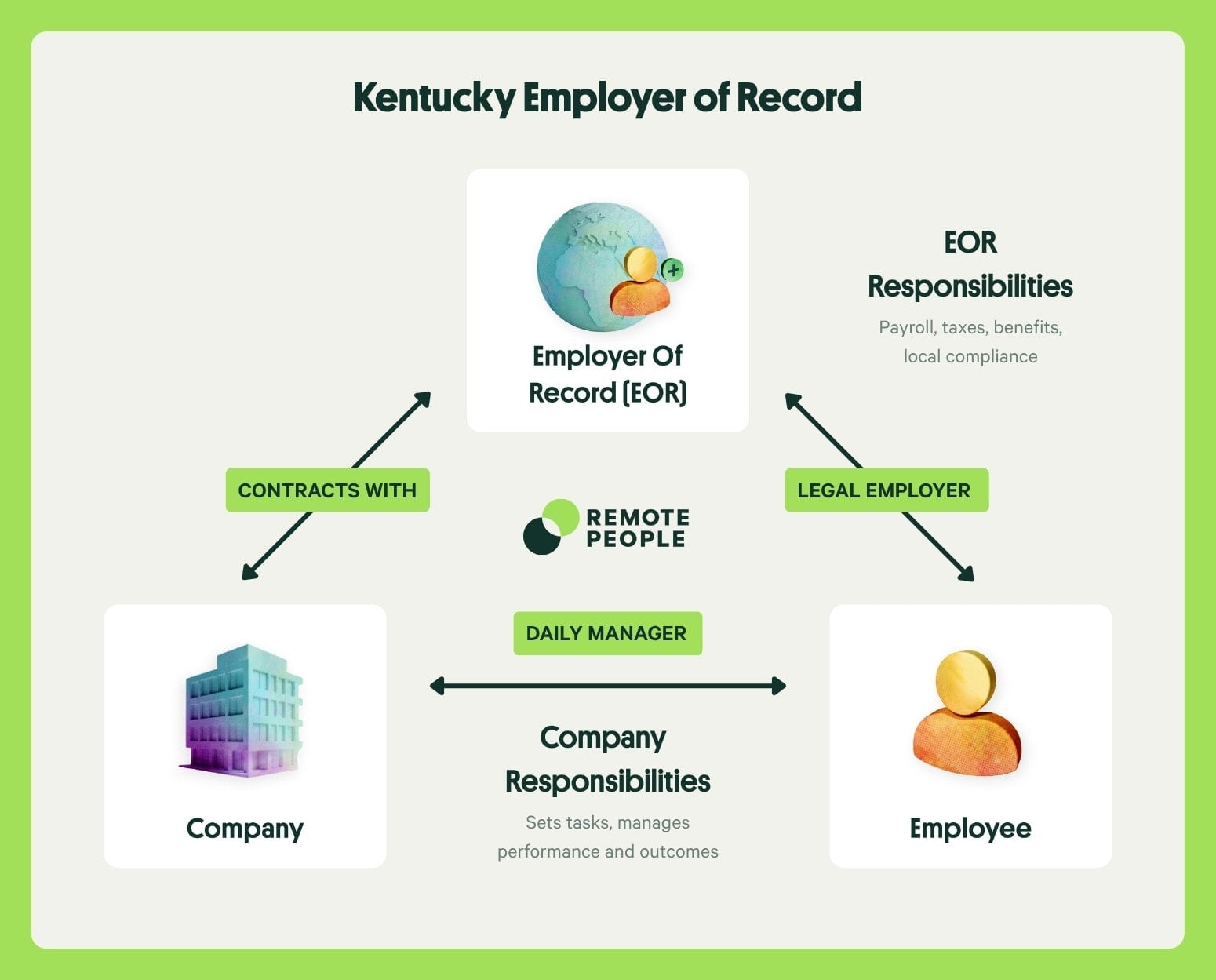
A Kentucky employer of record (EOR) is a third-party service provider based in the state that helps companies hire, pay, and manage employees without a legal entity. They act as your official employer “on paper,” but you still retain managerial control over your employee’s performance and job duties. This setting is best if you are a foreign employer in another country or state with little to no idea of how the labor law works in Kentucky.
What is an EOR can help explain how this employment model works in more detail.
An EOR in Kentucky also helps you to manage every other vital aspect of your employment lifecycle, such as state-specific payroll, taxes, benefits, onboarding, and even offboarding. This way, you can take a huge chunk of the administrative tasks off your shoulders (or that of your HR team) and focus on building your business.
What Is the Difference Between a Kentucky EOR and a Kentucky PEO?
A Kentucky Employer of record takes full responsibility for the administrative and compliance tasks related to workers in the state. This includes drafting compliant employment contracts, withholding taxes and other relevant contributions, payroll management, benefits administration, and most importantly, ensuring that your activities comply with Kentucky and federal labor laws.
The entire process is automated. Once you become a client, you can evaluate potential hires for the role on the platform, submit their details, approve the employment terms, and initiate onboarding. The EOR generates a compliant contract, handles new-hire documentation, sets up payroll, and manages tax filings. All of these are handled compliantly while you focus on your business.
A professional employer organization is way different. Rather than handing off all your employer rights to them, they only handle a part of your HR duties. Simply put, they operate a co-employment model where you retain legal responsibility as the employer while they oversee administrative tasks such as payroll & tax filing, creating benefits package creation, and talent management. You are also likely to find PEOs in Kentucky that offer full HR solutions, including HR compliance support and risk management.
What this means in practice is that if you already have an HR team in your company but need help managing workers across different states, or don’t have knowledge of Kentucky labor law, hiring a PEO can help them transition smoothly without issues. However, you’ll need to set up a local legal entity first.
Start hiring with a Kentucky EOR
Let us handle the complexities of hiring, compliance, and payroll in Kentucky while you focus on growing your team.
- Hire employees in Kentucky with a Kentucky EOR
- No local entity is needed
- Pricing starts at USD 199 per employee
- RemotePeople can also help you find the best talent in Kentucky
How Does a Kentucky EOR Work?
Here’s a simple step-by-step explanation of how a Kentucky employer of record works:
Draft a Compliant Employment Contract
The process starts with you finding a worker in the state. If you haven’t, you can work with a recruitment agency in Kentucky or go for an EOR that offers recruitment support. Once you’ve finally found a match for your role, enter their details on the EOR platform to create a compliant employment contract.
There are three major types of employment contracts in Kentucky:
- At-will employment contract: Kentucky is a “work at will” state, which means both the employer and employee can terminate the employment at any time without cause (as long as it’s legal), except where a written contract or employee handbook policy states otherwise.
- Fixed-term contract: This type of contract outlines the specifics of an employment, including its terms, duration, compensation, and an early termination clause. Even though Kentucky is an “at-will” state, a fixed-term written contract overrides the default at-will rule.
- Independent contractor agreement: This type of contract outlines the work terms of between the employer and a contractor. It includes the work responsibilities, compensation, and termination clauses.
Then, the EOR will send the contract to your candidate for signature. When they sign and return the contract, they become officially hired by the EOR.
Set up Payroll with State Registrations
Now that the candidate is legally hired, the next step is to onboard them and set up payroll. You can create pre-boarding workflows to send welcome messages and send training modules after they accept the offer.
Also, Kentucky has a flat state income tax and Unemployment Insurance (UI) program that you must deduct and remit to the Kentucky Department of Revenue. But first, you need to register for your own payroll with the Kentucky Department of Revenue for the income tax and the Kentucky Office of Employment for the UI. Also, you need to register your business on the Kentucky MyTaxes portal to remit taxes for you and your employee(s).
As in every US state, all your new hires must complete and submit Form I-9 on or before their first day of work to verify that they’re legally authorized to work in the United States.
Handle Tax Withholding and Remittances
As an employer, you’re responsible for withholding and remitting taxes from your employees’ wages or salaries. This includes calculating and withholding income tax and the social security from your employee’s paycheck. You also have to calculate and remit your own portion, including the state unemployment tax and social security contributions.
Administer Benefits
Next, your EOR designs a competitive employee benefits package. This includes health insurance, retirement plans, workers’ comp, and other supplementary perks such as private health insurance, retirement savings, and financial security.
Oversees Ongoing Compliance Management
Lastly, your EOR constantly monitors regulatory updates at the state and federal levels and updates your system in real-time. They also calculate and remit all mandatory withholdings to the state authorities as due. And in case you’re ready to dissolve a contract or expand to another state, they help you handle the entire process compliantly.
How Labor Laws Affect Hiring in Kentucky?
Minimum Wage & Overtime
The minimum wage in Kentucky, as of the time of writing this piece, is $7.25 per hour, in line with the federal standard. You can offer to pay your employees above this threshold based on their roles, the industry you operate in, or simply because you want to. Most of the time, it’s best to pay your employees more than the federal limit to attract top talent in the state. And if you can’t, you can make it up by offering supplementary perks like workers’ comp, paid time off, training, etc.
The Kentucky Government also permits workers in the state to work overtime. They use the 7th-day overtime law, which states that if an employee works every day in a single work week, the employer must pay them 1.5X their regular wage for the hours worked on the seventh day. Since the state uses a 40-hour workweek, any time outside this window is counted as overtime, and the employee must be duly compensated.
However, the law only applies to employees who exceed the 40-hour work time limit. Employees who work 7 days but do not exceed the 40-hour work limit are not entitled to any compensation. You’re only required to compensate employees who work more than 40 hours per week, regardless of the days worked.
If your employees receive more than $30 in tips per month, they’re considered “tipped employees” and don’t receive the same pay as everyone else. Instead, they receive $2.13 per hour if it equals the minimum wage after adding the tip. In cases when it doesn’t, you have to make up the difference.
Income Tax
Kentucky has a flat personal income tax of 3.5%. This tax is levied on income earned by Kentucky residents and on income earned in Kentucky by nonresidents. Employers are responsible for deducting and remitting the tax to the Kentucky Department of Revenue.
State Unemployment Insurance (SUI)
Kentucky Unemployment Insurance (UI) fund provides temporary financial assistance to people who lost their jobs due to layoffs or other circumstances beyond their control. This tax is managed by the Kentucky Office of Unemployment Insurance.
The employer fully bears the SUI in Kentucky, and the rate depends on the industry and history for unemployment claims. For new employers, the rate is 2.7% of your employee’s annual wages. Experienced employers are allowed to pay 0.3% – 9% based on the rate schedule A. Here’s a breakdown of the payments:
Employment History/Industry | Rate |
|---|---|
New employers | 2.7% |
New employers in construction | 9.0% |
Experienced employers | 0.3 – 9% |
Paying the SUI in full and on time makes you eligible for 90% off the Federal Unemployment Tax Act (FUTA) bill! For context, FUTA is the federal unemployment tax, and it is 6% on the first $ 7,000 of your employees’ taxable income. So, ensure you make your payments on or before the due date.
Paid Leave
Kentucky state law does not require employers to provide paid leave to employees, except in sensitive cases such as pregnancy, disability, or other qualifying medical conditions. Whether or not you provide paid leave to your employees depends on your company’s policy or contract terms. If it’s stated there, the law mandates that you comply accordingly.
However, all your employees are entitled to 12 weeks of unpaid, job-protected leave for family or medical reasons. This can be to take care of their spouse with a critical health condition, for childbirth, or for any other condition specified by the Family and Medical Leave Act (FMLA). For your employees to qualify, they must have worked consistently in your organization for 12 months and logged a minimum of 1250 hours. Also, you must have 50 or more employees who live within 75 miles of your organization.
In Kentucky, there’s no statutory law that mandates you to pay accrued leave to employees. Again, if it’s stated in the employment contract or part of your company’s policy, you need to keep your end of the deal to avoid legal issues. Ensure you have a clearly written policy that states whether your company pays out accumulated unused leave and the conditions that apply.
Workers' Compensation
Almost all the states in the US require employers to pay workers’ compensation, including Kentucky. In fact, you need to provide this benefit to full-time, part-time, temporary, and even family-member employees. This fund is used to provide medical treatment or financial support to workers who sustain injuries or illness on the job.
Termination and Final Pay
In Kentucky, you’re not allowed to dismiss workers without reason, unless you used the “at will” contract type. Upon termination, you must pay all wages or salary they earned on the day of dismissal or within 14 days thereafter. You must also include all the accrued and unused vacations as stated in your employment contract or company policy. This applies whether you terminated the contract or the employee left voluntarily.
Payroll Taxes and Employer Cost in Kentucky?
Kentucky is one of the tax-friendly states in the United States. Although they impose state income tax on residents and non-residents, their long-term goal is to eliminate it completely. Until then, here are the main taxes you need to be aware of:
Federal Payroll Taxes
The federal payroll tax in the US is the sum of the Social Security and Medicare taxes. This fund is used to finance healthcare, disability benefits, retirement, and survivor benefits.
The tax rate is 7.65% of the employee’s paycheck, and is split as follows:
Payroll tax | Rate |
|---|---|
Social security tax rate | 6.20% |
Medicare tax rate | 1.45% |
Total | 7.65% |
As an employer, you also need to contribute 6.2% of your employee’s paycheck to the payroll tax. The maximum amount taxable for you and your employee is $176,100.
Federal Income Tax
The federal income tax is used to finance social programs, foreign affairs, community development, and interest on national debt. The US follows a progressive income tax system, which means the total amount of income tax deductible depends on an individual’s income. That said, the higher your employee’s income, the higher the income tax. Employers in Kentucky are responsible for withholding and remitting this tax from their employees’ gross pay.
Here’s a breakdown of the tax rate:
Tax Income | Tax Rate |
|---|---|
$0 – $11,925 | 10% |
$11,926 – $48,475 | 12% |
$48,476 – $103,350 | 22% |
$103,351 – $197,300 | 24% |
$197,301 – $250,525 | 32% |
$250,526 – $626,350 | 35% |
$626,351+ | 37% |
If you have married employee(s) in your organization, they can choose to file separately or together, and this affects the tax rate. Employees who are the head of their household have different tax rates as well. You can check out the breakdown here.
State Income Tax Withholding
Kentucky imposes a state income tax of 3.5% on all income for Kentucky residents and income earned in the state for non-residents.
SUI Contributions
Employers in Kentucky have to pay state Unemployment Insurance. This tax is managed by the Kentucky Office of Unemployment Insurance and is used to provide temporary income to individuals who lost their jobs.
The amount payable depends on your industry and history of paying unemployment claims. For instance, if you’re a new employer in the state with at least two employees, you need to pay 2.7% of their annual paycheck. This rate applies to wages up to $12000 per employee per year. So, say your employee earns $30000 per year, your contribution would be: $12000 * 2.5% = $324/year
Here’s a breakdown of the payments:
Employment History/Industry | Rate |
|---|---|
New employers | 2.7% |
New employers in construction | 9.0% |
Experienced employers | 0.3% – 9% |
Workers Compensation Premiums
Kentucky has a mandatory workers’ compensation premium, and as an employer in the state, you need to provide this benefit to your employees. The fund is managed by the Kentucky Department of Workers’ Claims (DWC).
Workers’ comp is considered the “exclusive remedy” for affected workers. This means you provide protection for your workers in exchange for their right to file a lawsuit if they sustain injuries on the job. The workers’ comp can be half of their wages, cover all medical bills, or offer a better job after they’ve fully recovered. By law, you’re mandated to display the workers’ compensation notice in a visible area of your workplace so that your employees can easily access the information about their rights and what to do when injured.
Not paying workers’ comp premiums can lead to civil penalties of up to $1,000 per employee affected. Your employees can also file a lawsuit when they get injured at work and are not compensated.
While workers’ comp premiums are compulsory, farm workers, domestic servers working in a home with fewer than 2 full-time employees, and home management staff employed for 20 days or more are exempt from the mandatory coverage.
Also, your employee can choose to waive their coverage by signing Form 4, the Employee’s Notice of Rejection of the Workers’ Compensation Act. But it must be voluntary, not a condition of employment. You can read the full details here.
Payroll Tax Example
Let’s say your employee, Sarah, earns $3000 per month. The total payroll tax is calculated as:
Component | Rate | Amount |
|---|---|---|
Gross Pay | — | $3,000.00 |
Social Security Tax | 6.20% | $186.00 |
Medicare Tax | 1.45% | $43.50 |
Federal Income Tax (per Form W-4) | — | $250.00 |
State Income Tax | 3.5% | $105.00 |
Total Deductions | $584.50 |
Sarah’s net take-home pay is $2,415.50 per month, excluding other pre-tax withholdings.
If your employees contribute to any other pre-tax withholdings, such as retirement plans, 401(k) s, or FSA (Flexible Spending Accounts), deduct those contributions before other payroll taxes. You can use the RemotePeople payroll tax calculator to know how much you’re expected to pay in total.
Employee Classification Rules in Kentucky
Misclassification of workers is a serious offense in Kentucky. Employers found guilty will face tax penalties and interests, and costly lawsuits if the worker is injured on the job.
By law, an independent contractor is someone you hire for a role not related or connected to your business. This person operates independently and you have no control how they perform the work. An employee, on the other hand, is someone who doesn’t have employees, and does the work you’re supposed to do. If you’re in doubt, contact the office of Unemployment Insurance in Kentucky or partner with an EOR.
What Makes Hiring in Kentucky Unique?
Kentucky is an “at-will” state, which gives you hiring flexibility as an employer. For instance, say you want to test the Kentucky market before expanding your footprint in the state. You can quickly hire one or two employees using an EOR in Kentucky and dissolve the partnership if things don’t meet your expectations, as long as your reason is legal. The system favors employees, too. Kentucky is a “right-to-work state,” which means employers can’t force employees to join a union as a condition of employment.
Other benefits of hiring here are:
Favourable Business Climate
Kentucky ranks among the states in the US with a low cost of doing business. Companies in the state enjoy low industrial electricity costs, approximately 17% lower than the national average!
Access to a Large, Skilled Workforce
The state is located at the center of a 34-state distribution in the eastern part of the US, giving you access to two-thirds of the US population. Also, Kentucky also offers free workforce recruiting and training assistance for new and old employees to help them serve you better. Currently, they are investing $100 million to expand and create new workforce training facilities across the state.
Tax-friendly Rate
Kentucky levies a flat 5% corporate income tax on all corporations doing business in the state or earning income from sources within the state. They’re also working to eliminate personal income tax (the tax dropped from 4.0% in 2025 to 3.5% in 2026) to simplify compliance for workers and business owners.
What Are the Benefits of a Kentucky Employer of Record?
Using an EOR in Kentucky offers several advantages for companies looking to hire in the state without setting up a local entity. Some of these benefits are:
- Requires No Entity Set-Up: To do business in Kentucky as a foreigner or out-of-state employee, you need to establish a physical presence or a local entity. An EOR helps you skip this step totally. This makes it faster for you to begin operations in the state.
- Fastracks Employee Onboarding Process: Employee onboarding can take several weeks to a month to be completed. A Kentucky EOR already has customizable, pre-built onboarding workflows to get your employees up and running quickly without your oversight.
- Makes It Easy To Oversee And Manage Compliance: Kentucky has its own labor rules, payroll, and tax requirements that you must adhere to if you want to do business in the state. An EOR helps you keep track of everything at the state and federal levels so that you can focus on your business. This includes managing employees’ compensation requirements, calculating and remitting payroll taxes, and administering unemployment insurance.
- Reduces The Possibilities of a Legal Risk: Violations of state and federal labor laws can result in fines and lawsuits by affected employees. By partnering with a Kentucky EOR, you transfer a huge chunk of the legal responsibility to them while you focus on business growth.
- Makes It Easy to Scale Across Multiple States: If your growth strategy extends beyond Kentucky, an EOR with multi-state expertise makes it easy for you to scale.
What Are the Downsides of a Kentucky EOR?
Here are the disadvantages of using a Kentucky EOR:
- The Service Fee Might Be High For Small Business Owners: Partnering with an EOR isn’t cheap. If you’re a start-up or small business owner who is looking to hire one or two employees in Kentucky, the monthly and setup fees may strain your budget. Better, you can go for EORs like RemotePeople that offer employee-based payment models.
- Gives You Less Control Over Payroll Management: Since the EOR is your legal employer, you have little control over your employee management. There are EORs with fixed templates that are hard to customize based on your company’s terms or policies. To avoid this, ensure you check out the features, or better, sign up for their free trials to see how things work before making an investment.
How to Choose a Kentucky Employer of Record?
Here are some features to look out for when sourcing an EOR in Kentucky:
Transparent Pricing
Always check the EOR’s pricing package to ensure they offer the core services you need and have no hidden fees. RemotePeople, for instance, charges a flat rate of $199/employee.
Direct EOR
The EOR must have directly owned entities in Kentucky, and not partners. This way, you have quick access to help when you need it. Also, directly-owned entities mean your data is not passed through multiple third parties.
US Multi-state Expertise
Kentucky labor laws differ from those in Idaho. If you plan to expand your footprint into other states as well, you need an EOR that has entities in most, or even better, all of the US.
Dedicated Support
Also, your EOR must provide quality support that understands your company’s unique needs and is ready to address your concerns promptly. RemotePeople clients, for instance, get a dedicated in-state human account manager that is assigned to them upon signup. This is to ensure they get personalized support for faster, easier resolution. This is why we were ranked #1 on G2 for support!
Strong Compliance Track Record
Your EOR will act as your legal employer, and by extension, manage all administrative and legal activities related to employment. Any slight mistake can expose your company to fines, audits, and worse, reputational damage. So, ensure the EOR has a strong compliance track record. You can also check out for compliance certifications, such as SOC 2, ISO 27001, and GDPR.
Engage a Kentucky Employer of Record with RemotePeople
Now you’re all set!
This article contains all the details you need to hire employees in Kentucky. Take advantage of an EOR to help you hire workers faster, simplify compliance, and oversee your entire employment lifecycle while you focus on your business growth. If you’re not sure where to start, reach out to us at RemotePeople. We provide Kentucky EOR solutions designed to help you build your team in the state.
Employer of Record in
Employer of Record in
Employer of Record in
Employer of Record in
Employer of Record in
Employer of Record in
Employer of Record in
Employer of Record in