
 Recruit
Employer of Record in South Carolina
-
 Drew Donnelly
- Published
- July 22, 2026
South Carolina’s employment law includes state unemployment insurance and workers’ comp, and an SC EOR handles payroll, taxes, and full state compliance with no local entity needed.
Hire in South Carolina — book a free 30-minute demo
Tell us what you need. You'll get a tailored, transparent proposal within 24 hours, plus a free call to walk through it.
Tell us about your company
So we can match you with a specialist who knows your market — and unlock volume pricing tiers.
* All fields are required.
Where and when are you hiring?
Tell us the geography and timing and we'll quote each country line by line, with onboarding timelines.
* All fields are required.
Help us beat your current setup
We'll benchmark your current deal and send a line-by-line proposal in 24 hours — showing exactly where we cut cost, time, or risk. After you submit, you can book a call to walk through it together.
* All fields are required.
Thanks! Your proposal is on its way.
Expect a tailored, line-by-line proposal in your inbox within 24 hours. In the meantime…
Want to walk through it together?
Book a free 30-minute call with one of our specialists. We'll explain every line, answer your questions, and tailor the proposal further if you need.
No obligation. Pick a time that works for you.








- Hire in South Carolina — book a free 30-minute demo
- Tell us about your company
- Where and when are you hiring?
- Help us beat your current setup
- Thanks! Your proposal is on its way.
- South Carolina Employer of Record
- What Is the Difference Between a South Carolina Employer of Record and a South Carolina PEO?
- How Does a South Carolina Employer of Record Work?
- How Labor Laws Affect Hiring in South Carolina?
- Payroll Taxes and Employer Costs in South Carolina
- Employee Classification Rules in South Carolina
- What Makes Hiring in South Carolina Unique?
- What Are the Benefits of a South Carolina Employer of Record?
- What Are the Downsides of a South Carolina Employer of Record?
- How to Choose a South Carolina Employer of Record?
- Engage a South Carolina Employer of Record with RemotePeople
- Related EOR Destinations

Let RemotePeople handle payroll, compliance, and HR admin worldwide so you can focus on building your team.
Key Takeaways:
- South Carolina offers performance-based incentives, including Jobs Tax Credits, Investment Tax Credits, and discretionary grants through the Coordinating Council for Economic Development.
- An Employer of Record (EOR) lets you hire in South Carolina without setting up a local entity. The EOR becomes the legal employer, handles payroll, taxes, unemployment insurance, and compliance, while you control daily work and decisions.
- South Carolina follows at-will employment rules and has flexible final pay requirements. Employment can end at any time for any legal reason, with no notice required.
- South Carolina is business-friendly with low regulation, right-to-work laws, competitive costs, a skilled workforce, and strong incentives for companies expanding into the state.
South Carolina has built a reputation as one of the Southeast’s most welcoming states for business, and the numbers back it up. The 2025 Rich States, Poor States index places it 8th nationally in economic performance, and the Fraser Institute’s Economic Freedom of North America report puts it among the top performers in overall economic freedom.
Right-to-work laws, low union presence, fast permitting, and strong public-private collaboration have helped the state land major investments across multiple industries year after year.
The economy is broad and growing. Advanced manufacturing, automotive, aerospace, logistics, agribusiness, electric vehicles, clean energy, and technology are all active sectors. BMW and Boeing have significant operations here.
The port infrastructure, particularly through Charleston, makes the state a serious logistics hub for the entire region. The wages are moderate, real estate outside the major metros is affordable, and the overall tax burden sits well below most coastal states.
In this guide, we’ll walk through what an Employer of Record is, South Carolina’s state labor laws, and what to look for when choosing an EOR partner.
South Carolina Employer of Record
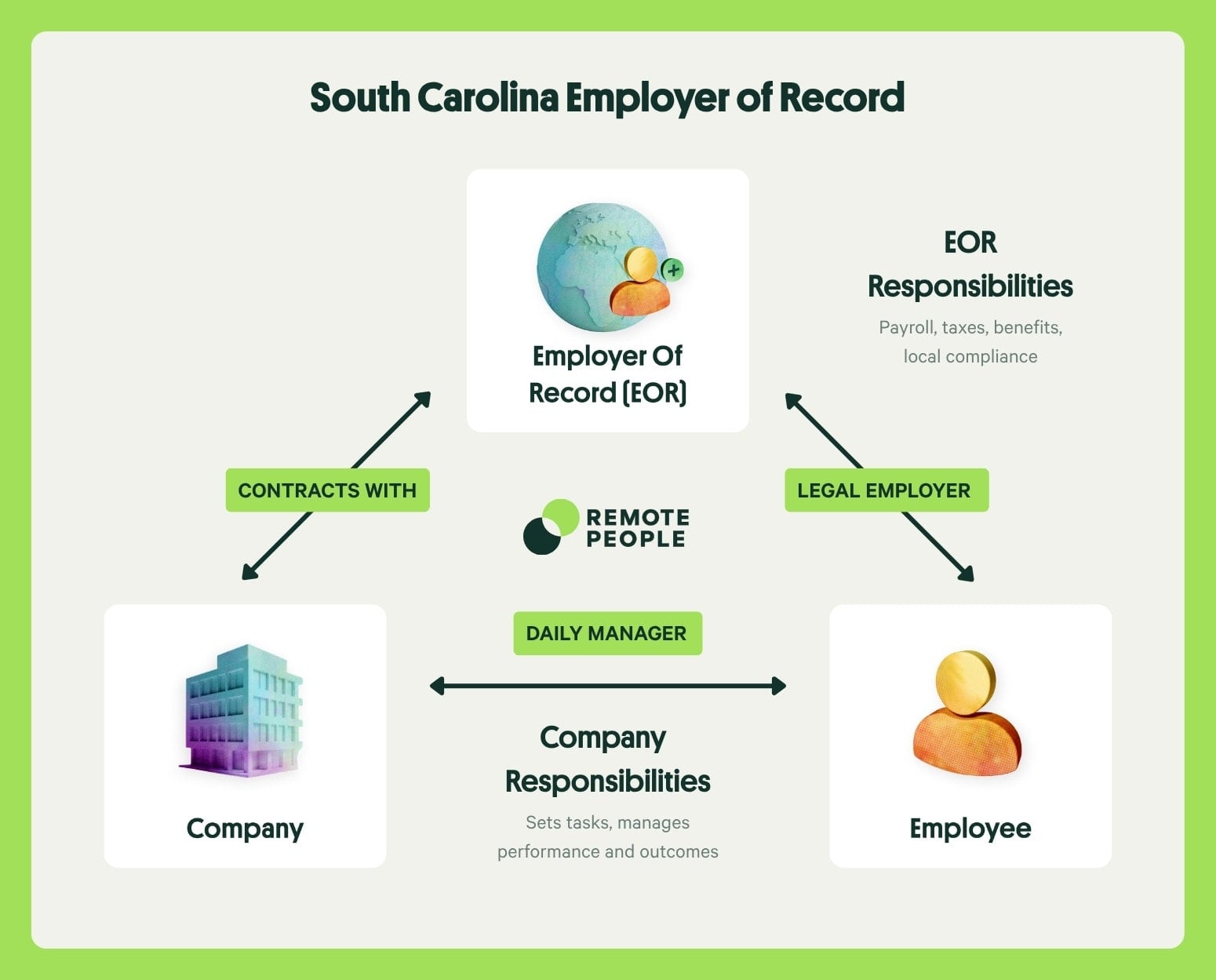
An Employer of Record in South Carolina takes on the legal employer status for your workers in the state. You handle the work direction, performance management, and business decisions, while the EOR handles everything that comes with being the employer of record under South Carolina and federal law.
What is an EOR can help explain how this employment model works in more detail.
That basically means running payroll, withholding and remitting federal and state income taxes, managing unemployment insurance contributions, securing workers’ compensation coverage, and keeping up with the state’s wage and hour requirements.
The EOR also files the quarterly and annual reports required by the South Carolina Department of Revenue and the Department of Employment and Workforce, so those obligations never land on your desk.
The appeal for most companies is simple. Setting up a legal entity in a new state is not fast or cheap. You need a state tax ID, unemployment insurance accounts, and a working understanding of local compliance requirements before you can pay anyone legally.
An EOR skips all of that because it already has the infrastructure in place. You can have someone hired, onboarded, and on payroll within days of making an offer. And because the EOR is the legal employer, the liability that comes with that status, including exposure to wage claims, misclassification disputes, tax penalties, and workers’ comp issues, transfers away from your company.
For businesses entering the U.S. market, scaling quickly, or testing a new region without committing to a full entity setup, that combination of speed and protection is hard to beat.
What Is the Difference Between a South Carolina Employer of Record and a South Carolina PEO?
Professional Employer Organization(PEOs) and Employer of Record(EORs) are often mentioned in the same breath, but they are different products built for different situations. Understanding which one fits your circumstances matters before you sign anything.
A PEO works through co-employment. That means both the PEO and your company share employer status, and in most cases, you need to already have a legal entity in South Carolina for the arrangement to work.
PEOs tend to serve established domestic businesses that want help managing HR administration, benefits, and payroll processing without fully outsourcing employer liability.
An EOR, on the other hand, is structured differently. It becomes the sole legal employer, takes on full liability, and does not require you to have any existing entity in the state. That matters for companies that are new to South Carolina, whether they are foreign businesses entering the U.S. for the first time or domestic companies expanding into the state without an established presence.
The EOR model is faster to set up, carries cleaner liability boundaries, and requires far less infrastructure on your end.
Start hiring with a South Carolina EOR
Let us handle the complexities of hiring, compliance, and payroll in South Carolina while you focus on growing your team.
- Hire employees in South Carolina with a South Carolina EOR
- No local entity is needed
- Pricing starts at USD 199 per employee
- RemotePeople can also help you find the best talent in South Carolina
How Does a South Carolina Employer of Record Work?
Compliant employment contract
The EOR drafts and signs an employment contract built around South Carolina law and federal requirements. It addresses at-will employment, compensation, overtime, and any applicable restrictions, while leaving the day-to-day management of the role entirely with you.
Payroll setup with correct state registrations
Before the first paycheck goes out, the EOR confirms its registrations with the South Carolina Department of Revenue for income tax withholding and with the Department of Employment and Workforce for unemployment insurance. These are already in place on the EOR’s end, which is what makes same-week hiring possible.
Tax withholding and remittance
Every payroll run accounts for federal deductions, including Social Security, Medicare, and federal unemployment tax. The EOR sends the right amounts to the right agencies on schedule and manages all required filings.
Benefits administration
Health insurance, dental coverage, retirement plans: if you offer them, the EOR manages enrollment, maintains records, and handles required notices when employment ends. Workers’ compensation coverage is also arranged through the EOR, covering your employees in the event of a workplace injury.
Ongoing compliance management
Tax rates change, reporting deadlines shift, and classification rules get updated. The EOR tracks all of it and adjusts your payroll and processes accordingly. When someone leaves, they handle the final paycheck correctly. When an audit comes up, they manage it. The compliance work runs continuously in the background, so you do not have to follow it yourself.
How Labor Laws Affect Hiring in South Carolina?
South Carolina keeps its employment law framework relatively close to the federal baseline, which is genuinely useful for employers managing teams across multiple states. That said, there are a few things that are worth knowing in detail.
Minimum Wage and Overtime
South Carolina is one of a small number of states that has no state minimum wage law of its own. The federal floor of $7.25 per hour applies as a result.
For tipped workers, the federal cash wage of $2.13 per hour applies, with the employer responsible for making up any shortfall if tips do not bring total earnings to $7.25.
Overtime works the same way it does federally. Non-exempt employees earn 1.5 times their regular rate for hours beyond 40 in a workweek. However, no daily overtime rule applies, and exemptions follow the federal Fair Labor Standards Act(FLSA).
Income Tax
Unlike some states that have moved to a flat rate, South Carolina still uses a graduated income tax structure. The top marginal rate sits at 6.2% for 2026, with a temporary reduction to 6% only through June 30, 2026. Employers withhold from both resident wages and from non-residents earning income in the state, remitting to the South Carolina Department of Revenue on a quarterly and annual basis.
State Unemployment Insurance (SUI)
New employers typically start at 1.0% on the first $14,000 of each employee’s wages per year. That taxable wage base is notably lower than many other states, which keeps the dollar cost of SUI contributions relatively contained.
After the first year, rates shift based on your claims history, with the range running from 0.06% to 5.46% for 2026. There is no solvency surcharge in effect. Contributions go to the Department of Employment and Workforce on a quarterly schedule.
Paid Leave
South Carolina does not require private employers to offer paid leave of any kind. No state mandate exists for paid sick days, paid family leave, or general paid time off.
However, the federal Family and Medical Leave Act(FMLA) still applies if you have 50 or more employees, providing up to 12 weeks of unpaid, job-protected leave for qualifying family and medical reasons. Beyond that, what you offer in terms of paid leave is a business decision, not a legal requirement.
Workers' Compensation
Coverage is mandatory for most employers with four or more employees, which is a slightly higher threshold than in some neighboring states. There is no exclusive state fund; coverage comes through private carriers with premiums that vary significantly based on industry risk classification.
The South Carolina Workers’ Compensation Commission oversees the program. The maximum weekly compensation rate is set at approximately $1,189.94, based on two-thirds of the state’s average weekly wage.
Termination and Final Pay
South Carolina employers operate under at-will employment, which means the working relationship can end at any time, on either side, for any lawful reason. No notice is required unless a contract creates that obligation. In practice, many employers give notice anyway, but there is no legal requirement to do so.
However, at-will employment has limits worth understanding. Federal and state anti-discrimination protections apply regardless of employment status. Ending someone’s job because of race, sex, age, disability, religion, national origin, or another protected characteristic is not permitted.
Neither is terminating someone in retaliation for filing a complaint, reporting a safety issue, or exercising a legal right. At-will covers the broad middle ground of business decisions, but it does not protect decisions driven by discrimination or retaliation.
Final pay in South Carolina works on a tighter timeline than many employers expect. Wages must be paid within 48 hours of termination or by the next regular payday, whichever comes first, though the total window cannot exceed 30 days. For employees who resign voluntarily, the next regular payday is the standard. This is a shorter window than some states offer, and missing it carries meaningful consequences.
On unused Paid Time Off(PTO), the state defers entirely to employer policy. If your written policy promises a payout of accrued vacation or PTO at termination, you are bound by that commitment. If your policy is silent on the question, courts have generally read silence as an obligation to pay. If you want to avoid that payout, you need a clear and properly communicated forfeiture clause in your policy documents. Vague or inconsistent policies create exposure here.
The penalty for late or unpaid final wages is severe here. South Carolina law allows for triple damages on unpaid amounts, in addition to interest, court costs, and attorney fees. A delayed final check is a liability that can grow quickly.
An EOR can manage the offboarding process thereby eliminating this risk entirely.
Payroll Taxes and Employer Costs in South Carolina
One of South Carolina’s genuine advantages for employers is that the overall payroll tax burden is fairly contained. The federal layer is the same everywhere: Social Security at 6.2% up to the annual wage cap, Medicare at 1.45% with no ceiling, and Federal Unemployment Tax Act(FUTA) at up to 6% on the first $7,000 of wages per employee.
Most employers who stay current on state unemployment contributions get a credit that brings the effective FUTA rate down to 0.6%.
The state costs add relatively little on top. The SUI taxable wage base of $14,000 is lower than most states, which means your unemployment contributions cap out earlier in the year. Workers’ comp rates vary by job type but are competitive for office and administrative roles.
| Cost Category | Description | Estimated Employer Cost |
|---|---|---|
| Federal Insurance Contributions Act (FICA) | Social Security and Medicare (employer share) | ~$7,650 |
| Federal Unemployment Tax Act (FUTA) | After state credit applied | ~$42 |
| State Unemployment Insurance (SUI) | 1% on $14,000 taxable wage base | ~$140 |
| Workers’ Compensation | Varies by job classification and carrier (office/administrative rates are competitive) | $400–$900 |
Total employer overhead, excluding voluntary benefits, is around 8 to 11 percent above base salary. That sits at the lower end of the range you will find across U.S. states, and it reflects a tax structure that was designed with cost competitiveness in mind.
Employee Classification Rules in South Carolina
South Carolina takes a practical approach to worker classification, applying tests that are more flexible than the stricter frameworks used in states like California.
For wage and hour purposes under the FLSA, the state follows the federal economic reality test. This looks at the whole picture of the working relationship: how much control the company exercises, whether the worker operates independently and takes on financial risk, how permanent the arrangement is, whether the worker has invested in their own equipment, and whether the work is a core part of the company’s business. The test is meant to reflect economic reality rather than just contractual labels.
For unemployment insurance and workers’ compensation, South Carolina applies a common law right-to-control test. In practice, this often comes down to four factors: whether the employer has the right to control the work and actually exercises it, how the worker is paid, whether the employer supplies equipment, and whether the employer has the right to terminate.
The state does not use California’s ABC test, which significantly reduces the risk of unintentional misclassification. But the risk is never zero. Misclassifying an employee as a contractor can mean back taxes, unpaid wages, penalties, interest, and audits from the IRS, the Department of Labor, the South Carolina Department of Revenue, or the Department of Employment and Workforce.
An EOR sidesteps most of this exposure by bringing workers on as employees from day one and maintaining documentation that holds up if questions are ever raised.
What Makes Hiring in South Carolina Unique?
South Carolina is a different kind of business environment than you might expect if you have not spent time there. It has a serious industrial base. BMW’s U.S. manufacturing headquarters is in Spartanburg. Boeing assembles 787 Dreamliners in North Charleston. The Port of Charleston is one of the fastest-growing container ports on the East Coast. These are not small operations, and they have shaped a workforce culture and training infrastructure that runs deep in certain parts of the state.
What that means practically is that you can find genuinely skilled workers in advanced manufacturing, logistics, and aerospace without going to a major coastal city. The talent exists in mid-size markets that most companies overlook.
Also, the incentive structure is worth taking seriously. The Jobs Tax Credit program offers per-job credits that scale with where in the state you hire and how many jobs you create. Investment Tax Credits reward capital spending. The Coordinating Council for Economic Development has discretionary grant authority for significant projects. Companies that engage with the state’s economic development apparatus early in their planning process often find meaningful financial support available.
The tax picture is also predictable. A top income tax rate of 6.2% for 2026, low corporate tax rates, and a regulatory environment that does not add unnecessary layers on top of federal requirements make it straightforward to model your employment costs.
The state actively wants businesses to come in and stay, and that shows in how the compliance framework is structured.
What Are the Benefits of a South Carolina Employer of Record?
- No entity setup required: You skip business registration, state tax ID applications, unemployment account setup, and all the compliance groundwork that comes with forming a new entity. The EOR has it handled already.
- Faster onboarding: You can hire and pay compliant employees in South Carolina within days. The EOR’s existing registrations and processes cut out the months of setup that would otherwise come first.
- Centralized compliance: An EOR covers payroll taxes, unemployment filings, workers’ comp, wage laws, and required state and federal reporting.
- Reduced legal risk: The EOR is the legal employer, which means they carry the liability for employment taxes, wage claims, misclassification issues, and compliance violations. That exposure moves off your plate entirely.
- Scalable across multiple states: Add employees in South Carolina and other states through the same partner without forming separate entities or building state-specific expertise in-house.
What Are the Downsides of a South Carolina Employer of Record?
The cost is the honest answer. EORs charge either a percentage of payroll or a flat monthly fee per employee, and that adds to your total employment expense compared to running payroll directly. You also give up some control over how payroll is timed and processed, since the EOR’s systems govern the mechanics.
Whether that cost is worth it depends on your situation. For most companies entering South Carolina without an existing entity, the fees are easily justified because you avoid months of setup work, the risk of compliance errors, potential penalties, and managing payroll and filings in-house.
At some point, if your team in the state grows large and stable enough, bringing everything in-house starts to make financial sense. Until that point, the EOR is usually the more practical and cost-effective option.
How to Choose a South Carolina Employer of Record?
Transparent pricing
Look for clear upfront fees with no hidden charges or surprise add-ons. You should know your total cost of employment before you commit. Compare pricing structures carefully so you understand what services are included and which may cost extra later.
Direct EOR model
Choose a provider that operates directly rather than routing work through subcontractors. Direct providers mean clearer accountability and faster resolution when something goes wrong. This also helps ensure more consistent communication and service quality throughout the employment process.
U.S. multi-state expertise
Make sure they have real working experience managing payroll, tax filings, and compliance across multiple states, with specific knowledge of South Carolina’s requirements. Providers with broader U.S. expertise are often better equipped to handle employee relocations or future expansion plans.
Dedicated support
There should be real people available for onboarding questions, payroll issues, and compliance concerns. A responsive account manager matters more than a ticketing system when you encounter issues. Fast, knowledgeable support can prevent small administrative problems from becoming costly delays.
Strong compliance track record
Look for clean filing history, regular audits, appropriate insurance coverage, and references from existing clients who can speak to the experience directly. A proven compliance history reduces the risk of penalties, worker classification issues, and payroll disruptions.
Engage a South Carolina Employer of Record with RemotePeople
An Employer of Record in South Carolina handles compliant employment contracts, payroll, federal and state tax withholding, benefits administration, and all required filings.
They do this so you can keep full day-to-day control over the employee’s work and performance without the need for a local entity needed.
And if you’re ready to hire in South Carolina right now, RemotePeople provides direct EOR service starting at $199 per month per employee. Reach out to us today!
Employer of Record in
Employer of Record in
Employer of Record in
Employer of Record in
Employer of Record in
Employer of Record in
Employer of Record in
Employer of Record in




