Recruit
Employer of Record (EOR) in West Virginia
-
 Drew Donnelly
- Published
- July 22, 2026
West Virginia’s employment law includes state unemployment insurance, workers’ comp, and wage rules, and a West Virginia EOR handles payroll and state compliance with no local entity needed.
Hire in West Virginia — book a free 30-minute demo
No sales call required. Free 30-minute expert call if you want one.
Tell us about your company
So we can match you with a specialist who knows your market — and unlock volume pricing tiers.
* All fields are required.
Where and when are you hiring?
Tell us the geography and timing and we'll quote each country line by line, with onboarding timelines.
* All fields are required.
Help us beat your current setup
We'll benchmark your current deal and send a line-by-line proposal in 24 hours — showing exactly where we cut cost, time, or risk. After you submit, you can book a call to walk through it together.
* All fields are required.
Thanks! Your proposal is on its way.
Expect a tailored, line-by-line proposal in your inbox within 24 hours. In the meantime…
Want to walk through it together?
Book a free 30-minute call with one of our specialists. We'll explain every line, answer your questions, and tailor the proposal further if you need.
No obligation. Pick a time that works for you.








- Hire in West Virginia — book a free 30-minute demo
- Tell us about your company
- Where and when are you hiring?
- Help us beat your current setup
- Thanks! Your proposal is on its way.
- West Virginia Employer of Record
- What Is the Difference Between a West Virginia Employer of Record and a West Virginia PEO?
- How Does a West Virginia Employer of Record Work?
- How Labor Laws Affect Hiring in West Virginia?
- Payroll Taxes and Employer Cost in West Virginia
- Employee Classification in West Virginia
- What Makes Hiring in West Virginia Unique?
- What Are the Benefits of a West Virginia Employer of Record?
- What Are the Downsides of a West Virginia EOR?
- How to Choose a West Virginia Employer of Record?
- Engage a West Virginia Employer of Record with RemotePeople
- Related EOR Destinations

Let RemotePeople handle payroll, compliance, and HR admin worldwide so you can focus on building your team.
Key Takeaways:
- West Virginia offers a lower-cost labor environment but has a smaller talent pool compared to major U.S. markets.
- The state has a graduated personal income tax and requires employer withholding and unemployment contributions.
- Minimum wage is $8.75 per hour for most employers, with federal overtime rules applying.
- A West Virginia Employer of Record allows companies to hire without forming a local entity while managing payroll, tax, and compliance obligations.
Despite the similar name, West Virginia is a completely separate state from Virginia with its own legal system, tax structure, and employment regulations. Employers expanding into the U.S. often confuse it with neighboring Virginia, but the two jurisdictions operate independently and require separate registrations, payroll accounts, and compliance processes.
West Virginia’s economy is driven by energy, healthcare, advanced manufacturing, chemicals, logistics, and public sector employment. While traditional industries such as coal and natural resources remain important, the state has been investing in diversification, including aerospace components, automotive supply chains, and remote-capable professional services.
Doing business in West Virginia is generally a great idea, with lower wage levels and operating costs than most Eastern states. The workforce is, however, smaller and more geographically dispersed, which can affect hiring timelines for specialized roles.
From a regulatory perspective, West Virginia follows a moderate framework. It largely aligns with federal wage and overtime standards but maintains its own minimum wage, income tax system, unemployment insurance structure, and workers’ compensation requirements.
Because employers must register separately with the West Virginia State Tax Department and Workforce agencies before hiring, an Employer of Record can provide a faster and lower-risk way to build a presence in the state.
West Virginia Employer of Record
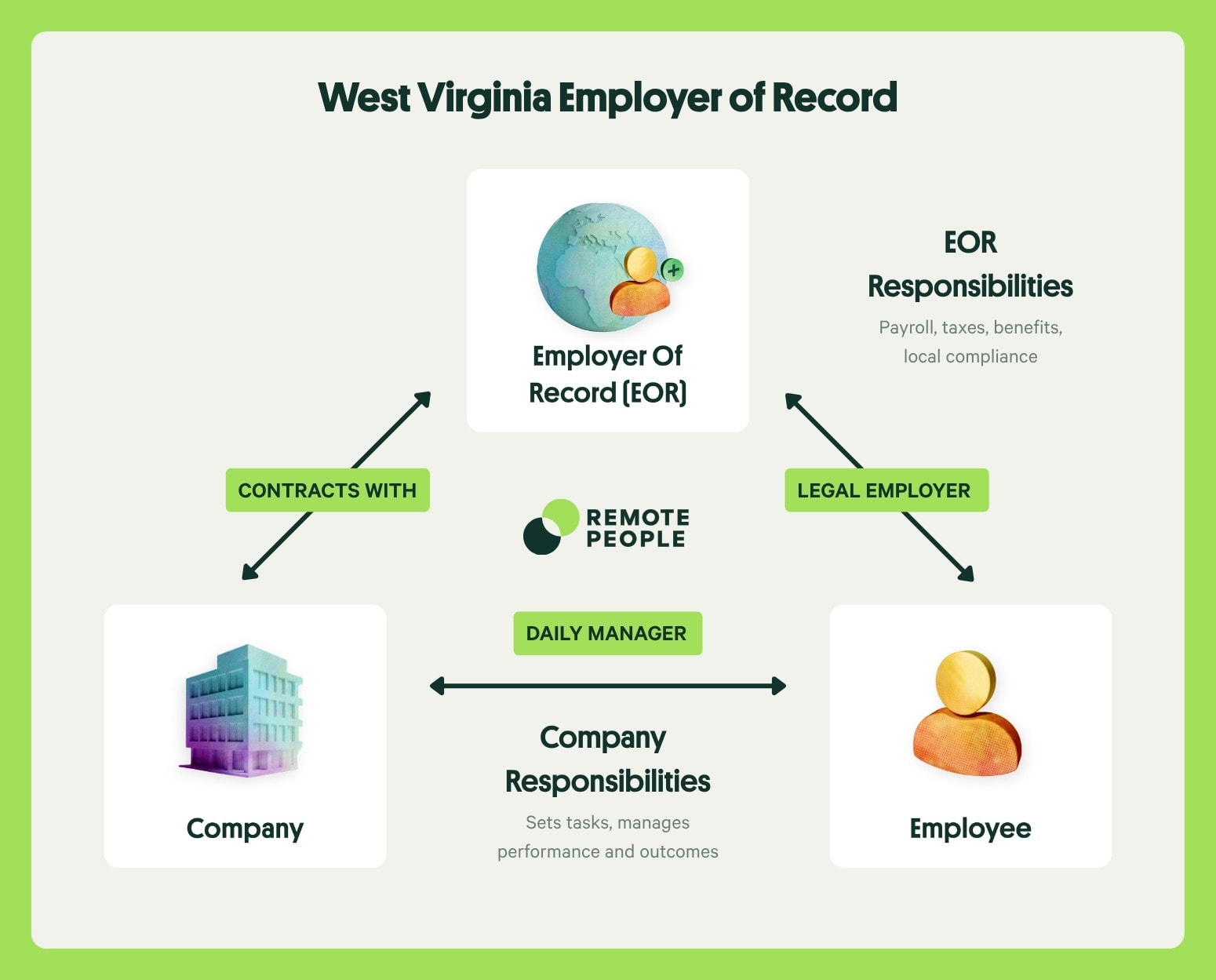
A West Virginia Employer of Record (EOR) is a third-party organization that legally employs workers on your behalf within the state.
What is an EOR can help explain how this employment model works in more detail.
The EOR becomes the official employer for payroll and tax purposes. It handles:
- Payroll processing and wage payments
- State and federal tax withholding and filings
- Unemployment insurance administration
- Workers’ compensation coverage
- Benefits administration and employment records
Your company continues to manage the employee’s day-to-day work, responsibilities, and performance.
Because the EOR assumes legal employment responsibility, it also takes on key compliance risks related to payroll taxes, wage laws, and statutory reporting. This allows companies unfamiliar with West Virginia regulations to hire quickly while reducing administrative exposure.
An EOR also removes the need to form a legal entity or register as a foreign business in West Virginia, significantly accelerating market entry.
What Is the Difference Between a West Virginia Employer of Record and a West Virginia PEO?
Both Employer of Record (EOR) providers and Professional Employer Organizations (PEOs) help companies manage payroll, benefits, and HR administration. The key difference is who legally employs the worker and who carries the compliance risk.
A PEO operates under a co-employment model. Therefore, your company must first establish and maintain a legal entity in West Virginia, register with the State Tax Department for income tax withholding, open an unemployment insurance account with WorkForce West Virginia, and secure workers’ compensation coverage. Once this structure is in place, the PEO can support payroll processing, benefits administration, and HR functions.
However, your organization remains the legal employer, and is responsible for worker classification decisions, compliance with West Virginia wage and hour laws, worker classification decisions, and unemployment claims.
While a PEO helps manage employment administration, it does not remove these underlying legal obligations.
An EOR works differently.
The EOR becomes the legal employer of record for your West Virginia-based staff. Because the provider already maintains the required state registrations and employment infrastructure, your company does not need to form a West Virginia entity or register with state agencies.
Under an EOR model, the provider manages everything.
- Payroll processing and tax remittance
- State income tax withholding and filings
- Unemployment insurance administration
- Workers’ compensation coverage
- Employment documentation and recordkeeping
- Ongoing compliance with state and federal labor laws
Your company continues to direct the employee’s day-to-day work and performance, while the EOR assumes the administrative burden and a significant portion of employment risk.
Though mostly used interchangeably in practice, a PEO is more suited for companies that already have an established U.S. presence and want administrative support for an existing workforce. For international organizations, early-stage U.S. expansion, or businesses hiring across multiple states, an EOR usually provides a faster, more flexible, and lower-risk path to employment in West Virginia.
Start hiring with a West Virginia EOR
Let us handle the complexities of hiring, compliance, and payroll in West Virginia while you focus on growing your team.
- Hire employees in West Virginia with a West Virginia EOR
- No local entity is needed
- Pricing starts at USD 199 per employee
- RemotePeople can also help you find the best talent in West Virginia
How Does a West Virginia Employer of Record Work?
A West Virginia Employer of Record manages the full employment process so companies can hire locally without building their own payroll and compliance infrastructure.
Once you select a candidate, the EOR issues an employment agreement that aligns with federal requirements and West Virginia labor standards. The provider then completes onboarding, confirms work authorization, collects required tax documentation, and activates the employee within its payroll system.
While your organization directs the employee’s day-to-day work and performance, the EOR handles the regulatory and administrative responsibilities. This includes maintaining active employer accounts with key state agencies, such as the West Virginia State Tax Department for income tax withholding and WorkForce West Virginia for unemployment insurance.
Each pay cycle is processed with the correct federal and state withholdings, employer tax contributions, and required filings. Equally important, the EOR monitors changes in West Virginia employment laws, tax rates, and reporting rules. This ongoing oversight allows companies to employ workers in the state without building internal expertise, managing multiple agency relationships, or tracking regulatory updates themselves.
How Labor Laws Affect Hiring in West Virginia?
Minimum Wage & Overtime
West Virginia’s minimum wage is $8.75 per hour for most employers, with legislation introduced to raise it to $11 by 2027. Smaller employers with fewer than six employees may be subject to the federal minimum wage of $7.25, and a training wage that is generally less than the state’s minimum wage may be paid to under-20-year-old workers during the first 90 days of their employment.
The state follows federal Fair Labor Standards Act (FLSA) rules for overtime. Non-exempt employees must receive overtime pay at 1.5 times the regular rate for hours worked beyond 40 in a workweek. There are no daily overtime requirements.
Income Tax
West Virginia applies a graduated personal income tax system with five brackets. For the 2023–2026 period, rates range from approximately 2.22% to 4.82%, with the top rate of 4.82% applying to taxable income over $60,000.
| Taxable Income | Tax |
|---|---|
| Not over $10,000 | 2.22% of taxable income |
| Over $10,000 but not over $25,000 | $222.00 plus 2.96% of the excess over $10,000 |
| Over $25,000 but not over $40,000 | $666.00 plus 3.33% of the excess over $25,000 |
| Over $40,000 but not over $60,000 | $1,165.50 plus 4.44% of the excess over $40,000 |
| Over $60,000 | $2,053.50 plus 4.82% of the excess over $60,000 |
The state calculates taxable income based on federal adjusted gross income (AGI), with specific West Virginia adjustments where applicable. Because the top bracket begins at a relatively moderate income level, many full-time employees will fall into the highest marginal rate.
Employers hiring in West Virginia must withhold state income tax from employee wages, file periodic withholding returns based on assigned frequency, and issue annual Forms W-2 reporting state wages.
Recent legislative changes have already reduced personal income tax rates, and additional reductions of 5% to 10% are under consideration for 2026. Employers should monitor these developments, as future rate changes may affect withholding calculations.
West Virginia does not tax Social Security benefits that are taxable at the federal level. In addition, some municipalities may impose local income taxes, which employers should account for where applicable.
State Unemployment Insurance (SUI)
West Virginia requires employers to contribute to SUI, an employer-paid payroll tax administered by WorkForce West Virginia, part of the Department of Commerce. The program provides temporary financial assistance to workers who lose their jobs through no fault of their own and meet eligibility requirements.
Employers must register for SUI through the West Virginia One Stop Business Portal and file tax reports quarterly. Contributions apply to the first $9,000 of wages per employee each year.
SUI rates vary based on the employer’s experience rating, which reflects the company’s history of unemployment claims. New employers are assigned an initial rate, while established businesses receive updated rate notices annually from WorkForce West Virginia.
| Employer Type | SUI Rate |
|---|---|
| New Employers | 2.7% |
| Experienced Employers | 1.5% – 8.5% |
Because rates adjust based on workforce stability and claims activity, accurate reporting and proper separation documentation are important for managing long-term unemployment costs.
Paid Leaves
West Virginia does not require private employers to provide paid sick leave, paid vacation, or general paid time off. Leave benefits for private-sector employees are largely determined by employer policy. However, if an employer chooses to offer paid time off, they must administer those benefits in accordance with their written policies or employment agreements.
State law does provide certain unpaid leave protections. Under the West Virginia Parental Leave Act, employees working for employers with 12 or more employees may be eligible for up to 12 weeks of unpaid leave for qualifying family and medical reasons.
Additional paid leave programs primarily apply to public-sector workers. For example, a pilot program provides state employees with up to 12 weeks of paid parental leave at a percentage of their average weekly wages. These provisions generally do not apply to private employers.
Employers should also be aware of related workplace requirements. West Virginia requires a 20-minute meal or rest break for employees working six or more hours. Breaks of 20 minutes or less are treated as paid time under federal wage rules.
Because leave requirements for private employers are minimal, policy design and consistent administration play an important role in compliance and employee relations.
Workers' Compensation
West Virginia requires nearly all employers to maintain workers’ compensation insurance, including businesses with part-time, temporary, or seasonal employees. The coverage protects employees who suffer work-related injuries or illnesses and shields employers from direct liability in most cases.
The system operates on a no-fault basis, meaning eligible employees can receive benefits regardless of who caused the accident, as long as the injury occurred in the course of employment.
Workers’ compensation benefits may include payment for necessary medical treatment, temporary wage replacement (up to two-thirds of the employee’s average weekly earnings), compensation for permanent disability, where applicable, and vocational rehabilitation in certain cases.
Employees must report the injury promptly and file a claim within six months of the incident. Claims are submitted to the employer or insurer and reviewed for approval. If a claim is denied, the employee may appeal through the West Virginia Workers’ Compensation Board of Review.
Most independent contractors and freelancers are not covered under the system. Employers that fail to carry required coverage may face significant financial liability for workplace injuries, along with potential regulatory action.
Termination and Final Pay
Like Virginia, West Virginia is an employment-at-will state, meaning employers may terminate employees at any time for any lawful reason, provided the decision does not violate anti-discrimination, retaliation, or other employment protections.
When employment ends, employers must pay all final wages by the next regular payday, whether the employee resigned or was terminated. Some interpretations of the law code even opine that employees who are involuntarily terminated may be entitled to payment within 72 hours, making timely processing especially important.
Final pay must include all earned wages and salary, along with accrued but unused vacation time if the employer’s written policy or agreement promises such payment. Employers may deduct the cost of unreturned company property if the deduction is authorized in writing and does not reduce the employee’s pay below minimum wage.
Failure to issue final pay on time can result in wage claims and potential liquidated damages of up to three times the unpaid amount, making accurate and timely offboarding a critical compliance requirement.
Payroll Taxes and Employer Cost in West Virginia
Employers hiring in West Virginia must budget for a combination of federal payroll taxes and state-level employment costs. While the state’s overall labor costs are relatively moderate, employers are responsible for income tax withholding, unemployment contributions, and workers’ compensation coverage.
At the federal level, employers pay the statutory Social Security and Medicare of 6.2% and 1.45%, respectively, with Federal Unemployment Tax (applied at an effective rate of 0.6% on the first $7000 of wages).
At the state level, employers must withhold personal income tax from employee wages, pay SUI contributions, and maintain workers’ compensation insurance.
If, for example, an employee earns $100,000 annually, here’s what the employer’s cost would look like.
| Employer Cost Item | Estimated Amount |
|---|---|
| Social Security and Medicare (FICA) | $7,650 |
| FUTA (effective) | Up to $42 |
| West Virginia SUI (estimated range) | $200 to $500 |
| Workers’ compensation | $400 to $2,000 |
| Total estimated employer cost | $8,292 to $10,192 |
Employers generally spend around 8-11% of employees’ salaries on employer costs.
Because unemployment rates are experience-based and workers’ compensation costs vary by industry, actual employer expenses may differ. Accurate payroll administration and proper claims management are important for controlling long-term employment costs in West Virginia.
Employee Classification in West Virginia
Proper worker classification in West Virginia focuses on determining whether an individual is an employee or an independent contractor, as well as whether employees are exempt or non-exempt under federal wage laws. These decisions affect payroll taxes, overtime eligibility, benefits, and employer liability, making careful evaluation essential.
For independent contractor status, West Virginia law prioritizes the degree of control the business exercises. If the company directs how, when, and where work is performed, the individual is likely to be considered an employee.
Independent contractors, by contrast, operate independently, control their work methods, and bear their own business risk. To qualify as an independent contractor under state criteria, the worker generally must:
- Have a written contract stating they are not an employee.
- Not be eligible for workers’ compensation or unemployment benefits from the hiring company.
- Be responsible for their own taxes, tools, and equipment, subject to industry practice.
Importantly, simply labeling a worker as a contractor or signing an agreement does not determine status. Regulators evaluate the actual working relationship, including behavioral control, financial independence, and economic dependence.
Employers must also classify employees under the FLSA.
Misclassification can result in liability for unpaid wages, overtime, income tax withholding, Social Security and Medicare contributions, and unemployment taxes. Industries such as construction, healthcare, transportation, and delivery services face heightened scrutiny.
Because classification errors can trigger multi-agency exposure and financial penalties, employers hiring in West Virginia should document worker relationships carefully.
Importantly, when the working arrangement is unclear, treating the worker as an employee or using an Employer of Record can help reduce compliance risk.
What Makes Hiring in West Virginia Unique?
Again, West Virginia is not in any way an extension of Virginia. Employers must complete separate registrations, manage different tax rates, and comply with a different unemployment and workers’ compensation framework.
From a cost perspective, West Virginia offers lower salary levels and operating costs, making it attractive for support roles, back-office functions, and cost-sensitive teams. At the same time, the workforce is smaller and more geographically dispersed, which can make specialized hiring slower than in larger markets.
The state’s combination of lower costs, moderate regulation, and increasing remote-work participation makes it a practical option for distributed workforce strategies.
What Are the Benefits of a West Virginia Employer of Record?
An Employer of Record makes it possible to build a presence in West Virginia without the time and complexity of setting up a local entity. Instead of navigating business registration, tax accounts, and agency approvals, companies can hire through an established employment structure and begin operations much faster.
Beyond speed, the EOR model simplifies day-to-day workforce management by placing core employment administration under one system. Payroll, tax withholding, unemployment contributions, workers’ compensation coverage, and required filings are handled on your behalf, reducing the need for internal state-specific expertise.
Because the EOR is the legal employer of record, it also helps reduce operational and compliance exposure. This is especially valuable for companies entering the state for the first time or managing a small team without a dedicated U.S. HR infrastructure.
Additional advantages include:
- Simplified market entry without long-term corporate commitments
- Predictable employment administration through standardized processes
- Support for smaller or pilot teams before scaling locally
- Flexibility to expand or reduce headcount as business needs change
For organizations hiring across multiple locations, an EOR also provides a practical way to manage employees in West Virginia alongside other states under a single, consistent employment framework.
What Are the Downsides of a West Virginia EOR?
While an EOR offers convenience and risk protection, it may not be the right fit for every situation. The most notable consideration is cost. EOR services introduce an additional layer of fees on top of salary, taxes, and insurance, which can make the model less economical for companies planning to build a large, long-term workforce in West Virginia.
There is also a structural tradeoff. Because the EOR is the legal employer, certain employment processes must follow the provider’s standards. This can limit flexibility around payroll customization, benefit design, or unique employment arrangements compared to running everything in-house.
An EOR may be less suitable for organizations that:
- Already operate a registered West Virginia entity
- Have established U.S. HR and payroll teams
- Plan to scale quickly to a large local headcount
In these cases, direct employment may provide greater control and lower long-term costs.
However, for companies entering the state for the first time, hiring a small team, or testing the market, the ability to avoid setup complexity and shift compliance responsibility often makes the EOR model a practical short- to medium-term solution.
How to Choose a West Virginia Employer of Record?
Selecting an Employer of Record in West Virginia requires careful attention to both service quality and compliance capability. Start by looking for clear and transparent pricing so you understand exactly what is included in the service and can accurately project your employment costs as your team grows.
It is also important to confirm that the provider operates a direct EOR model rather than relying on multiple local intermediaries. A direct structure typically offers stronger accountability, more consistent service, and clearer responsibility for employment compliance.
Given the complexity of U.S. employment regulation, companies should prioritize providers with demonstrated multi-state expertise. Even if your immediate need is limited to West Virginia, the ability to support hiring in other states allows you to scale without changing providers or rebuilding your employment structure.
Operational reliability is equally critical. Look for an EOR that delivers consistent and accurate payroll processing, timely federal and state tax filings, and proper handling of unemployment insurance and workers’ compensation.
A provider with strong compliance processes and dependable support will help ensure a smooth employee experience while minimizing regulatory risk as your West Virginia team grows.
Engage a West Virginia Employer of Record with RemotePeople
RemotePeople enables companies to hire and manage employees in West Virginia quickly and compliantly, without the need to navigate state registration requirements. The service covers the entire package: full employment lifecycle, payroll processing, federal and state tax filings, benefits administration, workers’ compensation coverage, and ongoing monitoring of employment regulations.
By acting as the legal employer of record, we help reduce administrative burden and limit exposure to payroll errors and compliance risks. We also support both single-state hiring and broader multi-state expansion, giving organizations a reliable and scalable way to build their workforce while maintaining full compliance.
Contact us today to get started!
Employer of Record in
Employer of Record in
Employer of Record in
Employer of Record in
Employer of Record in
Employer of Record in
Employer of Record in
Employer of Record in