
 Recruit
Employer of Record in Virginia
-
 Drew Donnelly
- Published
- July 22, 2026
Virginia’s employment law includes a state minimum wage above the federal rate, workers’ compensation requirements, and Virginia Employment Commission rules, and a Virginia EOR manages state payroll compliance with no local entity needed.
Hire in Virginia — book a free 30-minute demo
Tell us what you need. You'll get a tailored, transparent proposal within 24 hours, plus a free call to walk through it.
Tell us about your company
So we can match you with a specialist who knows your market — and unlock volume pricing tiers.
* All fields are required.
Where and when are you hiring?
Tell us the geography and timing and we'll quote each country line by line, with onboarding timelines.
* All fields are required.
Help us beat your current setup
We'll benchmark your current deal and send a line-by-line proposal in 24 hours — showing exactly where we cut cost, time, or risk. After you submit, you can book a call to walk through it together.
* All fields are required.
Thanks! Your proposal is on its way.
Expect a tailored, line-by-line proposal in your inbox within 24 hours. In the meantime…
Want to walk through it together?
Book a free 30-minute call with one of our specialists. We'll explain every line, answer your questions, and tailor the proposal further if you need.
No obligation. Pick a time that works for you.








- Hire in Virginia — book a free 30-minute demo
- Tell us about your company
- Where and when are you hiring?
- Help us beat your current setup
- Thanks! Your proposal is on its way.
- Virginia Employer of Record
- What is the Difference Between a Virginia Employer of Record and a Virginia PEO?
- How Does a Virginia Employer of Record Work?
- How Labor Laws Affect Hiring in Virginia?
- Payroll Taxes and Employer Cost in Virginia
- Employee Classification Rules in Virginia
- What Makes Hiring in Virginia Unique?
- What Are the Benefits of a Virginia Employer of Record?
- What are the Downsides of a Virginia Employer of Record?
- How to Choose a Virginia Employer of Record
- Engage a Virginia Employer of Record with RemotePeople
- Related EOR Destinations

Let RemotePeople handle payroll, compliance, and HR admin worldwide so you can focus on building your team.
Key Takeaways:
- Virginia combines a business-friendly environment with moderate employment regulation, making it attractive for domestic and international hiring.
- The state minimum wage is $12.77 per hour, with federal overtime rules applying.
- Employers must manage state income tax withholding and unemployment insurance, though overall payroll costs remain relatively moderate.
- Virginia does not require statewide paid sick leave or paid family leave for most private employers.
Virginia has become one of the most attractive hiring destinations in the United States. Its economy blends government contracting, advanced technology, logistics, financial services, and manufacturing, supported by a highly educated workforce and impressive infrastructure.
Northern Virginia is one of the world’s largest technology and cloud computing hubs, driven by federal demand and a dense concentration of data centers. Richmond and Norfolk offer growing financial, healthcare, and logistics sectors, while smaller cities provide access to skilled talent at significantly lower salary levels.
From a regulatory standpoint, Virginia sits in the middle of the spectrum. It is not a low-regulation state, but it also avoids many of the complex employment mandates seen in places like California, New York, or Massachusetts. The state follows federal overtime standards, has limited leave mandates, and maintains predictable tax structures.
Costs are also competitive. Employer payroll taxes are moderate, unemployment insurance rates are relatively low for new employers, and there is no state-level payroll tax beyond income withholding and unemployment contributions.
For companies expanding into the U.S. for the first time, Virginia offers a stable environment to do business. However, hiring still requires state tax registration, unemployment accounts, workers’ compensation coverage, and ongoing compliance management.
An Employer of Record can simplify these processes and allow hiring to begin immediately.
Virginia Employer of Record
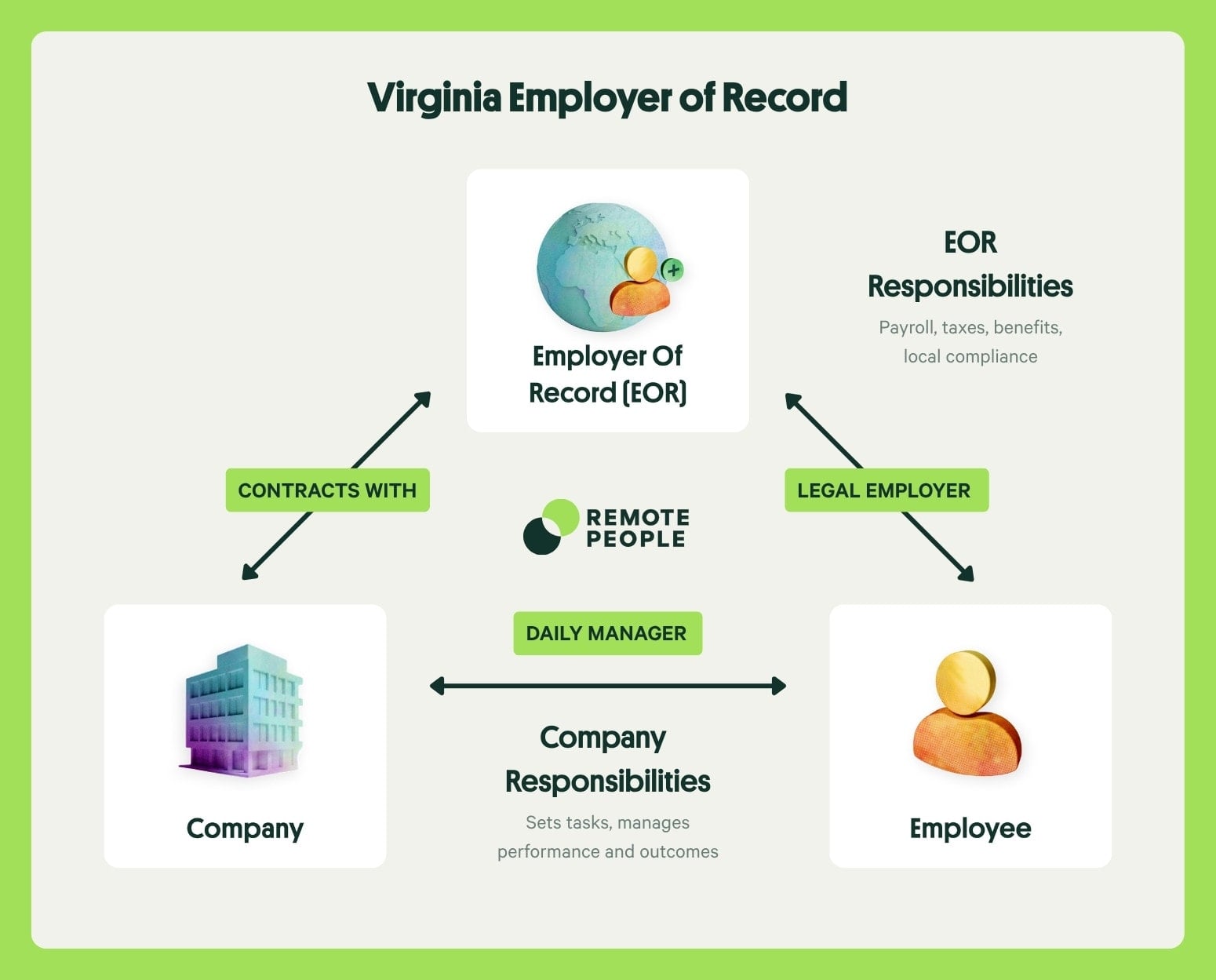
A Virginia Employer of Record (EOR) is a third-party organization that legally employs workers on your behalf within the state.
What is an EOR can help explain how this employment model works in more detail.
The EOR becomes the official employer for tax and compliance purposes. It handles payroll processing, tax withholding and remittance, unemployment insurance reporting, benefits administration, and employment recordkeeping. Your company retains full control over the employee’s daily responsibilities, performance, and business objectives.
This structure shifts a significant portion of employment liability to the EOR. Wage compliance, payroll tax accuracy, workers’ compensation coverage, and regulatory reporting are managed by the provider rather than your internal team.
What is the Difference Between a Virginia Employer of Record and a Virginia PEO?
Although both Employer of Record (EOR) providers and Professional Employer Organizations (PEOs) help companies manage payroll and HR functions, the difference between them lies in who legally employs the worker and who carries the compliance risk. Understanding this distinction is important when deciding how to hire in Virginia.
A PEO operates under a co-employment model.
Your company must first establish and maintain a legal entity in Virginia, register for state tax withholding, open a State Unemployment Insurance (SUI) account, and secure workers’ compensation coverage. Only after those structures are in place can the PEO share certain administrative responsibilities like payroll processing, benefits administration, and HR support.
However, your company remains the legal employer. This means you are still responsible for:
- State and federal employment compliance
- Wage and hour obligations
- Proper worker classification
- Unemployment claims and experience rating
- Employment-related liability, including audits, penalties, or disputes
In other words, a PEO helps manage employment, but it does not remove the underlying legal and regulatory burden.
An Employer of Record works a tad differently.
Unlike PEOs, EORs become the legal employer of record for your Virginia-based staff. Because the EOR already maintains the necessary state registrations and infrastructure, there is no need for your company to form a Virginia entity or register with state agencies.
Under an EOR model, the provider assumes responsibility for:
- Payroll processing and tax remittance
- Virginia income tax withholding and reporting
- State unemployment insurance administration
- Workers’ compensation coverage
- Employment documentation and recordkeeping
- Ongoing compliance with federal and Virginia labor laws
Your organization continues to direct the employee’s daily work, performance, and business priorities, but the employment risk and administrative burden shift to the EOR.
The practical difference comes down to speed, liability, and operational complexity.
A PEO is commonly suitable for U.S. companies that already have a registered presence in Virginia and want support managing a growing workforce. An EOR, on the other hand, is designed for companies that need to hire quickly without setting up a legal entity, or for organizations expanding across multiple states and looking to centralize compliance.
For international businesses entering the U.S., or for companies testing the Virginia market before committing to a permanent structure, an EOR usually provides a faster, more flexible, and lower-risk path to employment.
Start hiring with a Virginia EOR
Let us handle the complexities of hiring, compliance, and payroll in Virginia while you focus on growing your team.
- Hire employees in Virginia with a Virginia EOR
- No local entity is needed
- Pricing starts at USD 199 per employee
- RemotePeople can also help you find the best talent in Virginia
How Does a Virginia Employer of Record Work?
When you hire through an EOR, the employment process is structured to ensure full compliance from day one.
First, the employee receives a compliant employment agreement that reflects both federal requirements and Virginia-specific employment standards. The EOR then processes onboarding, verifies work authorization, and establishes payroll.
Behind the scenes, the EOR manages all required state registrations. In Virginia, this includes income tax withholding registration with the Department of Taxation and unemployment insurance registration with the Virginia Employment Commission.
Payroll is processed with federal and state tax withholding, FICA contributions, unemployment insurance, and year-end reporting. The EOR also administers benefits, secures workers’ compensation coverage where required, and monitors ongoing compliance with wage laws and reporting deadlines.
This structure allows companies to focus on operations while the EOR handles the administrative and regulatory burden.
How Labor Laws Affect Hiring in Virginia?
Minimum Wage and Overtime
Virginia’s minimum wage is $12.77 per hour as of 2026, with plans to steady it at $15/hr by 2028.
The state follows federal Fair Labor Standards Act (FLSA) rules for overtime. Non-exempt employees must receive overtime pay at 1.5 times their regular rate for hours worked beyond 40 in a workweek.
Virginia does not impose daily overtime requirements.
Income Tax
Virginia applies a graduated personal income tax system with four brackets, ranging from 2% to 5.75%. The highest rate of 5.75% applies to taxable income above $17,000.
| Taxable Income | Tax Rate |
|---|---|
| First $3,000 | 2% |
| $3,001 to $5,000 | 3% |
| $5,001 to $17,000 | 5% |
| Over $17,000 | 5.75% |
The state calculates taxable income based on federal adjusted gross income (AGI), with specific Virginia additions and subtractions applied where required. This approach simplifies administration for employers because state withholding closely follows federal wage reporting.
Employers hiring in Virginia must register for withholding with the Virginia Department of Taxation, withhold state income tax from employee wages, file withholding returns based on assigned filing frequency, and issue annual Forms W-2 reporting state wages and taxes withheld.
Because the top tax rate applies at relatively low income levels, most full-time employees fall into the 5.75% bracket.
State Unemployment Insurance (SUI)
Virginia employers must contribute to the State Unemployment Insurance through the VEC. The tax is employer-paid and applies to the first $8,000 of wages per employee each year.
SUI rates vary based on the employer’s experience rating, which reflects the company’s history of unemployment claims.
Rates currently range from 0.1% to 6.2%.
New employers are usually assigned a starting rate of 2.5% (plus any applicable administrative adjustments) until the VEC establishes a personalized rate. The agency reviews and issues updated SUI rates annually based on claims history.
Because rates are tied to workforce stability and proper reporting, ongoing administration and accurate filings are important for managing long-term payroll costs.
Paid Leave
Virginia currently requires paid sick leave only for home health workers, who accrue one hour of paid leave for every 30 hours worked, up to 40 hours per year, with carryover allowed. Employers are not required to pay out unused leave at termination unless their policy or contract provides for it.
For most private-sector employees, there is no statewide mandate for paid sick leave or paid family leave, though employers must follow their own written leave policies.
Legislative changes may expand these requirements. House Bill 5 (2026) proposes mandatory paid sick leave for all employees, and separate legislation is under consideration for a state-run paid family leave program.
Employers should monitor these developments, as they could significantly increase future compliance obligations.
Workers’ Compensation
Workers’ compensation coverage is mandatory in Virginia for employers with three or more employees. Coverage is obtained through a private insurance carrier and provides medical care and wage protection for employees who suffer work-related injuries or illnesses.
If a claim is approved, the employer’s insurance is responsible for medically necessary treatment, including doctor visits, hospitalization, rehabilitation, prescriptions, and related care. Injured employees may also receive wage replacement benefits.
Temporary total disability payments generally equal two-thirds (66 2/3%) of the employee’s average weekly wages, subject to statewide limits, while partial disability benefits may apply if the employee returns to work with restrictions.
Additional compensation may be available for permanent impairment, severe disability, or, in fatal cases, death benefits for dependents and funeral expenses as defined under the Virginia Workers’ Compensation Act.
Termination and Final Pay
Virginia is an at-will employment state, which means either the employer or the employee may end the employment relationship at any time and for any lawful reason. However, terminations must still comply with federal and state anti-discrimination, retaliation, and wage laws.
When employment ends, final wages must be paid by the next regular payday. Virginia does not allow employers to delay payment beyond the normal payroll cycle, regardless of whether the separation was voluntary or involuntary.
The state does not require payout of unused vacation or paid time off (PTO) unless the employer’s written policy, handbook, or employment agreement promises such payment. Because wage claims often arise from inconsistent policy application, employers should ensure their PTO terms are clearly documented and applied consistently.
Virginia law does not require advance notice for individual terminations. However, employers conducting large layoffs or facility closures may be subject to the federal Worker Adjustment and Retraining Notification (WARN) Act, which requires 60 days’ notice when certain workforce thresholds are met.
Failure to pay wages on time or to follow established compensation policies can result in employee wage claims, recovery of unpaid amounts, and potential statutory penalties. For employers operating in Virginia, consistent termination procedures and timely final payroll processing are critical to reducing post-employment risk.
Payroll Taxes and Employer Cost in Virginia
Employers hiring in Virginia must account for both federal payroll obligations and state-level employment costs. While the state does require income tax withholding and unemployment contributions, overall employer payroll costs remain moderate compared to many other U.S. jurisdictions.
At the federal level, employers are responsible for Social Security (6.2%) and Medicare (1.45%) contributions, along with Federal Unemployment Tax (FUTA). After available credits, FUTA is applied at an effective rate of up to 0.6% on the first $7,000 of wages.
At the state level, employers must:
- Withhold Virginia personal income tax from employee wages (based on the state’s graduated rates of 2% to 5.75%)
- Pay State Unemployment Insurance (SUI) contributions on the first $8,000 of wages per employee
- Maintain workers’ compensation insurance once they employ three or more workers
Though not a tax, workers’ compensation premiums represent a required employment cost. Rates depend on industry risk classification, payroll size, and claims history.
For an employee who earns $100k, here’s what the employer cost looks like:
| Cost Category | Employer Cost (Estimated) |
|---|---|
| Social Security & Medicare (FICA) | $7,650 |
| FUTA (effective) | Up to $42 |
| Virginia SUI (new employer estimate) | $200 |
| Workers’ Compensation (role dependent) | $300 – $1,500 |
The estimated total employer burden usually lies between 8% and 10% of salary for most professional roles.
Because SUI rates adjust annually based on workforce stability and workers’ compensation costs vary by industry, actual employer costs may differ. Managing these variable obligations accurately is a key part of maintaining payroll compliance in Virginia.
Employee Classification Rules in Virginia
Virginia generally follows the federal IRS common law standard when determining whether a worker is an employee or an independent contractor. The analysis focuses on three core areas: behavioral control, financial control, and the nature of the working relationship. In general, the more independence and business risk a worker has, the more likely they are to qualify as independent contractors. Workers who are economically dependent on a company and subject to its direction are more likely to be considered employees.
In 2020, Virginia strengthened enforcement by passing legislation specifically aimed at reducing worker misclassification. The law was introduced after state findings estimated that more than 200,000 workers had been improperly classified as independent contractors.
Under Virginia Code § 40.1-28.7:7, there is now a presumption of employee status. Any individual paid to perform services is presumed to be an employee unless the hiring company can demonstrate, using IRS guidelines, that the individual meets the criteria for independent contractor classification. This effectively shifts the burden of proof to the employer.
The risks of misclassification are significant. If a court determines that a worker was improperly classified, the employer may be required to pay:
- Unpaid wages and overtime
- Lost benefits and leave entitlements
- Medical or business expenses that should have been covered
- Attorney’s fees and legal costs
Employees generally have two years to bring a misclassification claim.
Because Virginia’s framework places the burden on the employer and allows recovery of multiple forms of compensation, classification decisions carry meaningful legal and financial risk.
For companies hiring in the state without an established HR or compliance infrastructure, using an EOR can help reduce exposure by ensuring workers are engaged under the correct employment structure.
What Makes Hiring in Virginia Unique?
Virginia’s workforce is shaped by its proximity to Washington, D.C., which drives demand for highly skilled professionals in technology, cybersecurity, intelligence, and government services. Many workers hold advanced degrees or specialized certifications, making the state attractive for high-value roles.
At the same time, significant regional variation allows employers to balance talent quality with cost efficiency. Hiring outside Northern Virginia can reduce salary pressure while maintaining access to strong educational pipelines.
The state’s regulatory environment is also predictable. Unlike states with extensive leave mandates or complex wage rules, Virginia’s employment framework closely aligns with federal standards. This reduces administrative complexity, particularly for multi-state employers.
Combined with moderate taxes and a stable business climate, Virginia remains one of the more practical entry points for companies expanding their U.S. workforce.
What Are the Benefits of a Virginia Employer of Record?
Using an EOR allows companies to hire in Virginia without establishing a local legal entity, removing one of the biggest barriers to entry. Instead of registering a foreign business, opening state tax accounts, and managing ongoing corporate filings, organizations can employ staff immediately through the EOR’s existing infrastructure.
Speed is another major advantage. Because the EOR already maintains the required registrations and payroll systems, employees can often be onboarded and placed on compliant payroll within days. This is particularly valuable when filling critical roles, supporting time-sensitive projects, or expanding quickly into new regions.
An EOR also centralizes compliance. Payroll processing, Virginia income tax withholding, unemployment insurance reporting, workers’ compensation coverage, and year-end filings are managed through a single provider.
This structure significantly reduces legal and administrative risk. As the legal employer of record, the EOR assumes responsibility for payroll tax accuracy, statutory reporting, and core employment compliance. Standardized onboarding, documentation, and termination processes help reduce exposure to wage claims, misclassification issues, and audit risks.
For companies hiring beyond a single location, the model also supports multi-state growth. The same employment framework can be used to hire in Virginia and other U.S. states without repeating entity setup or managing separate compliance systems. This allows organizations to scale their workforce up or down as business needs evolve while maintaining consistent employment practices across locations.
What are the Downsides of a Virginia Employer of Record?
The main consideration when using an Employer of Record is the service fee, which is added to standard employment costs. While the fee covers payroll processing, compliance management, benefits administration, and employment liability, it can make the total cost higher than managing payroll internally.
Companies may also have less direct control over certain administrative processes, such as payroll timing, benefits structure, or employment documentation, since these functions are managed within the EOR’s systems and compliance framework.
For organizations that already have a registered Virginia entity, internal HR capabilities, and established payroll infrastructure, direct employment may be more cost-effective over the long term, particularly for larger teams.
That said, for international businesses, companies entering Virginia for the first time, or organizations hiring only a small number of employees, the speed, simplicity, and risk reduction offered by an EOR often outweigh the additional cost and operational tradeoffs.
How to Choose a Virginia Employer of Record
Choosing the right EOR means looking beyond basic payroll support to the provider’s reliability and compliance strength. Start with transparent pricing so you understand the full cost of employment without hidden fees or unexpected add-ons.
It is also important to work with a provider that offers direct EOR services, rather than relying on layered local partners. A direct model provides clearer accountability, faster support, and stronger control over employment compliance.
Because U.S. employment rules vary by state, companies should prioritize an EOR with proven multi-state expertise. Even if you are hiring only in Virginia today, the ability to expand into other states without changing providers supports long-term growth.
Finally, look for a strong operational foundation. Accurate payroll processing, timely tax filings, responsive support, and a solid compliance track record are essential to reducing risk and ensuring a smooth experience for both the employer and employees.
Engage a Virginia Employer of Record with RemotePeople
RemotePeople helps companies hire employees in Virginia quickly and compliantly without establishing a local entity. The service includes payroll management, tax filings, benefits administration, workers’ compensation coverage, and ongoing compliance monitoring.
With experience supporting both international and multi-state employers, RemotePeople enables organizations to expand into Virginia with confidence while minimizing administrative complexity and employment risk.
Get started with us today.
Employer of Record in
Employer of Record in
Employer of Record in
Employer of Record in
Employer of Record in
Employer of Record in
Employer of Record in
Employer of Record in




