Recruit
Employer of Record in North Carolina
-
 Drew Donnelly
- Published
- July 22, 2026
North Carolina’s employment law includes state unemployment insurance and specific wage regulations, and an NC EOR handles payroll, taxes, and full state compliance with no local entity needed.
Hire in North Carolina — book a free 30-minute demo
No sales call required. Free 30-minute expert call if you want one.
Tell us about your company
So we can match you with a specialist who knows your market — and unlock volume pricing tiers.
* All fields are required.
Where and when are you hiring?
Tell us the geography and timing and we'll quote each country line by line, with onboarding timelines.
* All fields are required.
Help us beat your current setup
We'll benchmark your current deal and send a line-by-line proposal in 24 hours — showing exactly where we cut cost, time, or risk. After you submit, you can book a call to walk through it together.
* All fields are required.
Thanks! Your proposal is on its way.
Expect a tailored, line-by-line proposal in your inbox within 24 hours. In the meantime…
Want to walk through it together?
Book a free 30-minute call with one of our specialists. We'll explain every line, answer your questions, and tailor the proposal further if you need.
No obligation. Pick a time that works for you.








- Hire in North Carolina — book a free 30-minute demo
- Tell us about your company
- Where and when are you hiring?
- Help us beat your current setup
- Thanks! Your proposal is on its way.
- North Carolina Employer of Record
- What Is the Difference Between a North Carolina Employer of Record and a North Carolina PEO?
- How Does a North Carolina Employer of Record Work?
- How Labor Laws Affect Hiring in North Carolina?
- Payroll Taxes and Employer Cost in North Carolina
- Employee Classification Rules in North Carolina
- What Makes Hiring in North Carolina Unique?
- What Are the Benefits of a North Carolina Employer of Record?
- What Are the Downsides of a North Carolina Employer of Record?
- How to Choose a North Carolina Employer of Record?
- Engage a North Carolina Employer of Record with RemotePeople
- Related EOR Destinations

Let RemotePeople handle payroll, compliance, and HR admin worldwide so you can focus on building your team.
Key Takeaways:
- North Carolina is business-friendly with low regulation, right-to-work laws, competitive costs, a skilled workforce, and solid incentives for companies expanding into the state.
- An Employer of Record (EOR) lets you hire in North Carolina without setting up a local entity. The EOR becomes the legal employer, handles payroll, taxes, unemployment insurance, and compliance, while you control daily work and decisions.
- An EOR is usually the better choice over a PEO for companies new to North Carolina. No local entity is required, liability shifts fully to the EOR, onboarding is faster, and the risk is lower.
- North Carolina follows at-will employment rules and has flexible final pay requirements. Employment can end at any time for any legal reason, with no notice required.
North Carolina ranks as one of America’s top business-friendly states. CNBC named it the 2025 Top State for Business, its third win in four years, and Business Facilities gave it the 2025 State of the Year for Economic Development.
The economy centers around advanced manufacturing, biotech, IT and software, financial services, clean energy, agriculture, and fintech. But what makes it genuinely attractive for employers is the combination of right-to-work laws, low union influence, streamlined permitting, strong infrastructure, and job creation incentives that are among the better ones in the country.
Costs are reasonable compared to most coastal states. Wages are moderate, real estate is competitive outside the major metros, and utilities are affordable. Urban growth has pushed prices up in some areas, but the overall picture remains favorable.
This guide covers everything you need to know about hiring in North Carolina. We walk through what an Employer of Record is and how it works, how North Carolina’s labor laws affect your obligations as an employer, what payroll actually costs in the state, how worker classification rules work, and what to look for when choosing an EOR partner.
North Carolina Employer of Record
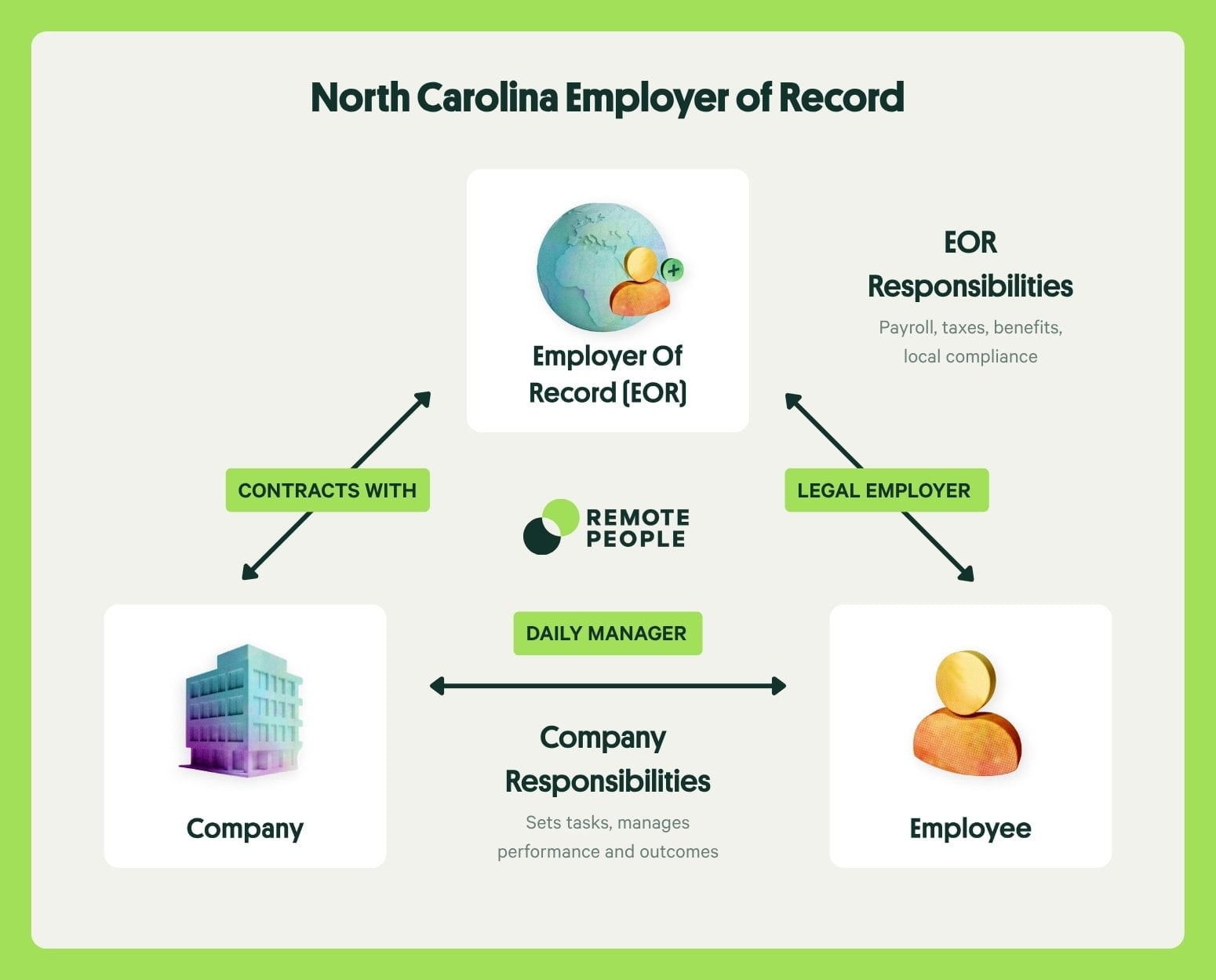
An Employer of Record in North Carolina is the legal employer for your workers in the state, while you retain full control over what those people actually do. You set the tasks, manage performance, and make all strategic decisions. The EOR handles everything else on the employer side.
That means processing payroll, withholding and remitting federal and state income taxes, managing unemployment insurance contributions, handling workers’ compensation, and staying current with North Carolina’s wage and hour laws. They file the required quarterly and annual reports with the North Carolina Department of Revenue and the Division of Employment Security, so you don’t have to.
One of the main reasons companies use an EOR is to avoid setting up a local entity. Registering a business in a new state, getting a state tax ID, and opening unemployment insurance accounts all take time and money.
An EOR already has everything in place. You can hire someone and have them on payroll within days. The legal liability that comes with being an employer transfers to the EOR as well, which protects you from wage claims, misclassification disputes, tax penalties, and workers’ comp issues.
For international companies entering the U.S., fast-growing startups, or businesses testing a new market, this model cuts through a lot of the friction.
What Is the Difference Between a North Carolina Employer of Record and a North Carolina PEO?
Both PEOs and EORs offer HR and compliance support, but they work differently and suit different situations.
A North Carolina PEO operates under a co-employment model where the PEO and your company share employer responsibilities. This usually requires you to already have a legal entity in North Carolina. PEOs work well for established U.S. based companies that want to outsource HR functions like benefits administration, payroll processing, and risk management while keeping their existing structure.
The client holds primary control and liability in most areas, with the PEO handling the administrative side.
An EOR, on the other hand, is the sole legal employer and takes on full liability. No local entity is required. That makes it the better fit for international companies, out-of-state businesses, or anyone who needs to hire in North Carolina quickly without the infrastructure investment. There’s no entity setup, no ongoing maintenance costs, and onboarding moves much faster.
For companies new to North Carolina or expanding across multiple states, the EOR offers more speed, simplicity, and risk reduction. Whereas a PEO makes more sense for established domestic employers primarily looking to offload HR administration.
Start hiring with a North Carolina EOR
Let us handle the complexities of hiring, compliance, and payroll in North Carolina while you focus on growing your team.
- Hire employees in North Carolina with a North Carolina EOR
- No local entity is needed
- Pricing starts at USD 199 per employee
- RemotePeople can also help you find the best talent in North Carolina
How Does a North Carolina Employer of Record Work?
Compliant Employment Contract
The EOR drafts and signs an employment contract that follows North Carolina state law and federal requirements. It covers at-will employment, pay and overtime rules, and any applicable restrictions on non-compete agreements, while leaving you in full control of the employee’s day-to-day responsibilities.
Payroll Setup with Correct State Registrations
The EOR uses its existing accounts to ensure everything is registered with the state before the first paycheck goes out. This includes registration with the North Carolina Department of Revenue for state income tax withholding and with the Division of Employment Security for unemployment insurance. Since the EOR already has these in place, your new hire can be paid legally from day one.
Tax Withholding and Remittance
Every payroll run includes the correct deductions for federal taxes: Social Security, Medicare, and federal unemployment, plus North Carolina’s flat state income tax of 3.99%. The EOR remits those amounts to the right agencies on time and handles all required filings. Errors here lead to penalties that can compound quickly.
Benefits Administration
If you offer health insurance, dental, or retirement plans, the EOR handles enrollment paperwork, keeps records current, and sends required notices when someone leaves. They also arrange workers’ compensation coverage so your employee is protected if something happens on the job.
Ongoing Compliance Management
Employment law changes. The EOR monitors updates to North Carolina and federal rules, including tax rates, reporting deadlines, overtime classifications, and leave policies, and adjusts accordingly. They manage any audits, handle final paychecks correctly when someone exits, and make sure worker classification stays clean throughout the relationship.
How Labor Laws Affect Hiring in North Carolina?
North Carolina follows federal standards closely in most areas, which keeps things fairly straightforward for employers. The state does not layer on a lot of additional complexity, but there are specific rules worth knowing before you bring on your first hire. Here is what matters most.
Minimum Wage and Overtime
The state minimum wage is $7.25 per hour, matching the federal floor set by the Fair Labor Standards Act. For tipped employees, the cash wage floor is $2.13 per hour, but total earnings, including tips, must reach $7.25. If tips fall short of that threshold in a given shift, the employer is required to make up the difference.
Overtime follows federal Fair Labor Standards Act(FLSA) rules, which state that non-exempt employees get 1.5 times their regular rate for anything over 40 hours in a workweek. There is no daily overtime threshold, no mandatory weekend or holiday premium unless your company policy creates one, and overtime exemptions mirror the federal categories exactly.
Income Tax
North Carolina taxes income at a flat 3.99% for 2026 and beyond. No brackets, no tiers, just one rate regardless of what an employee earns. Employers withhold this from wages for both state residents, regardless of where the work is performed, and non-residents earning wages while working in the state. Withheld amounts go to the North Carolina Department of Revenue(NCDOR) through quarterly and annual filings.
State Unemployment Insurance (SUI)
New employers start at a contribution rate of 1.000% on the first $34,200 of each employee’s wages per year. After the first year, your rate adjusts based on claims history through the experience rating system, ranging from 0.06% to 5.76%. Contributions are filed and paid quarterly through the Division of Employment Security.
Paid Leave
North Carolina has no state mandate for paid sick leave, paid family leave, or any other form of paid time off. The federal Family and Medical Leave Act(FMLA) applies to employers with 50 or more employees, covering up to 12 weeks of unpaid job-protected leave. Whatever paid leave you offer is voluntary and governed entirely by your own written policies.
Workers' Compensation
Coverage is required for most employers with three or more employees. You obtain it through private carriers since there is no exclusive state fund. Premiums vary by industry. High-risk roles in construction and manufacturing carry significantly higher rates than office or administrative positions. The North Carolina Industrial Commission oversees the program and handles disputes.
Termination and Final Pay
North Carolina is an at-will employment state. Either party can end the employment relationship at any time, for any legal reason, with no required notice period, unless a contract says otherwise. There is no state requirement to give advance notice before a termination, though many employers choose to do so as a matter of professional practice.
However, at-will does not mean unlimited freedom to terminate. Federal and state anti-discrimination laws still apply. You cannot end someone’s employment based on race, sex, religion, national origin, disability, age, or other protected characteristics, and retaliation against employees who have exercised legal rights is also prohibited.
Within those boundaries, the at-will framework gives North Carolina employers more flexibility than they would have in states with just cause or implied contract protections.
Final wages, including any earned bonuses or commissions, must be paid by the next regular payday through normal channels or by mail if the employee requests it. There is no requirement to issue a same-day final check at the time of termination, which gives employers a reasonable window to process the payment correctly.
Unused Paid Time Off(PTO) is a separate question. North Carolina does not require employers to pay out accrued time off when employment ends. Whether a departing employee is entitled to that payout depends entirely on what your written policy says.
If your policy clearly states that unused PTO is forfeited upon termination and that policy was properly communicated, no payout is required. If your policy promises payout or is silent on the issue, you may be obligated to pay it. Having a clear written policy that addresses this directly is the safest approach.
Late or unpaid final wages can lead to penalties under the Wage and Hour Act, including liquidated damages equal to double the amount owed, plus interest, court costs, and attorney fees. A small administrative error can quickly become a significant expense.
Payroll Taxes and Employer Cost in North Carolina
Employer payroll costs include a standard federal layer plus state contributions that are relatively low compared to most other states.
Federal obligations apply across the board: Social Security at 6.2% up to the annual wage cap, Medicare at 1.45% with no cap, and Federal Unemployment Tax Act(FUTA) at up to 6% on the first $7,000 of each employee’s wages.
Most employers who stay current on state unemployment tax payments receive a credit that brings the effective FUTA rate down to 0.6%.
At the state level, employers withhold and remit North Carolina’s 3.99% flat income tax, contribute to SUI through the Division of Employment Security, and carry workers’ compensation insurance at rates that depend on job type.
Example Cost Breakdown
Cost Component | Estimated Amount (Annual) | Notes |
|---|---|---|
Federal Insurance Contributions Act (Social Security & Medicare – employer share) | $7,650 | Based on $100,000 salary |
FUTA (after state credit) | $42 | Federal unemployment tax |
State Unemployment Insurance (SUI) | $342 | 1% on first $34,200 of wages |
Workers’ Compensation | $500–$1,000 | Varies by job classification and insurance carrier |
Total employer payroll overhead, excluding voluntary benefits, runs about 9 to 12 percent above base salary. That is competitive compared to states with higher income taxes, larger unemployment wage bases, or more expensive workers’ comp requirements.
Employee Classification Rules in North Carolina
North Carolina uses clear and relatively employer-friendly tests to determine whether a worker is an employee or an independent contractor. The standards are generally less strict than in states like California.
For wage and hour purposes, the state follows the federal economic reality test under FLSA. This looks at the full picture of the working relationship: how much control the company exercises over the work, whether the worker has genuine financial independence, how permanent the relationship is, whether the worker has invested in their own tools or equipment, and whether the work is central to the company’s core business. No single factor is automatically decisive.
For unemployment insurance and workers’ comp, the simpler common law right-to-control test applies. This focuses on whether the employer controls how the work gets done, including the methods used and the standards expected. If the company is directing the process and not just the outcome, that points toward employee status.
North Carolina does not use California’s ABC test, which lowers misclassification risk considerably. Getting it wrong still carries real consequences, though: back taxes, unpaid wages, fines, interest, and audits from the IRS, the Department of Labor, NCDOR, or Division of Employment Security(DES).
An EOR reduces this risk by classifying workers as employees from the start and keeping documentation clean throughout.
What Makes Hiring in North Carolina Unique?
North Carolina has strong roots in manufacturing and agriculture, but has built out fast-growing sectors in biotech, IT, fintech, advanced manufacturing, and clean energy.
Right-to-work laws keep union influence minimal. State incentives for job creation are competitive and actively marketed to companies considering expansion or relocation.
The Research Triangle and Charlotte both draw strong talent and generate real competition for skilled workers, pushing wages up in tech and biotech, particularly.
Workforce supply is solid statewide. A steady flow of graduates from strong universities and community colleges keeps the talent pipeline moving, and ongoing in-migration to areas that still feel affordable compared to the coasts adds to the available pool.
Some rural areas see tighter talent markets, but the metros and surrounding regions offer good depth across most fields. The 3.99% flat income tax, low corporate tax rates, and a straightforward regulatory environment make financial planning predictable.
The infrastructure is solid, and the quality of life across much of the state remains a genuine draw for workers weighing their options. For companies looking to build a long-term team, North Carolina is a serious option.
What Are the Benefits of a North Carolina Employer of Record?
- No entity setup required: You skip business registration, state tax ID applications, unemployment account setup, and all the compliance groundwork that comes with forming a new entity. The EOR has it handled already.
- Faster onboarding: You can hire and pay compliant employees in North Carolina within days. The EOR’s existing registrations and processes cut out the months of setup that would otherwise come first.
- Centralized compliance: One partner covers payroll taxes, unemployment filings, workers’ comp, wage and hour laws, and required state and federal reporting. They track regulatory changes so you do not have to watch for them yourself.
- Reduced legal risk: The EOR is the legal employer, which means they carry the liability for employment taxes, wage claims, misclassification issues, and compliance violations. That exposure moves off your plate entirely.
- Scalable across multiple states: Add employees in North Carolina and other states through the same partner without forming separate entities or building state-specific expertise in-house.
What Are the Downsides of a North Carolina Employer of Record?
The main drawback is cost. EORs charge either a percentage of payroll or a flat monthly fee per employee, which adds to your overall employment expense compared to running payroll yourself. You also give up some direct control over payroll timing and certain administrative choices.
For most companies entering North Carolina, those costs are outweighed by what you avoid: entity setup, compliance mistakes, tax penalties, and the ongoing administrative burden of managing it all in-house.
For companies hiring across multiple locations or new to the state, an EOR is usually more cost-effective and lower risk than building the infrastructure yourself. At the point where your headcount in the state is large and stable enough that EOR fees outweigh setup costs, bringing things in-house becomes worth a closer look. Until then, the EOR model is usually the smarter call.
How to Choose a North Carolina Employer of Record?
Transparent pricing
Look for clear upfront fees with no hidden charges or surprise add-ons. You should be able to calculate your total cost of employment before you commit. A reliable EOR should also provide detailed pricing breakdowns so you understand exactly what services are included.
Direct EOR model
Choose a provider that operates directly rather than through layered subcontractors. Direct providers offer clearer accountability and faster resolution when something goes wrong. This structure also reduces the risk of communication delays and compliance gaps.
U.S. multi-state expertise
Make sure they have real experience managing payroll registrations, tax filings, and compliance across multiple states, including specific working knowledge of North Carolina’s requirements. Providers with broad multi-state expertise can also help your business scale more efficiently as you hire in new locations.
Dedicated support
Confirm there are actual people available for onboarding help, payroll questions, and compliance issues. A responsive account manager is worth far more than a ticketing system when a problem comes up. Fast and knowledgeable support can prevent small administrative issues from becoming costly disruptions.
Strong compliance track record
Look for a history of clean filings, regular audits, appropriate insurance coverage, and references or case studies from existing clients. Consistent compliance performance is a strong indicator that the provider can protect your business from avoidable legal and tax risks.
Engage a North Carolina Employer of Record with RemotePeople
An Employer of Record (EOR) in North Carolina acts as the legal employer for your workers in the state, handling compliant employment contracts, payroll processing, federal and North Carolina state tax withholding, benefits administration, and all required state and federal filings, while you retain full day-to-day control over the employee’s work, performance, and decisions.
This eliminates the need to form a local entity, allowing you to hire talent quickly, minimize legal and penalty risks, and scale your team in North Carolina with ease.
Ready to hire in North Carolina the easy way? RemotePeople provides a reliable, direct EOR service starting at just $199 per month per employee. Reach out to us today!
Employer of Record in
Employer of Record in
Employer of Record in
Employer of Record in
Employer of Record in
Employer of Record in
Employer of Record in
Employer of Record in