
 Recruit
Employer of Record in Maryland
-
 Drew Donnelly
- Published
- September 22, 2026
Maryland’s employment law includes paid family leave, earned sick leave, and wage transparency rules, and a Maryland EOR handles payroll and full state compliance with no local entity needed.
Hire in Maryland — book a free 30-minute demo
Tell us what you need. You'll get a tailored, transparent proposal within 24 hours, plus a free call to walk through it.
Tell us about your company
So we can match you with a specialist who knows your market — and unlock volume pricing tiers.
* All fields are required.
Where and when are you hiring?
Tell us the geography and timing and we'll quote each country line by line, with onboarding timelines.
* All fields are required.
Help us beat your current setup
We'll benchmark your current deal and send a line-by-line proposal in 24 hours — showing exactly where we cut cost, time, or risk. After you submit, you can book a call to walk through it together.
* All fields are required.
Thanks! Your proposal is on its way.
Expect a tailored, line-by-line proposal in your inbox within 24 hours. In the meantime…
Want to walk through it together?
Book a free 30-minute call with one of our specialists. We'll explain every line, answer your questions, and tailor the proposal further if you need.
No obligation. Pick a time that works for you.








- Hire in Maryland — book a free 30-minute demo
- Tell us about your company
- Where and when are you hiring?
- Help us beat your current setup
- Thanks! Your proposal is on its way.
- Maryland Employer of Record
- What Is the Difference Between a Maryland Employer of Record and a Maryland PEO?
- How Does a Maryland Employer of Record Work?
- How Labor Laws Affect Hiring in Maryland?
- Payroll Taxes and Employer Cost in Maryland
- Employee Classification Rules in Maryland
- What Makes Hiring in Maryland Unique?
- What Are the Benefits of a Maryland EOR?
- What Are the Downsides of a Maryland EOR?
- How to Choose a Maryland Employer of Record?
- Engage a Maryland Employer of Record with RemotePeople
- Related EOR Destinations

Let RemotePeople handle payroll, compliance, and HR admin worldwide so you can focus on building your team.
Key Takeaways
- Maryland’s minimum wage is $15.00 per hour under the Fair Wage Act, with a reduced base rate of $3.63 per hour for tipped employees.
- Employers must register for a withholding tax account via the Maryland Tax Connect portal and an unemployment insurance account through the BEACON system before running payroll.
- Maryland enforces strict worker classification under the ABC Test, with misclassification penalties including up to triple the wages owed and potential criminal charges.
- A Maryland EOR lets companies hire in the state without setting up a local entity, taking on all payroll, tax, compliance, and benefits responsibilities on the client’s behalf.
Maryland, also known as the Old Line State, is home to more than 60 federal agency offices and research labs, making it one of the most government-connected states in the US. With the federal government serving as its largest employer and a primary driver of its economy, the state has attracted major Fortune 500 corporations such as Lockheed Martin, Marriott International, Constellation Energy, and McCormick & Company.
This concentration of government and corporate activity has built a strong and highly qualified workforce. Maryland consistently ranks among the top states for educational achievement. As of 2026, it has the second-highest percentage of residents with a graduate or professional degree in the country. For businesses hiring in Maryland, this means strong access to key industries like technology, life sciences, defense and aerospace, and healthcare. The state also offers a business environment focused on innovation and growth.
In this guide, we’ll cover everything you need to know about hiring in Maryland and how a Maryland Employer of Record can help you hire quickly and compliantly.
Maryland Employer of Record
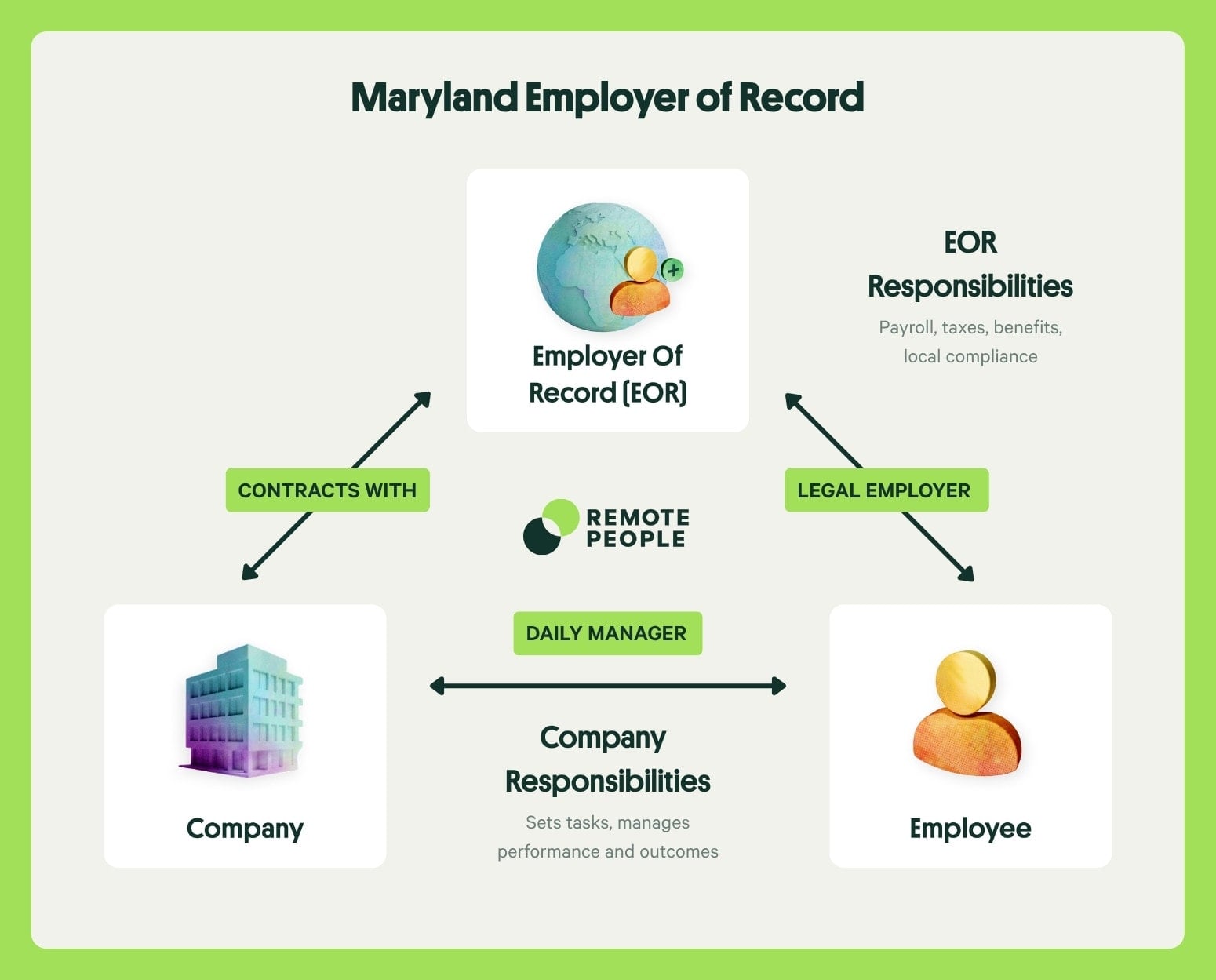
A Maryland Employer of Record is a third-party service provider that becomes the legal employer of your workers in the state. This means the Employer Of Record takes on full responsibility for payroll processing, tax filings, benefits administration, and compliance with Maryland’s labor laws, while you retain complete control over your employees’ day-to-day work and responsibilities. The liability shifts to the Employer Of Record, significantly lowering the risks of legal troubles.
What is an EOR can help explain how this employment model works in more detail.
This arrangement is especially helpful for companies that want to hire in Maryland without creating a local legal entity. Setting up a business in Maryland requires time, money, and administrative work. You don’t need any of that when an Employer Of Record already has the necessary infrastructure. Instead of waiting weeks for registration and compliance, you can get your first Maryland employee hired and working in just days.
What Is the Difference Between a Maryland Employer of Record and a Maryland PEO?
Both a Maryland EOR (Employer of Record) and a Maryland PEO (Professional Employer Organization) help businesses manage employment responsibilities, but they work quite differently, and choosing the wrong one can create compliance gaps down the line.
A PEO operates on a co-employment model. You remain the legal employer while the PEO steps in to share HR, payroll, and compliance responsibilities. However, to use a PEO in Maryland, your business must already be registered with the Maryland State Department of Assessments and Taxation (SDAT) and hold a federal EIN. It’s a practical option for domestic companies already established in the state that need operational support in managing their workforce.
An EOR, on the other hand, becomes the legal employer entirely. You do not need a local entity; the EOR assumes full employment liability, handles all payroll and tax filings, and ensures compliance with Maryland’s labor laws from day one. This makes it the stronger option for international companies or out-of-state businesses looking to hire in Maryland quickly without the cost and complexity of entity setup.
Ultimately, if you already have a presence in Maryland, a PEO can support your operations. But if you’re entering the Maryland market for the first time or expanding from outside the US, an EOR is the smarter move. It gets you there faster, eliminates the need for entity setup, and keeps your business fully protected from day one. That’s exactly what a Maryland EOR like RemotePeople is built for.
Start hiring with a Maryland EOR
Let us handle the complexities of hiring, compliance, and payroll in Maryland while you focus on growing your team.
- Hire employees in Maryland with a Maryland EOR
- No local entity is needed
- Pricing starts at USD 199 per employee
- RemotePeople can also help you find the best talent in Maryland
How Does a Maryland Employer of Record Work?
A Maryland Employer Of Record (EOR) manages the entire employment process on your behalf, from drafting contracts to staying on top of regulatory changes. Here is a breakdown of the process:
Draft a compliant employment contract
The process starts once you identify a candidate(s) you want to hire. The EOR drafts an employment contract that follows through with Maryland’s labor regulations, clearly outlining the job role, compensation, work conditions, and termination clauses. Maryland is an at-will employment state, meaning either party can end the employment relationship at any time, provided it does not violate anti-discrimination laws.
Set Up Payroll With State Registrations
Before running payroll in Maryland, employers must register for a withholding tax account through the Maryland Tax Connect portal and an unemployment insurance account via the BEACON system. The EOR manages these registrations using its existing infrastructure, ensuring your employee is accounted for under the EOR’s withholding tax account and unemployment insurance account from the start.
Handle Tax Withholding and Remittance
Once payroll is active, the EOR calculates and withholds all applicable taxes. This includes Maryland state income tax (2.0% to 6.5%) and local county taxes (2.25% to 3.30%), which are determined by the employee’s county of residence. The EOR also handles the standard 6.2% Social Security and 1.45% Medicare (FICA) contributions on your behalf, ensuring all remittances are filed accurately and on time.
Administer Benefits
The EOR manages all statutory benefits, including workers’ compensation and unemployment insurance. They also help employers prepare for the Maryland FAMLI (Family and Medical Leave Insurance) program, ensuring the correct payroll structures are in place ahead of contributions beginning in January 2027 and benefits becoming available in January 2028. They can also provide supplementary benefits like 401(k)s and health insurance to keep you competitive.
Ongoing Compliance Management
Once everything is up and running, the EOR continuously monitors Maryland’s state and federal regulatory environment on your behalf. This includes tracking changes to labor laws, updating payroll calculations when tax rates change, ensuring all mandatory filings are submitted on time, and managing any employment-related documentation. When it’s time to offboard an employee, the EOR also guides you through a legally compliant termination process, helping you avoid wage penalties, wrongful termination claims, and other legal risks that can arise from improper offboarding.
How Labor Laws Affect Hiring in Maryland?
Minimum Wage & Overtime
Maryland’s minimum wage is $15.00 per hour as of 2026, applying to most employers across the state under the Fair Wage Act. For tipped employees, employers can pay a reduced base rate of $3.63 per hour, but the combined total of tips and base pay must still meet the $15.00 threshold. If it doesn’t, the employer must cover the difference. Employees under 18 are entitled to at least 85% of the state minimum wage rate.
On overtime, most non-exempt employees must be paid 1.5 times their regular hourly rate for all hours worked beyond 40 in a seven-day workweek. There are no daily overtime requirements, and the threshold is calculated on a weekly basis only. Agricultural workers are subject to a separate threshold of 60 hours per week.
Maryland does not require employers to provide severance pay by law. Any such arrangements are determined entirely by individual employment contracts or company policy.
Income Tax
Maryland has a state income tax with a progressive graduated system, meaning tax rates increase as income rises. State rates range from 2.0% to 6.50% for high earners. On top of that, residents are also subject to local income taxes depending on the county they live in, with rates ranging from 2.25% to 3.30%.
When it comes to withholding obligations, Maryland takes a strict approach. Employers paying wages to both residents and non-residents working in Maryland are required to withhold state income tax, and in most cases, local income taxes as well. Withholding rates generally range from 2% to 5.75%, with the higher rate of 6.50% applying to certain high earners as of mid-2025. These obligations apply unless employees have submitted the appropriate withholding exemption forms.
State Unemployment Insurance (SUI)
Maryland requires all employers to contribute to the state’s unemployment insurance program, which provides temporary financial support to workers who lose their jobs through no fault of their own. New employers are assigned a standard SUI tax rate that generally ranges from 1.0% to 2.6%. This rate applies until the business builds sufficient employment history, typically at least two years, after which an experience-based rate is assigned. The experience rate reflects the employer’s actual history of unemployment claims, meaning businesses with fewer claims over time are rewarded with lower rates going forward.
Maryland uses a taxable wage base to calculate employer Unemployment Insurance (UI) contributions, meaning only a fixed portion of each employee’s annual earnings is subject to unemployment taxes, not their full salary.
When it comes to filing, Maryland employers must submit wage reports and pay unemployment insurance taxes on a quarterly basis, with deadlines falling on April 30, July 31, October 31, and January 31 each year. Missing these deadlines can result in penalties, so having a reliable payroll system that tracks and submits these filings on time is essential. It is also worth noting that claimant obligations are separate; employees receiving unemployment benefits are required to file weekly certifications to continue receiving their payments.
Paid Leave
Maryland has some of the more structured paid leave requirements in the U.S., so it is important to understand exactly what applies to your business.
Under the Maryland Healthy Working Families Act (MHWFA), employers with 15 or more employees are required to provide paid sick and safe leave. Employers with 14 or fewer employees are still obligated to provide sick and safe leave, but it may be unpaid. The law mandates that employee’s earn 1 hour of leave for every 30 hours worked, up to a maximum of 40 hours per year. This applies to both full-time and part-time employees, making it a broad obligation that most Maryland employers will need to account for.
On accrual, Maryland’s Earned Sick and Safe Leave Law sets clear rules that employers must follow. Employees earn at least 1 hour of paid leave for every 30 hours worked, limited to 40 hours per year. Unused leave can carry over into the next year, also capped at 40 hours, with a maximum leave balance of 64 hours at any time. This allows employees to accumulate a leave balance over time. Employers must carefully track and manage these balances to remain compliant.
Maryland has also passed the Family and Medical Leave Insurance (FAMLI) program, which takes paid family leave a step further. The program rolls out in two stages: employer and employee contributions begin on January 1, 2027, while paid benefits become available to employees starting January 2028. Once active, the program allows eligible employees up to 12 weeks of paid, job-protected leave for qualifying family-related needs, including bonding with a new child, caring for a family member with a serious health condition, or managing urgent matters which may come from a family member’s military deployment. With the contribution start date approaching, employers are advised that their payroll systems are set up to handle FAMLI deductions correctly and on time.
Workers’ Compensation
Maryland law requires almost all employers with one or more employees to carry workers’ compensation insurance, making it one of the broader mandatory coverage requirements in the U.S.
The coverage is created to provide employees with benefits for medical bills, partial wage replacement, and rehabilitation costs arising from work-related injuries or illnesses, regardless of who was and is at fault. Employers who fail to maintain the required coverage can face fines of up to $10,000.
When it comes to how coverage is obtained, Maryland operates a competitive mixed system. Employers can purchase workers’ compensation insurance from private, licensed insurance carriers or through the state-sanctioned competitive fund, Chesapeake Employers’ Insurance Company. Employers who meet the necessary state requirements also have the option to self-insure, giving businesses some flexibility in how they manage their coverage obligations.
Industry considerations also play a significant role in how workers’ compensation works in Maryland. Premiums and safety requirements are heavily influenced by risk classification codes and NCCI loss cost filings, meaning the nature of your business directly affects what you pay and what is expected of you. High-risk industries such as construction face stricter regulations and higher premiums compared to lower-risk sectors. Regardless of industry, however, the obligation to carry coverage remains, and employers should ensure their policies accurately reflect the type of work their employees perform to avoid compliance issues down the line.
Termination and Final Pay
Maryland is an at-will employment state, meaning either the employer or the employee can end the employment relationship at any time, for any lawful reason, without prior notice. However, at-will status does not exempt employers from Maryland’s strict wage payment and termination laws, so it is important to follow the correct procedures when ending any employment relationship.
When employment ends, either through resignation or termination, Maryland employers must issue the final paycheck covering all earned wages by the next regular payday after the separation date. Employees can ask for their final pay to be delivered by direct deposit or mail. Accrued, unused vacation time or PTO must be paid out upon termination, unless there is a clear written policy stating otherwise. If no such policy exists or if it is not mentioned, the payout is usually required. Employers need to inform employees of any forfeiture policy at the time of hire to prevent disputes later.
For notice requirements, Maryland does not require a specific notice period for individual resignations, though employees commonly give two weeks notice before leaving. Employers with 50 or more staff members are required to give 60 days’ notice before carrying out mass layoffs.
Employers who fail to follow Maryland’s wage payment rules face serious consequences under the Maryland Wage Payment and Collection Law (MWPCL) and the Maryland Wage and Hour Law (MWHL). Penalties can include:
These risks make timely and accurate offboarding an important part of managing employees in Maryland, and another area where a Maryland EOR keeps your business fully protected.
- Paying up to triple the amount of wages owed.
- Covering the employee’s legal fees, and in some cases.
- Facing potential criminal charges.
These risks make timely and accurate offboarding an important part of managing employees in Maryland, and another area where a Maryland EOR keeps your business fully protected.
Payroll Taxes and Employer Cost in Maryland
When hiring in Maryland, employers must cover both federal and state payroll costs in addition to an employee’s salary. Here is a breakdown of what to expect.
On the federal side, employers contribute 6.2% of each employee’s wages to Social Security and 1.45% to Medicare. These rates are the same across all US states. Employers also need to pay the Federal Unemployment Tax (FUTA) at an effective rate of 0.6% on the first $7,000 of each employee’s wages per year, as long as state unemployment taxes are paid on time.
For state taxes, Maryland employers must withhold state income tax from employee wages at rates ranging from 2.0% to 6.5%, depending on the employee’s income level. Most non-resident employees are allowed to receive a flat withholding rate of 7.0%, though a higher rate of 8.75% applies to non-resident supplemental wages (like bonuses) and real estate transactions as of January 1, 2026. On top of that, local income taxes apply at rates of up to 3.30%, depending on the county where the employee lives and works.
Maryland SUI contributions are based on the first $8,500 of each employee’s annual wages. New employers pay a rate between 1.0% and 2.6%, while established employers receive a rate between 0.30% and 7.50% based on their unemployment claims history. For workers’ compensation, Maryland employers pay an average of $0.98 for every $100 of payroll, though this amount varies depending on the industry and risk level of the work involved.
Starting January 1, 2026, Maryland introduced a new annual administrative fee of 0.15% on the taxable wage base, applicable to all liable employers. To balance this out, employer contribution rates for 2026 were reduced by 0.15% across the board, though new employers remain subject to a minimum rate of 1% regardless.
Example Cost Breakdown for an Employee on a $50,000 Annual Salary.
Cost Item | Rate | Taxable Amount | Employer Cost |
|---|---|---|---|
Social Security | 6.2% | $50,000 | $3,100.00 |
Medicare | 1.45% | $50,000 | $725.00 |
FUTA | 0.6% | $7,000 | $42.00 |
SUI (new employer) | 2.6% | $8,500 | $221.00 |
SUI Administrative Fee | 0.15% | $8,500 | $12.75 |
Workers’ Compensation | $0.98 per $100 | $8,500 | $490.00 |
Total Employer Cost | — | — | $4,590.75 |
Base Salary | — | — | $50,000.00 |
Total Employment Cost | — | — | $54,590.75 |
Employer Burden | — | — | 9.18% |
Employee Classification Rules in Maryland
Maryland takes worker classification seriously. Unlike many states in the U.S., Maryland presumes all workers to be employees by default, placing the burden on the employer to prove otherwise. To classify a worker as an independent contractor, the employer must satisfy the ABC Test. ABC stands for:
- A — Control: The worker is free from the employer’s direction and control in how they perform their work.
- B — Outside Course of Business: The work performed is outside the usual course of the hiring company’s business.
- C — Independent Trade: The worker is customarily engaged in an independently established trade or business of the same nature.
All three conditions must be met for a worker to qualify as an independent contractor. If any one of them is not satisfied, the worker must be classified as an employee and receive all the protections and entitlements that come with that status, including overtime eligibility, tax withholdings, and benefits.
Misclassification is illegal in Maryland and heavily penalized under the Workplace Fraud Act and related unemployment insurance laws. Employers found guilty of misclassifying workers face:
- Civil fines and financial penalties.
- Mandatory restitution of back wages owed to the misclassified worker.
- Interest on unpaid tax and unemployment insurance contributions.
- Potential state audits.
Working with a Maryland EOR like RemotePeople significantly reduces this risk, as the EOR ensures every worker is correctly classified from the start, keeping your business fully protected.
The Workplace Fraud Act specifically targets the construction and landscaping industries, requiring employers in these sectors to maintain strict documentation of worker classification, pay, and hours worked.
What Makes Hiring in Maryland Unique?
Maryland’s economy is built around government, healthcare, and professional services, with strong growth in cybersecurity, biotechnology, aerospace, and IT, especially in the Washington D.C. suburbs. This makes it a great state for businesses looking to tap into a highly skilled workforce in specialized industries.
From a regulatory standpoint, Maryland is one of the more heavily regulated states in the U.S., ranking 21st most regulated as of 2023. The state has been tightening rules particularly in the energy and environmental sectors, so employers should stay on top of compliance requirements.
Maryland’s minimum wage is stable at $15.00 per hour following the full rollout of the Fair Wage Act, though some counties maintain higher local rates. The state has a highly educated workforce with a labor force participation rate of 65.3% as of mid-2024. While 94,000 private sector jobs were added recently, the state lost nearly 15,000 federal jobs in 2025, which has affected workforce availability in some areas.
On taxes, Maryland has one of the higher tax burdens in the country due to its progressive state income tax combined with local income taxes. However, specific exemptions for retirees and tax-advantaged savings plans can offer some relief depending on your situation.
What Are the Benefits of a Maryland EOR?
Working with a Maryland EOR comes with several advantages:
- No Entity Setup: You do not need to register a legal entity in Maryland before hiring. The EOR already has the infrastructure in place, so you can bring on employees without the cost and paperwork of setting up a local business presence.
- Faster Onboarding: Instead of spending weeks on registrations and compliance requirements, the EOR gets your new hire set up and working in a matter of days. This keeps your business moving without unnecessary delays.
- Centralized Compliance: Maryland has a lot of moving parts when it comes to employment law, from payroll taxes, leave requirements, workers’ compensation, and more. The EOR handles all of it in one place, so you don’t have to juggle multiple obligations on your own.
- Reduced Legal Risk: From correct worker classification to timely final pay, the EOR makes sure everything is handled correctly. This protects your business from fines, lawsuits, and other legal issues that can arise from employment errors.
- Scalable Across Multiple States: If your hiring plans grow beyond Maryland, the EOR can support you in other states as well. You won’t need to start the process from scratch each time and everything stays under one system.
What Are the Downsides of a Maryland EOR?
While a Maryland EOR offers a lot of value, there are a couple of things worth keeping in mind:
- Service Fee: Using an EOR comes with an additional cost on top of your employee’s salary and employer taxes. For businesses hiring just one or two people, this fee may feel like an extra expense. That said, when you weigh it against the cost of setting up a legal entity, managing compliance on your own, and the risk of penalties, the EOR model is often the more cost-effective choice.
- Less Direct Payroll Control: Since the EOR is the legal employer, certain payroll and employment processes follow the EOR’s systems and standards. This means you may have less flexibility to customize things like pay structures or benefit arrangements compared to running everything in-house. However, formost businesses, the time and stress saved by handing these responsibilities to an expert far outweighs the downside.
How to Choose a Maryland Employer of Record?
Not all EORs are the same. Here is what to look for when choosing the right one for your business in Maryland:
Transparent Pricing
The EOR should have clear, straightforward pricing with no hidden fees. You should know exactly what you are paying for before signing anything.
Direct EOR
Make sure the EOR has its own legal entity in Maryland and is not outsourcing your employment to a third party. A direct EOR means clearer accountability and better service.
US Multi-State Expertise
If your hiring plans ever grow beyond Maryland, you want an EOR that can support you in other states as well. This saves you the trouble of switching providers every time you expand.
Dedicated Support
Your EOR should assign you a dedicated point of contact who understands your business and is available to help when you need it. Impersonal customer service is not enough when dealing with employment compliance.
Strong Compliance Track Record
Maryland has a complex regulatory environment, so your EOR must have a proven track record of keeping clients compliant. Look for relevant certifications and client reviews before making a decision.
Engage a Maryland Employer of Record with RemotePeople
Maryland is one of the most rewarding states to hire in, but it is also one of the most complex. Between its strict worker classification rules, progressive tax system, county-level income taxes, mandatory workers’ compensation, and the upcoming FAMLI program, staying compliant as an employer requires constant attention. That is exactly what RemotePeople is here for.
RemotePeople operates as a direct Employer of Record in Maryland. We handle everything from state registrations, payroll processing, tax withholding and remittance, workers’ compensation coverage, benefits administration, and ongoing compliance with Maryland’s labor laws. You stay in full control of your team’s work while we take care of the rest.
RemotePeople is the ideal fit for international businesses making their first hire in the U.S., out-of-state companies expanding into Maryland, and any business looking for a fast, compliant way to grow their Maryland team without the administrative burden.
Speak with the RemotePeople team today and let’s get your Maryland hiring started!
Employer of Record in
Employer of Record in
Employer of Record in
Employer of Record in
Employer of Record in
Employer of Record in
Employer of Record in
Employer of Record in