
 Recruit
Employer of Record in Missouri
-
 Drew Donnelly
- Published
- September 22, 2026
Missouri’s employment law includes state unemployment tax, workers’ comp, and wage rules, and a Missouri EOR handles payroll and full state compliance with no local entity needed.
Hire in Missouri — book a free 30-minute demo
Tell us what you need. You'll get a tailored, transparent proposal within 24 hours, plus a free call to walk through it.
Tell us about your company
So we can match you with a specialist who knows your market — and unlock volume pricing tiers.
* All fields are required.
Where and when are you hiring?
Tell us the geography and timing and we'll quote each country line by line, with onboarding timelines.
* All fields are required.
Help us beat your current setup
We'll benchmark your current deal and send a line-by-line proposal in 24 hours — showing exactly where we cut cost, time, or risk. After you submit, you can book a call to walk through it together.
* All fields are required.
Thanks! Your proposal is on its way.
Expect a tailored, line-by-line proposal in your inbox within 24 hours. In the meantime…
Want to walk through it together?
Book a free 30-minute call with one of our specialists. We'll explain every line, answer your questions, and tailor the proposal further if you need.
No obligation. Pick a time that works for you.








- Hire in Missouri — book a free 30-minute demo
- Tell us about your company
- Where and when are you hiring?
- Help us beat your current setup
- Thanks! Your proposal is on its way.
- Missouri Employer of Record
- What Is the Difference Between a Missouri Employer of Record and a Missouri PEO?
- How Does a Missouri Employer of Record Work?
- How Labor Laws Affect Hiring in Missouri?
- Payroll Taxes and Employer Cost in Missouri
- Employee Classification Rules in Missouri
- What Makes Hiring in Missouri Unique?
- What Are the Benefits of a Missouri EOR?
- What Are the Downsides of a Missouri Employer of Record Service?
- How to Choose a Missouri Employer of Record?
- Engage a Missouri Employer of Record with RemotePeople
- Related EOR Destinations

Let RemotePeople handle payroll, compliance, and HR admin worldwide so you can focus on building your team.
Key Takeaways
- Missouri is an attractive location for hiring due to its cost-effective workforce and business-friendly environment.
- Prominent in industries such as manufacturing, aerospace, agriculture, healthcare, logistics, and financial services.
- Offers manageable compliance requirements and a diverse industry base.
- An Employer of Record in Missouri can help companies hire without setting up a legal entity.
- Companies can hire quickly and compliantly when instructing an EOR.
Missouri is centrally positioned in the United States, making it an attractive location for businesses looking to expand into the country, particularly those in distribution and logistics. It has a strong, growing economy, with a GDP of 473 million US dollars (2025), and is strong across a range of industries, including advanced manufacturing, aerospace, agriculture, healthcare, financial services, and transportation.
It’s known for its employer-friendly business climate, with the state maintaining moderate labor regulations while aligning with federal standards in areas such as overtime and wages. This keeps compliance predictable, especially in comparison with other highly regulated states.
Missouri is also known for its competitive cost environment. Wage levels tend to be lower than in coastal areas, and commercial operating expenses are reasonable. Companies seeking to scale across the US, with good access to a skilled workforce and a manageable regulatory environment, Missouri provides a good balance – particularly with an Employer of Record on hand.
Missouri Employer of Record
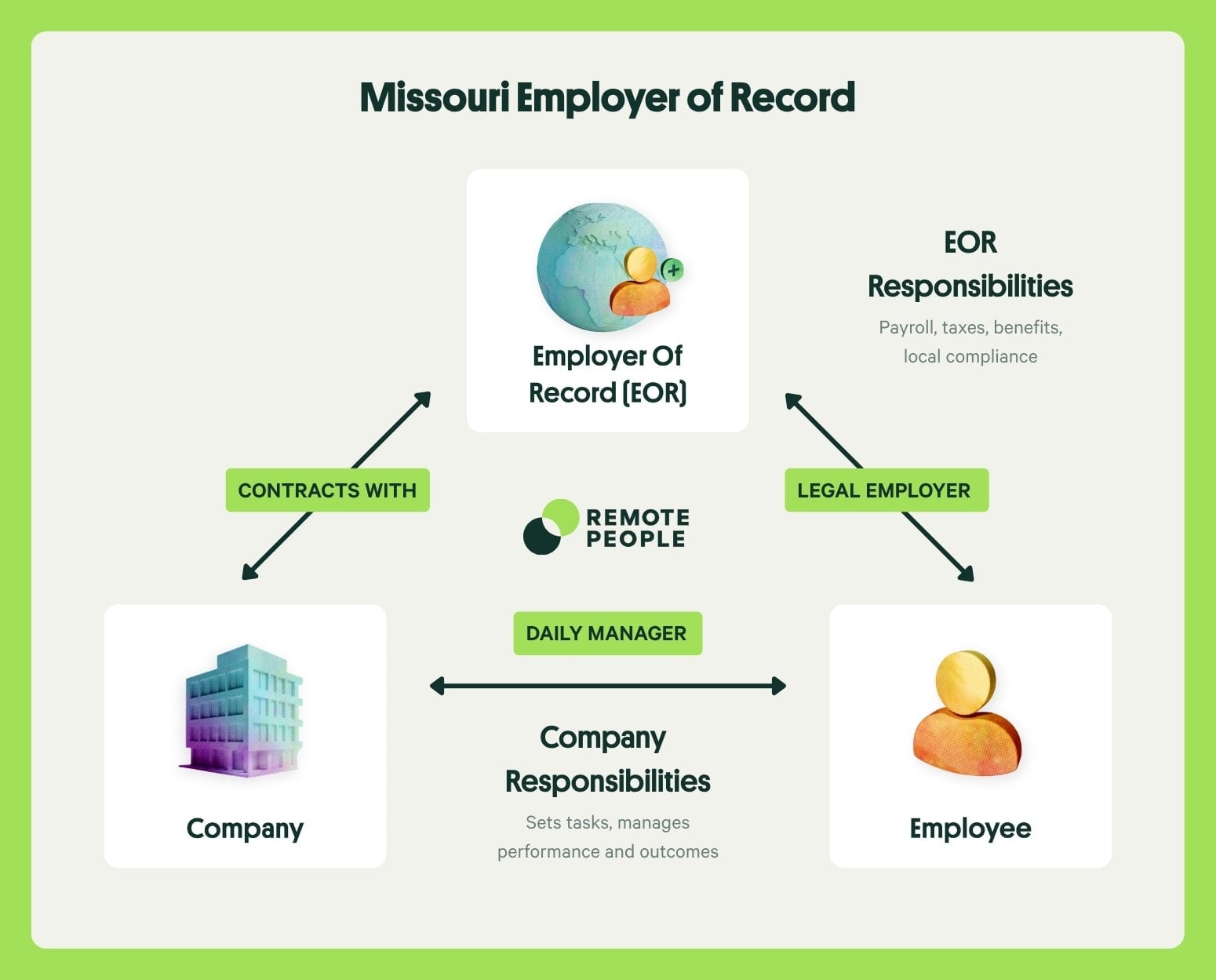
A Missouri Employer of Record (EOR) is a third-party company that acts as the legal employer of workers in Missouri. The main purpose of this is to allow companies to do business in Missouri compliantly without needing to set up their own legal entity, which can be expensive and admin-heavy.
What is an EOR can help explain how this employment model works in more detail.
There is a range of tasks that an EOR is responsible for, including:
- Processing payroll and issuing employee wages.
- Managing employment contracts and onboarding processes.
- Withholding and remitting both federal and state-level taxes.
- Ensuring practices strictly align with federal and local labor laws.
- Managing and administering employee benefits alongside workers’ compensation coverage.
The company would continue to manage day-to-day activities, while the EOR ensures workers are hired compliantly, efficiently, and in strict adherence with federal/state laws.
One of the most attractive aspects of using an EOR for companies is that it negates the need to set up a local entity, which would involve registering a business, setting up payroll accounts, and navigating state-level compliance independently. An EOR would assume employment liability and be able to hire workers much more quickly.
What Is the Difference Between a Missouri Employer of Record and a Missouri PEO?
There are key differences between an EOR and a Professional Employer Organization, although both are used to manage payroll, HR, and compliant hiring.
Professional Employer Organization (PEO)
A PEO works with a company via a co-employment relationship, primarily to provide administrative HR support while the company remains the legal employer.
This means that the company must have its own legal entity in Missouri and that it will retain full legal liability for all employment compliance.
Employer responsibilities are shared between the company and the PEO, with PEOs typically being used for domestic businesses already operating in Missouri.
Employer of Record (EOR)
An EOR works under a full employment model and acts as the legal employer of new workers.
This means that no Missouri local entity is required by the company, and employment compliance liability shifts to the EOR. Tasks such as hiring new workers compliantly, handling employment contracts, and managing payroll/remittances can all be handled by an EOR.
This method is commonly used by international and out-of-state companies that wish to expand operations in Missouri, without forming a legal entity or navigating state registrations alone.
Start hiring with a Missouri EOR
Let us handle the complexities of hiring, compliance, and payroll in Missouri while you focus on growing your team.
- Hire employees in Missouri with a Missouri EOR
- No local entity is needed
- Pricing starts at USD 199 per employee
- RemotePeople can also help you find the best talent in Missouri
How Does a Missouri Employer of Record Work?
A Missouri EOR manages the legal and administrative side of employment, while the employer focuses on daily operations and growing the business.
The process EORs typically use includes the following steps:
Compliant Employment Contract
The EOR is responsible for putting together compliant employment contracts for new workers in Missouri. These contracts must clearly outline important aspects of a working relationship, such as working terms, employee benefits, wages, and termination regulations.
Contracts must align with both federal and state labor laws and be signed by all parties prior to commencing work.
Payroll Setup with Correct State Registrations
EORs will set up all payroll registrations according to local Missouri registrations, including:
- Missouri Department of Revenue
- Missouri Division of Employment Security
- Workers Compensation Coverage
Registering with the above bodies ensures that payroll taxes and contributions are made correctly and on time, from the very first pay cycle.
Tax Withholding and Remittance
The EOR calculates, withholds, and remits all filings associated with federal income tax, Social Security, and Medicare.
They also manage contributions towards the Missouri state income tax and state unemployment insurance contributions.
The benefit of EORs handling this area is that all filings will be submitted according to strict Missouri reporting schedules and in line with the latest regulations.
Benefits Administration
All employees working in Missouri are entitled to certain benefits, such as compensation coverage, health insurance, and retirement plans.
EORs manage both statutory and optional benefits, ensuring strict compliance and competitive offerings for all workers.
Ongoing Compliance Management
An EOR is responsible for ongoing compliance management, ensuring that any changes to labor laws or employment records are complied with.
They all support termination and disciplinary procedures to ensure continued adherence to rules if contracts are ended.
Together, these steps will centralize payroll, tax, and regulatory management to enable companies to hire quickly and compliantly without needing to establish a legal entity.
How Labor Laws Affect Hiring in Missouri?
Missouri maintains relatively employer-friendly labor laws, but companies should familiarize themselves with these requirements, such as minimum wage rules and tax/insurance contributions.
Minimum Wage
Missouri sets an individual minimum wage, which is separate from the federal requirement.
As of 2026, this is set at $15.00 per hour for most private-sector employees, which applies to businesses whose annual gross income is over $500,000.
Tipped Employees
Employers are required to pay tipped employees at least half of the state minimum wage rate, which equates to $7.50 per hour.
If tips do not make up the other half of the minimum wage, the employer is responsible for making up the difference.
Overtime
Missouri follows rules set by the federal Fair Labor Standards Act (FLSA), which states that overtime counts as hours worked over 40 hours per week, and that overtime must be paid at 1.5 times an employee’s normal rate of pay.
There are no daily overtime limits on overtime worked in Missouri.
Income Tax
Missouri issues a state income tax via a progressive income tax system, with rates that increase based on income level.
Rates vary from 2% – 4.70% depending on salary, which is subject to legislative adjustments.
Employers are required to register with the Missouri Department of Revenue and remit all state income tax from their employees’ wages. They must withhold returns and remit payments according to the latest filing schedules.
Unemployment Insurance (SUI)
Employers are obligated to contribute towards the Missouri unemployment insurance program that has been set through the Division of Employment Security.
New employers usually pay an entry-level rate of around 2.7% on the first $9,000 of an employee’s wages, while more experienced employers tend to pay higher rates based on experience and claims history.
Wage reports and remit contributions must be filed quarterly.
Paid Leave
There is no state-wide paid sick leave or family leave in Missouri.
Employers must adhere to federal FMLA requirements, but are not obligated to provide a state-level paid leave insurance program. Some employers voluntarily offer paid leave, but at their own discretion and as per written policies.
Workers’ Compensation
Workers’ compensation coverage is mandatory for employers in Missouri.
Employers with 5 employees or more must carry workers’ compensation insurance, with policies obtained via private insurance programs. The state does not offer a monopolistic fund, and premiums vary depending on payroll size, claims history, and industry risk classification.
For example, industries such as construction, manufacturing, and transportation are higher risk than office-based jobs, and therefore typically face higher premiums.
Termination and Final Pay
Employers must fully understand termination regulations in Missouri before hiring workers in order to avoid wage disputes and penalties.
Is Missouri At-Will?
Missouri follows the ‘at-will’ employment doctrine, which permits employers and employees to terminate an employment relationship at any time (provided that it is lawful).
Employers must still comply with federal and state anti-discrimination laws to ensure contracts are terminated lawfully.
Final Paycheck Deadline
If an employee in Missouri has their contract terminated, they must be paid all outstanding wages at the time of discharge.
Wages must be paid as soon as possible if immediate payment cannot be made, and failure to provide timely pay can result in penalties/late-fees.
PTO Payout Requirement
There is no requirement in Missouri for employers to pay out unused vacation or PTO.
This only becomes applicable if a written company policy or employment agreement promises a payout.
Notice Requirements
There are no state-mandated notice periods for terminations in Missouri. However, employers do have to comply with federal WARN Act rules if they are issuing large layoffs or closures.
Wage Penalty Risks
If final wages are not paid in accordance with local labor laws, employers may face wage penalties, interest, legal costs, or potential civil claims (in severe cases).
Where Missouri requires prompt final payment when a contract is terminated, administrative errors can quickly lead to exposure. This is where an EOR can be helpful in ensuring termination procedures are standardized and final calculations are handled timely and accurately.
Payroll Taxes and Employer Cost in Missouri
There are various payroll taxes and employer costs that must be taken into account when hiring new workers in Missouri.
These statutory costs add to an employee’s base salary, and must therefore be factored in when employers budget for new staff.
Include:
Federal Payroll Taxes
All US employers are responsible for paying federal payroll taxes as follows:
Income Tax Withholding
While income taxes are deducted from employee pay, it is the employer’s responsibility to withhold income tax and remit payments to the Missouri Department of Revenue.
Employers must accurately calculate, report, and remit income tax, ensuring that all remittances meet local deadlines.
State Unemployment Insurance (SUI)
Missouri employers must contribute towards the SUI system based on the assigned experience rate and the annual wage base.
Rates vary depending on industry and claims history.
Workers’ Compensation
All Missouri employers must carry workers’ compensation insurance. This is purchased via private insurers, with costs depending on total payroll, claims history, and industry risk classification.
Example Cost Breakdown
We’ve included below an illustration of usual employer costs for hiring an employee in Missouri on an annual salary of $100,000:
Cost Component | Estimated Range |
|---|---|
Federal Payroll Taxes | 7.65% |
FUTA | 0.6% (capped) |
Workers’ Compensation | 0.3% – 3%+ |
Michigan SUI | 1% – 4%+ |
Benefits | 5% – 15% |
The above table indicates that employers must pay an additional 13% – 27% of an employee’s base salary, depending on the industry and benefit structure.
For an employee earning $100,000 per year, total employer costs can range from $113,000 – $127,000 annually.
An EOR can help consolidate these costs into a predictable service model, allowing companies to balance payroll compliance and budgeting effectively.
Employee Classification Rules in Missouri
Employees must be properly classified when hired in Missouri to ensure compliance with local and federal regulations.
Independent Contractor Test
Missouri uses an independent contractor test to determine the degree of control and economic dependence in a relationship between employer and employee.
This usually combines:
These tests determine whether the employer or the employee controls how and when work is performed, whether the worker provides their own tools and equipment, and whether the working relationship is short-term or permanent.
Misclassification can result in the back payment of wages and overtime, unpaid payroll taxes/penalties, retroactive benefit liabilities, and interest/fines.
Classification Strictness
Missouri is moderate in its classification strictness.
It does not apply a strict ABC test like states in California; however, misclassification audits do occur, and agencies have been known to coordinate with federal authorities where necessary.
EORs can help reduce the risk of misclassification by assuming full responsibility for worker classification and compliance with Missouri/federal standards. They are well-experienced in classifying workers and therefore tend to understand the factors that must be considered when hiring in Missouri.
This can reduce exposure to misclassification penalties/fines, particularly for companies that are operating from abroad and may be unfamiliar with the intricacies of US labor laws.
What Makes Hiring in Missouri Unique?
Missouri provides employers with a unique hiring environment by balancing its key central location, diversified industry mix, and moderate regulatory framework.
Its economy is driven by a range of industries such as manufacturing, aerospace, agriculture, financial services, and healthcare. Its strategic positioning in Central America also makes it a great area for companies working in transport, logistics, and distribution.
With a business-friendly regulatory framework, employers are given freedom to keep regulations manageable while still maintaining a strong stance on minimum wage and unemployment insurance. Wages tend to be lower in Missouri than the national coastal average, making it a great choice for employers on a budget.
The state benefits from a steady workforce of skilled individuals, with its wealth of universities, community colleges, and availability of vocational training courses. It also has a progressive income tax system, providing competitiveness in comparison with other high-tax states.
What Are the Benefits of a Missouri EOR?
There are a few key benefits to instructing a Missouri EOR, including:
- No entity setup, with the ability to hire without registering a legal entity.
- Faster onboarding and the ability to onboard workers without waiting for company information.
- Centralized compliance, including payroll, taxes, benefits, and reporting.
- Reduced legal risk with employment liability shifting to the EOR.
- Scalable across multiple states, allowing businesses to expand beyond Missouri using the same structure.
What Are the Downsides of a Missouri Employer of Record Service?
While a Missouri EOR can greatly assist with compliance and quick hiring, there are some considerations that employers must take into account.
EORs tend to charge a service fee, which is either a flat rate or a percentage of your monthly payroll. This will naturally add to your overall employment costs, especially if you’re managing a larger team.
You’ll also have less payroll control when working with an EOR, as you’re outsourcing payroll processing and tax filings. This may reduce hands-on oversight, so it is another important consideration to bear in mind.
However, when compared with the costs and complexities that come with setting up a legal entity, managing registrations, maintaining in-house HR teams, and managing compliance risk, EORs are significantly more efficient and usually well worth the costs/relinquishment of control.
How to Choose a Missouri Employer of Record?
Choosing the right Missouri EOR for your business is super important. You want a company to stay with you for the long-term and enable your transition into the Missouri market with ease.
Follow the checklist below to ensure that you’re choosing the right partner for your business:
- Transparent pricing without hidden fees is a must to ensure you know exactly what you’re getting for your money.
- Make sure you’re using a direct EOR, rather than a layered partner that outsources responsibility.
- An EOR should be able to expand your business beyond Missouri, rather than leave you needing multiple EORs for different states.
- Dedicated support should be available easily, as well as access to knowledgeable HR/compliance experts.
- Check your chosen EOR has a good track record in managing payroll taxes, regulatory updates, and local/federal labor laws.
Engage a Missouri Employer of Record with RemotePeople
If you’re keen to get started with a Missouri EOR, look no further than RemotePeople.
We specialize in EOR broker services, connecting businesses to the best-suited EOR for their company. This enables companies to hire quickly and compliantly in Missouri, without needing to establish their own legal entity.
Our network of EORs can manage employment contracts, payroll processing and tax remittance, unemployment insurance, benefits administration, and ongoing compliance monitoring, all while providing dedicated support for both employer and employee.
We can also help you hire directly via our recruitment services, where our partners can help you hire top talent in Missouri with local expertise and cost-effective recruitment.
Contact us today to meet your perfect EOR and start expanding your business in Missouri today.