
 Recruit
Employer of Record in Wisconsin
-
 Drew Donnelly
- Published
- September 22, 2026
Wisconsin’s employment law includes state unemployment insurance, workers’ comp, and specific wage rules, and a Wisconsin EOR handles payroll, taxes, and full state compliance with no local entity needed.
Hire in Wisconsin — book a free 30-minute demo
Tell us what you need. You'll get a tailored, transparent proposal within 24 hours, plus a free call to walk through it.
Tell us about your company
So we can match you with a specialist who knows your market — and unlock volume pricing tiers.
* All fields are required.
Where and when are you hiring?
Tell us the geography and timing and we'll quote each country line by line, with onboarding timelines.
* All fields are required.
Help us beat your current setup
We'll benchmark your current deal and send a line-by-line proposal in 24 hours — showing exactly where we cut cost, time, or risk. After you submit, you can book a call to walk through it together.
* All fields are required.
Thanks! Your proposal is on its way.
Expect a tailored, line-by-line proposal in your inbox within 24 hours. In the meantime…
Want to walk through it together?
Book a free 30-minute call with one of our specialists. We'll explain every line, answer your questions, and tailor the proposal further if you need.
No obligation. Pick a time that works for you.








- Hire in Wisconsin — book a free 30-minute demo
- Tell us about your company
- Where and when are you hiring?
- Help us beat your current setup
- Thanks! Your proposal is on its way.
- Wisconsin Employer of Record
- What Is the Difference Between a Wisconsin Employer of Record and a Wisconsin PEO?
- How Does a Wisconsin Employer of Record Work?
- How Labor Laws Affect Hiring in Wisconsin?
- Payroll Taxes and Employer Cost in Wisconsin
- Employee Classification Rules in Wisconsin
- What Makes Hiring in Wisconsin Unique?
- What Are the Benefits of a Wisconsin Employer of Record?
- What Are the Downsides of a Wisconsin EOR?
- How to Choose a Wisconsin Employer of Record?
- Engage a Wisconsin Employer of Record with RemotePeople
- Related EOR Destinations

Let RemotePeople handle payroll, compliance, and HR admin worldwide so you can focus on building your team.
Key Takeaways
- Wisconsin has a state minimum wage of $7.25 per hour that mirrors the federal rate.
- Different statutory tests are used when classifying workers for unemployment insurance and workers’ compensation.
- Wisconsin’s SUI is taxed on a $14,000 wage base. Rates are now set according to Schedule D.
- The Wisconsin Family and Medical Leave Act (WFMLA) mandates unpaid leave that companies with 50+ employees must offer.
- By utilizing a Wisconsin Employer of Record (EOR), foreign businesses won’t need to register with the Department of Revenue or the Department of Workforce Development.
Wisconsin’s economy features large employment in manufacturing, as well as growing technology-based industries like biohealth and niche engineering. Wisconsin ranks among the highest states by concentration of employment in manufacturing. Wisconsin workers are skilled in high-tech machinery and production.
The overall business environment in Wisconsin is stable. There is a moderate level of government regulation, and labor force participation rates are relatively high. Wisconsin employers cite difficulty filling positions as a major challenge due to the low unemployment rate, especially in northern and central areas of the state.
The cost of doing business in Wisconsin is generally considered to be affordable. However, hiring costs are somewhat elevated due to competition in the region and administrative costs related to social insurance and worker protections.
Wisconsin Employer of Record
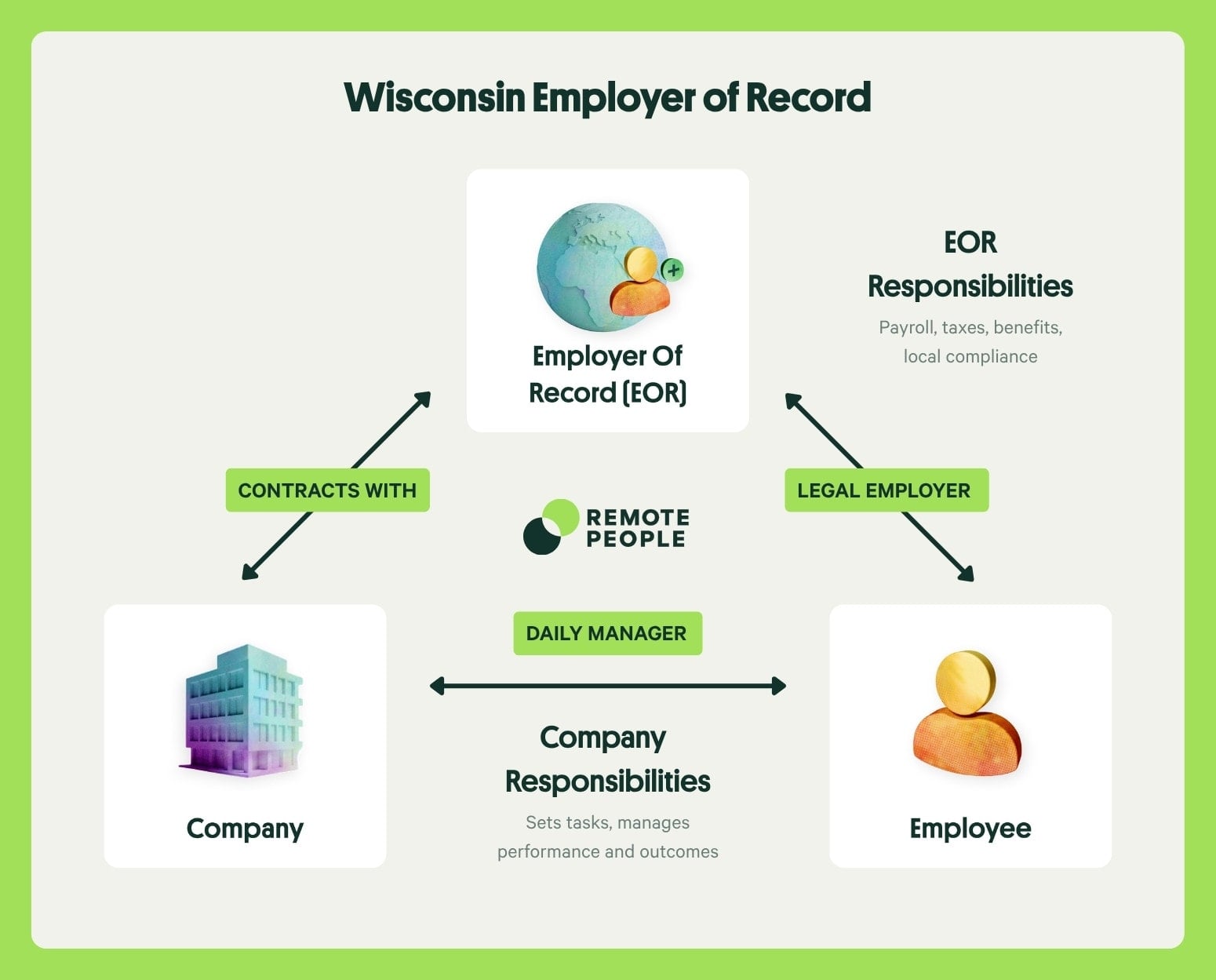
A Wisconsin Employer of Record (EOR) is a third-party entity that becomes the official legal employer for a company’s employees in the state of Wisconsin. With an EOR, the company outsources all legal compliance and administrative responsibilities to the EOR and maintains control of the day-to-day work, project allocation, and work quality of the staff.
What is an EOR can help explain how this employment model works in more detail.
The EOR processes payroll, files federal and state taxes, and manages benefits programs on behalf of the client company. The EOR uses its existing state registrations with the Wisconsin Department of Revenue (DOR) and the Department of Workforce Development (DWD) to manage all employment needs.
Using an EOR in Wisconsin shifts significant liability and legal compliance responsibilities to the EOR since the EOR becomes the legal employer on record with the state and will be responsible for meeting the needs of any state labor law or worker classification tests.
An EOR also allows an organization to avoid the months it takes to create a local legal entity by dramatically improving the speed-to-hire and onboarding talent in a matter of days while mitigating the risk of non-compliance, payroll, or misclassification claims within the advanced regulatory state of Wisconsin.
What Is the Difference Between a Wisconsin Employer of Record and a Wisconsin PEO?
PEO
A Wisconsin Professional Employer Organization (PEO) solution is a co-employment arrangement in which the employer is defined and divided between the service provider and the client company. For a PEO to be utilized in Wisconsin, the business must also maintain its own state-registered legal entity.
The client company also remains the primary employer of record for many legal purposes. Wisconsin PEOs are regulated by Chapter 202 of the Wisconsin Statutes and must register and maintain specific net working capital with the Department of Financial Institutions. The co-employment structure does, however, leave the client company with some direct legal exposure with regard to employment-related lawsuits or audits.
EOR
The EOR in Wisconsin becomes the legal employer of the workforce, thereby negating the need for the client company to maintain a local legal entity of its own. This is a slight but important differentiator that allows a company to operate virtually in Wisconsin without the need to establish a local entity, as the EOR fully assumes statutory employment liability.
The EOR contracts with the workers and contributes to the applicable statutory funds under its own account numbers and with its own workers’ compensation insurance policy. The EOR relationship can be an especially useful option for companies looking to rapidly expand or manage remote teams where a long-term physical presence is not needed.
Start hiring with a Wisconsin EOR
Let us handle the complexities of hiring, compliance, and payroll in Wisconsin while you focus on growing your team.
- Hire employees in Wisconsin with a Wisconsin EOR
- No local entity is needed
- Pricing starts at USD 199 per employee
- RemotePeople can also help you find the best talent in Wisconsin
How Does a Wisconsin Employer of Record Work?
The Wisconsin EOR Payroll Lifecycle commences when the EOR has an employment agreement in place, compliant with state-at-will legislation and state wage payment requirements.
Subsequently, the EOR Employer confirms each new employee’s work eligibility using Form I-9. The EOR completes new hire reporting to the state within 20 days of hire, as required by the Wisconsin Statutes.
For payroll setup, the EOR opens up new hires utilizing pre-existing EOR Employer accounts with the Revenue Department for withholding (Form BTR-101) and the Department of Workforce Development (DWD) for unemployment insurance (Form UCT-43-E).
The EOR Employer withholds progressive state income taxes, calculates, and files according to schedules provided by the state. The EOR Employer also files quarterly contribution and wage reports in order to fully fund the unemployment trust fund.
In addition to taxes, the EOR Employer provides statutory benefits, like workers’ compensation insurance and processing leave requests (under the WFMLA), and stays up-to-date with state changes to taxable wage bases and white-collar exemptions.
How Labor Laws Affect Hiring in Wisconsin?
Minimum Wage & Overtime
Wisconsin follows the federal minimum wage of $7.25 per hour. Interestingly enough, Wisconsin actually prohibits cities and towns from enacting a higher minimum wage, so $7.25 is the baseline.
Wisconsin breaks from the federal minimum wage for tipped employees and “training wages.” The former only requires employers to pay $2.33 per hour if employees make at least $7.25 per hour with tips. The training wage is $5.90 per hour, but only for employees under the age of 20 and only for their first 90 days of employment.
Overtime in Wisconsin follows the standard 40 hours per week. Any hours worked over 40 in a week are considered overtime and should be paid at 1.5 times the normal wage. There is no overtime rule for adults on a daily basis, just weekly.
Income Tax
Wisconsin taxes individual income with a graduated income tax, and it can be one of the highest taxes for employees and employers to consider. Wisconsin operates on a 4-bracket progressive scale, meaning the rate of taxation is dependent on the income earned by the employee.
The 2025-2026 rates range from 3.50% to 7.65%. The brackets were adjusted in 2025 to widen the income ranges for the lower brackets as an attempt to lessen the tax burden on middle-class employees. Wisconsin also has a Sliding Scale Standard Deduction (SSSD), which phases out as the taxpayer’s WAGI increases and goes to zero for high-income earners.
Employers are required to withhold income taxes from each paycheck. Employers must withhold the proper amount using the personal allowance and exemptions listed on the state’s WT-4 form. Wisconsin’s WT-4 contains allowances for taxpayers who are 65 years of age or older and the visually impaired.
State Unemployment Insurance (SUI)
SUI, in Wisconsin, is a tax that employers pay to provide temporary income benefits to eligible displaced workers. The taxable wage base for 2026 is $14,000 per employee. New employers, in most non-construction industries, begin at a rate of 3.05% or 3.25%, depending on their total payroll volume. Contributions are due quarterly to the DWD. To receive the maximum federal FUTA tax credit, timely deposits must be made.
Paid Leave
Wisconsin doesn’t have a paid sick leave law or paid family leave law that applies to private-sector workers. If your employer chooses to offer paid time off, they can set their own policies.
Wisconsin employers do provide family medical leave. Wisconsin’s Family and Medical Leave Act covers employers with 50 or more permanent employees.
Employees covered by the Wisconsin FMLA who have worked at least 1,000+ hours during the last year are eligible to take up to 6 weeks off from work for the birth of a new child, up to 2 weeks to care for a family member with a serious health condition, and up to 2 weeks to recover from a disabling health condition. Leave provided under the FMLA is unpaid.
Workers’ Compensation
Wisconsin workers’ compensation insurance laws are part of the regulatory scheme governing Wisconsin employers and employees. The workers’ compensation program is a compulsory, no-fault form of insurance coverage. It provides benefits to employees who suffer accidental injury or job-caused diseases.
Most Wisconsin private and public employers who have three or more employees (full-time or part-time) must provide a workers’ compensation policy for employees. An employer who has fewer than three employees still needs to obtain coverage if the employer paid gross wages of $500 or more during any calendar quarter and the employer has at least one employee.
The Worker’s Compensation Division of the DWD administers benefits under the program. Coverage is obtained by purchasing a policy from a private insurance carrier licensed in Wisconsin. Benefits are divided into four major categories: Medical coverage, income replacement or temporary disability, permanent disability, and dependents’ benefits.
Employers should be aware that fines up to double the amount of premiums that should have been paid ($750 or more) may be imposed, and they may also be ordered to close if found operating without insurance. The most important aspect of the Act for employers is the protection it provides, which prevents most civil litigation against the company.
Termination and Final Pay
Termination in Wisconsin is largely based upon the at-will employment doctrine. It is at-will unless otherwise agreed and can be terminated at any time for any legal reason. There is a narrow exception to this doctrine for violations of public policy, such as termination for filing a workers’ compensation claim.
Wisconsin’s final paycheck laws mandate that most workers who are separated from employment receive all wages they have earned by the next regular payday.
Additionally, there is a specific acceleration provision that requires employers to pay final wages within 24 hours if the separation is caused by the employer merging with another company, going out of business, or moving its business out of state.
Accrued, unused vacation or PTO must be paid out if the company’s written policy or employment contract provides for such a payout. However, if the employer fails to pay out accrued vacation time as promised, the employer may be liable for double damages if sued in civil court.
Payroll Taxes and Employer Cost in Wisconsin
Hiring an employee is more than their salary, since employers also pay additional taxes and insurance, known as the “employer burden.”
| Category | Cost |
|---|---|
| FICA (Social Security & Medicare) | Employers match the 6.2% Social Security tax on an employee’s wages earned up to $184,500. Employers match the 1.45% Medicare tax on all employee wages. There is an additional 0.9% in Medicare taxes on wages over $200,000 for high earners, but employers do not match the additional tax. |
| FUTA (Federal Unemployment) | 6% on the first $7,000 of wages. Paying into state unemployment tax will qualify most employers for a 5.4% credit and a net cost of only 0.6% (actual cost is $42 per employee per year). |
| SUI (State Unemployment) | In 2026, a new non-construction employer with less than $500k in payroll has a rate of 3.05%, and a new non-construction employer with over $500k in payroll has a rate of 3.25%, both on the first $14,000 of an employee’s wages. |
| Workers’ Compensation | This is based on the risk of your business and the types of jobs. A low-risk office job may pay $0.19 per $100 of payroll, but a manufacturing job may pay $10 per $100, or a construction job could pay $20 per $100. |
Example Cost Breakdown
Employing a worker in Wisconsin will cost a new employer $81,349.00 per year for the example Professional salary level of $75,000 in 2026. That breaks down to a basic cost of salary plus 8.47% ($6,799) in mandatory taxes and fees that must be paid by Wisconsin employers. Wisconsin employers pay 6.2% ($4,650) for Social Security taxes, 1.45% ($1,087.5) for Medicare taxes, and $42 for federal unemployment taxes (FUTA) tax.
Wisconsin requires 3.05% ($427) for unemployment insurance (SUI) tax on the first $14,000 earned. Depending on the location and class code, Wisconsin employers pay an average of $0.19 per $100 of payroll for workers’ compensation on a low-risk clerical job. Overall, Wisconsin employers have a burden rate under 9% when only considering required taxes and fees.
Although the total of the required taxes is less than 9%, employers usually provide health insurance, a 401(k) match, and an EOR service fee, so the total cost of employment is considerably higher than the taxes alone. The standard benefits push the employer’s total burden to between 20% and 35% of the salary. A more reasonable total, or “all-in” cost to an employer for an employee with a salary of $75,000 is between $90,000 and $101,000.
Employee Classification Rules in Wisconsin
Wisconsin is one of the toughest states when it comes to worker classification. The law there begins with a presumption that any person providing services for compensation is considered an “employee”. When it comes to workers’ comp and unemployment insurance, Wisconsin applies a nine-part statutory test found at Stat. § 102.07(8).
The test requires the worker to pass all nine requirements to be considered an independent contractor. Some of these requirements include the existence of a separate business, possession of a FEIN, and provision of services under certain contracts for specific amounts of money.
Wisconsin has a separate six-part “Economic Realities” test for labor standards purposes, like wage and hour laws. This test determines whether a worker is economically dependent on the putative employer.
Intentional misclassification can result in administrative penalties of $500 per employee. Criminal prosecution is also available for repeat willful offenders. Using an EOR greatly minimizes this risk by properly classifying all workers as W-2 employees of the provider.
What Makes Hiring in Wisconsin Unique?
Wisconsin has a unique labor market, especially when it comes to engineering trades and high-tech manufacturing. In addition to being a key manufacturing center, the state is a leader in “physical AI,” using new technology to revitalize legacy heavy industries, often through public-private research consortia.
There is a high demand for technical talent and a skills gap caused by an aging population in the north and central regions of the state.
Wisconsin also provides a “Manufacturing & Agriculture Credit” (MAC) available to qualified companies to effectively lower the corporate tax rate to as low as 0.4%.
The state is considered a high regulatory intensity state. Its field audit process for unemployment insurance and nine-part classification test for workers’ compensation are both more stringent than neighboring states. It requires employers to keep pristine records to avoid multiple layers of penalties.
What Are the Benefits of a Wisconsin Employer of Record?
- No Local Entity – Employers can begin hiring Wisconsinites without the extra step (and complexity) of incorporating locally
- Quicker Hiring – Leverage the EOR’s existing employer-employee relationship to drastically decrease the time-to-hire (from months to days)
- Streamlined Regulatory Support – The EOR handles all third-party interactions with the DWD, DOR, and other agencies (e.g., state tax withholdings and new hire reporting)
- Minimized Liability – The EOR is the primary liable party in the event of a workers’ compensation claim, misclassification penalty, or wage claim
- Simplified Growth – Increase or decrease your workforce in any state, all through a single, simplified administration platform
What Are the Downsides of a Wisconsin EOR?
Employing a Wisconsin EOR comes with a professional services fee, often a percentage of payroll or a flat monthly per-head charge. While this is a cost to consider, the fee is commensurate with the value of the compliance assurance and liability transfer of an EOR.
Additionally, clients have slightly less control over the technical timing of paychecks and the choice of individual insurance providers.
For most organizations, however, these tradeoffs are vastly outweighed by the efficiencies and cost savings of outsourcing DIY compliance to Wisconsin’s complex regulatory environment (including its unique §102.07(8) classification and graduated income tax withholding).
How to Choose a Wisconsin Employer of Record?
Transparent Pricing
The provider should be upfront about base salary, the mandatory employer burden (FICA, FUTA, SUI, WC), and its own service fees without unexpected markups.
Wisconsin-Owned EOR
Make sure the EOR provider is the owner of the legal entity you work with in Wisconsin, as opposed to a network model that outsources to third-party partners, as this can lower the quality of service and raise the level of risk.
Wisconsin-Specific Experience
Because Wisconsin has many unique labor code requirements, such as the WFMLA and tax credits, such as the MAC, it is important that the EOR provider has experience and can demonstrate an established understanding of the specific statutes for the state.
Audit and Legislative Track Record
Wisconsin has an active State Capitol. Ensure your EOR has the experience and successful history of both audit support and staying on top of legislative changes.
Dedicated Support Team
Ensure your EOR has demonstrated they have fast and effective support by having a dedicated account manager who knows the Wisconsin market.
Engage a Wisconsin Employer of Record with RemotePeople
Partner with RemotePeople as your Employer of Record in Wisconsin and equip your business with the compliance framework and agility to confidently onboard Wisconsin employees. RemotePeople, as your official employer, handles every aspect of employment, including crafting legally compliant contracts that generate W-2s, accurate tax filings, and nine-part worker classification assessments.
Gain speed and let your team concentrate on building your business and working on the technical side of things by transferring the burden of Wisconsin employment law to the specialists.
Contact RemotePeople today to start hiring compliantly and quickly in Wisconsin, with payroll and benefits also handled.