Recruit
Employer of Record in Minnesota
-
 Drew Donnelly
- Published
- July 3, 2026
Minnesota’s employment law includes paid family leave, earned sick leave, and wage theft protections, and a Minnesota EOR handles payroll and full state compliance with no local entity needed.

Hiring in Minnesota at a glance
Up to 9.85%
$11.13/hr
~$5,500/mo
Monthly (max)
~12-14%
Paid sick + family leave
Not enforceable
After 40 hrs/week
Required
CST (GMT-6)








- Minnesota Services
- Key Takeaways
- What Is a Minnesota Employer of Record?
- What Is the Difference Between a Minnesota Employer of Record and a Minnesota PEO?
- How Does a Minnesota Employer of Record Work?
- How Labor Laws Affect Hiring in Minnesota?
- Payroll Taxes and Employer Cost in Minnesota
- Employee Classification Rules in Minnesota
- What Makes Hiring in Minnesota Unique?
- What Are the Benefits of a Minnesota Employer of Record?
- What Are the Downsides of a Minnesota EOR?
- How to Choose a Minnesota Employer of Record?
- Engage a Minnesota Employer of Record with Remote People
- Related EOR Destinations

Let Remote People handle payroll, compliance, and HR admin worldwide so you can focus on building your team.
Key Takeaways
- Minnesota has a worker-protective regulatory environment with active labor enforcement.
- Employers must manage state income tax withholding, unemployment insurance, paid leave requirements, and workers’ compensation.
- Minnesota does not allow a traditional tipped wage credit for most employers.
- A Minnesota Employer of Record enables fast, compliant hiring without forming a local entity.
Minnesota is one of the most stable and productive labor markets in the Midwest. The state is known for its strong workforce participation, high education levels, and concentration of major corporate employers across healthcare, manufacturing, retail, financial services, and technology.
The business climate is generally supportive, but employment regulation is more structured than in many neighboring states. Wage standards are higher than federal minimums, leave requirements have expanded in recent years, and enforcement around worker classification and wage compliance is active.
Cost-wise, Minnesota sits right in the middle of the U.S. range. Salaries are higher than in Southern states but lower than in coastal markets, making it attractive for professional roles, operations teams, and remote knowledge workers.
Because employers must register with multiple state agencies and manage evolving leave and payroll requirements, many organizations use an Employer of Record to simplify entry into the state.
What Is a Minnesota Employer of Record?
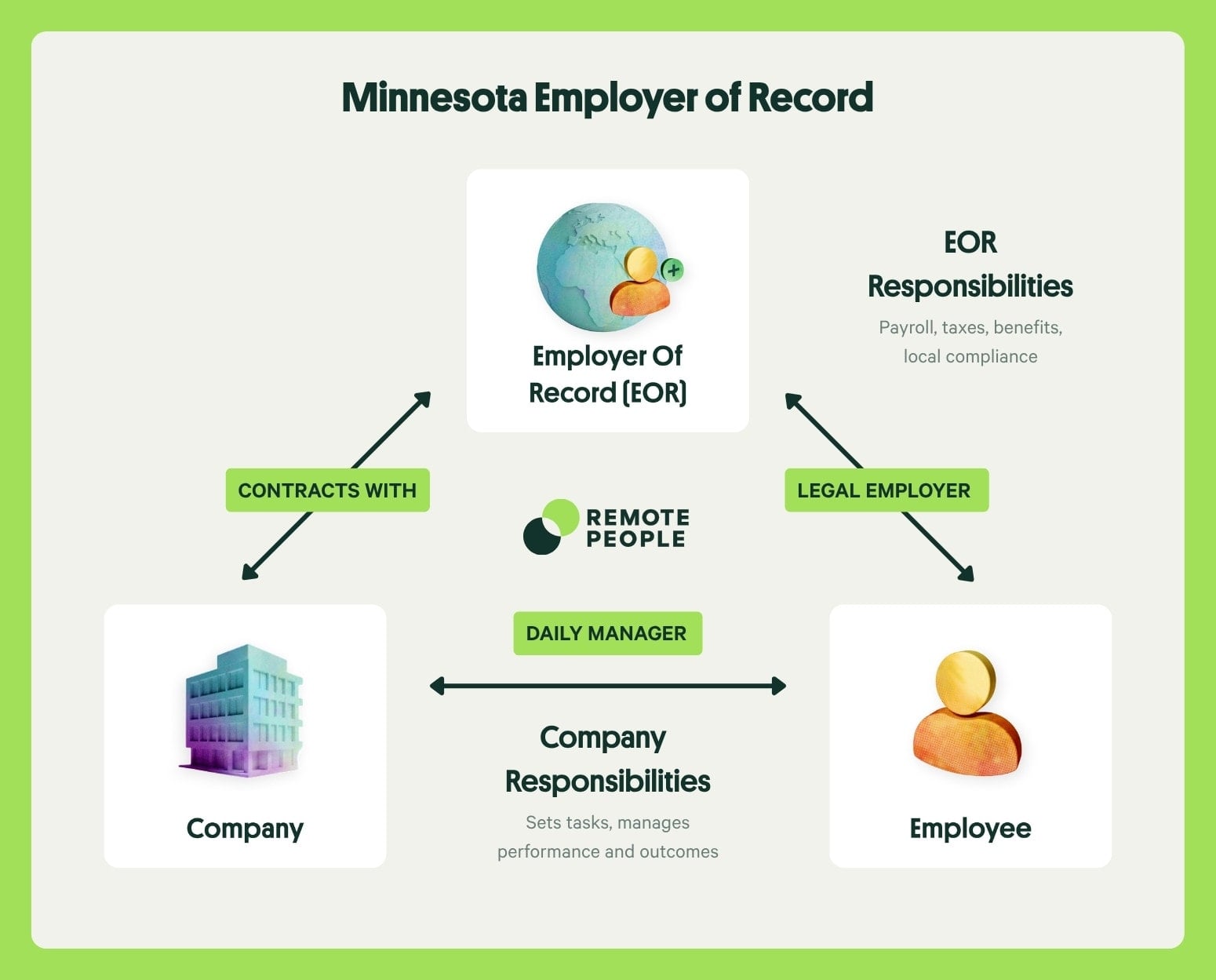
A Minnesota Employer of Record (EOR) is a third-party provider that legally employs workers on your behalf within the state. Instead of your company becoming the registered employer in Minnesota, the EOR assumes that role for payroll, tax, and compliance purposes.
Part of the responsibilities of the typical EOR service provider include:
- Payroll processing and wage payments
- Federal and Minnesota income tax withholding and filings
- State unemployment insurance registration and reporting
- Administration of required leave programs and benefits coordination
- Workers’ compensation coverage
- Employment documentation, recordkeeping, and regulatory reporting
While the EOR handles the legal and administrative side of employment, your organization maintains full control over the employee’s day-to-day work, performance management, compensation decisions, and business priorities. From an operational standpoint, the employee works for you; from a legal standpoint, they are employed through the EOR.
By transferring legal employment responsibility to the provider, companies can hire in Minnesota without forming a local entity, opening multiple state accounts, or building internal payroll and compliance processes. This structure is invaluable for first hires, remote teams, or organizations expanding into the state while minimizing administrative complexity and regulatory risk.
What Is the Difference Between a Minnesota Employer of Record and a Minnesota PEO?
Both Employer of Record (EOR) providers and Professional Employer Organizations (PEOs) support payroll, benefits, and HR administration, but the difference-maker is who legally employs the worker and who assumes the regulatory risk.
A PEO operates under a co-employment model. What this means is that before engaging a PEO, your company must establish and maintain a legal entity in Minnesota and complete all required employer registrations. This includes setting up accounts for state income tax withholding, unemployment insurance, and workers’ compensation coverage. The PEO then assists with administrative functions such as payroll processing, benefits management, and certain HR support.
You, however, remain responsible for compliance with Minnesota wage and hour laws, proper employee classification, managing unemployment claims, and employment-related liability
In essence, a PEO helps streamline administration but does not remove your underlying legal obligations.
An EOR takes things a notch higher, with the provider becoming the legal employer of record, allowing your company to hire in Minnesota without forming a local entity or opening state payroll accounts.
The EOR assumes responsibility for payroll tax filings, unemployment contributions, workers’ compensation coverage, leave administration, and ongoing compliance with state and federal employment requirements.
Your company continues to manage the employee’s daily work, performance, compensation decisions, and operational direction, while the EOR handles the employment infrastructure and regulatory responsibilities.
For companies already operating in the U.S. with established HR and payroll capabilities, a PEO may be an appropriate administrative solution. For international organizations, companies testing the Minnesota market, or businesses expanding across multiple states, an EOR provides a faster, more flexible, and lower-risk path to building a compliant workforce.
Start hiring with a Minnesota EOR
Let us handle the complexities of hiring, compliance, and payroll in Minnesota while you focus on growing your team.
- Hire employees in Minnesota with a Minnesota EOR
- No local entity is needed
- Pricing starts at USD 199 per employee
- Remote People can also help you find the best talent in Minnesota
How Does a Minnesota Employer of Record Work?
Using an Employer of Record changes the hiring process from a multi-step compliance project into a straightforward operational decision.
Once you’ve identified a candidate, the EOR prepares a locally compliant employment offer that reflects Minnesota wage rules, leave entitlements, and statutory requirements. The provider then manages onboarding, collects required tax forms, verifies work authorization, and activates the employee within its payroll system so they can begin work without delay.
From that point forward, the EOR serves as the registered employer with the relevant state authorities, including:
- The Minnesota Department of Revenue for income tax withholding
- The Minnesota Unemployment Insurance Program
- An approved insurer for workers’ compensation coverage
Payroll is processed with the correct federal and state withholdings, unemployment contributions, and any applicable leave-related deductions. The EOR also handles year-end reporting, supports benefit administration where offered, and tracks statutory leave, including Earned Sick and Safe Time, and upcoming paid family leave requirements.
Rather than coordinating multiple registrations, filing schedules, and compliance deadlines internally, your team works through a single employment structure. You manage the employee’s role, goals, and performance, while the EOR keeps payroll, reporting, and state obligations aligned with Minnesota requirements as they evolve.
How Labor Laws Affect Hiring in Minnesota?
Minimum Wage & Overtime
As of January 1, 2026, Minnesota’s statewide minimum wage is $11.41 per hour, and this rate applies to all employers, regardless of size. The wage is adjusted annually based on inflation.
A lower training wage of $9.31 per hour may be paid to employees under age 20 during their first 90 days of employment. Minnesota does not allow tip credits, meaning tipped employees must receive the full state minimum wage directly from the employer, in addition to any tips earned.
Overtime requirements depend on which law applies. Under Minnesota state law, overtime is required at 1.5x the regular rate for hours worked over 48 hours in a seven-day workweek. However, most employers are covered by the federal Fair Labor Standards Act (FLSA), which requires overtime after 40 hours in a workweek. In practice, most employees qualify for the federal 40-hour threshold.
Overtime calculations are based on actual hours worked; paid time off, such as vacation, sick leave, or holidays, does not count toward overtime eligibility. Certain executive, administrative, and professional employees may be exempt if they meet federal salary and duties tests.
Employers should also note that local ordinances in cities such as Minneapolis and St. Paul may set higher minimum wage rates. Where local and state requirements differ, the higher rate must be applied.
Income Tax
Minnesota applies a progressive state income tax system, with rates based on taxable income and adjusted annually for inflation. For the 2026 tax year, four tax brackets apply, with rates ranging from 5.35% to 9.85%.
The tax is calculated using federal taxable income as the starting point, with Minnesota-specific adjustments for certain deductions and credits. There are no local income taxes at the city or county level.
2026 Minnesota Income Tax Brackets (Single Filers)
Tax Rate | Taxable Income Range |
|---|---|
5.35% | $0 – $32,570 |
6.80% | $32,571 – $106,990 |
7.85% | $106,991 – $198,630 |
9.85% | Over $198,630 |
Employers must:
- Register with the Minnesota Department of Revenue
- Withhold state income tax from employee wages based on the applicable bracket
- File withholding returns according to the assigned frequency
- Issue annual Forms W-2 reporting Minnesota wages and tax withheld
Most full-time employees fall within the middle brackets, making accurate withholding important for payroll compliance. Nonresidents and part-year residents may not be required to file if their Minnesota income falls below certain thresholds, but employer withholding requirements still apply whenever wages are subject to Minnesota tax.
State Unemployment Insurance (SUI)
Minnesota employers are required to contribute to State Unemployment Insurance (SUI), an employer-funded program that provides temporary wage replacement to workers who lose their jobs through no fault of their own. The program is administered through the Minnesota Unemployment Insurance Trust Fund and is financed entirely by employer payroll taxes.
SUI contributions are reported and paid quarterly, and employers must register for a Minnesota UI account before hiring employees.
For 2025–2026, experienced employer tax rates generally range from 0.4% to 9.3% on taxable wages. The exact rate is determined annually based on the employer’s experience rating, which reflects prior unemployment claims, as well as the overall condition of the state’s trust fund.
For employees, the program typically replaces about 50% of average weekly wages, up to a maximum weekly benefit of $914, for a period of up to 26 weeks, provided eligibility requirements are met.
Because Minnesota uses experience-based pricing, workforce stability and accurate separation documentation play an important role in managing long-term unemployment tax costs.
Paid Leave
Minnesota has expanded employee leave protections in recent years, making this an important compliance area.
The state requires Earned Sick and Safe Time (ESST) for most employees. Workers accrue paid leave based on hours worked, which can be used for personal illness, caring for family members, domestic violence-related needs, or certain public health situations.
In addition, Minnesota has enacted a statewide Paid Family and Medical Leave (PFML) program, scheduled to take effect in 2026. The program will provide wage replacement benefits for qualifying family and medical reasons and will be funded through payroll contributions shared by employers and employees.
Eligible uses will include bonding with a new child, caring for a family member, and the employee’s own serious health condition. Because the program introduces new contributions, reporting, and eligibility requirements, employers hiring in Minnesota should ensure payroll systems are properly configured and updated as implementation progresses.
Workers’ Compensation
Workers’ compensation is mandatory for most Minnesota employers and operates as a no-fault system. This means employees who suffer work-related injuries or illnesses are eligible for benefits regardless of who was at fault, and employers generally receive protection from direct liability claims related to workplace injuries.
A work-related injury includes any condition caused, aggravated, or accelerated by job duties. This may include traumatic injuries, repetitive stress conditions, occupational diseases, and certain qualifying mental health conditions such as post-traumatic stress disorder (PTSD).
Minnesota’s workers’ compensation program provides three primary categories of benefits:
- Wage-loss benefits, including temporary or permanent disability payments, when an employee cannot work or has a reduced earning capacity
- Medical benefits, covering reasonable and necessary treatment such as hospital care, surgery, therapy, medications, and related travel expenses
- Vocational rehabilitation, designed to help injured employees return to their previous role or transition to suitable employment through retraining, job placement support, or workplace modifications
Employers (or their insurers) must ensure prompt reporting and claims handling, and coverage must be in place through a private insurer or approved self-insurance program. The system is administered and regulated by the Minnesota Department of Labor and Industry.
Because coverage applies to both full-time and part-time employees and benefit obligations can be extensive, workers’ compensation represents a significant compliance and cost consideration for employers operating in Minnesota.
Termination and Final Pay
Minnesota is an at-will employment state, meaning employers may terminate employees at any time for any lawful reason, provided the action does not violate anti-discrimination or other employment protections.
Final pay timelines depend on the circumstances of separation and whether the employee makes a formal demand.
For terminated employees, final wages must be paid:
- Within 24 hours if the employee makes a written demand, or
- By the next regularly scheduled payday, but no later than 20 days after separation, if no demand is made
Employees who resign must receive their final paycheck on the next regular payday or within 20 days of their last day of work, whichever comes first.
Final wages may be delivered through the employer’s normal payment method, including by mail, with the postmark date considered the payment date.
Accrued, unused vacation or PTO must be paid out at termination unless the employer has a clear, written policy stating otherwise. Employers may not deduct amounts for unreturned equipment or property unless the employee has provided written authorization and the deduction does not reduce pay below minimum wage.
Failure to meet final pay deadlines can result in waiting-time penalties of up to 15 days of additional wages, along with potential legal costs and attorney’s fees.
Payroll Taxes and Employer Cost in Minnesota
Employers in Minnesota face a cost structure that merges standard federal payroll taxes with several state-specific obligations. While salary levels are generally moderate compared to coastal markets, total employment costs can be higher than expected due to the state’s high unemployment wage base and the introduction of paid family and medical leave contributions.
At the federal level, employers pay Social Security at 6.2% and Medicare at 1.45% of wages, along with Federal Unemployment Tax (FUTA), which is applied at an effective rate of up to 0.6% on the first $7,000 of wages after available credits.
State-level responsibilities add another layer.
Employers must withhold Minnesota’s progressive income tax (ranging from 5.35% to 9.85%) and remit it to the Department of Revenue. They must also contribute to State Unemployment Insurance, which applies to a wage base exceeding $40,000 per employee and uses experience-based rates that can vary significantly depending on claims history.
Employers must also now participate in the statewide Paid Family and Medical Leave program, with payroll contributions shared between employers and employees. In addition, workers’ compensation coverage is required for all employees, with premiums based on industry risk and payroll levels.
For a professional employee earning $100,000 annually, employer payroll costs include $7,650 for Social Security and Medicare, a small FUTA liability, unemployment contributions that may range from roughly $600 to $2,500, workers’ compensation costs of approximately $400 to $1,800 depending on the role, and an estimated employer share of paid leave contributions of about $300 to $500.
In practice, total employer burden in Minnesota generally falls between 10% and 15% for low-risk professional roles. Because unemployment rates are experience-driven and new leave contributions add an ongoing payroll obligation, careful payroll management and workforce stability play an important role in controlling long-term employment costs.
Employee Classification Rules in Minnesota
Employee classification in Minnesota is based on the degree of control and independence in the working relationship. Employers must determine whether a worker is an employee or an independent contractor by evaluating behavioral control, financial control, and the overall nature of the relationship, rather than relying on job titles or contract language.
A worker is generally considered an employee if the company has the right to direct how the work is performed, provides the tools or equipment, or if the individual is economically dependent on the business. True independent contractors, by contrast, typically operate their own business, control how and when work is completed, and are responsible for their own taxes. They are not eligible for overtime, unemployment insurance, or workers’ compensation coverage.
Minnesota applies particularly strict standards in certain sectors.
For example, since March 1, 2025, the construction industry has been under a strict mandate to meet a detailed 14-factor test under Minnesota Statute 181.723 to establish independent contractor status.
In addition to contractor classification, employers must determine whether employees are exempt or non-exempt under the federal Fair Labor Standards Act. Non-exempt employees are entitled to overtime pay, while exempt employees must meet specific salary and duties requirements.
Misclassification is actively enforced in Minnesota and can result in liability for unpaid wages, back taxes, unemployment contributions, workers’ compensation premiums, and civil penalties. Because enforcement agencies closely scrutinize worker status, employers should carefully evaluate each engagement and document their classification decisions.
What Makes Hiring in Minnesota Unique?
Minnesota stands out for its combination of a highly capable workforce and a regulatory environment that places a strong emphasis on employee protections. The state consistently ranks well for education levels, labor force participation, and productivity, with talent across professional niches.
From a compliance standpoint, however, Minnesota requires more hands-on payroll and policy management than many neighboring states. Employers must administer Earned Sick and Safe Time, manage contributions tied to a relatively high unemployment wage base, and prepare for the operational impact of the statewide Paid Family and Medical Leave program. Local ordinances in cities such as Minneapolis and St. Paul may also introduce additional wage considerations.
Cost planning is equally important. While base salaries are generally lower than in coastal markets, total employment costs can rise due to unemployment taxes, leave contributions, and benefits-related administration. These layered requirements mean that workforce budgeting and payroll accuracy matter more than the headline salary alone.
For companies building distributed teams or expanding their Midwest footprint, Minnesota offers dependable talent, economic stability, and a strong work culture. The tradeoff is a more structured compliance environment, one that benefits from the kind of operational support an EOR model can provide.
What Are the Benefits of a Minnesota Employer of Record?
Given Minnesota’s layered compliance requirements, using an EOR to simplify entry into the state is a no-brainer. An EOR allows organizations to hire employees without establishing a local legal entity or setting up multiple state accounts, removing the administrative steps that slow down expansion.
Because the provider already maintains the necessary registrations, employees can be onboarded quickly and begin working without delays tied to tax setup or program enrollment.
The model also brings operational clarity to ongoing employment. Instead of managing separate processes for income tax withholding, unemployment contributions, paid leave deductions, workers’ compensation, and year-end reporting, these responsibilities are handled through a coordinated payroll system. This centralized approach reduces internal workload and helps minimize errors in a state where payroll accuracy and timely filings are especially important.
For companies building distributed teams, the advantage extends beyond Minnesota. An EOR creates a consistent employment framework across locations, allowing organizations to add Minnesota employees alongside other states without developing separate compliance infrastructure for each new hire.
What Are the Downsides of a Minnesota EOR?
While an EOR simplifies market entry and compliance management, the model is not without tradeoffs. The most immediate consideration is cost. EOR services include a management fee on top of standard employment expenses, which can make the structure less economical for organizations planning to build large, permanent teams in Minnesota.
There is also a practical shift in how certain employment processes are handled. Because payroll, documentation, and statutory reporting run through the provider’s systems, companies may have less flexibility around payroll timing, benefit customization, or specialized employment arrangements. Most operational decisions remain with the client, but administrative changes need to align with the EOR’s standardized framework.
For organizations that already maintain a registered Minnesota entity and have internal HR and payroll capabilities, direct employment may offer greater control and long-term cost efficiency. However, for international companies, first hires, or multi-state expansion, the administrative simplicity and risk reduction of an EOR often outweigh these limitations.
How to Choose a Minnesota Employer of Record?
Selecting the right EOR in Minnesota requires more than basic payroll capability. Companies should look for a provider with deep U.S. compliance experience, particularly in managing multi-state employment and adapting to evolving requirements such as paid family and medical leave, local wage ordinances, and experience-based unemployment taxes. Clear, transparent pricing and a direct employment model, rather than layered third-party partnerships, help ensure accountability and predictable costs.
Operational strength is equally important. Evaluate how quickly the provider can onboard employees, the quality of its payroll accuracy and reporting, and its ability to administer benefits efficiently. A strong EOR should also be equipped to handle ongoing requirements such as unemployment claims management, leave tracking, workers’ compensation coordination, and Minnesota’s specific final pay rules without delays or errors.
Finally, consider scalability. Providers with robust multi-state infrastructure make it easier to expand beyond Minnesota while maintaining a consistent employment framework. Dedicated support, responsive communication, and a proven compliance track record help ensure a smooth experience for both the employer and the employee as hiring grows.
Engage a Minnesota Employer of Record with Remote People
Remote People enables companies to hire employees in Minnesota quickly and compliantly without establishing a local entity. The service includes payroll processing, tax filings, unemployment reporting, paid leave administration, workers’ compensation coverage, and ongoing compliance monitoring.
By acting as the legal employer of record, we help organizations manage Minnesota’s evolving employment requirements while reducing administrative complexity and compliance risk.
With infrastructure across all U.S. states, Remote People provides a scalable solution for companies building distributed teams or expanding their workforce with confidence.
Contact us to get started.