
 Recruit
Employer of Record in Iowa
-
 Drew Donnelly
- Published
- September 22, 2026
Iowa’s employment law includes state unemployment insurance, workers’ comp, and wage rules, and an Iowa EOR handles payroll, taxes, and full state compliance with no local entity needed.
Hire in Iowa — book a free 30-minute demo
Tell us what you need. You'll get a tailored, transparent proposal within 24 hours, plus a free call to walk through it.
Tell us about your company
So we can match you with a specialist who knows your market — and unlock volume pricing tiers.
* All fields are required.
Where and when are you hiring?
Tell us the geography and timing and we'll quote each country line by line, with onboarding timelines.
* All fields are required.
Help us beat your current setup
We'll benchmark your current deal and send a line-by-line proposal in 24 hours — showing exactly where we cut cost, time, or risk. After you submit, you can book a call to walk through it together.
* All fields are required.
Thanks! Your proposal is on its way.
Expect a tailored, line-by-line proposal in your inbox within 24 hours. In the meantime…
Want to walk through it together?
Book a free 30-minute call with one of our specialists. We'll explain every line, answer your questions, and tailor the proposal further if you need.
No obligation. Pick a time that works for you.








- Hire in Iowa — book a free 30-minute demo
- Tell us about your company
- Where and when are you hiring?
- Help us beat your current setup
- Thanks! Your proposal is on its way.
- Iowa Employer of Record
- What Is the Difference Between an Iowa Employer of Record and an Iowa PEO?
- How Does an Iowa Employer of Record Work?
- How Labor Laws Affect Hiring in Iowa?
- Payroll Taxes and Employer Cost in Iowa
- Employee Classification Rules in Iowa
- What Makes Hiring in Iowa Unique?
- What Are the Benefits of an Iowa Employer of Record?
- What Are the Downsides of an Iowa EOR?
- How to Choose an Iowa Employer of Record?
- Engage an Iowa Employer of Record with RemotePeople
- Related EOR Destinations

Let RemotePeople handle payroll, compliance, and HR admin worldwide so you can focus on building your team.
Key Takeaways
- Iowa doesn’t use a state minimum wage. It follows the federal rate of $7.25 per hour.
- The state imposes personal income tax, and employers must withhold and remit it properly.
- All employers must pay unemployment insurance (SUI) on a taxable wage base set annually by the state.
- Workers’ compensation insurance is compulsory for all employers, regardless of company size.
- An Iowa Employer of Record allows companies to hire successfully in the state without registering a local entity.
Manufacturing, agriculture, and food production play a major role in Iowa’s economy. The state also has strong insurance, healthcare, and logistics sectors that create steady job opportunities within the local workforce.
Hiring in Iowa is very straightforward compared to other US states. The state follows federal rules for minimum wage and overtime, which makes it easier for employers to administer payroll. However, businesses must still register properly before paying employees.
They are expected to set up state income tax withholding, unemployment insurance accounts, and workers’ compensation coverage if required. Failure to comply with this may result in heavy fines and legal disputes.
If you are planning to set up a team in Iowa this year, an EOR can provide all the administrative support your business needs to begin operations successfully. They’ll help you hire and onboard talent compliantly, even if you do not own a local entity.
Iowa Employer of Record
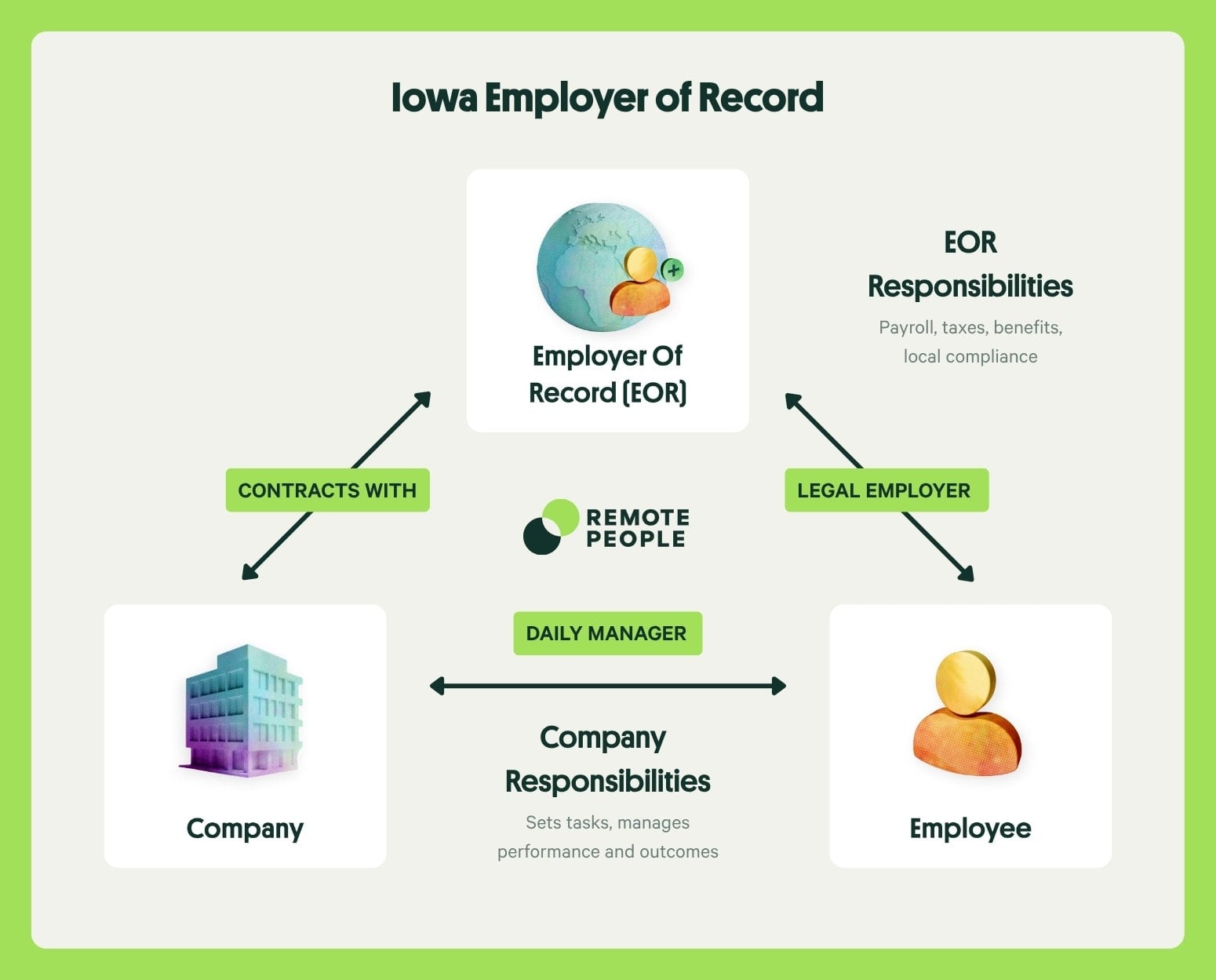
An Iowa Employer of Record (EOR) is a third-party organization that acts as the legal employer for your business in Iowa. They recruit, hire, and onboard talent on your behalf, in compliance with federal and state labor laws.
What is an EOR can help explain how this employment model works in more detail.
Your company still manages the employee’s daily work and performance, while the EOR is responsible for other administrative duties. They handle payroll processing, tax filings, required state registrations, and ongoing compliance.
Working with an EOR means you do not need to form or register a legal entity in Iowa before hiring. The EOR allows you to onboard employees faster and automatically bears the employment liability and compliance risks.
This includes income tax withholding, unemployment insurance reporting, workers’ compensation administration, and proper payroll management.
What Is the Difference Between an Iowa Employer of Record and an Iowa PEO?
An Iowa Employer of Record (EOR) and an Iowa Professional Employer Organization (PEO) both help businesses manage payroll and HR tasks, but they operate differently. If you are expanding to Iowa this year, understanding the difference will help you make an informed decision.
Professional Employer Organization (PEO)
A PEO works under a co-employment model. This means that your company must already have a registered legal entity in Iowa. You remain the legal employer, while the PEO shares administrative responsibilities such as payroll processing, tax filings, and benefits administration.
The liability is shared, not fully transferred. If you are already established in the state and simply want administrative & HR support, we recommend partnering with a PEO in Iowa.
Employer of Record (EOR)
An EOR works differently from a PEO. They become the legal employer of labor and ensure you remain compliant with Iowa labor laws. Your company will only be responsible for managing the employee’s daily work, while the EOR handles all administrative responsibilities on your behalf.
Employers who work with an EOR don’t have to handle the burden of wage payments, tax withholding, unemployment insurance filings, and workers’ compensation coverage. The EOR provides all the support you need to set up successfully and focus on business growth, even if you do not own a legal entity in Iowa.
If you are seeking to hire compliantly in Iowa within days, instead of weeks, we recommend partnering with an EOR.
Start hiring with an Iowa EOR
Let us handle the complexities of hiring, compliance, and payroll in Iowa while you focus on growing your team.
- Hire employees in Iowa with an Iowa EOR
- No local entity is needed
- Pricing starts at USD 199 per employee
- RemotePeople can also help you find the best talent in Iowa
How Does an Iowa Employer of Record Work?
When you work with an EOR provider to help you hire and manage employees in Iowa, you can expect a structured process that ensures payroll accuracy, tax compliance, and ongoing compliance with labor laws.
Drafting of Compliant Employment Contracts
The EOR prepares an employment contract that complies with Iowa and federal labor laws. Iowa is an “at-will employment” state, so either the employer or employee can end employment at any time, unless a written agreement clearly states otherwise.
The contract must clearly outline the salary, job role, payment frequency, and other employment terms that ensure legal protection and clarity from the start.
Payroll Registration
Before a company begins to process payroll and pay its workers in Iowa, it must have completed the necessary registrations mandated by the state.
Employers must register for income tax withholding with the Iowa Department of Revenue and register for unemployment insurance with Iowa Workforce Development.
Payroll Processing
Once the employee resumes work in your company, the EOR immediately updates and processes payroll to prevent errors.
They’ll calculate the employee wages, apply overtime rules when required, and withhold all federal and Iowa state income taxes. They are also responsible for withholding and remitting Social Security and Medicare taxes to the appropriate authorities. Failure to meet the remittance deadlines may result in heavy penalties.
Insurance and Benefits Administration
The EOR handles the workers’ compensation coverage on your behalf. If employee benefits are provided by your company, the EOR ensures that health insurance, retirement plans, or other company benefits are properly administered.
If any employee ever gets injured at work, this structure ensures that they receive the required workers’ coverage while the employer avoids compliance risks or legal disputes.
Ongoing Compliance Management
Employment compliance does not end after onboarding staff. The EOR continues to monitor tax rate updates, manage unemployment insurance filings, maintain payroll records, and ensure minimum wage compliance.
They also handle final paycheck requirements if employment ends. This ongoing compliance helps to reduce the risk of penalties and administrative errors that may affect your business.
How Labor Laws Affect Hiring in Iowa?
Businesses that plan to hire in Iowa must understand and follow several aspects of the labor law. The state mostly adopts federal rules, but there are still state-specific laws employers must comply with to avoid penalties.
Minimum Wage & Overtime
Iowa follows the federal minimum wage of $7.25 per hour. The state previously used to let cities set their own minimum wages, but the new Iowa law now mandates employers to follow the general minimum wage.
There are currently no state-specific laws on overtime. If an employee has worked beyond the standard 40 hours required for a work week, the employer must comply with federal laws on overtime. Employees are entitled to 1.5 times their pay for additional hours spent at work. There are, however, no daily overtime rules.
Tipped Employees
Iowa does not have a separate tipped wage, so employers must make sure that when tips are added to a worker’s pay, the total still meets the federal minimum wage. If tips fall short of that amount, the employer must cover the difference.
Income Tax
Iowa uses a progressive income tax structure. This simply means that taxes increase as the salary increases. You can expect a range of 0.33% to 8.53%, depending on the income earned.
Employers must withhold the correct amount from the employee’s salary and remit it to the Iowa Department of Revenue. Any employee working in Iowa must have income taxes withheld from their paycheck, even if they live in a different state. Failure to comply can result in penalties and heavy interest.
State Unemployment Insurance (SUI)
Employers in Iowa must pay the re-employment (unemployment) tax through Iowa Workforce Development. New businesses will pay a 2.0% unemployment tax rate, though this can change and is checked each year. Employers must also file tax reports every quarter.
This tax only applies to the first $30,300 earned by each employee in 2026. The state updates the taxable wage base for employees annually. Businesses with a good payment track record avoid compliance risks and may earn a lower tax rate over time.
Paid Leave
Iowa does not mandate employers to offer paid sick leave or paid family leave to employees. A business can choose to offer these benefits as part of its compensation package, but it must be stated clearly in the employment contract and applied throughout the duration of employment. If a company promises employees they will earn leave or be paid out unused leave when they quit or have their contract terminated, the company must stick to that policy to avoid heavy penalties or legal issues.
Workers’ Compensation
Workers’ compensation is mandatory for most employers in Iowa, as it protects both the employee and employer and ensures compliance with Iowa law. The compensation covers workplace injuries or occupational illnesses that may affect employees during the course of their work in a company.
Coverage insurance can be obtained through private insurance companies approved by the state. The specific rate for a business depends on the industry classification and payroll size. Some exemptions exist for very small businesses, but most employers are required to carry coverage.
Termination and Final Pay
Iowa is an “at-will employment state”. This means that employers and employees can quit or terminate employment at any time, with or without a “reason”, unless the employment contract clearly states otherwise. Employers do not have to provide a notice period for termination unless the contract mandates it.
All outstanding wages must be paid on the next payday after an employee’s contract has been terminated, and any accrued vacation or PTO must be added if the company policy makes provision for it. Failure to pay final wages or accrued employee benefits on time can result in heavy penalties and legal disputes.
Payroll Taxes and Employer Cost in Iowa
Employers in Iowa must consider federal and state payroll obligations when calculating total employment costs. This includes federal payroll taxes, state income tax withholding, unemployment insurance, and workers’ compensation premiums. Additional costs may be required, but understanding the basic employment costs helps to prepare a budget.
Federal Payroll Taxes
Employers in Iowa must follow the federal payroll tax requirements according to the stipulated wage base limit. Wage base is simply the maximum amount of an employee’s salary that is subject to taxes in Iowa.
| Tax Type | Employer Rate | Wage Base/Limit | Notes |
|---|---|---|---|
| Social Security (FICA) | 6.2% | Up to the annual wage base | Employer matches what the employee contributes and only stops when your annual earnings exceed the maximum taxable amount. |
| Medicare (FICA) | 1.45% | No limit | Employer portion only |
| Federal Unemployment Tax (FUTA) | 0.60% | First $7000, per employee | The FUTA rate is 6.0%, but is generally reduced to 0.6% if state unemployment taxes are paid on time. |
The total FICA cost for employers in Iowa is 7.65% of the employee wages (Social Security + Medicare)
Iowa withholds income tax ranging from 0.33%–8.53% on employee wages, depending on the salary earned. Employers must remit these taxes to the Iowa Department of Revenue to avoid compliance risks.
State Unemployment Insurance
Iowa employers are mandated to contribute to the Reemployment Tax program. New employers contribute at a starting rate of 2.0%, and remittance must be done quarterly.
Workers’ compensation coverage is also mandatory for most Iowa employers, but the rates vary by industry and payroll size.
Example Cost Breakdown
If an employee earns an annual Salary of $100,000 in Iowa, here’s a sample employer cost breakdown to help you budget.
| Cost Component | Rate / Notes | Annual Cost |
|---|---|---|
| Base Salary | — | $100,000 |
| Federal Payroll Taxes (Social Security + Medicare) | 7.65% of gross salary | $7,650 |
| FUTA | 0.6% on first $7,000 | $42 |
| Iowa SUI | 2.0% on first $30,300 taxable wage | $606 |
| Total Estimated Employer Cost | $108,298 |
Workers’ compensation varies by industry, but you can expect an estimate of 0.5%–2% of payroll. Iowa income tax withholding also depends on the employee’s salary
The employer burden would approximately range between 8–10% of the gross salary, excluding voluntary benefits. Working with an Iowa EOR simplifies this process by managing all tax filings and contributions on your behalf.
Employee Classification Rules in Iowa
Iowa uses the common law test to determine whether a worker is an employee or an independent contractor. Three important factors are considered for this test:
- Behavioral control: Does the company control how, when, and where a person does their work?
- Financial control: Who supplies the tools, pays additional expenses, and bears the profit or loss?
- Relationship type: Are there written contracts or employee benefits that suggest the working relationship is long-term or permanent?
Employers must avoid the risk of misclassification as it may result in heavy penalties, back taxes, interest, and potential wage claims. An Employer of Record reduces exposure by ensuring workers are correctly classified, and all payroll, tax, and insurance obligations are met.
What Makes Hiring in Iowa Unique?
The largest industries in Iowa can be found in the manufacturing, agriculture, insurance, healthcare, and logistics sectors. Iowa is generally considered to be business-friendly since it focuses mainly on federal laws and uses a progressive tax structure for income tax.
Employers will easily find a skilled labor pool in the local workforce, especially for businesses in the manufacturing and healthcare sectors. The labor laws are straightforward compared with those in some coastal states, and that makes it easier to set up a business and administer payroll.
What Are the Benefits of an Iowa Employer of Record?
- No Entity Setup Required If you are planning to expand your business into Iowa, an EOR allows you to successfully hire and onboard employees without setting up a legal entity first.
- Faster Onboarding The process of setting up a business legally in Iowa requires a lot of time, from registration to other compliance duties needed to begin payroll processing. An Iowa EOR ensures your employees can resume work within weeks, instead of months.
- Centralized compliance The right EOR provider manages payroll, taxes, unemployment insurance, and workers’ compensation on your behalf, so you can remain compliant in Iowa.
- Reduced legal risk When you partner with an EOR, they automatically assume the employment liability and compliance risks, so you can reduce legal exposure for your company.
- Scalable across multiple states If you are trying to manage employees beyond Iowa and other US states, an EOR provider like RemotePeople can help you handle payroll without additional entity setup.
What Are the Downsides of an Iowa EOR?
EORs simplify the entire hiring process and ease you of all administrative burdens so you can fully focus on your business growth and success. However, their services come at a cost and will add to the total employment expenses if you decide to partner with one.
Employers who prefer to have full control of their payroll management may not enjoy working with an EOR since the structure offers less direct control when they handle payroll and compliance on their behalf.
There’s also limited benefit customization. Basic benefits are available, but unique or complex benefit needs may need extra planning. Despite the additional factors to consider, using an Employer of Record is still the fastest and safest option for businesses that are new to operating in Iowa.
How to Choose an Iowa Employer of Record?
Working with the right EOR provider in Iowa can bring a lot of ease and support to your business. Employers will find several EOR options online, but it is important to choose wisely, so you can make an informed decision for your business.
Here are a few factors to consider when selecting an EOR in Iowa:
Transparent Pricing
Before you sign up with an EOR provider, ensure all service fees, including payroll and administrative costs, are clearly stated upfront. Hidden charges are usually a red flag to avoid.
Direct EOR Relationship
Some EORs may not have an existing presence in some states and may attempt to outsource to another local EOR provider. Confirm that the provider is the legal employer and does not subcontract to a third party.
Multi-State Expertise
EOR providers who are experienced in hiring across U.S. states often handle compliance better since they are well updated on federal and state-specific laws.
Dedicated Support
Never partner with an EOR that wouldn’t be accessible when your business requires immediate attention. The right EOR provides you with trained and dedicated HR and account management support as often as you need it.
Strong Compliance Track Record
The right EOR provider should have verified experience managing payroll, tax filings, and other compliance duties for companies in Iowa and other US states.
Working with a reliable EOR to set up your business in Iowa ensures employees are onboarded quickly, paid correctly, and remain compliant with all state and federal requirements.
Engage an Iowa Employer of Record with RemotePeople
RemotePeople acts as the legal employer for businesses in Iowa that need to hire successfully and compliantly. We will manage payroll, taxes, employee benefits, unemployment insurance, and workers’ compensation so your company can fully focus on daily work and business growth.
We can help you hire employees quickly and ensure compliance with all Iowa and federal regulations, even if you do not own a local entity. Our team monitors wage laws, unemployment rates, and reporting deadlines so your business can reduce compliance risks and administrative burden.
If you are planning to expand into Iowa for the first time or relocating your team, our EOR in Iowa can help you begin the hiring process with confidence.
Contact us today to get a proposal.