
 Recruit
Employer of Record in Nebraska
-
 Drew Donnelly
- Published
- September 22, 2026
Nebraska’s employment law includes state unemployment insurance, workers’ comp, and wage payment rules, and a Nebraska EOR handles payroll and full state compliance with no local entity needed.
Hire in Nebraska — book a free 30-minute demo
Tell us what you need. You'll get a tailored, transparent proposal within 24 hours, plus a free call to walk through it.
Tell us about your company
So we can match you with a specialist who knows your market — and unlock volume pricing tiers.
* All fields are required.
Where and when are you hiring?
Tell us the geography and timing and we'll quote each country line by line, with onboarding timelines.
* All fields are required.
Help us beat your current setup
We'll benchmark your current deal and send a line-by-line proposal in 24 hours — showing exactly where we cut cost, time, or risk. After you submit, you can book a call to walk through it together.
* All fields are required.
Thanks! Your proposal is on its way.
Expect a tailored, line-by-line proposal in your inbox within 24 hours. In the meantime…
Want to walk through it together?
Book a free 30-minute call with one of our specialists. We'll explain every line, answer your questions, and tailor the proposal further if you need.
No obligation. Pick a time that works for you.








- Hire in Nebraska — book a free 30-minute demo
- Tell us about your company
- Where and when are you hiring?
- Help us beat your current setup
- Thanks! Your proposal is on its way.
- Nebraska Employer of Record
- What Is the Difference Between a Nebraska Employer of Record and a Nebraska PEO?
- How Does a Nebraska Employer of Record Work?
- How Labor Laws Affect Hiring in Nebraska?
- Payroll Taxes and Employer Cost in Nebraska
- Employee Classification Rules in Nebraska
- What Makes Hiring in Nebraska Unique?
- What Are the Benefits of a Nebraska Employer of Record?
- What Are the Downsides of a Nebraska EOR?
- How to Choose a Nebraska Employer of Record?
- Engage a Nebraska Employer of Record with RemotePeople
- Related EOR Destinations

Let RemotePeople handle payroll, compliance, and HR admin worldwide so you can focus on building your team.
Key Takeaways
- An Employer of Record (EOR) in Nebraska allows employers to hire workers quickly and compliantly, without the need to set up a local entity.
- Labor costs are competitive, with lower wages and operating costs than in coastal Nebraska.
- Nebraska offers employers a stable, business-friendly environment with dominant industries including agriculture, manufacturing, and logistics.
- Labor laws are moderate, with many standards aligning with federal law.
- An EOR can be helpful in reducing legal risk and miscompliance issues, while also simplifying payroll, tax, and HR processes.
Nebraska is a state centrally located in the US, offering employers a stable economy in which to employ new workers. Its key industries include agriculture, food processing, manufacturing, logistics, and financial services, with cities like Omaha and Lincoln supporting growth in technology and professional services.
It’s considered to be a highly business-friendly state, offering predictable regulations such as low compliance burdens and often following federal employment laws. This makes it easier for employers to manage wage and hour rules without being tied to state-specific labor laws.
Wages tend to be competitive in Nebraska, with affordable real estate and moderate benefit costs providing a good cost environment. Combined with a skilled labor force and central location, Nebraska is becoming more popular for employers looking to expand their workforce across the US, particularly when paired with an Employer of Record.
Nebraska Employer of Record
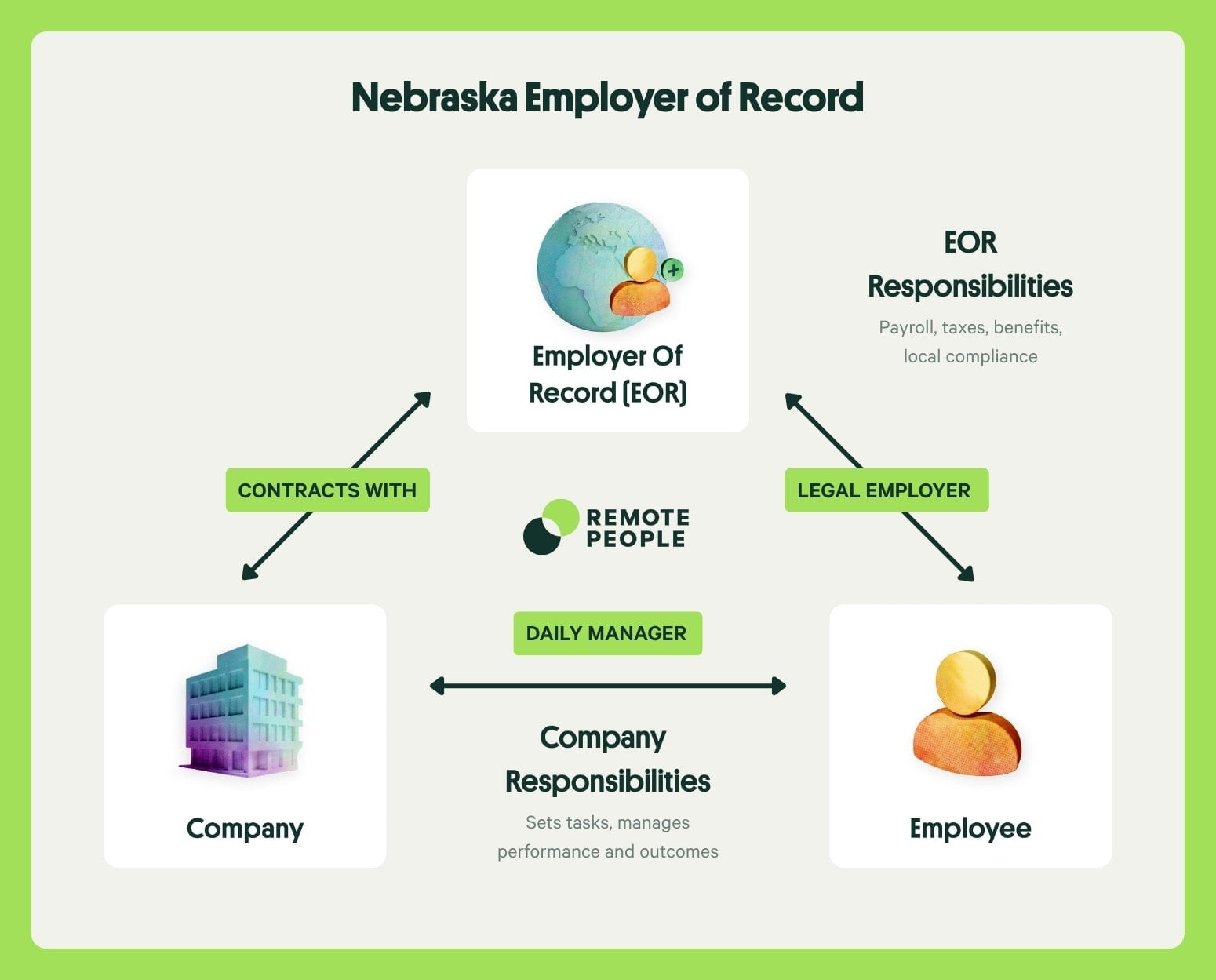
A Nebraska Employer of Record (EOR) is a third-party company that employs workers on a company’s behalf, allowing the business to retain full control over day-to-day work.
What is an EOR can help explain how this employment model works in more detail.
The main benefit of instructing a Nebraska EOR is that the company will not be required to set up a legal entity in this state. This means quicker hiring, less administration, and smaller financial costs, all while shifting employment liability to the EOR.
EORs are typically responsible for the following tasks when instructed to hire workers in Nebraska:
- Payroll processing and wages
- Federal and state-level tax withholdings/filings
- Employment contracts and onboarding processes
- Compliance with state and federal labor laws
- Employee benefits and workers’ compensation administration
In short, an EOR allows companies to hire quickly in Nebraska, while also taking on the pressures and legal responsibilities that come with employing new workers in this state.
What Is the Difference Between a Nebraska Employer of Record and a Nebraska PEO?
Some employers choose to instruct a Professional Employer Organization (PEO) alongside or instead of an EOR. Both of these structures assist with HR and payroll; however, they operate under different legal models and naturally offer varying services.
Professional Employer Organization (PEO)
A PEO works alongside a company through a co-employment relationship. Both the company and the PEO are responsible for sharing employment responsibilities, but the company is responsible for setting up a legal entity and being the legal employer of workers in Nebraska.
This means that the company is legally responsible for workers and must therefore ensure full compliance with local and federal labor laws.
PEOs are best for domestic companies that are already established in Nebraska and are looking for a quick way to outsource HR/payroll processes.
Employer of Record (EOR)
An EOR works under a full employment model, with no legal entity required, and the EOR assumes all legal employment liability.
This means the EOR would act as the legal employer of workers in Nebraska, while the company would handle the day-to-day running of the business and focus on growing the business.
EORs are best suited to international companies doing business in Nebraska that may be unfamiliar with the labor setting, allowing them to enter the market quickly with less liability.
Start hiring with a Nebraska EOR
Let us handle the complexities of hiring, compliance, and payroll in Nebraska while you focus on growing your team.
- Hire employees in Nebraska with a Nebraska EOR
- No local entity is needed
- Pricing starts at USD 199 per employee
- RemotePeople can also help you find the best talent in Nebraska
How Does a Nebraska Employer of Record Work?
Nebraska EORs simplify hiring by managing the full employment process, from drafting compliant employment contracts to handling ongoing compliance management.
There are a few key steps that EORs typically follow, which have been outlined in the step-by-step process below.
Creating Compliant Employment Contracts
The first step for a Nebraska EOR is to prepare and issue legally compliant employment contracts with new workers.
This begins the employment relationship and must be legally aligned with both state and federal labor laws. Employment contracts tend to cover a range of areas such as salary, benefits, statutory requirements, and start/end dates.
Payroll Setup with Specific Nebraska Registrations
The EOR will then ensure payroll is correctly set up with the relevant Nebraska registrations, including:
- Nebraska Department of Revenue
- Nebraska Department of Labor
- Workers’ compensation insurance setup
Ensuring these registrations are set up correctly ensures that workers are correctly paid and on time, from their first month of employment.
Tax Withholding and Remittance
EORs are responsible for calculating, withholding, and remitting all necessary taxes, including payroll and federal income taxes, Social Security and Medicare contributions, and Nebraska state income taxes.
With an EOR onboard, employers can rest easy in the knowledge that filings and payments are being handled accurately and on time to avoid any legal/financial issues.
Employee Benefits Administration
All employees in Nebraska are entitled to statutory employee benefits when working for their employer.
EORs are responsible for managing these on behalf of the employer, ensuring benefits such as health insurance, annual leave, sick pay, and workers’ compensation coverage are administered correctly.
Ongoing Compliance Management
Once the main steps are complete, EOR will handle ongoing compliance management, including any regulatory changes to labor laws, maintenance of employee records, and ensuring strict alignment with wage, tax, and federal/state laws.
This allows employers to focus on running and growing their businesses, without being burdened by administrative work or compliance risk.
Keeping the above processes in line with an EOR further promotes quicker, compliant hiring, without employers needing to set up a legal entity or employ an in-house HR/payroll team.
How Labor Laws Affect Hiring in Nebraska?
Labor laws in Nebraska are fairly employer-friendly, with many being closely aligned with federal standards.
This makes them easier to predict and follow, mitigating legal risks and penalties for noncompliance.
It’s key for employers to clearly understand both federal and Nebraska-specific labor laws, which are predominantly outlined in the following acts:
- Nebraska Wage and Hour Act
- Nebraska Wage Payment and Collection Act
- Nebraska Workers’ Compensation Act
- Nebraska Employment Security Law
- Nebrasaka Fair Employment Practice Act
- Nebraska Healthy Families and Workplaces Act
Minimum Wage & Overtime
Nebraska’s state minimum wage is currently $15.00 per hour, applying to companies with four or more employees. This sits above the federal minimum wage, reflecting the state’s effort to make positions more competitive for workers. Employees under the age of 20 may be paid at least 75% of the minimum wage during their first 90 consecutive days of employment.
Overtime in Nebraska follows the Fair Labor Standards Act (FLSA), which requires employers to pay 1.5 times the regular rate for any hours worked beyond the standard 40-hour week. There are no daily overtime limits. Exemptions may apply to executive, administrative, or professional roles depending on their classification under federal guidelines.
Tipped Wages
Employers in Nebraska must pay tipped employees a minimum wage of at least $2.13 per hour, with tips making up a worker’s full wage to $15 per hour.
If tips do not make up the full amount, employers are responsible for making up the difference as per the federal Fair Labor Standards Act (FLSA).
Income Tax
Nebraska follows a state-level income tax, with a graduated, progressive income tax system including four main tax brackets.
This taxes income of residents, partial-year residents, and nonresidents, with rates typically ranging from 2.46% – 5.84% depending on income level.
Employers are responsible for withholding and remitting taxes to the state, and may be penalized if they fail to do so.
State Unemployment Insurance (SUI)
Most employers in Nebraska are required to pay State Unemployment Insurance (SUI) rates, to provide temporary partial wage replacement to workers who find themselves unemployed without fault.
In 2026, the SUI rates for a new employer sit at 1.25% and increase up to a maximum rate of 5.40%. The taxable wage base is $24,000 per employee per year, and filings are due quarterly.
Paid Leave
Once an employee has worked 80 hours for an employer, they are eligible for paid sick leave.
This equates to 1 hour of paid sick leave for every 30 hours worked, and employers are entitled to cap annual accrual as required.
Nebraska does not have a paid family leave law; however, employees are covered by federal laws, which state that employees can take up to 12 weeks of unpaid, job-protected leave per year for health or family reasons.
Workers’ Compensation
Workers’ compensation is a mandatory obligation for most employers in Nebraska.
This compensation covers accidents, injuries, or occupational diseases that occur from employment, with policies primarily provided through private insurance companies.
Costs vary based on industry risk, with higher risk industries (such as construction) paying higher rates and lower risk industries (such as office work) carrying lower rates.
Termination and Final Pay
While familiarizing themselves with hiring processes in Nebraska, employers must also ensure they understand termination and final pay laws to ensure wage disputes and legal issues are kept to a minimum.
Is Nebraska At-Will?
Nebraska follows the ‘At-Will’ employment rule, which ensures both employers and employees can terminate a working relationship at any time.
This means both parties can enjoy a flexible working relationship. However, contracts cannot be terminated for unlawful reasons, and the At-Will system doesn’t completely protect employers from wrongful termination claims.
Employers should always maintain an open line of communication with employees to protect themselves where necessary.
Final Paycheck Deadline
If an employee’s contract is terminated, employers must adhere to final paycheck deadlines.
In Nebraska, employees leaving their jobs must be paid any outstanding wages on the next regular payday or within 2 weeks of their contract being terminated.
PTO Payout Requirement
There is no employer obligation in Nebraska to pay employees unused vacation pay or PTO if they leave their positions.
However, if a company policy stipulates that this is to be paid, employers must honor these policies.
Notice Requirements
Nebraska does not require employers to provide specific notice periods when terminating contracts.
They must, however, abide by the federal laws, including the WARN Act, particularly when carrying out large layoffs or facility closures.
Payroll Taxes and Employer Cost in Nebraska
Employers must familiarize themselves with the payroll taxes and employment costs that Nebraska requires from businesses hiring new workers.
Nebraska is considered to be a cost-effective state in comparison with other areas of the US, but employers must bear in mind these costs to ensure compliance and a full understanding of the variety of expenses involved with hiring a new worker.
Tax / Contribution | Rate | Notes |
|---|---|---|
Social Security | 6.2% | Applies up to the annual wage cap |
Medicare | 1.45% | No cap |
Federal Unemployment Tax (FUTA) | Up to 0.6% | Applied to the first $7,000 of wages, after credits |
Nebraska Income Tax Withholding | Varies | Deducted from employee wages and remitted to the Nebraska Department of Revenue |
State Unemployment Insurance (SUI) | 1.25% to 5.40% | Taxable wage base of $24,000 per employee per year; filings due quarterly |
Workers’ Compensation Premiums | Varies by industry | Higher-risk industries incur higher rates |
All businesses in Nebraska must comply with both federal and state payroll tax obligations. Federal taxes cover Social Security, Medicare, and FUTA contributions, while state-level requirements include income tax withholding filed with the Nebraska Department of Revenue, SUI contributions based on the employer’s experience rating, and workers’ compensation premiums that vary depending on the risk level of the industry.
Example Cost Breakdown
We’ve included below an example cost breakdown to show the typical employer costs for hiring a Nebraska-based employee on an annual salary of $100,000:
Cost Component | Estimated Range |
|---|---|
Federal Payroll Taxes | 7.65% |
FUTA | 0.6% (capped) |
Workers’ Compensation | 0.5% to 3%+ |
Nebraska SUI | 1% to 5% |
Benefits | 5% to 15% |
This equates to roughly 13% – 28% of an employee’s salary, which may vary depending on experience, industry, and insurance rates.
On an employee earning a salary of $100,000 per year, this would put total employer costs in the region of $113,000 – $128,000 per year.
EORs can help consolidate these costs into a standardized model, ensuring predictability and allowing companies to effectively budget for new staff members.
Employee Classification Rules in Nebraska
When hiring new workers, employers must make sure that classification rules are strictly adhered to. It’s crucial for legal compliance in Nebraska that workers are correctly classified as either employees or workers, with errors leading to financial or legal penalties in severe cases.
Independent Contractor Test
An independent contractor test is usually taken to determine whether a worker should be classed as an employee or a contractor.
This involves looking at economic dependence, independence, and control for a worker, combining the following tests to determine these factors:
The IRS Common Law Test
The US Department of Labor Economic Realities Test
These tests will identify who controls how work is carried out and when, plus whether a worker provides their own tools and the permanency of the working relationship.
Classification Rules
Nebraska is considered to be moderately strict in terms of classification rules.
They don’t require ABC tests like strict states such as California, however, misclassification penalties include taxes, fines, and back pay if companies fail to classify workers correctly.
EORs can be particularly useful when it comes to reducing misclassification risk by assuming legal employer responsibility and having experience classifying workers in Nebraska correctly.
What Makes Hiring in Nebraska Unique?
Nebraska offers a unique hiring space for employers.
Its economy is dominated by a wide range of industries, including agriculture, logistics, finance, and manufacturing, and offers employers a low to moderate regulation environment in which to hire workers.
Wages tend to be lower than the national average, which can be appealing to employers working to a budget, and its taxes are competitive but progressive in their nature.
Nebraska’s workforce is small but stable, with a variety of skilled workers from a range of age groups.
What Are the Benefits of a Nebraska Employer of Record?
There are many benefits to instructing a Nebraska EOR when hiring in this state, including:
- No need for setting up a legal entity
- Quick onboarding in a matter of days/weeks
- Centralized compliance, with payroll, taxes, and benefit administration handled in one place
- Reduced legal risk with EOR assuming legal hiring responsibility
- Scalable across multiple states with a standardized system for predictability and ease.
What Are the Downsides of a Nebraska EOR?
While there are many benefits to hiring a Nebraska EOR, there are also a few downsides that employers should consider.
There are service fees that must be paid when instructing an EOR, which naturally affect overall hiring costs. These are typically calculated as a set monthly fee or a percentage of monthly payroll.
It should also be considered that employers will have less direct payroll control when working with an EOR. The EOR will naturally take responsibility for areas such as payroll administration and employee benefit management, meaning these areas will be handled externally rather than within the company.
However, EORs are significantly more efficient than DIY compliance and tend to be more cost-effective, particularly for small teams or those who are new to hiring in Nebraska.
How to Choose a Nebraska Employer of Record?
Choosing a Nebraska EOR that is well-suited to your business is an important decision, as its success is vital in expanding into this state.
Use the checklist below as a guideline when choosing an EOR to ensure you’re making the best choice for your business:
- They must offer transparent pricing with no hidden costs.
- Choose a direct EOR provider, rather than a layered partner network that outsources responsibility.
- EORs should offer multi-state expertise beyond Nebraska to allow you to further grow your business.
- Make sure your EOR is easily contactable and that you have good access to dedicated support and knowledgeable HR/compliance specialists.
- Ensure the EOR has a strong compliance track record by looking for demonstrated experience managing payroll taxes, labor laws, and regulatory updates.
Engage a Nebraska Employer of Record with RemotePeople
8:22 PMWhen you choose RemotePeople as your Nebraska Employer of Record, you get more than payroll processing and contract management. You get a team that understands the state’s employment landscape, from compliance requirements to workers’ compensation obligations, so nothing falls through the cracks.
We handle the administrative weight of hiring in Nebraska, giving your leadership team the space to focus on growth. No unexpected penalties, no compliance gaps, just a reliable foundation for building your workforce with confidence.
Ready to hire in Nebraska? Contact RemotePeople to get started with a proposal.