
 Recruit
Average Salary in Zimbabwe
-
 Drew Donnelly
- Published
- September 21, 2026
Curious about salaries in Zimbabwe? This guide breaks down the average wages, compares professions, highlights minimum wage figures, and explores how Zimbabwe’s earnings measure up internationally. Partnering with an Employer of Record (EOR) in Zimbabwe lets you employ staff there without establishing a legal entity of your own.
- 5 ★ on G2








Let RemotePeople handle payroll, compliance, and HR admin worldwide so you can focus on building your team.
Zimbabwe’s cost-effective labor and skilled workforce make it an excellent outsourcing destination. Employers seeking remote opportunities in the country may wonder, What is the average salary in Zimbabwe? This information will help them make a fair hiring offer.
The average salary in Zimbabwe is USD 253 monthly. However, wages vary depending on experience, education, location, salary, and position. Comparing salaries in the country to earnings worldwide provides additional insight.
This guide will explore all aspects of salaries in Zimbabwe, preparing you for your hiring journey.
What is the Average Salary in Zimbabwe?
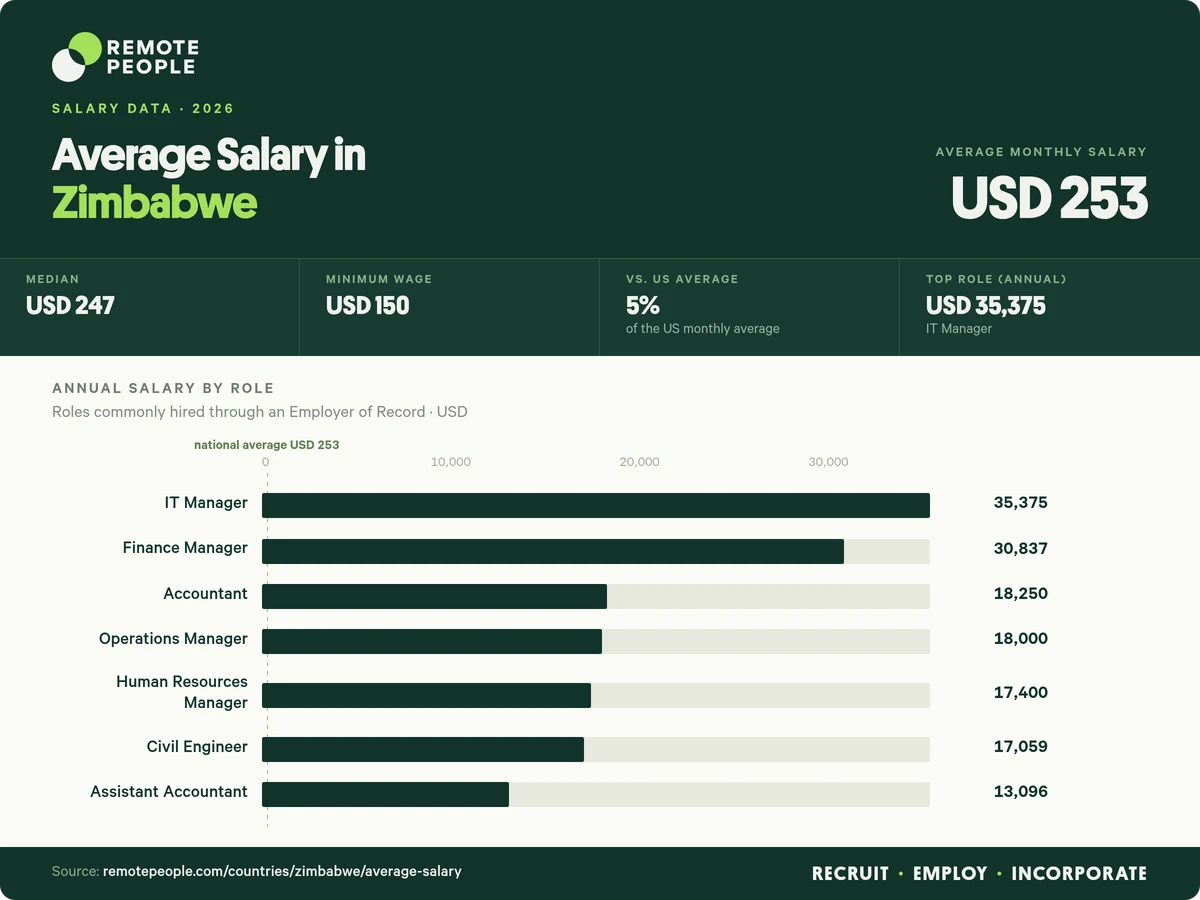
The average monthly salary in Zimbabwe is $253. Wages in the country are low due to currency devaluation and hyperinflation. The lack of a minimum wage, low productivity, and minimal educational investment also contribute to low wages.
Median Income
The median monthly income in Zimbabwe is $247. Half the population makes higher wages, the other half earns less.
Salary Range
In Zimbabwe, low-skilled workers may earn $231 per month, while those in management positions can earn as much as $5500.
Salary Comparisons in Zimbabwe
Average salaries provide insight, but you must also consider how earnings vary based on education, experience, location, position, and industry. The following sections will reveal how these factors impact earnings.
Salary by Position
This salary comparison chart shows how wages vary by industry.
Position | Average Annual Salary ($) |
|---|---|
Accountant | 18,250 |
Finance Manager | 30,837 |
Human Resources Manager | 17,400 |
Civil Engineer | 17,059 |
Operations Manager | 18,000 |
IT Manager | 35,375 |
Assistant Accountant | 13,096 |
Average Wage in Zimbabwe based on Education
Zimbabwe has low education rates and low access to education. However, those who can attain an education are more valued in the job market. Studies reveal that salaries increase based on the years of education a worker has attained. Furthermore, people with education are less likely to rely on public assistance.
Zimbabwe’s returns on education are expected to increase as years go by.
Salary Comparison by Experience
Although education may be the most significant factor in wage determination, experience also plays a role. Experienced workers in Zimbabwe earn more than entry-level workers. Employees also become eligible for raises with tenure in their field.
Salary Comparison by Location
Location also plays a role in wage determination. Urban workers earn more than rural workers due to higher living costs and proximity to large companies offering more job opportunities. In Zimbabwe, workers in areas like Harare and Bulawayo typically earn more than those in the country’s towns and villages.
Minimum wage is also set differently across regions and is highest in region I (Hanoi and Ho Chi Minh City). Region IV has the lowest salaries.
How Much is Minimum Wage in Zimbabwe?
After years of not having one, the government mandated a monthly minimum wage of $150. However, it does not pertain to agricultural and domestic workers, the country’s most vulnerable population. Although it is unclear why the minimum wage does not cover these workers, the reasoning may be based on race.
Average Salary in Zimbabwe vs. the Rest of the World
The following charts compare salaries in Zimbabwe to those in developed, developing, and undeveloped countries to provide more insight.
Zimbabwe vs. Developed Countries
Country | Average Salary | Comparison to Average Zimbabwe Salary |
|---|---|---|
Japan | 379,434 Yen (approx. $2,635) | – 940% |
United Kingdom | 3,000 Euros (approx. $3,116) | – 1140% |
Norway | 50,790 Kroner (approx. $4,700) | – 1780% |
Germany | 4,300 Euros (approx. $4,467) | – 1700% |
Austria | 3,500 Euros (approx. $3,636) | – 1340% |
Zimbabwe vs. Developing Countries
Country | Average Salary | Comparison to Average Zimbabwe Salary |
|---|---|---|
Romania | 4,000 RON (approx. $835) | – 236% |
Russia | 73,709 Rubles (approx. $700) | – 180% |
Albania | 1,500 Euros (approx. $1,550) | – 520% |
Kazakhstan | 342,082 Tenge (approx. $645) | – 160% |
Ukraine | 18,000 Hryvnia (approx. $500) | 100% |
Zimbabwe vs. Undeveloped Countries
Country | Average Salary | Comparison to Average Zimbabwe Salary |
|---|---|---|
Afghanistan | 30,000 Afghanis (approx. $419) | – 68% |
Philippines | 18,423 PHP (approx. $875) | – 252% |
Cambodia | 1,000,027 KHR (approx. $250) | 0% |
Egypt | 13,244 EGP (approx. $263) | – 4% |
Pakistan | 45,000 PKR (approx. $150) | 66% |
Zimbabwe is an undeveloped country with a lower-middle-income economy. Its infrastructure has suffered from years of neglect. Political and economic instability, hyperinflation, and fiscal pressures plague the country.
Despite internal pressures, Zimbabwe’s low average salary makes it a cost-effective destination for outsourcing countries. It offers a skilled workforce and a wealth of natural resources. However, its potential for instability could be problematic for foreign investors.
What are the Most Common Outsourced Industries in Zimbabwe?
Companies that outsource to Zimbabwe will see the most benefits when focusing on the following industries:
Agriculture
Zimbabwe’s agriculture is crucial to its economy, contributing heavily to the GDP. It offers various crops, including staple grains, horticultural products, and tobacco. However, limited access to finance and technology stunts the industry’s growth.
Mining
The country’s mining sector accounts for a significant portion of its GDP. It is known for its wealth of mineral exports, including gold, platinum, diamonds, and lithium. The government actively promotes the sector to attract foreign investments, particularly in lithium, which fuels battery production.
BPO
Zimbabwe began expanding in the BPO market in 2019. The Minister of Information Technology announced that the industry has shown to be the country’s most effective driver of inclusive growth. The government was looking into tax incentives and rebates to attract foreign investors.
Conclusion
Zimbabwe’s low average salary and skilled workforce make it an attractive outsourcing option. Companies establishing remote partnerships in the country can benefit from cost savings and high-quality products and services while helping workers overcome poverty, resulting in positive outcomes for all involved parties.




