Recruit
Deel vs Remote: Which Is the Best EOR?


Let RemotePeople handle payroll, compliance, and HR admin worldwide so you can focus on building your team.
With the surge of remote work and the continued push toward globalization, more companies are expanding their teams across multiple countries and continents. However, managing a global workforce presents its own set of challenges—recruitment, hiring, compliance, payroll, and contract management being just the tip of the iceberg. For companies looking to simplify these complexities, having the right tools and support is essential.
This is where Global Employment Platforms (GEPs) like Deel and Remote come into play. Both of these Employer of Record (EOR) service providers offer comprehensive solutions to help businesses legally hire and manage employees across the world, without the need to set up local entities. But when it comes to choosing the right provider, how do you decide which one will best suit your business needs?
Deel and Remote are both industry leaders with stellar reputations, yet they each bring something unique to the table. Whether it’s Deel’s extensive integration options or Remote’s focus on intellectual property protection, both platforms offer robust functionalities that can streamline your HR processes and support your global expansion efforts.
What You’ll Discover:
- In-Depth Feature Analysis: A thorough breakdown of the features and usability of both platforms.
- Pricing Comparison: A detailed look at the costs associated with each service to assist with effective budgeting.
- Pros and Cons: Unbiased assessments of the strengths and limitations of Deel and Remote.
As we dive deeper into this comparison, we’ll explore which platform excels in specific areas to help you make an informed decision. Whether you’re prioritizing pricing, feature sets, or specialized services, this review will give you the clarity you need to choose the best fit for your business.
Deel vs Remote Overview
Feature | Deel | Remote | Explanation |
|---|---|---|---|
User Reviews | While both companies have excellent user reviews, Deel’s are slightly better than Remote’s. | ||
Pricing | $599/employee per month; $49/contractor per month | $599/employee per month; $29/contractor per month | Both companies charge the same starting fee for EOR services. Remote is cheaper for contractor management. |
Coverage | 180 locations for EOR and contractors | Around 100 locations for EOR, 180 for contractors | Deel has broader international coverage for EOR services. |
User-friendliness | Very good | Excellent | Both companies have highly-rated, easy-to-use platforms. |
Customer Support | 24/7 live chat support | 24/5 live chat support | Deel has daily live support, while Remote support is email-based over weekends. |
Integrations | Very good | Very good | Remote features an API and integration with top applicant tracking and HR software like Greenhouse, Bamboo HR, and Zapier. Deel has an API and integration with major HR and accounting software like Ashby, QuickBooks, and Xero. |
Data security | Excellent | Excellent | Both platforms are GDPR and SOC 2 compliant and ISO 27001 certified. |
International hiring (EOR) | Very good | Excellent | Remote uses a “direct EOR” model through its own entities, while Deel uses a mix of owned entities and subcontracting. |
Recruitment | Not offered | Good | Remote has a built-in job board to connect employers with employees and contractors. Deel does not offer job advertising or in-house recruitment services. |
Benefits administration | Excellent | Excellent | Both Deel and Remote offer a full range of employee benefits, including pensions and health insurance. |
Payroll | Excellent | Very good | Deel provides a more comprehensive payroll solution with support for more currencies and payment methods. Remote’s payment options are slightly more limited. |
Main Differences: Deel vs Remote
When comparing Deel and Remote, two leading EOR providers, the decision often boils down to the specific needs of your business. Both platforms offer comprehensive services for managing global teams, but there are distinct differences that can shape the right choice for your organization.
Let’s break down these differences and highlight what each company brings to the table.
Deel
Deel positions itself as a powerhouse in the global employment space, catering to businesses of all sizes with a focus on compliance and flexibility. It allows companies to hire and manage international employees and contractors across more than 150 countries, streamlining everything from onboarding to payroll, benefits, and legal compliance.
Services offered by Deel
- Employer of Record (EOR): Full compliance support in over 150 countries for hiring employees without establishing a local entity.
- Contractor Management: Hire, manage, and pay contractors in over 200 countries.
- Professional Employment Organization (PEO): Co-employment services in the U.S., allowing companies to outsource HR tasks.
- Global Payroll: Run payroll independently or integrated with EOR, handling taxes, social contributions, and salary payments.
- Equity & ESOPs: Assistance in managing employee stock ownership plans.
Remote
Remote takes a slightly different approach, with a strong emphasis on transparency and control. Although it operates in fewer countries than Deel (around 100), Remote stands out by directly managing its employees through wholly-owned subsidiaries. This model provides a higher level of operational oversight and accountability, ensuring smoother processes in managing international teams.
Services offered by Remote
- Employer of Record (EOR): Directly manages employees in around 100 countries through its own entities, offering enhanced control and compliance.
- Contractor Payments: Manage and pay contractors globally, with a focus on seamless transactions.
- Global Payroll: Full payroll solutions for entities and EOR clients, ensuring tax compliance and accuracy.
- Integrated Job Board: A unique feature allowing businesses to post jobs and find global talent directly on the Remote platform.
- Benefits Administration: Offers customized health and wellness benefits for international teams.
Deel Pricing
Plan | Price per employee/contractor per month |
|---|---|
Deel EOR Services | $499 per employee per month and up |
Deel PEO Services | $79 per employee per month and up |
Deel Contractor Management | $49 per contractor per month and up |
Deel Payroll | $29 per person per month and up for global payroll or $19 per person per month and up for US payroll |
Remote Pricing
Plan | Price per employee/contractor per month |
|---|---|
Remote EOR | Starting at $599 per full-time employee per month |
Remote Contractor | $29 per contractor per month |
Remote Payroll | $50 per full-time employee per month |
Remote HR Management | Free |
Remote Talent | Starting at $119 per contractor per month |
Remote Contractor Management Plus | $99 per contractor per month |
Key Differences
Service Expansion
- Deel: Supports businesses in over 150 countries.
- Remote: Operates in around 100 countries.
Global Reach
- Deel: Wider geographical presence may be crucial for businesses expanding into less common markets.
- Remote: Focuses on streamlined operations in a more controlled set of countries.
Pricing Transparency
- Remote: Takes a direct approach with its owned subsidiaries.
- Deel: May involve subcontractors in some regions, potentially adding layers to the process.
As you continue exploring the intricacies of both platforms, it’s essential to consider your company’s priorities. Are you looking for the widest possible global reach, or do you value more direct control over hiring and payroll?
For cost-conscious businesses, Remote’s competitive pricing on contractor management may tip the scales, whereas Deel’s vast country coverage and integration options make it a strong contender for those seeking broad expansion.
Deel Pros and Cons
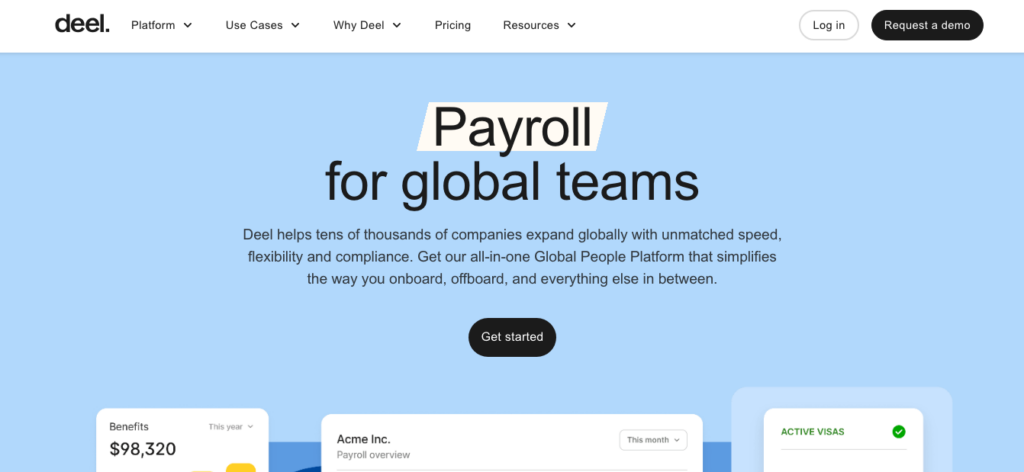
Every EOR service provider and employee management platform has its own unique advantages and disadvantages. Here, we look at the specific pros and cons of using Deel as a self-described “global people platform”:
- Pros
Easy onboarding
Using Deel, onboarding contractors and full-time employees is quick and efficient. Contracts are generated quickly, and workers can sign them online easily. Their identities and other documents can be quickly uploaded and stored for future use.
Data security
Deel is SOC 1, 2, and 3 compliant, GDPR compliant, and ISO 27001 certified. It protects data and user information with encryption protocols and 2FA (two-factor authentication).
Convenient payments
Deel lets clients pay their workers in over 120 currencies and also lets contractors receive payments through Payoneer, Wise, and Revolut.
Free HR offering
Small and medium enterprises (SMEs) with fewer than 200 employees can use Deel HR to manage their teams for free.
Support for enterprises
Deel offers dedicated service from account reps for enterprise accounts who can provide quick assistance and access to expert advice when required.
- Cons
Learning curve
While the Deel platform is fairly user-friendly in terms of finding information and using data, it also has a high degree of functionality. While this isn’t a disadvantage, it does take time for new users to orient themselves to this complex platform.
Complex/hidden pricing
Deel’s basic services are clearly laid out in its online information. However, these are starting processes and add-ons and tailored plans can quickly increase costs for employers.
High contractor management price
Starting at $49/person per month, the contractor management price is higher than many competitors charge.
Hard to scale
While this platform is excellent for SMEs, Deel can struggle to meet the transaction volume, customization, and performance needs of larger enterprises.
Lacks features
Deel lacks human capital management (HCM) features such as recruitment management. It also has no mobile app on offer.
Remote Pros and Cons

Remote bills itself as a global HR platform. Let’s examine this company’s specific pros and cons as a service provider:
- Pros
Scalability
Remote has the potential to be useful for businesses of all sizes, and its integrations can be used as the HR platform of choice for even large enterprises.
Data security
Remote is SOC 2 and GDPR compliant and ISO 27001 certified. Like Deel, Remote uses encryption protocols and 2FA (two-factor authentication) to protect data from potential threats.
User-friendly interface
Even users who are new to HR platforms can quickly become adept at using the remote platform to navigate to different sections and manage data.
Mobile app
Remote released a mobile app for Android and iOS in 2022. This app allows HR admins to access Remote on the go and lets contractors and employees access the system remotely to view their accounts and payments and create invoices.
Extensive remote work tools
Remote work provides features like time-tracking, recruitment, invoice, expense management, and paid time off (PTO) management to become a comprehensive HR solution.
Wholly-owned infrastructure
By only operating through its own subsidiaries, Remote ensures that you only work with one international partner, rather than multiple providers in different countries.
- Cons
Support limitations
Remote offers live chat only 24/5, and while it has an extensive help center full of resources, it doesn’t offer phone support as a standard feature. Live chat and email tickets can slow down problem-solving.
Complex pricing
While Remote is very transparent about its pricing, it can still be difficult for organizations to estimate their costs independently. Adding extra features, choosing benefits packages, or using different tiers of service can create complexity and potential confusion with prices.
Limited payment options
Remote offers reliable payment processing but limited choices for paying invoices. Clients can pay in one of only 12 major international currencies, and while it can pay contractors using Wise in 160 currencies, Wise payments are only supported when using one of seven billing currencies.
Head to Head Comparison: Deel vs Remote Features
After an examination of the strong and weak points of each platform, it’s time to put them head-to-head to see which provider is better in each of several different areas. Our goal is not to indicate an overall winner. Instead, we want to show the comparative strengths of each platform to give you an idea of which would be a better solution for your organization’s specific needs.
1. User-friendly platform: Deel Wins
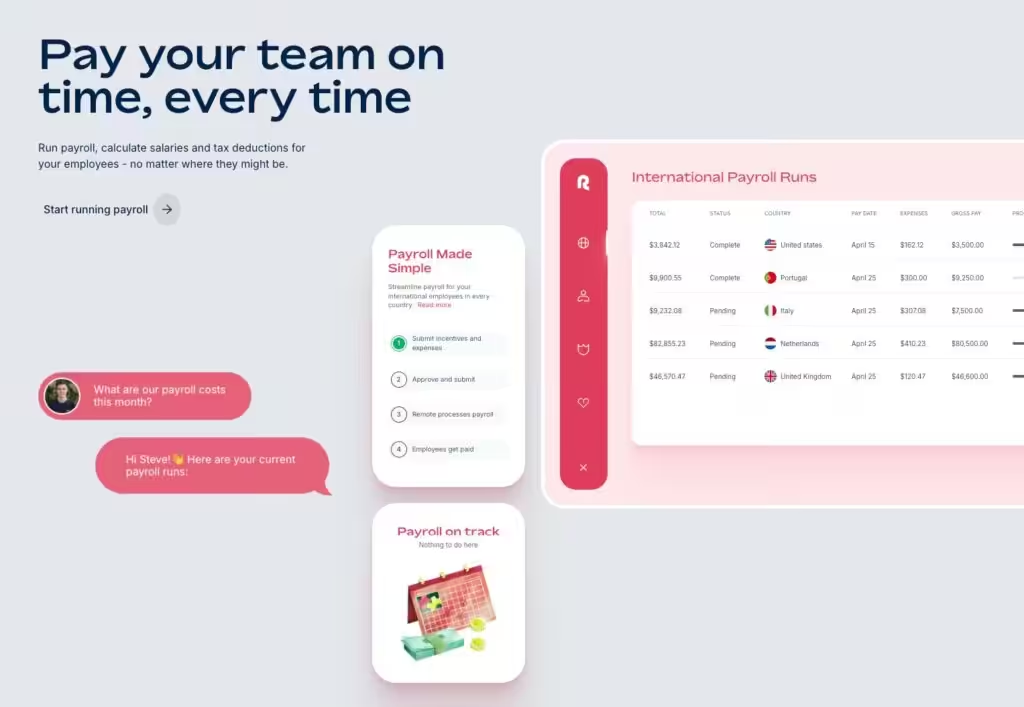
Both platforms have fairly easy-to-use user interfaces that most users can learn to manage in limited time. Deel’s extensive platform functions can make it more complicated, however, and potentially take longer to learn than Remote’s. While Deel includes the benefit of providing document storage and management, Remote’s interface feels more intuitive and it’s faster for finding data and performing most HR tasks. Remote’s platform can also handle bigger enterprises and that makes it more effective for scaling.
2. Resources: It’s a Tie
To enhance their clients’ experiences with their services, both platforms offer extensive tools and resources to help improve international hiring. Remote has an extensive catalog of country guides helping you understand what it’s like to do business and hire employees in countries around the world. It also offers tools like an employee cost calculator and misclassification risk tool. Deel has a useful blog, a global benefits tool, and a global employment comparison tool to help employers plan their international hiring.
3. Integration with Other Software: Deel Wins
Deel offers an API to enable developers to build integrations with other software packages. It also supports integration with many top-level solutions, including Ashby, BambooHR, Greenhouse, HiBob, Workday, Lever, and Workable. Most of these are also covered by Remote, and both are also integrated with Slack and Zapier. However, Deel’s integration with Asana project management and QuickBooks accounting software gives it a slight edge here.

4. International Hiring: It’s a tie
Deel works in over 150 countries to support international hiring through its partners and subsidiaries so that clients don’t have to register their own entities. While Remote only operates in around 100 countries for EOR services, it only operates through it’s own entities, meaning clients avoid dealing with intermediaries.
5. Contractor Solution: Remote Wins
Remote gives its clients the ability to hire contractors in more countries than Deel. While Deel provides a broader range of contractor payment options, Remote’s price for contractor management is far more affordable. Combined with excellent support from in-country experts, Remote also stays up to date on new laws that can affect contractor classification, which gives it the edge over Deel.

6. Employee Benefits: It's a Tie
Both of these service providers manage mandatory benefits for employees as part of their EOR duties as well as a range of non-mandatory benefits. These benefits are then managed more-or-less automatically through the platform and represent little to no extra work for HR administrators.
7. Payroll Management: Deel Wins
Payroll management through Deel’s platform is easier and more intuitive than with Remote. Deel offers more integrations with accounting software, easier payment processing, and more extensive payment options for employees and contractors than Remote does.

Our Verdict: Deel vs Remote
This review is designed to show the relative pros and cons of the features and functionality of these two service providers. When pitting Deel vs Remote against each other, we’ve aimed to highlight the use cases that would be more appropriate for each service provider. Here’s where each of these companies shines compared to the other.
When to choose Deel
Deel is an excellent choice for large enterprises looking at options for global payroll management or EOR services. This service provider offers a user-friendly platform with extensive integration capabilities, making it a very good option for companies already running their own HRIS software. It’s particularly good for businesses that need flexible solutions to pay contractors using multiple currencies and transfer methods.
When to choose Remote
Remote is a great choice for businesses of all sizes looking to both recruit and manage distributed global teams. This platform makes it easy to scale up a business and still manage most HR functions all within a single, easy-to-use platform.
Remote is also an excellent choice for any company focused on compliance due to it insistence on only using its own entities to hire employees.
Deel vs Remote vs Alternatives
RemotePeople are leading international EOR brokers, connecting client companies with the best deals for international hiring services. We can break down the pros and cons of Remote, Deel and other EORs and make sure you get the provider that is right for you.